For two or three relatives researching one ancestor together
A genealogy research plan on one board: one question, who checks which records, what was found
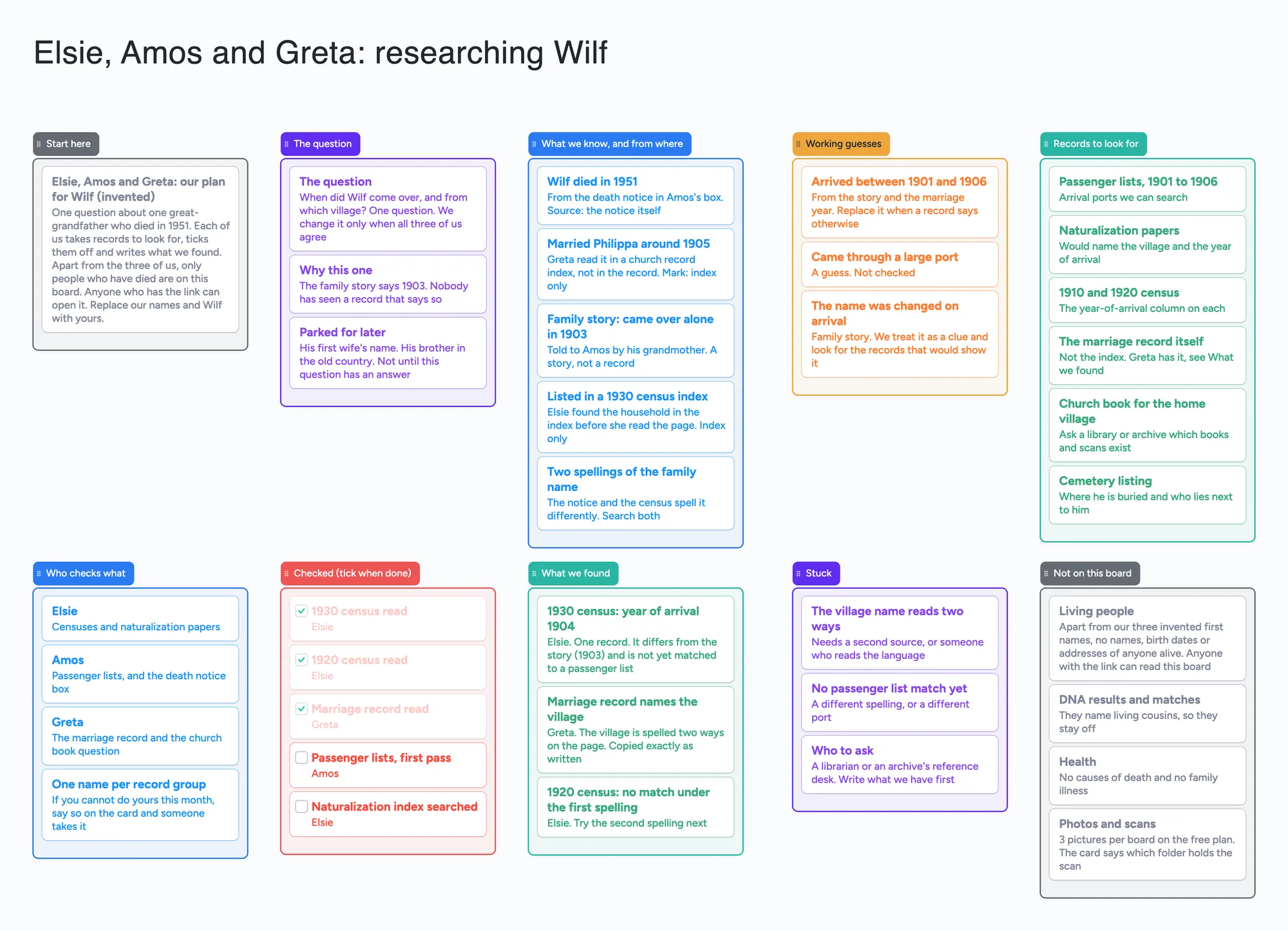
We make Instaboard, an online board. This page is for a few relatives who want to research one ancestor who has died and keep the plan where all of them can see it. The board is filled in for three invented siblings, Elsie, Amos and Greta, researching their great-grandfather Wilf: one question, what they know and where each fact came from, working guesses, records to look for, who checks what, a tick-box list, what they found and what is stuck. It is text only and moved by hand. It has no family-tree chart, no record search and no citation tool, it sends no reminders, and the notes below say where a research log, a template file or genealogy software does more.
Opens in your browser. Anyone can view; a free sign-in lets you edit.
Updated
Before you copy it: one researcher or several, and what stays off
- It fits a few relatives, not a lone researcher. Among the accounts quoted below from two r/Genealogy threads, several say their relatives do not join in the research, though others say their families enjoy hearing about it. If you are the only one looking, a notes file or your genealogy software is enough. This board is for two or three people who will each take some of the records.
- Only people who have died, apart from you. Anyone who has the link can open the board. Other than the three researchers' invented first names, the example has no names, birth dates or addresses of anyone alive, no DNA results or matches and nothing about health. Keep it that way in your copy.
- It holds what you type. The example has no family-tree chart, no search of records and no citation tool. It sends no reminders or due-date alerts. A card can carry a due date and the app has a calendar view, but nothing nudges anyone.
- Writing needs a free sign-in. New boards start as "Anyone who joins can view"; to let a sibling or cousin add and tick cards, switch Share to "Anyone who joins can edit". Each person signs in free, and the board counts as 1 of their 5 free boards.
- Free plan limits: 5 boards, 150 items across your account and 3 pictures per board. The example is 48 items, and a copy takes 1 of your 5 boards. Pro removes the item limit and costs $5 a month billed yearly ($59.99 a year), or $7.99 monthly.
Some family historians say their relatives don't join in the research
Two r/Genealogy threads, read November 25, 2026 in an archived copy, each reply one person's view credited per account. In "How would you feel if a relative or sibling dedicated time to compiling your family's tree and history?" (posted 2025-11-18 20:23 UTC by u/AdventurousBug74; Reddit shows 119 comments, and we read the first 25 in an archived copy), the poster writes that when asking relatives for "stories, photographs, or documents" their lack of support is noticeable, and that only elderly aunts are supportive. u/Mischeese replied "Literally no one in my immediate family cares. I have found some kindred spirits in 3rd cousins though." u/snarktologist wrote "No one in my family cares. I do it for myself."
In "What if you're the only family member interested in genealogy?" (posted 2024-07-17 03:07 UTC; Reddit shows 202 comments, and we read the first 25 in an archived copy), a commenter whose account shows as deleted wrote that siblings, aunts, uncles and cousins like hearing the discoveries but "don't want to participate in the research", and that the commenter shares stories, documents and photos in a private Facebook family group. u/maraq suggested donating your research to "a local library or historical society" and writing a will with instructions for it.
We read this as a limit, not a pitch: the board helps only when more than one relative will do the looking. When two or three will, the plan has to be somewhere all of them can see, and that is the only job the example board does. Neither thread asks for a research-plan board by name.
Not everyone in these threads is on their own. Searching the rest of the archived copy of the second thread, we found u/BlackAtState, who wrote "my family is very intrigued by our genealogy", and u/salemrhappy, who wrote that their family "enjoy when I share it on our Facebook family group". Both are outside the first 25 comments we read.
Who and what you keep off a board anyone with the link can read
- Living people. Anyone who has the link can read the board. Apart from your own first names, no names, birth dates or addresses of anyone alive, and no relatives you have only found through a record that names them as living.
- DNA results and matches. They name living cousins, so the example leaves them off.
- Health. No causes of death and no family illness.
- Photos and scans. 3 pictures per board on the free plan. A card says which folder holds the scan.
- Children. We don't suggest putting children on the board or writing about them by name.
One question, and where each fact came from
Family Tree Magazine's "How to Create a Genealogy Research Plan: A 5-Step Example" by Lisa A. Alzo (printed "Last Updated: November 20, 2026", with a note that a version appeared in the January 2011 issue; read in a browser November 25, 2026) starts with a research objective written "as specifically as possible", then a list of known facts, then a working hypothesis, then sources with related records, then how you will get to them. It also warns against blindly accepting "family tales" and says to treat them as clues and look for records that show what happened.
The example board follows that order and adds three rules of our own. There is one question on it, and it changes only when all three agree. Every known fact says where it came from, and a card says "index only" or "a story, not a record" when that is true. The things not to chase yet go in a Parked for later card, so a second question does not creep in. The question is when Wilf arrived and from which village; his first wife's name and his brother in the old country are parked. The kinds of records on the example board (censuses, naturalization papers, passenger lists, a church book) are the same kinds that article's worked example uses; the family on our board is invented.
Elsie, Amos and Greta's board, list by list
| List | What goes in it | In Elsie, Amos and Greta's board |
|---|---|---|
| Start here (grey) | What the board is and that the link is not private | One card |
| The question (purple) | The one question, why it was picked, what waits | 3 cards: the question, why this one, parked for later |
| What we know, and from where (blue) | Each fact with its source and how solid it is | 5 cards, three marked index only or a story |
| Working guesses (orange) | Guesses, each marked as a guess | 3 cards |
| Records to look for (green) | Record types that could answer the question | 6 cards |
| Who checks what (blue) | One name per record group | 4 cards: Elsie, Amos, Greta and the rule |
| Checked (red, tick boxes) | Each search done or still to do | 5 cards, 3 ticked |
| What we found (green) | What a record said, copied as written, with the name of who read it | 3 cards |
| Stuck (purple) | What needs a second source or a different spelling | 3 cards |
| Not on this board (grey) | What stays off | 4 cards: living people, DNA, health, photos and scans |
Swipe the table sideways to see every column.
Counted from the board: 10 lists, 37 cards and one title text box (48 items). A tick box records no name or time, and anyone who can edit can untick it.
Who checks what, and what a tick can and can't tell you
In the example Elsie takes the censuses and naturalization papers, Amos the passenger lists and the death notice box, and Greta the marriage record and the church-book question. The rule on the board, one name per record group, is ours: if you cannot do yours this month, you say so on the card and someone takes it.
The Checked list is the only list with tick boxes, and each card names who did it. A tick does not record who ticked it or when, and anyone with edit access can untick it, so the name in the card text is what tells you. A copy of the board keeps its ticks, so clear them in your copy. The Checked cards are not a research log: they say a search was done, and the What we found cards say what it showed. Where the same search has to be recorded with its date and result, a log does that better; see below.
When it gets stuck, the board only holds the question
The example has a Stuck list: a village name that reads two ways on the page, no passenger-list match yet, and a Who to ask card for a librarian or an archive's reference desk. The board cannot tell you which records exist. Family Tree Magazine's fifth step says that if you cannot find records online "you may need to order microfilm through a FamilySearch center, submit an interlibrary loan request or order the records from a repository, such as the National Archives", and the board's job there is to hold who is asking and what was asked.
Copy a record's wording exactly as it is written, and put the second spelling in its own card. In the example, the notice and the census spell the family name differently, so the card says to search both.
Where a research log, a template file or software does more
Read November 25, 2026 in a browser. Each line is what the page says, not something we tried, and there is no ranking. The American Ancestors and Family Locket pages showed no date; the Family Tree Magazine article prints its own, in the sources.
| Option | What the page says | Better than a board at | Where a board fits |
|---|---|---|---|
| Family Tree Magazine's 5-step article | Five steps from objective to access; offers a free Research Planner and Log download, which we did not open | Walking through one worked example | Keeping a few people on one live plan |
| American Ancestors, Research Templates | Links a Research Plan Template (a roadmap that takes you through a research question, which records answer it, record availability for the time and place, and repositories), a Research Log ("a list of every source you consulted—and whether your search was successful or not") and an Annotated Research Log, described as an Excel file where you "can easily add columns, rows, and sort your findings" | A long log you can sort and filter | A short plan three people can see at once |
| Family Locket, Research Like a Pro templates | A Research Project Document Template to copy to Google Docs or download as Word (sections: Objective, Research Plan, Findings and Analysis, Conclusion, Suggestions for Future Research, Results Summary), plus a Timeline Analysis Spreadsheet, a Locality Guide Template, a Citation Template and a Research Log | Analysis, a written report and citations | The to-do side before the report |
| Genealogy software | Not read. Commenters in the threads above named WikiTree and a program called Family Historian | Trees, linked sources and media | A shared to-do list beside it |
Swipe the table sideways to see every column.
Start your own in five steps
- Open the board and make your copy. "Make a copy" takes 1 of your 5 free boards. Replace Elsie, Amos, Greta and Wilf with your names and your ancestor, and clear the ticks.
- Write the one question. Move everything else to the Parked for later card.
- List what you know, and where each fact came from. Mark an index entry or a family story as exactly that.
- Give each record group one name, then add a card to Checked for each search.
- Share the link. To let the others write, switch Share to "Anyone who joins can edit"; they sign in free and the board counts as 1 of their 5.
How big it gets on the free plan, and what it cannot do
- Items. Each card and each list is 1 of 150 free items across your account. The example is 48, which leaves room for 102 more cards. A copy for a second ancestor is another 48, so three boards like this one are 144 (our arithmetic). Your other boards share the same 150.
- Boards. 5 on the free plan. A copy takes 1, and so does a board you open from someone's link.
- Pictures. 3 per board. The example has none.
- Writing needs a sign-in. Anyone who has the link can read the board; to change it they sign in free.
- Ticks. A tick records no name or time, anyone with edit access can untick it, and a copy keeps its ticks.
- No reminders or due-date alerts, no family-tree chart, no search of records, no citations and no way to say how reliable a source is beyond the words on the card.
Start from the ready board
It opens in your browser in a few seconds, with nothing to install. Sign in for free when you want to save it and share it.
Questions
Can I put living relatives on the board?
We don't suggest it. Anyone who has the link can read the board, so apart from the three researchers' invented first names the example holds only people who have died: no names, birth dates or addresses of anyone alive, no DNA matches and nothing about health.
Does it replace my genealogy software?
No. The board has no family-tree chart, no record search and no citation tool. It is a place for the plan: the question, who checks which records, and what was found. Keep your tree where it is.
Do my cousins need an account to tick things off?
To write on the board, yes: they open the link, sign in free, and you switch Share to "Anyone who joins can edit". The board counts as 1 of their 5 free boards. Someone who only wants to read can open the link without signing in.
Does a tick tell me who did the search?
No. A tick records no name or time, and anyone with edit access can untick it. In the example each Checked card carries the person's name in its text, and what a search found goes in a What we found card.
How many cards fit on the free plan?
150 items across your account, where each card and each list is one item. The example is 48, which leaves room for 102 more cards. That is our arithmetic, and your other boards share the same 150.
Can I keep scans and photos on it?
Only 3 pictures per board on the free plan, so it does not work as an archive. The example is text only; a card can say which folder holds a scan.
Sources
- Family Tree Magazine: How to Create a Genealogy Research Plan: A 5-Step Example, by Lisa A. Alzo (printed "Last Updated: November 20, 2026"; read in a browser November 25, 2026)
- American Ancestors: Research Templates (no date shown; read in a browser November 25, 2026)
- Family Locket: Research Like a Pro, templates and work samples (no date shown; read in a browser November 25, 2026)
- r/Genealogy: "How would you feel if a relative or sibling dedicated time to compiling your family's tree and history?" by u/AdventurousBug74 (posted 2025-11-18 UTC; Reddit shows 119 comments, we read the first 25 in an archived copy, November 25, 2026)
- r/Genealogy: "What if you're the only family member interested in genealogy?" (posted 2024-07-17 UTC; Reddit shows 202 comments, we read the first 25 and searched the rest of an archived copy, November 25, 2026)