For a small team that wants one shared page for a user's journey and what ships first
A user story map template: one list per step of the journey, stories under each step, and the release shown by card colour
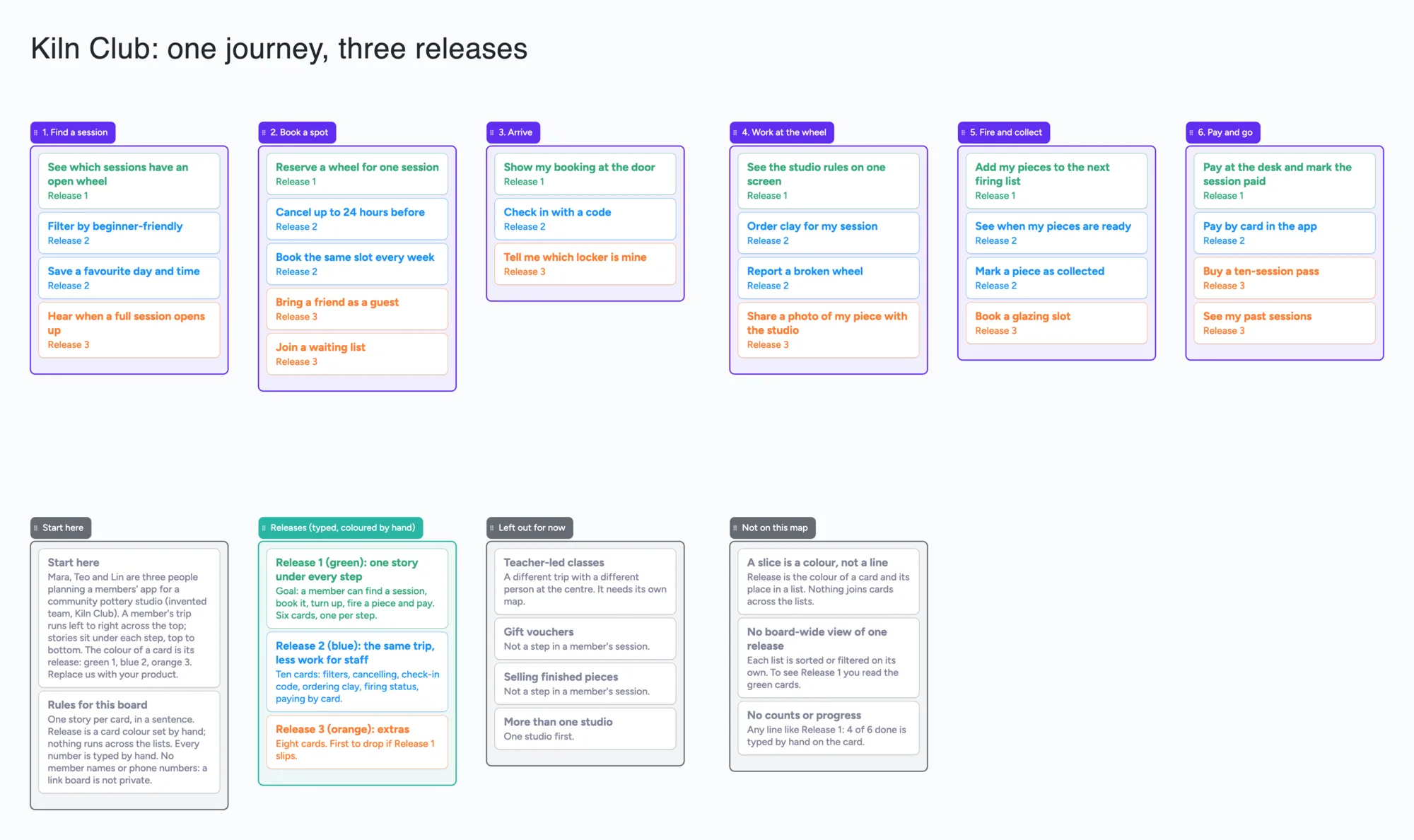
We make Instaboard, an online board. A user story map has a row of steps along the top and a row of releases cutting across all of them, and a board of lists can only do half of that. This page says which half first, then gives you a map already laid out on it for an invented three-person team: Mara, Teo and Lin are planning a members' app for a community pottery studio called Kiln Club. The board has six lists for a member's journey, 24 story cards under them, and four more lists for the start cards, the three releases, what was left out and what the board can't do. If you need the release lines drawn across the map, a free tool built for it does that better, and the next section names it.
Opens in your browser. Anyone can view; a free sign-in lets you edit.
Updated
In short: a story map with lists in place of lines
- What it is: a shared page where each step of a user's journey is a list, read left to right, each story is a card under its step, and a card's colour says which release it belongs to. The example uses 47 of your 150 free items.
- What it is not: a map with release lines across it. A release here is a colour you set by hand and the order of cards in a list. Nothing runs across the lists, no view shows only one release, and nothing counts or tracks progress.
- Where other tools win: storymaps.io is a free, open-source story map tool whose page says you don't need an account and whose slices run across the whole map; Trello's free plan page lists unlimited cards, 10 boards per Workspace and assignee and due dates. Both are in a table below.
- Where this board may help: a team of two to four that already knows the journey and wants one shared place to read it, move stories between releases and keep what was left out.
- Keep off it: names, phone numbers and anything about real members. The example is invented. A link board is not private.
Before you start: two tools that draw a map better
Our board cannot draw a release across the map. storymaps.io can, and it is made for exactly this. Its page, which we read on November 25, 2026, says it is a "free & open-source user story mapping tool", that you can start a story map and share the link, and that anyone with the link can open and edit it with no account of their own. It says that story map slices "group the cards you'll build together, such as an MVP and the releases after it" and that "A slice runs across the whole user story map", with a goal, date and progress for each. It also lists import from Jira, Asana, Linear, Phabricator and Azure DevOps. Our board has none of that, and writing on ours needs a free sign-in.
Trello is the other honest answer for a team that wants cards in lists. Its pricing page, read in a browser the same day, lists for the Free plan: free for up to 10 collaborators per Workspace, up to 10 boards per Workspace, unlimited cards, and assignee and due dates; Standard is $5 per user a month if billed annually ($6 billed monthly). Trello also has a template page titled "User Story Mapping Template", created by Faris Han, Developer @ Hubton Indonesia, which showed 9.3K copies and 66.7K views and described itself as "a minimalistic template for mapping digital product's user stories, with multiple user roles. Enhanced with Kanban system." (read in a browser on November 25, 2026; we did not open the board itself). We did not try mapping in Trello, so we can't say how it handles releases.
The case for this board is narrow: you want the journey and the stories on one page that people on your team can drag cards around together, and you are fine with a release being a colour. If you want a map with lines, imports or progress, use one of those two.
A journey as lists: the part a board does well
Jeff Patton's page, which we read in full, describes user story mapping as a "dead simple idea": talk about the user's journey through the product by building a simple model that tells the user's story as you do. Miro's template page says the technique was popularized by Patton in 2005 and gives the story format "As a < type of user >, I want < some goal > so that < some outcome >." Neither page is a how-to for our board; we use them for what the method is. We are not affiliated with Patton or with Miro.
storymaps.io's page describes the top of a map as three layers: the people it is for, the big things they are trying to do and the steps of their journey, with the work behind each step as cards below. The Kiln Club board keeps one layer. Its single user type, the member, is on the Start here card, and each of the six steps is a list. If you have more than one kind of user, you add their stories to the same step lists with a first word on the card, or you copy the board; the example doesn't show either.
- 1. Find a session: see which sessions have an open wheel; filter by beginner-friendly; save a favourite day and time; hear when a full session opens up.
- 2. Book a spot: reserve a wheel; cancel up to 24 hours before; book the same slot every week; bring a friend as a guest; join a waiting list.
- 3. Arrive: show my booking at the door; check in with a code; tell me which locker is mine.
- 4. Work at the wheel: see the studio rules on one screen; order clay; report a broken wheel; share a photo of my piece.
- 5. Fire and collect: add my pieces to the next firing list; see when they are ready; mark a piece as collected; book a glazing slot.
- 6. Pay and go: pay at the desk; pay by card in the app; buy a ten-session pass; see my past sessions.
How many stories fit in 150 items?
Each card and each list is 1 of your 150 free items, across all your boards. The title text box counts too. Arrows, sections and pen strokes don't. Our arithmetic from Kiln Club's lists:
- As built: 10 lists + 36 cards + the title = 47. The 36 cards are 24 stories, 2 Start here cards, 3 release cards, 4 left-out cards and 3 not-on-this-map cards.
- Everything that isn't a story or a step list: 4 lists + 12 cards + the title = 17. Each step list adds 1.
- A bigger map: 12 steps with 8 stories each is 12 + 4 lists, 96 stories, 12 other cards and the title = 16 + 96 + 12 + 1 = 125. With 10 stories a step it is 149; 11 a step is 161.
- Copies: two copies of the example as built are 2 x 47 = 94; a third would be 141 and a fourth 188. A copy takes 1 of your 5 free boards.
Pro removes the item limit: $5 a month billed yearly ($59.99 a year), or $7.99 monthly. A first map of one journey doesn't need it.
The slice problem: releases run across, lists run down
On a story map the release lines run sideways across every step: Release 1 is the thin cut of stories you ship first, one under each step if you can. On this board each step is its own list, so there is nowhere to draw a line that passes through all six. The example does three things instead, and all three are by hand.
- Colour. Each card has its own colour, separate from its list's: green for Release 1, blue for Release 2, orange for Release 3. To see Release 1 you read the green cards.
- Order. Inside each step, Release 1 cards sit at the top, then Release 2, then Release 3. Moving a story to a later release means changing its colour and dragging it down.
- A release list. The Releases list holds one card per release with its goal in a sentence and a typed count: Release 1 is six cards, one under every step; Release 2 is ten; Release 3 is eight.
Every list has its own Sort and Filter, one list at a time. There is no view that gathers one release's cards from all six lists and no total that updates when you recolour a card, so the numbers on the Releases cards go stale the moment someone moves a story. That is the main thing you give up compared with a tool where a slice is a real object.
The test the example passes is the one a story map is for: Release 1 has one story under every step, so a member can find a session, book it, turn up, read the studio rules, add pieces to the firing list and pay. Miro's page describes a related job: it says the map helps a team "identify gaps in the journey".
What the example leaves out, on purpose
Kiln Club's board has a list for what the team decided not to map yet: teacher-led classes (a different trip with a different person at the centre), gift vouchers, selling finished pieces, and more than one studio. Each card has a reason in a sentence. A story map covers one trip, and the cheapest way to keep it readable is to write down the trips that got cut instead of squeezing them in.
This is our suggestion, not a rule from the pages we read.
Set up your own, and the free-plan limits that apply
- Open the board and replace Kiln Club's cards as you go, so it is never half a pottery studio.
- Write the journey first. Rename the six step lists, add or delete lists to match your steps, and keep the order left to right as the user meets them.
- One story per card, in a sentence, under the step it belongs to. Don't write a second layer of tasks on the same board.
- Choose your colours and say what each means on the Releases card. Release 1 gets one story under every step if you can.
- Move left-out ideas to the Left out list with a reason, not off the board.
- Retype the counts on the Releases cards whenever you recolour a story.
- Share it. Set the share setting so anyone who joins can edit ("Anyone who joins can edit"); new boards start view-only, and each person signs in to write.
Limits of the free plan for this board:
- Boards. 5 on the free plan. "Make a copy" takes 1 of them.
- Pictures. 3 per board. The example has none.
- Writing needs a free sign-in. Anyone who joins can view the board; to change it they sign in, and the board then counts as 1 of their 5.
- No reminders or due-date alerts, no progress, no tracker link; ticking is not part of this example.
- Private stories. A link board is not the place for real member or customer details; invite-only boards are a Pro feature.
What people on r/agile say about doing this online
We read two threads on r/agile in an archived copy. Every line is one account's view.
- Thread pd4enf, "Recommendations for simple, online Story Mapping tools?" (2021-08-28, 15 comments read in an archived copy; the live page shows 15). u/jpsear, who says they are a co-founder of Avion, wrote that the choice is between free-form whiteboard tools such as Miro and Mural and specific story-mapping tools such as StoriesOnBoard, Cardboard or Avion, which give "a tighter structure". u/Brown_note11 said "Google sheets does the job also". The original poster wrote that they were worried about ending up with "a giant kanban with an overflowing backlog and estimates that don't mean anything".
- Thread 1qs6eu0, "Have you used User Story Mapping before?" (2026-01-31 UTC, 70 comments read in an archived copy; the live page shows 66). The original poster is the builder of storymaps.io, so treat the thread as a vendor-style voice. u/zigurana said story mapping "really explains to management what is and is not in scope for the mvp". u/Dull_Sense7928 wrote that a story map is "not intended to be completed in a single sprint" but explored, tested and released as features are ready.
Two replies in the second thread disagree about preparation. u/LightPhotographer advised preparing the backbone and the release plan beforehand with the product owner, to save discussion; u/knowsjack, who says they have coached it in over 100 agencies and development shops, advised not to prebuild the spine, because people learn more when they unfold it together. The Kiln Club board doesn't settle that: its Start here card is typed first and the rest is open to change.
On keeping a map alive, u/LightPhotographer wrote that many companies use and prescribe Jira, so "in the real world the stories end up in Jira and the model deteriorates", and u/takethecann0lis wrote that the best story mapping software is one that exports stories into Jira or is integrated into it. This board has no link to Jira or any other tracker, so the map is for the conversation and the first cut, not for tracking work afterwards.
Two tools and two pages, read November 25, 2026
"Not listed" means not on the page we read, not that the tool lacks it. No ranking: they suit different teams.
| Page | What it says | Better than a board at | Where a board fits |
|---|---|---|---|
| storymaps.io (no date printed) | Free and open source; no account needed to edit by link; real-time editing; slices run across the whole map with goal, date and progress; imports from Jira, Asana, Linear, Phabricator and Azure DevOps | Release lines across the map, imports, no account | A page next to your other boards and notes, with cards in plain lists |
| Trello pricing page (read in a browser) | Free for up to 10 collaborators per Workspace; up to 10 boards per Workspace; unlimited cards; assignee and due dates; Standard $5 per user a month billed annually | Assignees, due dates, more boards, a tool many teams already have | A map whose point is reading the journey at once |
| Miro's user story map template page (no date printed) | Says the technique was popularized by Patton in 2005; gives the story sentence format; says to insert sections for upcoming releases and versions and that cards can sync with Jira; plan limits not listed on that page | A large canvas, sections for releases, Jira sync | A small map you read as lists |
| Jeff Patton's story mapping page (no date printed) | Describes the idea as a simple model of the user's journey; points to a book, a blog post and quick references | The method itself, in the originator's words | Not applicable: it is not a tool |
Swipe the table sideways to see every column.
From each page as read November 25, 2026. storymaps.io, Trello and Miro are vendor pages. Instaboard isn't affiliated with any of them or with Jeff Patton.
Start from the ready board
It opens in your browser in a few seconds, with nothing to install. Sign in for free when you want to save it and share it.
Questions
What is a user story map?
A way of laying a product out as the journey a person takes through it, with the steps along the top and the work behind each step underneath. Patton's page calls it a simple model that tells the user's story, and storymaps.io describes it as the whole product on one page: who it's for, what they do, the work behind each step and what you're building first.
Can I draw release lines across the map on this board?
Not as lines. A release on our board is the colour of a card and its place in a list, set by hand, and nothing runs across the lists. storymaps.io describes slices that run across the whole map, so use it if you want that.
Is storymaps.io or Trello better than a board for this?
For releases drawn across the map, imports and progress, storymaps.io's page describes more than our board does. Trello's pricing page lists assignee and due dates and unlimited cards on its Free plan. Our board is better only if you want the journey as a few lists on one page beside your other boards.
Does it connect to Jira?
No. The board has no link to Jira or any other tracker. One commenter on r/agile wrote that in practice stories end up in Jira and another that the best tool exports into Jira, so a map made here is a place for the first conversation, not for tracking work.
Should we prepare the map before the workshop?
Two commenters on r/agile disagree: one advised preparing the backbone and release plan beforehand, the other advised letting people build the spine together. Both are one person's experience. On the board, the Start here card is typed first and the rest stays open to change.
Should I put real customers or members on the board?
No. A link board is not private. The example is an invented studio and invented stories. Keep names, contact details and anything about real people somewhere private.
Sources
- storymaps.io: Free Online User Story Mapping Tool (no date printed; read November 25, 2026; vendor content)
- Trello: Pricing (read in a browser November 25, 2026; vendor content)
- Trello: User Story Mapping Template, by Faris Han (read in a browser November 25, 2026; board not opened; vendor content)
- Miro: User Story Map Templates & Examples (no date printed; read November 25, 2026; vendor content)
- Jeff Patton & Associates: User Story Mapping (no date printed; read in full November 25, 2026)
- r/agile: Recommendations for simple, online Story Mapping tools? (2021-08-28; 15 comments read in an archived copy)
- r/agile: Have you used User Story Mapping before? (2026-01-31 UTC; 70 comments read in an archived copy, the live page shows 66; the original poster built storymaps.io)