For teachers, student teachers and mentors planning a science unit
A 5E lesson plan you can copy and edit as a unit board
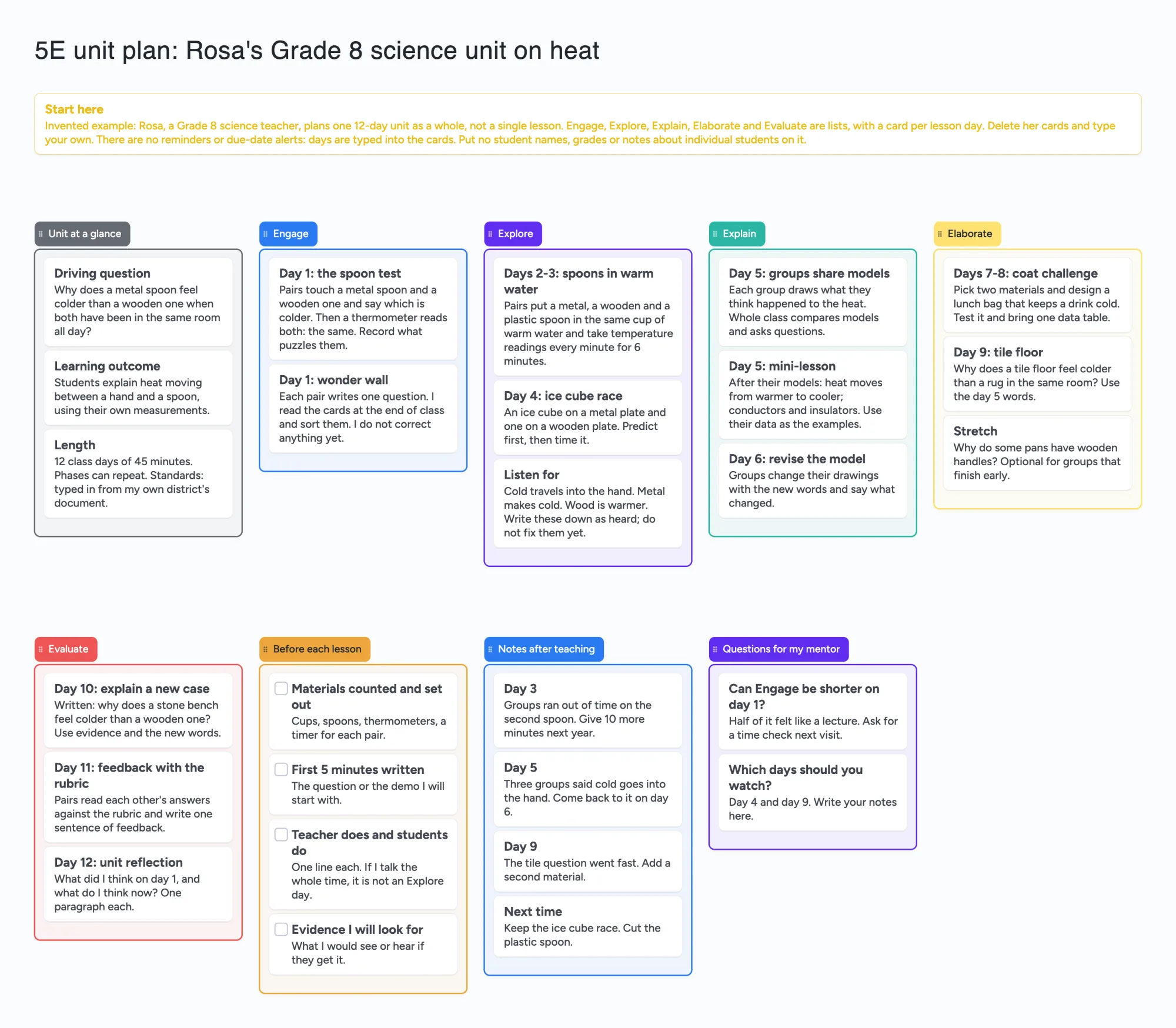
We make Instaboard, an online board. This page gives you a 5E plan already laid out on it and filled in for one invented teacher, Rosa, who plans a 12-day Grade 8 science unit on heat. Engage, Explore, Explain, Elaborate and Evaluate are lists, and each lesson day is a card. Three more lists hold a tick-box check before each lesson, notes after teaching and questions for a mentor. Open it, replace Rosa's cards with yours and share the link with a co-teacher or a mentor. It sends no reminders or due-date alerts, does not pull in standards or make a Word file, and holds no student names. The unit on it is made up. 5E is the BSCS 5E Instructional Model; this page is not affiliated with or endorsed by BSCS.
Opens in your browser. Anyone can view; a free sign-in lets you edit.
Updated
Read this first: what the board does and doesn't do
- What it is: the five phases as five lists, with one card per lesson day under each, so a whole unit is on one screen. A co-teacher, a mentor or a methods instructor who has the link sees the same plan. The example uses 38 of your 150 free items.
- What it isn't: no automatic phase timing, no reminders or due-date alerts, no standards lookup and no export to a Word file or a PDF. In the example, days and minutes are text you type into a card. The four "Before each lesson" cards are tick boxes you read and tick yourself.
- A unit, not one lesson: the board is laid out for a unit of several lessons, which is how the model's author says it works best. If your program makes you write a single lesson in 5E, the page has a section for that, and a Word template may suit you better.
- Keep students off it: a free board is shared by link. Put no student names, grades or notes about individual students on it.
- Free plan: 5 boards, 150 items, 3 pictures per board. Copying the board takes 1 of your 5 boards. Writing on it needs a free sign-in. New boards start with "Anyone who joins can view".
A unit, not one lesson: what BSCS and its author say
BSCS's 2006 report lists the five phases as engagement, exploration, explanation, elaboration and evaluation, and gives each one a job: surface what students already think, give them a common experience, introduce the concept, extend it to a new situation and check understanding. Rodger Bybee, who writes that he and a team of colleagues created the BSCS 5Es, wrote a later article in Science and Children (a PDF copy on pimser.org; the text we read prints no date). In it he says his experience suggests the optimal use of the model is a unit of two to three weeks, where each phase is the basis for one or more lessons, except Engage, which should be less than a lesson. He says using the model for a single lesson decreases the effectiveness of the individual phases, and that you should not omit a phase.
The San Diego County Office of Education's 5E page, which says it is adapted from BSCS and Bybee (the page shows no date), repeats the two to three week sequence. It adds that phases can be repeated or looped, for example Engage, Explore, Explain, Explore, Explain, Elaborate, Evaluate. Edutopia's article on the model for middle and high school science (by Elissar Gerges, March 4, 2022) suggests starting small, with a lesson that uses only two of the phases, and letting students explore before you explain.
That is why the board is a unit view. A list can hold a card for each day, a phase can take two days or four, and a looped phase is just two more cards in the same list.
Rosa's unit, list by list
Rosa teaches Grade 8 science. Every name, activity and note on the board is invented. She plans twelve 45-minute days on one question: why does a metal spoon feel colder than a wooden one that has sat in the same room all day? Read it left to right, top row then bottom row.
- Unit at a glance. Three cards: the driving question, the learning outcome in one sentence and the length. The standards are typed in from her own district's document; the board does not look them up.
- Engage (day 1). Pairs touch both spoons and say which is colder, then a thermometer reads the same for both. A "wonder wall" card collects one question per pair. Rosa only listens and sorts the cards. Bybee describes the observations in this phase as informal and says the engage phase is not a preassessment.
- Explore (days 2 to 4). Three spoons in the same cup of warm water with readings every minute, then an ice cube on a metal plate and on a wooden plate. A "Listen for" card records what she hears, such as "cold travels into the hand", without fixing it.
- Explain (days 5 and 6). Groups share their models first. Then a short mini-lesson on heat moving from warmer to cooler and on conductors and insulators, using their own data. On day 6 the groups change their drawings. SDCOE describes the phase as these two parts, students' explanations first and then the teacher's resources.
- Elaborate (days 7 to 9). A lunch-bag challenge, then a tile floor against a rug, then an optional stretch about pan handles. Each one asks students to use the day 5 words in a new case.
- Evaluate (days 10 to 12). A written explanation of a stone bench against a wooden one, rubric feedback between pairs and a one-paragraph reflection on what they thought on day 1.
- Before each lesson. Four tick-box cards: materials counted, the first five minutes written, one line each for what the teacher does and what students do, and the evidence she will look for.
- Notes after teaching and Questions for my mentor. Short dated notes on what happened, and what to ask or ask someone to watch.
If your program makes you write a single lesson in 5E
Some programs ask for one 5E plan per lesson, whatever the model's author says; the student teacher in the r/Teachers thread below is in one. Three r/ScienceTeachers and r/Teachers threads show how teachers handle it. Replies are single accounts, and we read the comments the page showed.
- r/ScienceTeachers "Is 5 E lesson plan really used?" (OP u/Phoenix-1322, March 13, 2025): u/lynsktee finds it very useful as a unit planning tool, never uses all five in a single lesson, and notes that some Es repeat within a unit. u/groudhogday says its creator has said it is meant for unit plans. u/AbstruseAlouatta says it works if you fully commit and is poor if you commit halfway, and has seen teachers merge the first two Es. u/sondelmen says it gives them and their admin a common language for discussing lessons, and otherwise calls it "more flair over function".
- r/ScienceTeachers "Creating a 5E Lesson" (OP u/NegativeGee, May 12, 2024, a question ahead of a job interview): u/wxmanchan thinks a 40-minute period can hold all five if the split is about 5-15-10-5-5, and says that takes discipline from teacher and students. u/SaiphSDC calls it a unit-level structure, says the Explore and Explain phases come as a pair, and says their own Engage is often 10 minutes.
- r/Teachers "Help Me Help My Student Teacher Please (5 e lesson plan)" (OP u/Kelleesayshi, January 24, 2026, a mentor teacher): u/Fun_Scallion7613, a history teacher, says an E can be as small as a question or a prompt, and plans two or three concrete student outputs a day: a bell-ringer, the daily assignment and an exit ticket. u/lester13364225689 suggests the mentor teach a lesson and the student teacher fill in the template from a video of it afterwards.
Those are people describing their own habits, not research. For a single lesson you can use the same lists and give each phase one small card. DraftMyLesson's guide (a vendor of lesson-planning software; the page shows May 15, 2026) gives sample minutes of 5 to 10 for Engage, 15 to 25 for Explore, 10 to 15 for Explain, 10 to 20 for Elaborate and 5 to 10 for Evaluate, and says 5E works poorly for lessons under 30 minutes. Those minutes are its view, not part of the model.
Planning with a mentor or a co-teacher
The extra lists in Rosa's board are there for the case in the r/Teachers thread, where one adult is learning the template and another is guiding them. Everyone with the link sees the same unit. Set Share to "Anyone who joins can edit" when the mentor should write too. Each person who writes signs in for free.
- Before each lesson borrows the columns of DraftMyLesson's template: one line for what the teacher does and one for what students do, and the evidence you will look for. That site says keeping teacher and student actions apart is the quickest way to check that Explore is student investigation and not a teacher demonstration.
- Notes after teaching keeps a short dated note per lesson, so the next unit starts from them.
- Questions for my mentor is a list the mentor can answer in the card, instead of in a hallway.
- Not on the board: names of students, grades, behaviour notes, IEP or 504 details and photos of student work. Keep those in your school's own system.
How many units fit in 150 items?
Each card and each list is 1 of your 150 free items, across all your boards. The title text box counts too. Arrows, sections and pen strokes don't. Our arithmetic from the example:
- As built: 9 lists + 28 cards + 1 title = 38 items.
- Of those, 14 are day cards (2 Engage, 3 Explore, 3 Explain, 3 Elaborate, 3 Evaluate). The other 24 are fixed: 9 lists, the title, the Start here card, 3 unit-at-a-glance cards, 4 tick cards, 4 notes cards and 2 mentor cards.
- A second unit on a copy: another 38, so two units come to 76. Three come to 114. A fourth makes 152, which is over 150, and each copy takes 1 of your 5 boards.
- Two units on one board: reuse the same nine lists and the same four tick cards, and add only the second unit's cards: 3 unit-at-a-glance, 14 day and 4 notes cards, 21 in all. Two units come to 59 and three to 80.
- Past 150: Pro removes the item limit.
What a board can't do
- No automatic phase timing and no reminders or due-date alerts. In the example, minutes and dates are text on a card. Nothing on the lists counts down a phase for you, and nothing knows when day 5 is.
- No reminders. A card does not warn you that tomorrow is an Explore day or that you have not ticked the check.
- No standards lookup. You type the standard in yourself and check it against your own district's document.
- No Word or PDF of the plan. If your program wants a submitted file in its own format, write it there. "Copy as image" gives you a picture of the board.
- Ticks don't say who or when. Anyone with edit access can untick a box, and a copy keeps its ticks, so untick the four cards before you reuse the board.
- Not private by default. New boards start with "Anyone who joins can view". Anyone you give the link to can read it; writing needs a free sign-in.
- A copy takes 1 of your 5 free boards, and the example has no pictures out of the 3 allowed per board.
Where a 5E template file or another tool does this better
Read on November 24, 2026; pages change, so check them. A date is printed only where the page shows one. The two vendor rows are the vendors' own statements.
| Tool | What the page says | Better for |
|---|---|---|
| DraftMyLesson (guide with Word and PDF template, May 15, 2026) | Offers a 5E lesson plan template in Word and as a PDF and a filled-in Grade 5 example, and says no account is needed for them. Two landscape pages, with a row per phase and columns for time, what the teacher does, what students do and the evidence you will look for. Also offers a lesson generator | A single lesson in the form a program asks for, a printed copy and a Word file you can hand in |
| Lessonspace (5E lesson plan template page, no date) | An interactive 5E template on its online whiteboard with sections per phase and sticky notes, built for live online lessons. The page says the template is available to users with an active subscription or trial and that new users are prompted to start a free trial | Planning inside a live online lesson space, where students can see the plan during class |
| San Diego County Office of Education (5E page, no date) | Describes each phase with student behaviors and teaching strategies, the two to three week sequence and questions for evaluating a 5E learning sequence | Reading what each phase should look like before you plan |
| A Word or Google Docs table | Not read for this page. Any table with a row per phase works, and a school's own form is often required | A form your program or district requires, minutes per phase, and a submitted file |
| Instaboard board | Free: 5 boards, 150 items, 3 pictures per board. Lists per phase and a card per lesson day, shared by link. No built-in phase timing, calendar or file export | A whole unit on one screen that a mentor or co-teacher can read and write on |
Swipe the table sideways to see every column.
From each page, read November 24, 2026: draftmylesson.com/blog/5e-lesson-plan, thelessonspace.com/templates/5e-lesson-plan-template, sdcoe.net/ngss/evidence-based-practices/5e-model-of-instruction. Our wording, not theirs.
Where these win
If a program wants a 5E form handed in as a file, use a Word or PDF template. If you plan inside a live online lesson, Lessonspace's template fits. Use this board when you plan a unit with someone else and want the whole sequence on one screen.
How to use it, in about twenty minutes
- Open the board and sign in free when it asks you to write. Delete Rosa's cards and keep the lists.
- Fill in Unit at a glance first: the driving question, one sentence for the outcome and the length in days.
- Plan Explore before Explain. Write what students do and what you will ask in Explore, then the short explanation that follows it.
- Give each phase as many cards as days it needs, and add a second Explore and Explain pair if a concept needs one.
- Before each lesson, go down the four tick-box cards and tick them. Untick them for the next lesson.
- After teaching, add a short dated card to Notes after teaching.
- To share it, leave Share on view for someone who should only read, or set it to "Anyone who joins can edit" if they should write. Each person who writes signs in for free.
Start from the ready board
It opens in your browser in a few seconds, with nothing to install. Sign in for free when you want to save it and share it.
Questions
What is a 5E lesson plan?
It is a plan built on the BSCS 5E Instructional Model: Engage, Explore, Explain, Elaborate and Evaluate. BSCS's report says each phase has a job, from surfacing what students already think to checking what they learned. The model's author recommends using it for a unit of two to three weeks rather than one lesson.
Can I fit all five Es into one 45-minute lesson?
Teachers disagree. The model's author says a single lesson decreases the effectiveness of the phases. Some teachers in r/ScienceTeachers and r/Teachers do it anyway with a short split such as 5-15-10-5-5 or with a question as a whole phase. If your program requires it, follow the program.
Does the board time the phases or remind me of anything?
No. The lists have no built-in phase timing: minutes and days are text you type on a card, and nothing on them counts down or warns you. The four cards before each lesson are tick boxes you read and tick yourself.
Can my mentor or co-teacher see it and write on it?
Yes. New boards start with "Anyone who joins can view", so anyone with the link can read it. Set it to "Anyone who joins can edit" if they should write too; each person who writes signs in for free. Keep student names and notes about individual students off it.
How many units fit on the free plan?
The example is 38 of your 150 free items. A copy per unit makes two units 76, three 114 and four 152, which is over 150 and also needs more than 5 boards. Reusing the same lists and adding only a second unit's 21 cards comes to 59 for two and 80 for three (our arithmetic).
Is Instaboard free?
Yes. The free plan includes 5 boards, 150 cards and items across your account (pen strokes, arrows and sections don't count), 3 images and 1 file per board, unlimited collaborators and video calls up to an hour. Pro is $5 a month billed yearly ($59.99 a year), or $7.99 monthly, and the people you invite join free.
Sources
- BSCS: The BSCS 5E Instructional Model: Origins and Effectiveness (report, Copyright 2006 BSCS; introduction and Table 1 read, not the whole report; read November 24, 2026)
- Rodger W. Bybee: The BSCS 5E Instructional Model: Personal Reflections and Contemporary Implications, Science and Children (PDF copy; the text we read prints no date; read in full November 24, 2026)
- San Diego County Office of Education: 5E Model of Instruction (adapted from BSCS and Bybee; page shows no date; read in full November 24, 2026)
- Edutopia: How to Use the 5E Model in Middle and High School Science Classes (by Elissar Gerges, March 4, 2022; read in full November 24, 2026)
- DraftMyLesson: 5E Lesson Plan guide (vendor page, Draft My Lesson Team, May 15, 2026; read November 24, 2026)
- Lessonspace: 5E Lesson Plan Template (vendor page; shows no date; read November 24, 2026)
- r/ScienceTeachers: Is 5 E lesson plan really used? (OP u/Phoenix-1322, March 13, 2025; replies are single accounts, comments the page showed, read November 24, 2026)
- r/ScienceTeachers: Creating a 5E Lesson (OP u/NegativeGee, May 12, 2024; replies are single accounts, comments the page showed, read November 24, 2026)
- r/Teachers: Help Me Help My Student Teacher Please (5 e lesson plan) (OP u/Kelleesayshi, January 24, 2026; replies are single accounts, comments the page showed, read November 24, 2026)