For a small team of teachers working on one standard, not for student work
Unpack one standard on a shared board, from its wording to its targets
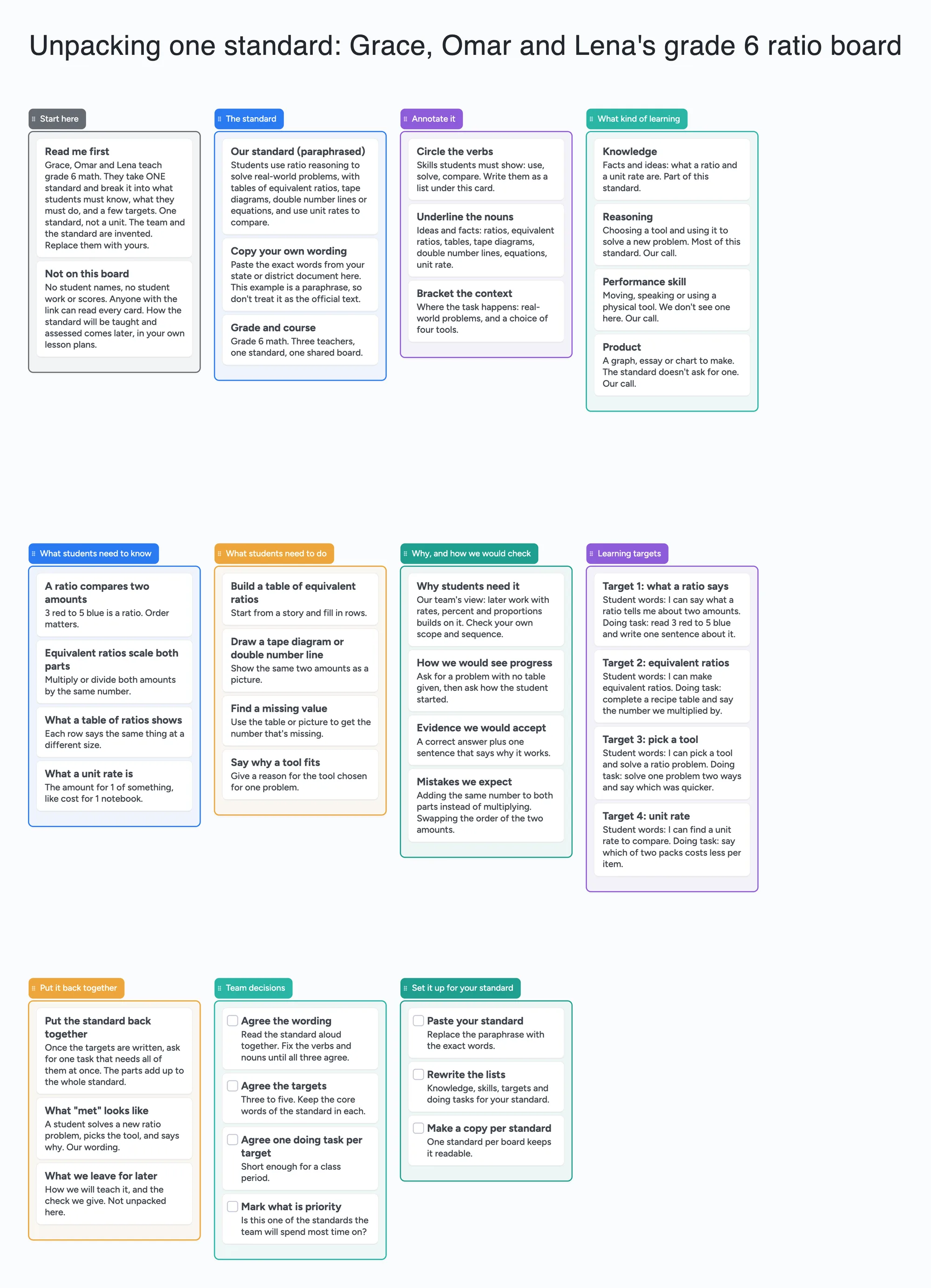
We make Instaboard, an online board for planning with other people. This page is about one standard at a time, not a whole unit and not a lesson plan. It gives you a board already laid out for that job and filled in for three invented grade 6 teachers, Grace, Omar and Lena, who take one ratio standard apart. There is a list for the standard's wording, one for annotating it, one for the kind of learning it asks for, one for what students need to know, one for what they need to do, one for how the team would check progress, one for learning targets with a doing task each, and one for putting the pieces back together. Open it, paste in your own standard, and send the link to the teachers who share it. It holds the team's thinking about the standard. It holds nothing about a student, and it sends no reminders.
Opens in your browser. Anyone can view; a free sign-in lets you edit.
Updated
Read this first: one standard, and what the board leaves out
- One standard: the board takes a single standard and breaks it into what students need to know, what they need to do, and a few learning targets. A unit, a course or a year of standards is a different job.
- Not here: how you will teach it, the lesson plan, the quiz or test, and anything about a student. A list called "Put it back together" closes the unpacking because the Nielsen post quotes Tom Schimmer saying the parts have to be rejoined.
- The wording is a paraphrase: the example standard is our own short paraphrase of a grade 6 ratio idea, so it isn't an official text. Paste your state or district wording over it.
- Some calls are ours: which kind of learning a standard is, and what counts as evidence, are the example team's judgement. The three pages we read give steps, not answers for your standard.
- Free plan: 5 boards, 150 items, 3 pictures per board. Copying the board takes 1 of your 5 boards. Writing on it needs a free sign-in. New boards start with "Anyone who joins can view".
One standard, not a unit: what this board covers and what it leaves out
- It covers one standard. The lists are built for one sentence from your standards document. A second standard needs its own set of lists or its own board; the section on items shows what each costs.
- It is not unit design. Choosing what a unit must produce, then planning backward from it, is a bigger job. This board stops at the standard and its targets.
- It does not teach or test. There is no lesson list and no assessment list. The Nielsen post we read says to unpack all the standards before digging into how they will be taught and assessed, and the board follows that order.
- It does not hold the official text. The standard on the board is a paraphrase. If your district needs the exact words, paste them into the card made for that and keep the paraphrase out.
- It holds nothing about students. A board is shared by link, and anyone you send the link to can read it. The only student words on it are the targets in student-friendly language, which describe what a student will say, not any student.
- It sends no reminders. A card can carry a due date, but nothing sends a reminder or a due-date alert.
Three pages, three recipes for unpacking a standard
We read three pages in full on November 25, 2026. Two are PDFs from the publisher Solution Tree Press (named in their footers), so they are one publisher's recipes, not independent views; the third is a blog post. All three annotate the standard (circle the verbs, underline the nouns) and write targets. The two PDFs add reflection questions, student-friendly wording and a doing task; Nielsen's post has none of those three, and asks instead for a depth-of-knowledge check and the academic vocabulary.
| Page | Steps it gives | How many targets |
|---|---|---|
| Solution Tree, "Tool: Unpacking Essential Standards" (PDF; footer shows © 2020) | Three steps: annotate the standard, reflect on it with four questions (what knowledge, what skills, why it matters, how to assess progress), then write student-friendly learning targets with a doing task | "three to five statements" |
| Solution Tree, "Tool: Deconstructing an Essential Standard" (PDF; footer shows © 2025) | Four steps: annotate the standard, sort it into one of four kinds of learning, reflect with the same four questions, then write learning targets, with a doing task if the team wants one | "between three and five statements" |
| All Things Assessment, Maria Nielsen, "Unpacking Standards Leads to Confidence, Not Chaos, for Teachers and Students" (July 19, 2016) | Read the standard as a team, circle the verbs, underline the nouns and noun phrases, decide how many targets it holds, write each as a separate target, check the depth of knowledge, pull the academic vocabulary | Not a set number: "Determine the number of targets found within the standards" |
Swipe the table sideways to see every column.
Pages read November 25, 2026. The 2020 PDF says its annotation step is adapted from Larry Ainsworth (2003) as set out by Kim Bailey and Chris Jakicic (2019). The 2025 PDF credits Bailey and Jakicic (2019) and adds "Adapted from Ferriter (2020)". Our summary, not their wording, except in quotation marks.
The board follows the two PDFs: annotate, say what students must know and do, then write targets in student words with a doing task. It has no depth-of-knowledge list or vocabulary list, which only Nielsen asks for.
Circle, underline, bracket: annotating when you can't mark the words
Both Solution Tree PDFs ask the team to circle the verbs (the skills students must show), underline the nouns and noun phrases (the ideas and facts) and put brackets around the words that give the context of the task. On paper that is three marks on a box of text. A board of cards can't mark words inside a card, so the example turns each mark into a card that lists what was marked:
- Circle the verbs: use, solve, compare, written as a list under the card.
- Underline the nouns: ratios, equivalent ratios, tables, tape diagrams, double number lines, equations, unit rate.
- Bracket the context: real-world problems and a choice of four tools.
That is our adaptation, and a sheet of paper does the marking more directly. The board's gain is that three teachers can add to the same lists at once and then argue over a card instead of over a photo of a worksheet.
Grace, Omar and Lena's board, list by list
The team, the school and the standard are invented, and the standard is our paraphrase. Read the board across the top row, then the middle row, then the bottom row.
- Start here. What the board is for, and a card saying what is not on it.
- The standard. The paraphrase, a card for pasting your exact wording, and the grade and course.
- Annotate it. The three annotation cards above.
- What kind of learning. Four cards, one per kind; three are marked as the team's call.
- What students need to know. Four facts and ideas: what a ratio is, equivalent ratios, what a table of ratios shows, what a unit rate is.
- What students need to do. Four skills: build a table, draw a picture of the same amounts, find a missing value, say why a tool fits.
- Why, and how we would check. Why it matters, how the team would see progress, what evidence it would accept, the mistakes it expects.
- Learning targets. Four targets, each with student words and a doing task.
- Put it back together. One task that needs all four targets, what "met" would look like, and what is left for later.
- Team decisions. A checklist of four tick-box cards: agree the wording, agree the targets, agree one doing task per target, mark what is priority.
- Set it up for your standard. A checklist of three tick-box cards for whoever copies the board.
Which teachers, which grade and which standard are all examples. The wording of the targets is ours; it is not advice about how to teach ratios.
How many standards fit in 150 items?
Each card and each list is 1 of your 150 free items, across all your boards. The title text box counts too. Arrows, sections and pen strokes don't. Our arithmetic from the example:
- As built: 11 lists + 38 cards + 1 title = 50.
- A second standard on the same board repeats 7 lists (the standard, annotate, kind, know, do, why, targets) and their 26 cards, so it adds 33: 50 + 33 = 83. A third makes 116 and a fourth 149.
- One board per standard: three copies of the board are 3 x 50 = 150, which is the whole free allowance, and 3 of your 5 boards.
- With Pro, the item limit is removed.
We suggest a board per standard because the lists get long when two standards share one.
Four kinds of learning, and the one this standard is
The 2025 Solution Tree PDF asks the team to sort a standard into one of four categories, which it credits to Jan Chappuis, Rick Stiggins, Steve Chappuis and Judith Arter (2012). In its words the four are knowledge, reasoning, performance skills and product.
| Kind | What the PDF says it asks of students | Where the example team lands |
|---|---|---|
| Knowledge | Learn factual information, procedural knowledge or conceptual understandings | Some of it: what a ratio and a unit rate are |
| Reasoning | Use thought processes to solve problems or apply knowledge to new situations | Most of it, in the team's view |
| Performance skills | Use physical processes such as running, playing, speaking or using a tool | None that the team sees |
| Product | Create a graph, essay, map, table or chart | The standard doesn't ask for one, in the team's view |
Swipe the table sideways to see every column.
Middle column paraphrased from the PDF's category table, read November 25, 2026. The right column is the example team's judgement, which another team could reasonably change.
The board has a card for each kind so the team has to say where it stands. The PDF asks the team to circle one category; the example splits it, which is a choice the PDF doesn't ask for.
Writing a target in student words, with a doing task
Both PDFs ask for three to five targets in student-friendly language. The 2020 PDF says to "remember to include a doing task" a student can complete to show mastery; the 2025 PDF says to "consider writing a doing task". The 2020 PDF's sample turns "Students will need to understand that poets often use figurative language to create a mood or tone" into "I can explain how writers use figurative language to influence readers' interpretations" and a task of looking at similes, metaphors and personification and predicting how they might make readers feel. The 2025 PDF's sample is about the Silk Road and ranking ideas by their impact on culture.
Nielsen's example goes the other way: a grade 6 reading standard on theme and summary becomes two targets, one on the central idea and one on a summary that is distinct from personal opinion. She warns not to omit any part of the standard and to keep its core language intact.
- Our four targets each pair student words with a doing task: say what a ratio tells you, make equivalent ratios, pick a tool and solve a problem, find a unit rate to compare.
- Check against the standard. Nielsen's warning is the team's to apply: read the standard again after writing the targets and confirm no part is missing. The board has no way to check that for you.
- Four is our count. The PDFs say three to five; Nielsen sets no number. Your standard may hold more or fewer.
Put it back together: why the unpacking ends with one task
Nielsen quotes Tom Schimmer saying that too many teachers stop short of repacking the standards, and that once a standard is unpacked the standard itself no longer exists unless students are asked to show their learning against it as a whole, "the whole really is greater than the sum of its parts." That is his view as she quotes it, and we have not read his original text.
The board's "Put it back together" list is the team's answer to that: one task that needs all four targets at once, what "met" would look like for the whole standard, and what the team leaves for its lesson plans. The example's "met" line is the team's wording, not a rubric.
How to use it with your own team
- Open the board and sign in free when it asks you to write. Replace Grace, Omar and Lena with your team.
- Paste your standard into the card made for it, in the exact words, and delete the paraphrase.
- Read it aloud together, then fill in the annotation cards and agree the wording.
- Fill in know and do before the targets, one card at a time.
- Write three to five targets with a doing task each, then read the standard again to check nothing is missing.
- Send the link to the team. Set Share to "Anyone who joins can edit" for the team, and view for guests.
- Copy the board for the next standard, or add its lists below if you accept a long board.
Where others do this better
Read on November 25, 2026. A date is printed only where the page shows one.
| Tool | What the page says | Better for |
|---|---|---|
| Solution Tree, Tool: Unpacking Essential Standards (PDF; footer shows © 2020) | A two-page reproducible with boxes for the annotation, the four reflection questions and a target table with one sample row | A printout for a team that wants to fill in a sheet by hand, from the publisher whose method this is |
| Solution Tree, Tool: Deconstructing an Essential Standard (PDF; footer shows © 2025) | A three-page reproducible with a box to paste the standard, the four-category step and a longer sample | The category step, and a fuller worked sample |
| Moore County Schools (North Carolina), "NC Essential Standards - Unpacking Documents" (page shows no date) | Says to click for the unpacked content of the NC Essential Standards, then lists science by grade from kindergarten and by course through physics, and health and physical education by grade band | Pages the district says hold unpacked content for those NC standards. We did not open them, so we can't say what they contain |
| Instaboard board | 5 boards, 150 items, 3 pictures per board on the free plan | Three teachers adding to the same lists at once and moving cards, with one link in place of a file |
Swipe the table sideways to see every column.
Pages read November 25, 2026: solutiontree.com PDFs and ncmcs.org (links in Sources). We opened the Moore County page in a browser and found no date on it; the © 2026 line in its footer is the website host's. Our wording, not theirs.
Where these win
If your state or district already publishes unpacked documents for your standard, start from those and use this board to talk them through as a team. If you want a sheet to fill in by hand, take the Solution Tree PDF. Use this board when three teachers need to add to the same lists, change them, and keep the result in one place.
Start from the ready board
It opens in your browser in a few seconds, with nothing to install. Sign in for free when you want to save it and share it.
Questions
What does it mean to unpack a standard?
Breaking one standard into the parts a student must know and be able to do, and then writing those parts as learning targets. All three pages we read annotate the wording and end with targets. The two Solution Tree PDFs also ask what knowledge and skills the standard needs and have the team write the targets in student-friendly language, with a doing task.
How is this different from planning a whole unit?
This board takes one standard. A unit plan starts from what students should be able to do at the end of a unit and works backward over many standards and lessons. There is a separate backward design unit plan board on this site for that job.
How many learning targets should one standard have?
The two Solution Tree PDFs say three to five. The Nielsen post sets no number and says to decide how many targets the standard holds. The example board has four, which is our count for an invented ratio standard, not a rule.
Can I put student names or student work on the board?
No. A board is shared by link, and anyone you send the link to can read it. The only student words on it are the targets, which describe what a student will say. Keep names, work and scores in your school's own system.
Can my team write on the same board?
Yes. New boards start with "Anyone who joins can view", so anyone you send the link to can read it. Set it to "Anyone who joins can edit" if the team should write too; each person who writes signs in free.
Is Instaboard free?
There is a free plan: 5 boards, 150 cards and items across your account (pen strokes, arrows and sections don't count), and 3 pictures and 1 file per board. Writing on a board takes a free sign-in. Pro removes the item limit and adds invite-only boards: $5 a month billed yearly ($59.99 a year), or $7.99 monthly.
Sources
- Solution Tree: Tool: Unpacking Essential Standards (PDF, footer shows © 2020; read November 25, 2026)
- Solution Tree: Tool: Deconstructing an Essential Standard (PDF, footer shows © 2025; read November 25, 2026)
- All Things Assessment: Unpacking Standards Leads to Confidence, Not Chaos, for Teachers and Students, by Maria Nielsen (July 19, 2016; read November 25, 2026)
- Moore County Schools: NC Essential Standards - Unpacking Documents (page shows no date; read November 25, 2026)