For a small product team turning customer interviews into one next idea
An opportunity solution tree template: the needs from your interviews, one target and three ideas, as lists on a shared board
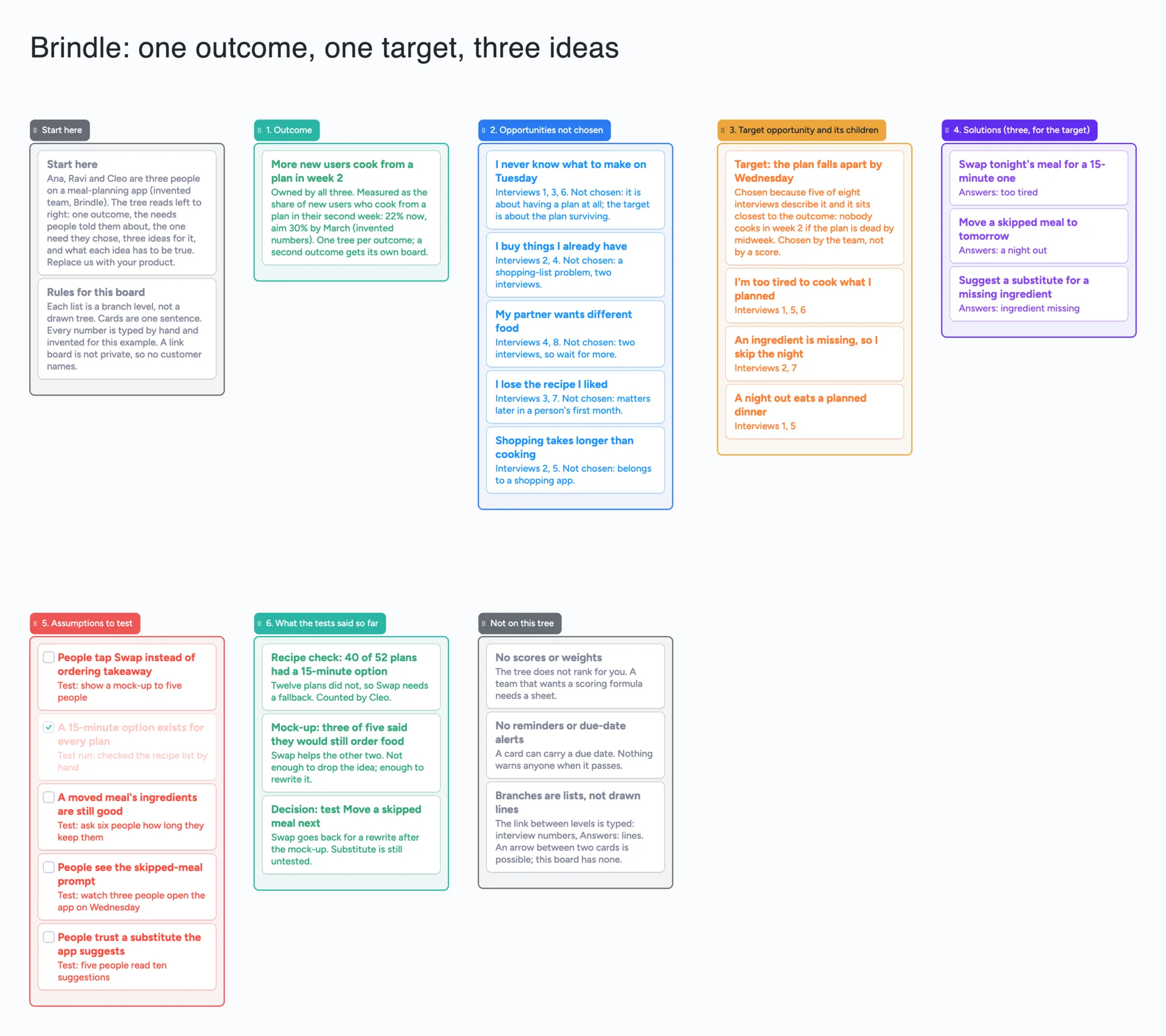
We make Instaboard, an online board. This page gives you an opportunity solution tree already laid out on it, filled in for an invented three-person team: Ana, Ravi and Cleo are working on a meal-planning app called Brindle and have talked to eight people. The board has eight lists and 26 cards: one outcome, five needs they heard and did not choose, a target need with three smaller needs under it, three ideas, five assumptions to test, three test results and a list of what the board does not do. The honest picture comes first. A tree is normally drawn with lines and this board has none: each level of the tree is a list, and the links between levels are typed on the cards.
Opens in your browser. Anyone can view; a free sign-in lets you edit.
Updated
Read this first: what the board does and doesn't do
- What it is: a shared page where the levels of an opportunity solution tree are lists, left to right, and each need, idea and assumption is a card. The example uses 35 of your 150 free items.
- What it is not: a drawn tree. No lines join a need to its ideas, nothing scores or ranks the needs for you, and there are no reminders or due-date alerts. The link between a need and the ideas under it is a line of text on the card.
- Where drawing tools win: Teresa Torres's page says any visual tool with shapes and arrows will do and that she uses Miro, with templates for Miro, Mural and FigJam. If you want to see the branches as a diagram, use one of those.
- Where this board may help: a team of two to four that wants one shared place to read the tree top to bottom, keep the needs it did not choose, and tick off assumption tests.
- Keep off it: customer names, emails and recordings. The example says Interview 1 to Interview 8. A link board is not private.
Lists instead of lines: how a tree fits on a board
Torres's page describes the tree in four layers: the outcome at the root, the opportunity space below it, the solution space below that and assumption tests under the solutions. Her page says you can build one in any visual tool that allows shapes and arrows. A board of cards and lists has no branches, so the example turns each layer into a list and reads left to right.
- 1. Outcome: one card. Torres's page says to put the outcome at the top, to build a new tree when the outcome's direction changes, and to give each team its own outcome.
- 2. Opportunities not chosen: one card per need people described, with the interview numbers that mention it and a line on why it is not the target.
- 3. Target opportunity and its children: the one need the team chose, then the smaller needs under it.
- 4. Solutions: three ideas for the target, each with an Answers: line that names the smaller need it addresses.
- 5. Assumptions to test: tick boxes, one card per thing that has to be true, with the test written under it.
- 6. What the tests said so far: short results, then the decision.
What you give up is the picture. On this board a reader finds the link by reading the typed lines (Interviews 1, 5, 6; Answers: too tired) and not by following a line. Arrows exist on the board and can carry a caption, so you can draw one between two cards if you want it; the example has none.
Is it a need or an idea in disguise?
The most common slip, according to Torres's page, is writing a solution in the opportunity list. Her test is a question: "Is there more than one way to address this opportunity?" Her example is "I want to go out to eat", which sounds like a need but has only one way to be met, so she reframes it by asking why, and gets needs such as "I don't have time to cook".
Brindle's board applies the test to its own cards. "I'm too tired to cook what I planned" can be met by a 15-minute swap, by moving the meal or by takeaway, so it is a need and stays in the target list. "Swap tonight's meal for a 15-minute one" is one way to meet it, so it sits in Solutions. That sorting is ours; the test is hers.
The page also says to take opportunities only from what you heard in interviews. It says that opportunities generated off the top of your head bring your own biases and half-truths, and that sales conversations, support tickets and feature requests are better used as inspiration for what to ask in the next interview. That is why every need card on the example carries interview numbers.
Interviews first: when to start the tree
Torres's page lists prerequisites: a theory of your target customer, a clearly defined outcome and three to four story-based customer interviews before the first tree. It calls trees "nearly impossible to create when you don't have good inputs". It says to start mapping the opportunity space after three or four customer stories and to revisit the space for every three or four interviews after that.
Brindle's board is at eight interviews. On the board a revisit is moving cards: a need that came up again gets a longer interview line, a need that was only one person's goes to the not-chosen list. Nothing on the board reminds anyone to do it.
The page also warns that the first map is messy. It says the structure should settle as interviews pile up, and that if the tree is still a mess after six to eight interviews it suggests Vistaly. The page says the author partners with Vistaly and licenses AI services to it, so that is her recommendation as a partner.
Choosing one target, and what the board can't score
Torres's page says to work on one small opportunity at a time and to choose a target as soon as there is a first draft of the opportunity space. It lists four sets of factors to assess: opportunity sizing (how many customers and how often), market factors, company factors and customer factors. It says effort is left out on purpose, because solutions take effort and any need can have both easy and hard solutions.
A board has no scoring, so Brindle's team writes its reason on the target card in a sentence: five of the eight interviews describe it, and it sits closest to the outcome. The card says the team chose it, not a score. If you want weights and totals, that belongs in a sheet next to the board.
On r/ProductManagement a user asked how to prioritise when there are dozens of opportunities (thread xlzrrw, 2022-09-23, 8 comments read in an archived copy). u/melvinzaldana answered with Torres's four criteria and said their team spends a month before each quarter assessing opportunities and mapping the first level of the tree, then each product trio spends a week mapping solutions and assumptions for the top opportunities. u/Thelastgoodemperor answered "Judgement. Size of market is only thing that really can be quantified." These are two accounts' views.
Three ideas, five assumptions, and what came back
Torres's steps are to brainstorm solutions for the target only, choose three to explore, break each down into assumptions, test the riskiest ones, and then decide: throw some ideas away, keep refining one, or pick a new target. Her page adds that a solution can be a product, a feature, a service, a workflow, a process or documentation, and recommends more than one solution for the target when there is risk.
- Swap tonight's meal for a 15-minute one. Assumes people tap Swap instead of ordering takeaway, and that a 15-minute option exists for every plan.
- Move a skipped meal to tomorrow. Assumes a moved meal's ingredients are still good, and that people see the prompt.
- Suggest a substitute for a missing ingredient. Assumes people trust a substitute the app suggests.
The assumption cards are tick boxes. One is ticked: Cleo checked 40 of 52 plans by hand and 12 had no 15-minute option, so Swap needs a fallback. A five-person mock-up test found that three would still order food. The Open Practice Library's version (Published October 01, 2019) has the team vote on solutions with dot-voting and write experiments for the top three; this board has no voting step, and the target card gives its reason in a sentence. The example's decision is to test Move a skipped meal next and rewrite Swap. All of those numbers are invented for the example, and the ticks are marks on the cards; the board doesn't record who ticked or when.
Brindle's board, list by list
- Start here (2 cards). Who they are and what the board shows, and the rules: every number is typed by hand, no customer names.
- 1. Outcome (1). More new users cook from a plan in week 2: 22% now, aim 30% by March (invented).
- 2. Opportunities not chosen (5). Needs with interview numbers and the reason each was not the target: a plan at all, buying what you have, a partner's tastes, losing a recipe, slow shopping.
- 3. Target and its children (4). The plan falls apart by Wednesday, then too tired, a missing ingredient, a night out.
- 4. Solutions (3). Swap, Move, Substitute.
- 5. Assumptions to test (5). Tick boxes, each with its test.
- 6. What the tests said so far (3). Two results and the decision.
- Not on this tree (3). No scores or weights, no reminders or due-date alerts, branches are lists and not drawn lines.
How big can the tree get before 150 items?
Each card and each list is 1 of your 150 free items, across all your boards. The title text box counts too. Arrows, sections and pen strokes don't. Our arithmetic from Brindle's lists:
- As built: 8 lists + 26 cards + the title = 35.
- What stays fixed: 8 lists + 2 Start here cards + 3 Not on this tree cards + the title = 14. That leaves 150 - 14 = 136 for the tree itself.
- A fuller tree: 1 outcome + 20 needs + 1 target + 8 smaller needs under it + 3 ideas + 9 assumptions (three each) + 6 results = 48 cards, so 48 + 14 = 62.
- Copies: two copies of that fuller tree are 2 x 62 = 124; a third would be 186. A copy takes 1 of your 5 free boards.
Pro removes the item limit: $5 a month billed yearly ($59.99 a year), or $7.99 monthly. One tree doesn't need it.
What people who use trees say
We read three r/ProductManagement threads about using the tree in practice. All are individual accounts, not rules from Torres's page.
- Thread 1vg5hg0 (2026-08-05; Reddit shows 37 comments, we read 38 in an archived copy): u/sedatedruler wrote that the book gets two things right, talking to customers weekly and keeping a menu of options ready, and that "the trees imo get too complex to actually build and maintain". u/j-bone-84 said their team had used a version of the tree for about a year, documents it in FigJam, and does not include an engineer in discovery because of how their organisation is structured. u/DeanOnDelivery said they have used it since about 2018 but "never as some precious laminated process".
- Thread 1lnba7o (2025-06-29; 15 comments read in an archived copy): asked how the tree sits alongside dual-track discovery. u/Dylando_Calrissian said the tree should evolve over time and that the riskiest assumptions are what you test in discovery. u/Zokleen, who says they are often brought into digital transformations and 0-to-1 launches, said the tree on its own is not that valuable as an artifact and that the value lies in the shared context it creates; their trio revisits it weekly and adds to it asynchronously. u/nicestrategymate said they use it only for innovation tracks, for high-value, high-risk bets.
- Thread xlzrrw (2022-09-23; 8 comments read in an archived copy): how to prioritise opportunities; see the target section above.
Among the accounts quoted here, one found the tree too complex to maintain and one valued it for shared context. A board of lists is lighter than a diagram and also less of a picture; which of those is a feature depends on the team.
One tree, one outcome, and when it gets too big
Torres's page says to start a new tree when the direction of the outcome changes, not when the target number changes: moving from 25% to 30% keeps the same tree, while switching from first-session activation to acquiring more customers means a new one. It does not recommend one tree for a whole company and says that tends to get unwieldy.
On a board a new tree is a copy. A copy takes 1 of your 5 free boards, and every card on it counts toward your 150 items. The section on 150 items above has the arithmetic.
What a board can't do for an opportunity solution tree
- Draw the tree. Cards sit in lists. A caption arrow can join two cards, but in our view a tree of many arrows becomes a tangle.
- Rank or score. No weights, no totals. The reason for the target is a sentence.
- Remind anyone. No reminders or due-date alerts. A card can carry a due date; nothing warns anyone when it passes.
- Show who ticked an assumption or when. Ticking is a mark on the card.
- Keep the interviews. Notes, recordings and names belong somewhere private; the board only carries Interview 1 to Interview 8.
- Offline. Changes made offline are kept and sync when you're back online.
If you already draw in one of these
Read November 25, 2026. "Not listed" means not on the page we read, not that the tool lacks it. No ranking.
| Option | What its page says | Better than a board at | Where a board fits |
|---|---|---|---|
| Miro | Its page lists four steps (define the outcome, identify opportunities, generate solutions, iterate and experiment), and its description says the template is "Designed by Teresa Torres, a product discovery coach"; Torres's page says she uses Miro for all her trees. No page date printed; plan limits not listed on that page (as of November 25, 2026) | Drawing branches and moving whole subtrees | A short tree you read as lists, with tick-box tests |
| Mural | A template says the tree was "originally developed by Teresa Torres in 2016"; no page date printed; plan limits not listed there (as of November 25, 2026) | A drawn tree in a workshop | A tree kept as cards between workshops |
| FigJam | Torres's page lists a FigJam template; u/j-bone-84 documents their tree in FigJam. We did not read the FigJam page text, so we say nothing about its limits | Same as above | Same as above |
| Vistaly | Torres's page calls it a startup built for these trees and says she licenses AI services to it. We did not read Vistaly's own pages, so no price or feature claim | A tool made for the tree | A plain board with no extra tool |
| Product School's template | A page with example trees and a blank customizable one (printed December 02, 2024, Updated: November 19, 2026) that the reader downloads and edits as a slide | A slide to show stakeholders | A shared place a team edits together |
Swipe the table sideways to see every column.
From each page as read November 25, 2026; Miro, Mural and Product School are vendor pages. Instaboard isn't affiliated with any of them, with Teresa Torres or with Product Talk.
Set up your own, and the free-plan limits that apply
- Open the board and replace Brindle's cards as you go, so it is never half a meal-planning app.
- Write the outcome first, with its number, then number your interviews on the Start here card.
- Add one need per card with its interview numbers. Apply the test: if there is only one way to meet it, it is an idea.
- Choose one target and write the reason on its card. Move the others to the not-chosen list; don't delete them.
- Write three ideas and one Answers: line on each.
- Turn each idea into assumptions as tick-box cards, with the test under each.
- Share it. Set the share setting so anyone who joins can edit ("Anyone who joins can edit"); new boards start view-only, and each person signs in to write.
Limits of the free plan for this board:
- Boards. 5 on the free plan. "Make a copy" takes 1 of them.
- Pictures. 3 per board. The example has none.
- Writing needs a free sign-in. Anyone who joins can view the board; to change it they sign in, and the board then counts as 1 of their 5.
- Private notes. A link board is not the place for customer names; invite-only boards are a Pro feature.
Start from the ready board
It opens in your browser in a few seconds, with nothing to install. Sign in for free when you want to save it and share it.
Questions
What is an opportunity solution tree?
A way of showing the paths a team might take to a desired outcome. Torres's page describes the outcome at the root, the opportunity space (customer needs, pain points and desires) below it, the solution space below that and assumption tests under the solutions. Mural's template page says Teresa Torres developed it in 2016.
Can you really make one on a board with no lines?
You can lay out the same levels as lists and read them left to right, with the links typed on the cards. You lose the picture of branches. Torres's page says any visual tool with shapes and arrows works, so a diagram tool suits you better if you want to see the tree.
How many interviews do I need before starting?
Torres's page says three to four story-based interviews before the first tree, mapping after three or four customer stories and revisiting after every three or four interviews. The example board is at eight, our invented number.
Does the board rank the needs or pick the target?
No. It has no scores, weights or totals. The example writes the reason for its target in a sentence on the card. Torres's page lists four factors to weigh: opportunity sizing, market, company and customer factors.
Should the whole company share one tree?
Torres's page does not recommend it and says it tends to get unwieldy; it suggests one tree per outcome for one team. On this board a second tree is a copy, which uses 1 of your 5 free boards and adds its cards to your 150.
Should I put customer names or recordings on the board?
No. A link board is not private. The example calls people Interview 1 to Interview 8 and keeps only a short line from each. Keep names, contact details and recordings somewhere private.
Sources
- Product Talk, Teresa Torres: Opportunity Solution Trees: Visualize Your Discovery to Stay Aligned and Drive Outcomes (byline 06 Dec 2023 in a browser; read in full November 25, 2026)
- Miro: Opportunity Solution Tree Templates & Examples (no date printed; read in full November 25, 2026; vendor content)
- Mural: Opportunity solution tree template (no date printed; read November 25, 2026; vendor content)
- Product School: Opportunity Solution Tree template and guide (December 02, 2024; Updated: November 19, 2026; read in full November 25, 2026; vendor content)
- Open Practice Library: Opportunity Solution Tree (Published October 01, 2019; read November 25, 2026)
- r/ProductManagement: Continuous Discovery - Opportunity solution tree (2026-08-05; Reddit shows 37 comments, 38 read in an archived copy)
- r/ProductManagement: Opportunity Solutions Tree Alongside Dual Track Discovery/Delivery (2025-06-29; 15 comments read in an archived copy)
- r/ProductManagement: For those using opportunity solution trees (OST), how do you prioritize which opportunities to dive into? (2022-09-23; 8 comments read in an archived copy)