For psychology students comparing the stage theories in their own notes
Freud, Erikson, Piaget and Kohlberg: a stages chart you can edit
Intro psychology courses give you four stage theories in one chapter and then ask you to compare them. A printed chart shows the answer someone else already worked out. This page shows one way to build the comparison yourself on a board: an age strip for Erikson and Piaget, one list per theory with its focus, stages and criticisms, and a list of the mix-ups that cost marks. Open it, swap in your own course notes and keep it. It is a student-made study aid, not an answer key and not clinical guidance.
Updated
The short answer
- Start with what each theory is about, not with the stage names. Freud: how early childhood shapes personality. Erikson: how social relationships shape personality across the whole lifespan. Piaget: how children's thinking changes. Kohlberg: how moral reasoning changes. The stage names are easier to remember once you know which question each theory answers.
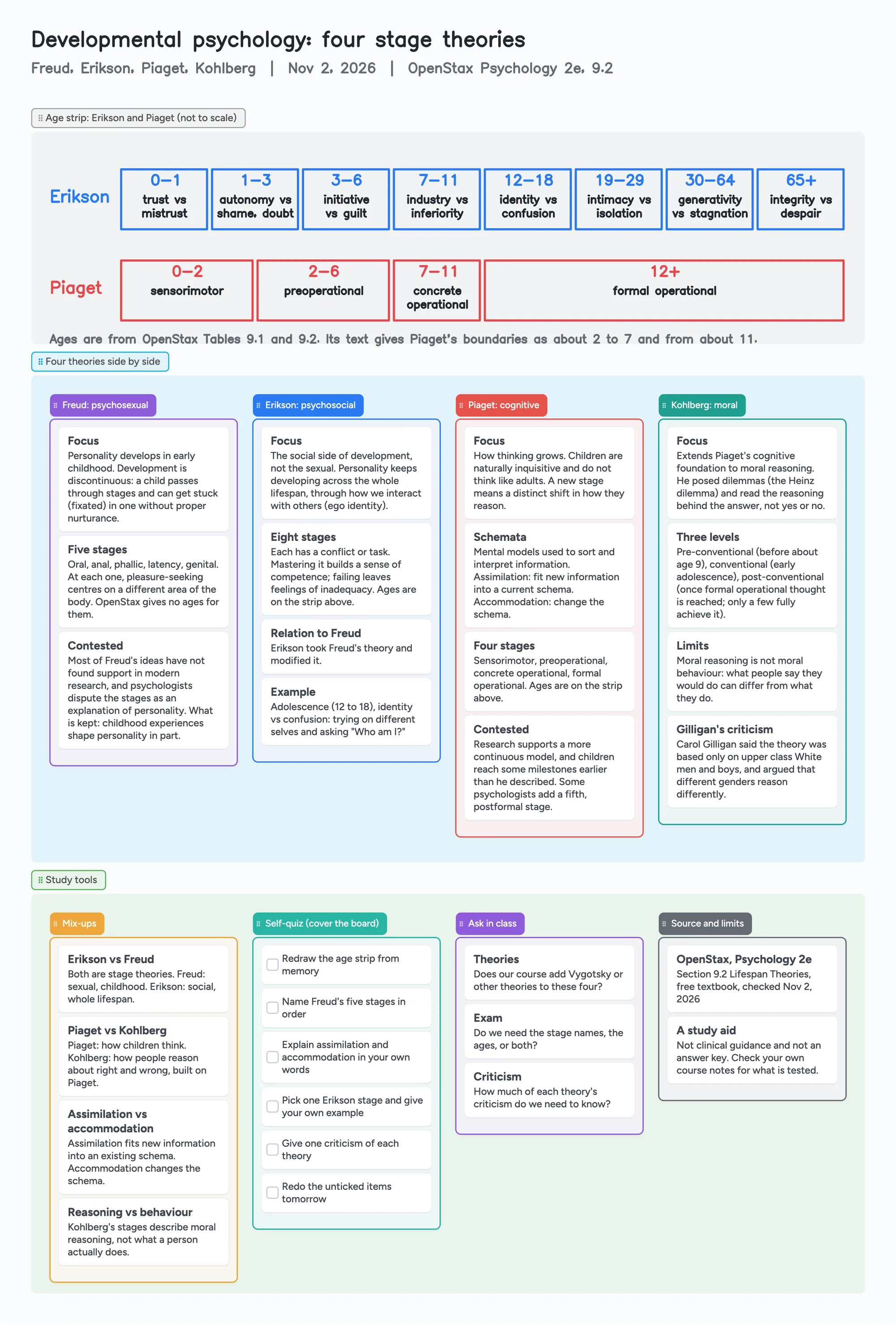
- Put Erikson and Piaget on one age strip. Both give ages, so you can see that Piaget's last stage starts at about age 11 or 12 while Erikson's eight run to old age. The board's strip is drawn that way, and it is marked not to scale.
- Write the criticism next to each theory. OpenStax says most of Freud's ideas have not found support in modern research, that research supports a more continuous model than Piaget's stages, and that Gilligan criticized Kohlberg's theory for relying only on upper class White men and boys. A chart that leaves these out is incomplete.
- A longer read or a printable is better in some cases. Simply Psychology has a long explainer comparing Piaget and Erikson, and a printed chart is the right tool if your teacher requires one. The board is for building your own version.
The four theories in one view
The summary below follows OpenStax Psychology 2e, section 9.2 (Lifespan Theories), read on November 2, 2026. The wording is shortened and paraphrased. Your course may use different ages or add other theories, so check your own notes.
| Theory | What it is about | Stages | Criticism OpenStax mentions |
|---|---|---|---|
| Freud, psychosexual | Personality develops in early childhood; a child can get stuck (fixated) in a stage without proper nurturance | Five: oral, anal, phallic, latency, genital. OpenStax gives no ages for them | Most of Freud's ideas have not found support in modern research; psychologists dispute the stages as an explanation of personality |
| Erikson, psychosocial | The social side of development, across the whole lifespan; each stage has a conflict or task to resolve | Eight, from trust vs mistrust (0 to 1) to integrity vs despair (65 and over) | OpenStax gives no specific criticism of Erikson in this section |
| Piaget, cognitive | How thinking grows; children are naturally inquisitive and do not think like adults | Four: sensorimotor, preoperational, concrete operational, formal operational | Research supports a more continuous model, and children reach some milestones earlier than he described; some add a fifth, postformal stage |
| Kohlberg, moral | How moral reasoning develops, judged from the reasoning behind answers to dilemmas such as the Heinz dilemma | Three levels: pre-conventional, conventional, post-conventional | Moral reasoning is not moral behaviour; Gilligan criticized the theory as based only on upper class White men and boys |
Swipe the table sideways to see every column.
From OpenStax Psychology 2e, section 9.2 Lifespan Theories, read November 2, 2026. Paraphrased and shortened for the board.
The age strip: Erikson and Piaget
Erikson's ages in OpenStax's table are 0 to 1, 1 to 3, 3 to 6, 7 to 11, 12 to 18, 19 to 29, 30 to 64 and 65 and over. Piaget's table gives 0 to 2, 2 to 6, 7 to 11 and 12 and over. The text around the table gives slightly different boundaries for Piaget (preoperational about 2 to 7, formal operational from about 11), which is why the board says the ages are approximate. If your textbook uses other ages, use yours.
OpenStax says Kohlberg's pre-conventional level comes before about age 9 and the conventional level in early adolescence, and that post-conventional morality comes once formal operational thought is reached and only a few people fully achieve it. It gives no fixed age range for the third level, so the board does not draw one. OpenStax also gives no ages for Freud's five stages, so they are not on the strip.
Build your own chart on a board, step by step
- Make one list per theory: Freud, Erikson, Piaget, Kohlberg. Give each list the same first card, Focus, so you can read across.
- Add a Stages card to each list and write the stage names in your own words. For Erikson and Piaget, draw the age strip above the lists with the pen or with cards.
- Add a Criticism card to each list. Write what your textbook or lecture says, not what you think should be there.
- Add one card with your own example for a stage you find hard, such as Erikson's identity vs confusion or Piaget's conservation.
- Make a Mix-ups list for the pairs you keep confusing, for example Erikson vs Freud, or assimilation vs accommodation.
- Make a checklist for self-testing: cover the board, redraw the strip from memory, name the stages, tick what you got right and redo the rest tomorrow.
The ready board above follows exactly this layout. The text is a worked example from the textbook section, so replace it with your own course notes.
Mix-ups the board lists
- Erikson vs Freud. Both are stage theories. OpenStax says Erikson took Freud's theory and modified it: Freud's is about sexual development in childhood, Erikson's about social development across the lifespan.
- Piaget vs Kohlberg. Piaget is about how children think. Kohlberg extended Piaget's foundation to moral reasoning.
- Assimilation vs accommodation. Assimilation fits new information into an existing schema. Accommodation changes the schema. OpenStax's example is a child who calls a sheep a dog and then changes his schema for dogs.
- Reasoning vs behaviour. Kohlberg's levels describe reasoning. OpenStax notes that what people say they would do may differ from what they do.
When something else is better
- You want a longer explanation. Simply Psychology's "Piaget vs Erikson" page, which we read in part on November 2, 2026, goes into much more depth on those two theories (focus, timespan, the nature of development) than a chart can. Read it for the reasoning, then build your chart from it.
- Your teacher requires a printed chart. Use the printable your course gives you. A board is for building your own version, not for matching a required format.
- You need the textbook's exact wording. Your course textbook and lecture notes decide what is tested. This board paraphrases one open textbook.
- You want practice questions. The board has a self-quiz checklist but no question bank and no answer key.
Study aid, not clinical guidance
The board summarizes theories as one textbook presents them. It is not an answer key, a diagnostic tool or advice about any child or adult. Check your own course materials for what is tested.
What Instaboard doesn't do
- The layout is manual. There is no chart template that builds itself, no AI that writes the comparison and no question bank.
- No handwriting search and no conversion of handwriting to text. The eraser removes a whole stroke at a time.
- Editing needs a free sign-in. Viewing a board by link doesn't.
- The free plan is 5 boards and 150 items (cards, lists, images, text boxes; pen strokes, sections and arrows don't count), with 3 images and 1 file per board. The ready board uses about 30 items, so one unit per board is a sensible split.
- No import from other note apps. PDF import is the only route in. Full-board PDF export works only on drawing boards and trip planners; for a card board, selected cards and lists can be saved as an image.
- Changes made offline sync when you're back online, but Instaboard isn't built to work offline first.
Start from the ready board
It opens in your browser in a few seconds, with nothing to install. Sign in for free when you want to save it and share it.
Questions
What are the stages in Freud, Erikson, Piaget and Kohlberg?
Per OpenStax Psychology 2e: Freud has five psychosexual stages (oral, anal, phallic, latency, genital); Erikson has eight psychosocial stages from trust vs mistrust to integrity vs despair; Piaget has four cognitive stages (sensorimotor, preoperational, concrete operational, formal operational); Kohlberg has three levels of moral reasoning (pre-conventional, conventional, post-conventional).
Is Freud's theory still accepted?
OpenStax says most of Freud's ideas have not found support in modern research and that psychologists dispute his psychosexual stages as an explanation of personality. It also says that childhood experiences shaping personality in part is what remains of his theory. Your course may treat it differently.
What is the difference between Erikson and Piaget?
Erikson's theory is about social development and covers the whole lifespan in eight stages. Piaget's is about how children's thinking develops, in four stages. They are on the same age strip on the board so you can see how the stages overlap.
Does this page give the answers to a worksheet?
No. It is a filled example of how to organize the comparison yourself, with a self-quiz checklist. If your teacher gave you a worksheet, fill it in from your own notes.
Can I use this board for my class?
Yes. Open it, replace the text with your own notes and keep the layout. If your course uses different ages or extra theories such as Vygotsky, add them. Check with your teacher about what is tested.
Is Instaboard free?
Yes. The free plan includes 5 boards, 150 cards and items across your account (pen strokes, arrows and sections don't count), 3 images and 1 file per board, unlimited collaborators and video calls up to an hour. Pro is $5 a month billed yearly ($59.99 a year), or $7.99 monthly, and the people you invite join free.
Sources
Related
Cornell notes, digital: cue cards that stay linked to your notes
How to take Cornell notes on a screen: a filled example (glycolysis) with cue cards joined to note cards by arrows, a self-quiz checklist and a summary. What a board does that a printable can't, and where a printable is better.
Make a biology concept map from your own notes
Turn your lecture notes into a biology concept map: concepts on cards, labelled arrows, feedback loops and a recall check. Worked example on the HPA axis, a ready board to copy, and a nursing version.
A pharmacology concept map you can edit: one list per drug class
A filled pharmacology concept map you can open and edit: five blood pressure drug classes with the prototype drug, how it works, side effects, what to watch for and what to teach. How to build your own, and where a printable template is better.
AP Biology Unit 5 heredity: a concept map you can edit, from meiosis to dihybrid crosses
A filled AP Biology Unit 5 heredity map you can open and edit: meiosis from one cell to four gametes, a 16-square dihybrid cross colour-coded to 9:3:3:1, the product rule, and four patterns where simple ratios stop working. A student-made study aid.