For indie filmmakers planning the release after the festival run
A film marketing and distribution plan on one shared board: release route, assets, launch week, what to count
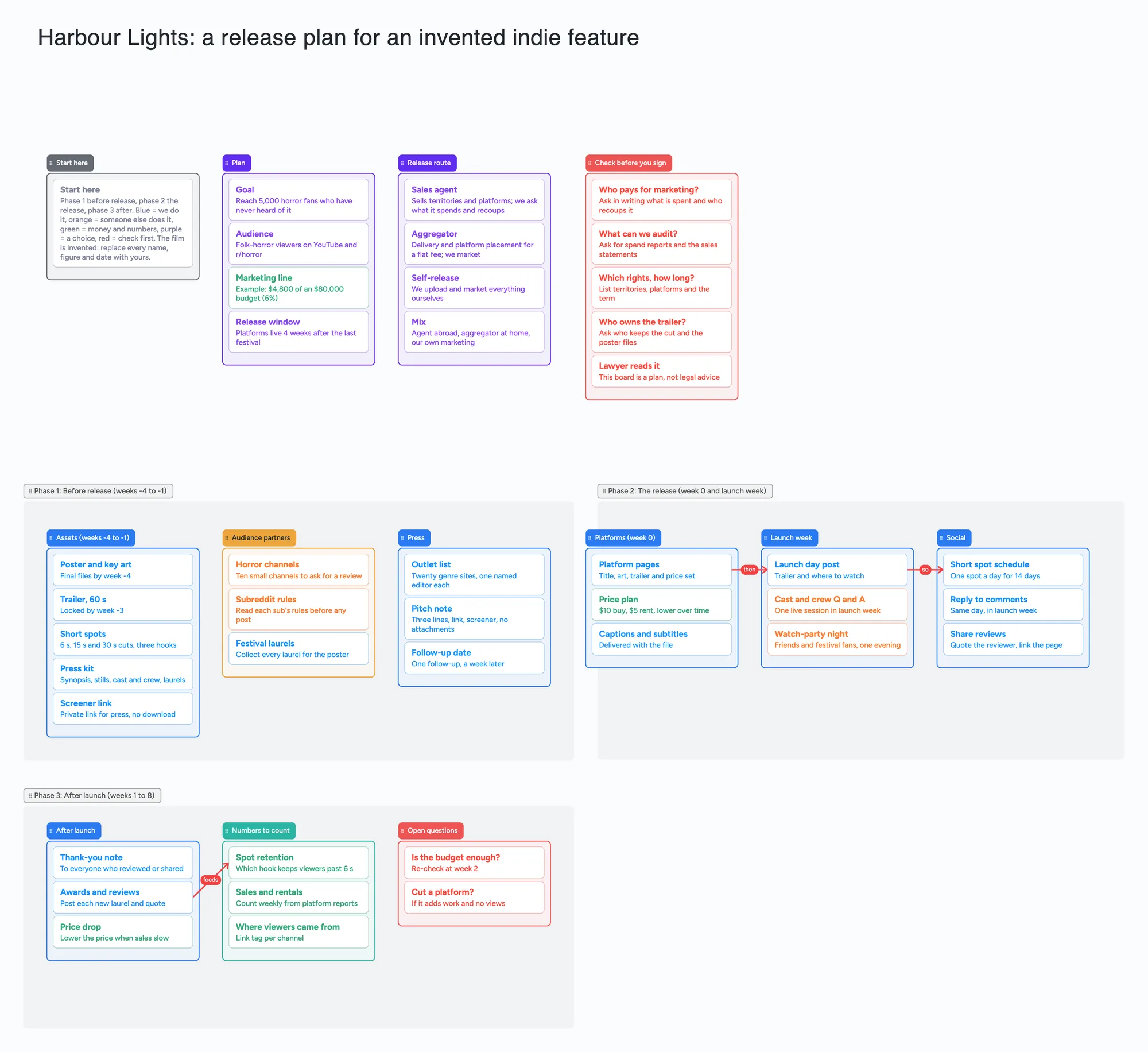
We make Instaboard, a free online board. This page gives you a release plan already laid out on it for an indie film that has finished its festival run: a goal and audience, four release routes (sales agent, aggregator, self-release or a mix), a list of questions to ask before you sign anything, then assets, press, launch week and what to count afterwards. The film is invented. Open it, replace the names and figures with yours, and send one link to your producer or editor. It is a plan, not a distributor, an aggregator or a budget spreadsheet: nothing on it delivers your film to a platform, adds up a budget or reminds you of a date, and it is not legal advice. For the festival run itself, use the [festival strategy board](/film-festival-strategy-board).
Opens in your browser. Anyone can view; a free sign-in lets you edit.
Updated
The short answer
- Four routes, one list of questions. The board puts a sales agent, an aggregator, self-release and a mix side by side as cards, and keeps a separate red list of what to ask before signing: who pays for marketing, what you can audit, which rights for how long, who owns the trailer. A lawyer reads any contract; the board does not.
- Plan the marketing money while you plan the film. On r/Filmmakers (January 2024) u/alyssathor wrote that she budgets 6-8% of the total budget for PR because "when a distribution company comes on they will add PR to your recoupable expenses before anyone sees ROI". The example uses 6% of an invented $80,000, which is $4,800 (our arithmetic). That is one producer's habit, not a rule.
- Three phases, left to right and top to bottom. Before release (assets, audience partners, press), the release (platforms, launch week, social), after launch (thank-yous, new laurels, numbers to count). Arrows join a step to what it causes.
- What it doesn't have: no delivery or QC, no budget totals, no calendar, reminders or deadline alerts, no analytics, no contract templates, no pictures beyond 3 per board.
- Count the items before you copy it. Each list and each card is one item; sections, arrows and pen strokes aren't. The example is 13 lists, 42 cards and the title text box: 56 of your 150 free items (our arithmetic). 100 cards would be 114.
- Pro lifts the limit: $5 a month billed yearly ($59.99 a year), or $7.99 monthly. The free plan keeps 5 boards, 150 items and 3 pictures per board.
- Anyone with the link can read it; writing takes a free sign-in. New boards start view-only. Set "Anyone who joins can edit" if your producer should add cards.
How this differs from our other film boards
Several of our film pages sit near this one. They hold different jobs, so pick the one that matches the question you are asking.
| Board | The question it answers | A card is | Example size |
|---|---|---|---|
| Film release plan (this page) | How does the finished film reach its audience, and what do we do each week? | A step: what, who, when | 56 items |
| [Festival strategy](/film-festival-strategy-board) | Which festivals, in what order, with what fees and premiere rules? | One festival: fee, deadline, premiere rule | 38 items |
| [Short film pre-production](/short-film-pre-production-board) | Who owns what before the shoot? | A task with an owner and a status | 63 items |
| [Documentary outline](/documentary-outline-board) | How do interviews, scenes and archive fit in acts? | An interview, scene or archive item | 50 items |
Swipe the table sideways to see every column.
Item counts are the example boards' own, each card and each list counting as one (our arithmetic).
Plan the festival run first, then come here when you know where the film has screened and what rights are still free.
How to fill in a film marketing and distribution plan
Rosa Camero's distribution post (January 25, 2025) says one of the biggest mistakes is waiting until the film is finished to think about distribution, because early partnerships and budgeting for marketing and P&A may be missed. Her free template covers distribution goals, audience and release strategies (traditional deals, self-distribution and hybrid). The board follows the same order.
- Write the goal and the audience first. The Plan list has one card for each, plus the marketing line and the release window. Milanote's film marketing guide (the page shows no date) asks the same two questions in the same order: who they are, what they enjoy, where they spend time. The example's goal is a number, not "get seen".
- Compare the four routes. The Release route list holds one card per route. Gille Klabin, quoted in No Film School's article (read November 20, 2026; the page shows no date), describes an aggregator as one that does QC and delivery, places the film on platforms, takes no ownership and no equity, and works for a flat service fee. He says most indie distributors control sales, marketing and PR. That is his view, in his words.
- Fill the red list before you sign anything. On r/Filmmakers (January 2023, a thread on distributing an indie film), a commenter who says they work in film distribution wrote that a good distributor looks after and pushes a film on platforms, and that just putting it up online will not get great results in general. Another commenter said Filmhub charges nothing upfront and takes 20% of earnings; those are two people's accounts, and Filmhub's own pricing page could not be read. Ask the real company the questions on the list.
- Build assets and partners in phase one. Poster, trailer, short spots, press kit and a private screener link are cards with a week. Klabin reports that his tests showed viewers on average stayed about six seconds, so he cut 6-, 15- and 30-second spots; that is one filmmaker's data, not a norm. u/sdbest wrote that for his next film he is compiling a list of potentially interested partner groups to promote it from the start; the Audience partners list is where yours goes.
- Set the platform price and launch week. Klabin's own plan was $10 to buy in 4K and $5 to rent, with the price lowered over time. The example copies that shape; your prices are yours to choose.
- Count after launch. The Numbers list has three cards: which hook keeps viewers, weekly sales and rentals from the platform reports, and where viewers came from. The board holds the plan for counting; the numbers come from the platforms and your own tracking.
- Share it. In the share menu set "Anyone who joins can edit" (new boards start view-only). A producer signs in free and writes live. If you each own one phase, you never type in the same card.
Producers disagree on how much to spend. On the same r/Filmmakers marketing thread, u/ammo_john wrote that he put 2-3% of a $50,000 short's budget into marketing (5-6% with the EPK), and u/StanYelnats3 wrote that marketing has been 25% of his budget on independent films. u/wrosecrans wrote that if your plan is to make a film and have somebody swoop in and take it from there, you have no plan. Those are single accounts, not a measurement; the budget card on the board is one number you replace.
Release planning tools, side by side
Each row is from the tool's own pages, read on November 20, 2026. Features and prices change, so check the page before you choose.
| Tool | What its page says | Where it beats a shared board | Where a shared board fits |
|---|---|---|---|
| Instaboard board | Free: 5 boards, 150 items. Pro $5 a month billed yearly ($59.99 a year), or $7.99 monthly | Nothing in this table on budget sums, delivery or contracts | Routes, assets, launch week and counting on one screen, your producer on the same link after a free sign-in |
| Milanote | A step-by-step film marketing plan guide with a built-in Film Marketing Plan template: logline, audience, goals, channels, a four-phase launch, a budget table, feedback | A table that does budget formulas, and a template you start from | A plan shaped by this page's release-route and check-before-you-sign lists, shared by link |
| Rosa Camero template | A free Film Distribution Template covering goals, audience and release strategies; a reader's comment on the page says it is sent by email | A document with the author's explanations | Your own plan with a producer editing the same cards |
| Peace is Loud sheet | A template for a full film distribution budget on one tab and an impact campaign budget on another, with a tab of common expenses | Real budget lines and sums that add up | The non-money plan around that sheet |
| Filmhub | Describes itself as a global film and television sales and distribution company | Actually selling and delivering the film | Deciding which route to ask about first |
Swipe the table sideways to see every column.
From each tool's own pages, read November 20, 2026. The Milanote guide, Rosa Camero page and Filmhub page show no date; the Peace is Loud page lists no date either. Filmhub's pricing page could not be read, so no fee is stated.
When another tool is the better choice
- You need to deliver the film to platforms. An aggregator or a distributor does delivery and QC. The board lists the question, not the delivery.
- You need budget totals. Use a spreadsheet such as Peace is Loud's template; the board does not add up cards.
- You are signing a contract. Have a lawyer read it. The red list helps you ask questions, not judge terms.
- You want to plan the festival run. Use the festival strategy board.
- You want reminders for dates. The board has none; use your calendar.
Limits of the free plan for a film release plan board
- Items. Each card and each list is 1 of your 150 free items, across all your boards, and a text box counts too. The example is 42 cards, 13 lists and a title text box, 56 in all. Arrows, sections and pen strokes don't count.
- Boards. The free plan includes 5 boards. Keep one release plan per film.
- Photos. 3 images per board. The example has none; a poster or still would use one of the 3.
- No budget math, delivery, analytics or alerts. Dates and figures are typed text.
- Writing needs a free sign-in. A producer who joins by link or code can add cards and arrows, and the board counts as one of their 5 boards.
- If you are under 18, check with a parent or your school before you sign up.
Start from the ready board
It opens in your browser in a few seconds, with nothing to install. Sign in for free when you want to save it and share it.
Questions
Is there a free film marketing plan template?
Yes, several. Milanote's guide has a built-in Film Marketing Plan template, Rosa Camero offers a free distribution template, and the ready board here is free within 5 boards and 150 items. Open the board, replace the example with your film and turn on "Anyone who joins can edit" if your producer should write on it.
What goes in a film distribution plan?
Rosa Camero's template covers distribution goals, audience identification and release strategies: traditional deals, self-distribution and hybrid. The board adds a check-before-you-sign list, assets, press, launch week and what to count afterwards.
How much should I spend on marketing an indie film?
There is no single answer. On one r/Filmmakers thread, producers reported 2-3% of a short's budget, 6-8% for PR, and 25% on independent films. Those are single accounts. The example board uses 6% of an invented $80,000 ($4,800, our arithmetic) as a card you replace.
What is an aggregator for a film?
In Gille Klabin's description in No Film School's article, an aggregator does QC and technical delivery, places the film on platforms, takes no ownership and no equity, and works for a flat service fee. Check any real company's own terms before signing.
How many cards fit on the free plan?
Each card and each list is one item of the 150 across all your boards. With 13 lists and the title text box, 100 cards is 114 items. That is our arithmetic. Arrows and sections are free.
Sources
- No Film School: reclaiming distribution, a modern indie release strategy (Gille Klabin on aggregators, price plan and short spots; page shows no date; read November 20, 2026)
- r/Filmmakers: producers, do you budget for marketing on indie films? (January 12, 2024; replies are single accounts; read November 20, 2026)
- r/Filmmakers: what's the best method to distribute an indie film? (January 1, 2023; replies are single accounts; read November 20, 2026)
- Rosa Camero: your film distribution game plan starts here (January 25, 2025; read November 20, 2026)
- Milanote: how to create a film marketing plan (guide and template; no date shown; read November 20, 2026)
- Peace is Loud: film distribution and impact budget template (read November 20, 2026)
- Filmhub: home page (sales and distribution company; read November 20, 2026)
Related
A festival strategy board for a short film, shared with your producer
Plan a short film's festival run on one shared board: goals, three budgets, tiers, a card per festival with fee, deadline and premiere rule. A filled example to copy. Not a submission tool.
A short film pre-production board: who owns what, on one screen
Plan a short film with a director and a producer on one shared board: cast, crew, gear, permits, locations and shoot days. Free ready board, and where StudioBinder does more.
A documentary outline board: the story you hope to tell, and what you still need to get
Outline a documentary on one shared board: three act lists, interviews, scenes to film and archive, with arrows between them. Free ready board, and where Celtx, StudioBinder and Boords do more.
A post-production tracker board: which cut is done and who owns each note
Track a short film's post-production on one shared board for a director and an editor: a card per cut and per note, an owner on each, arrows from a note to the cut that takes it. Free ready board.
A music video planning board: the treatment, one list per section of the song, a name on every shot
A music video plan to open and edit: treatment, locations, a list per song section with shot ideas and an owner on each. Item counts and where other tools win.