For horror screenwriters outlining a feature before the script
A horror screenplay outline on one shared board: three acts, a scare map, ghost or monster
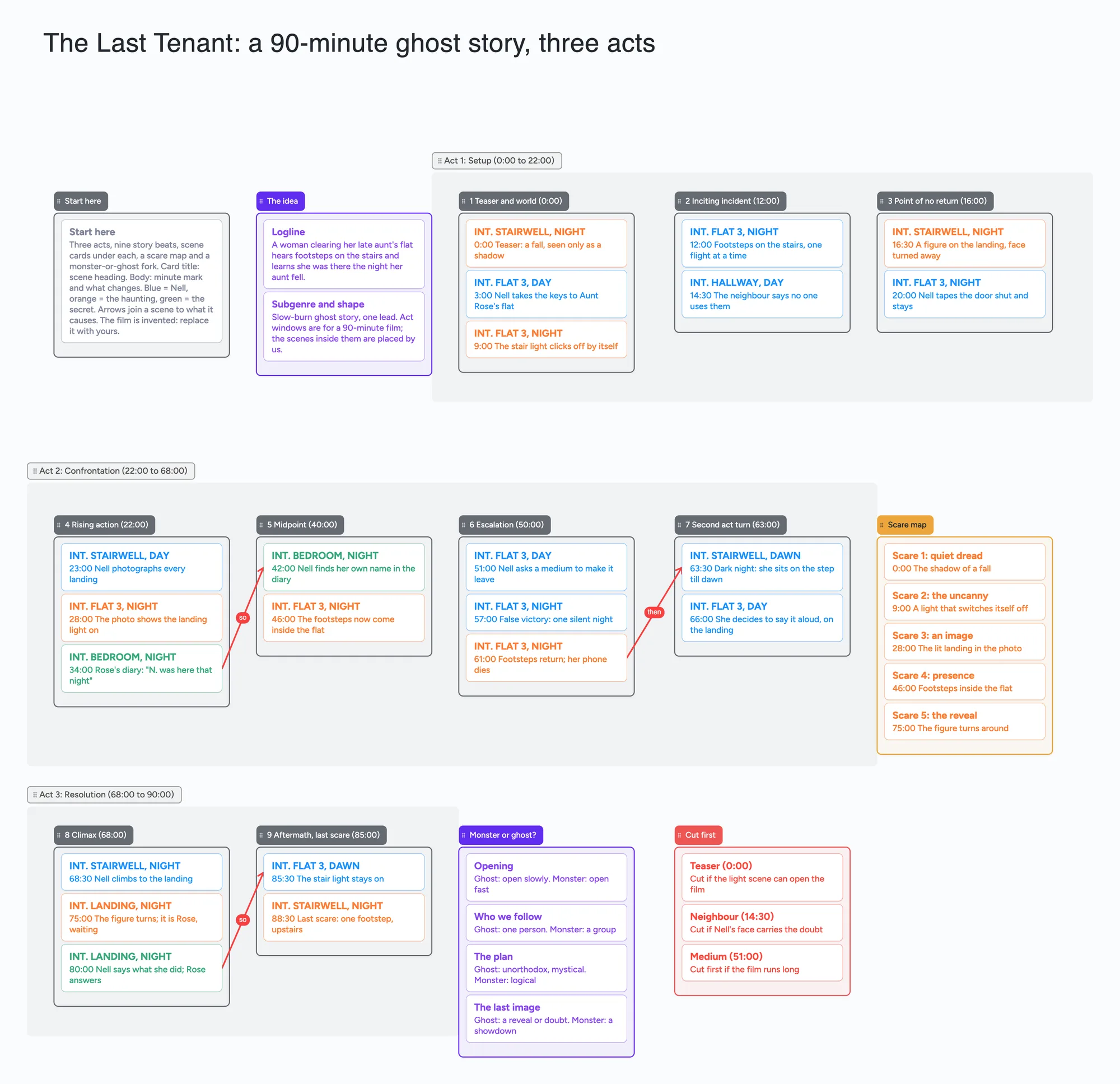
We make Instaboard, a free online board. This page gives you a horror feature outline already laid out on it: three act sections with minute marks for a 90-minute film, nine story beats with scene cards under each, a scare map, and a short ghost-or-monster list that shows where the two kinds of story usually differ. The film is invented. Open it, replace the story with yours, and send one link to a co-writer or script reader. It is a text board, not a screenwriting app: no script pages, no formatting, no export to a script format, and no pictures beyond 3 per board.
Opens in your browser. Anyone can view; a free sign-in lets you edit.
Updated
The short answer
- Acts, then beats, then scenes, with the scares on their own list. Three act sections group nine story-beat lists, each titled with a minute mark. A scene is a card: heading on top, minute mark and what changes underneath. The scare map is a separate list so you can see at a glance whether the scares are spread out or bunched.
- The minute marks are a rough guide. Raindance's horror lesson gives the three-act windows for a 90-minute film as 0-22, 22-68 and 68-90 minutes, and says not to get trapped by the timings. The nine beats use its sub-windows; where each scene sits inside a window is our choice.
- It shows one fork, not a formula. What Sleeps Beneath compares a general monster story and a general ghost story beat by beat. The board keeps four of its differences as a short list. Genre is not structure: one r/Screenwriting commenter on a thriller thread said genre tropes are "just individual story beats, not major structural road maps". Use the list as a prompt, not a rule.
- What it doesn't have: no script editor or formatting, no page or running-time count, no timeline axis, no script import, no export to a screenwriting format, no schedule or budget.
- Count the items before you copy it. Each list and each card is one item; sections, arrows and pen strokes aren't. The example is 14 lists, 37 cards and the title text box: 52 of your 150 free items (our arithmetic). 100 scene cards would be 130.
- Pro lifts the limit: $5 a month billed yearly ($59.99 a year), or $7.99 monthly. The free plan keeps 5 boards, 150 items and 3 pictures per board.
- Anyone with the link can read it; writing takes a free sign-in. New boards start view-only. Set "Anyone who joins can edit" if a co-writer should add cards.
How this differs from our other screenplay and film boards
Several of our film pages sit near this one. They hold different jobs, so pick the one that matches the question you are asking.
| Board | The question it answers | A card is | Example size |
|---|---|---|---|
| Horror screenplay outline (this page) | Where do the scares fall, and does the story follow a ghost or a monster? | A scene: heading, minute mark, what changes | 52 items |
| [Screenplay beat sheet](/screenplay-beat-sheet-board) | Does a feature of any genre hit its 15 beats on the right pages? | A scene under a beat | Beat lists plus scenes |
| [Short film outline](/short-film-outline-board) | What happens in a short, with the payoff in one line? | A scene: heading, minute mark, what changes | 38 items |
| [Shot list](/shot-list-board) | What shots do we need on shoot day? | One shot: size, lens, setup, owner | 57 items |
| [Short film pre-production](/short-film-pre-production-board) | Who owns what, and what waits on what? | A task with an owner and a status | 63 items |
Swipe the table sideways to see every column.
Item counts are the example boards' own, each card and each list counting as one (our arithmetic).
Use the beat sheet board if you want the same 15 beats for any feature. Use this one when the question is horror-shaped: where the scares go, and which kind of threat you are writing.
How to fill in a horror screenplay outline
Raindance's lesson (by Anna Taborska; the page shows no date; read November 20, 2026) takes the simplest structure, three acts, and shows roughly where its elements fall in a 90-minute film. It also notes that one page of properly formatted screenplay equals about a minute of screen time, and calls the timings a rough guideline.
- Pick the kind of threat first. What Sleeps Beneath (Arran Crawley; the page shows "Oct 17" with no year; read November 20, 2026) builds its 14 beats around monster stories and ghost stories. In its table the monster story opens fast and follows a group, while the ghost story opens slowly and follows one person. The example is a ghost story with one lead.
- Set your length. The example is 90 minutes. Retype the minute marks in the list titles and the act headings for yours. A shorter film moves every mark.
- Fill the teaser, the point of no return and the climax first. Raindance calls the teaser optional, so it is the first card on the cut-first list. A step with no scene is a gap you can see at a glance.
- Add scenes as cards, heading first. Scene heading in the title, minute mark and what changes in the body. The example colours three threads (the lead, the haunting, the secret) so a colour scan shows when the haunting goes quiet for too long.
- Put the scares on the scare map. One card per scare with its minute mark. Arc Studio's "Anatomy of a Scare" argues that each scare should be tailored to the subgenre, for example slashers want inventive kills and psychological horror plays on everyday perception. The board only lists the scares; writing one is your job.
- Use the fork as a prompt. The four cards on the monster-or-ghost list (how it opens, who we follow, the plan, the last image) come from What Sleeps Beneath's table. They are one writer's comparison of typical stories, not a requirement.
- Move doubtful scenes to Cut first, and draw an arrow when one scene causes another. An arrow joins a card in one list to a card in another and stays attached when you reorder cards or move a list. The example has three.
- Share it. In the share menu set "Anyone who joins can edit" (new boards start view-only). A co-writer signs in free and writes live. If you each own one thread, you never type in the same card; two people typing in one card merge letter by letter.
Writers disagree on how much genre shape a story needs. On r/Screenwriting (a thread on thriller staples, December 25, 2024), u/JayMoots wrote that some genres have tropes such as "the 'one last scare' moment in a horror film", but that these are individual story beats, not structural road maps. u/DelinquentRacoon replied that genre is "a set of expectations you know are going to be hit", which is staples rather than structure. Those are single accounts, not a measurement. The board suits either view: steps are lists you can rename, reorder or delete.
Horror outlining tools, side by side
Each row is from the tool's own pages, read on November 20, 2026. Features and prices change, so check the page before you choose.
| Tool | What its page says | Where it beats a shared board | Where a shared board fits |
|---|---|---|---|
| Instaboard board | Free: 5 boards, 150 items. Pro $5 a month billed yearly ($59.99 a year), or $7.99 monthly | Nothing in this table on script formatting, page counts or import | Scenes, scares and the cut list on one screen, a co-writer on the same link after a free sign-in |
| Arc Studio | Free $0 with 2 scripts and a watermark on exports, no iPhone and iPad app, outlining tools not on Free; Essentials $69 a year; Pro $99 a year; every account has a free 7-day Pro trial | Outlining and the script in one app, with formatted pages | Nothing to install and no script limit while you are still finding the story |
| Final Draft | Final Draft 13 is listed at $199.99 (struck from $249.99) for macOS 12 or higher and Windows 11 or higher, and the page says "Not available on Chromebook".. | Beats and the script in one app | No purchase and nothing to install; a link a co-writer opens in a browser |
| Plottr | A horror beat sheet page written for novels (15 beats; the page shows no date); Plottr lists $60 a year, Pro $99 a year and $150 once | A timeline and a template for a novel | A feature screenplay with minute marks and a scare list, not a novel |
| What Sleeps Beneath and Raindance | Free articles: a 14-beat monster-and-ghost table, and a 3-act lesson with minute marks for 90 minutes | Explaining why each beat is there, with film examples | Your own scenes sitting under those beats where a co-writer can move them |
Swipe the table sideways to see every column.
From each tool's own pages, read November 20, 2026. Final Draft's page also shows a Black Friday early-access price for its annual plan; that sale price is not used. Arc Studio, Plottr and Final Draft pages show no date.
When another tool is the better choice
- You want to write the script now. Use a screenwriting app such as Arc Studio or Final Draft. The board holds the plan, not the screenplay.
- You want formatted pages and page counts. Raindance counts about a page a minute for formatted script pages; the board only holds the minute marks you type.
- You are outlining a horror novel. Plottr's horror beat sheet is built for novels; this board is for a feature screenplay.
- You want to plan the shoot. Use the shot list board for shots and the pre-production board for who does what.
- You want a stills or mood board. This is a text board with 3 pictures allowed per board; use a tool built for images.
Limits of the free plan for a horror outline board
- Items. Each card and each list is 1 of your 150 free items, across all your boards, and a text box counts too. The example is 22 scene cards, 9 story-beat lists and 21 more items, 52 in all. Arrows, sections and pen strokes don't count.
- Boards. The free plan includes 5 boards. Keep the whole outline on one board.
- Photos. 3 images per board. The example has none, and this is not a stills or mood board.
- No script features. No script formatting, running-time sum, import, export to a screenwriting format, tagging or reminders.
- Writing needs a free sign-in. A co-writer who joins by link or code can add cards and arrows, and the board counts as one of their 5 boards.
- If you are under 18, check with a parent or your school before you sign up.
Start from the ready board
It opens in your browser in a few seconds, with nothing to install. Sign in for free when you want to save it and share it.
Questions
Is there a free horror screenplay outline template?
Yes. Open the board, replace the example film with yours and turn on "Anyone who joins can edit" if a co-writer should write on it. It is a board of lists and cards, not a formatted worksheet or a script editor. Raindance's lesson and What Sleeps Beneath's 14-beat article are free to read for the structure behind it.
How long is each act in a horror movie?
Raindance's lesson gives approximate windows for a 90-minute film: act one 0-22 minutes, act two 22-68, act three 68-90, and says not to get trapped by the timings. The board's minute marks are typed text you can change.
What is the difference between a ghost story and a monster movie structure?
What Sleeps Beneath compares general versions of each. In its table a monster story tends to open fast, follow a group, make a logical plan and end on a showdown, while a ghost story tends to open slowly, follow one person, try unorthodox ways to deal with the evil and end on a reveal or a doubt. It is one writer's comparison of typical stories, and many films mix the two.
How many scenes fit on the free plan?
Each card and each list is one item of the 150 across all your boards. With 14 lists, the scare, fork and cut cards and the title text box (30 items besides the scenes), 100 scene cards is 130 items. That is our arithmetic. Arrows and sections are free.
Should I outline a horror script with a beat sheet or a scare map?
They answer different questions. A beat sheet asks whether the story turns land where a feature's turns usually land; a scare map asks where the audience is meant to be frightened. The board holds both: the beat lists carry the story and the scare list carries the set pieces.
Sources
- Raindance: tailoring the 3-act structure for your horror film (Anna Taborska; minute marks for a 90-minute film; page shows no date; read November 20, 2026)
- What Sleeps Beneath: the horror structure paradigm, 14 beats (Arran Crawley; monster and ghost columns; page shows "Oct 17", no year; read November 20, 2026)
- Arc Studio: anatomy of a scare (scares tailored to the subgenre; no date shown; read November 20, 2026)
- Arc Studio: pricing (Free, Essentials $69 a year, Pro $99 a year, 7-day Pro trial; no date; read November 20, 2026)
- No Film School: breaking down how to write a horror movie (subgenres and tropes; the fetched page shows no date; read November 20, 2026)
- Final Draft: Final Draft 13 product page (price, platforms; read November 20, 2026)
- Plottr: pricing ($60 a year, Pro $99 a year, $150 once; no date; read November 20, 2026)
- Plottr: horror beat sheet for novels (15 beats; no date shown; read November 20, 2026)
- r/Screenwriting: what are the staples of a thriller? (December 25, 2024; replies are single accounts; read November 20, 2026)
Related
A screenplay beat sheet on one shared board: 15 beats, scenes under each, with pages
A 15-beat feature screenplay outline to open and edit: three act sections, a list per beat with its page, scene cards under each. Free-plan item counts and better tools.
A short film outline on one shared board: three acts, minute marks, the payoff in one line
A short film outline to open and edit: logline, payoff, three act sections with minute marks, scene cards under eight story steps. Free-plan item counts and better tools.
A shot list on a shared board: one card per shot, one list per scene
A shot list on one shared board: a list per scene, a card per shot with size, lens, owner and status. Free to open, and where StudioBinder does more.
A short film pre-production board: who owns what, on one screen
Plan a short film with a director and a producer on one shared board: cast, crew, gear, permits, locations and shoot days. Free ready board, and where StudioBinder does more.
Outline a novel or screenplay with index cards, on a board you can share
Outline a novel or screenplay on digital index cards: one list per act, 40 short cards, subplot arrows, a co-writer on the same board. Free to start; TV pilot too.