For nursing students
Build a pathophysiology concept map: one disease in six squares
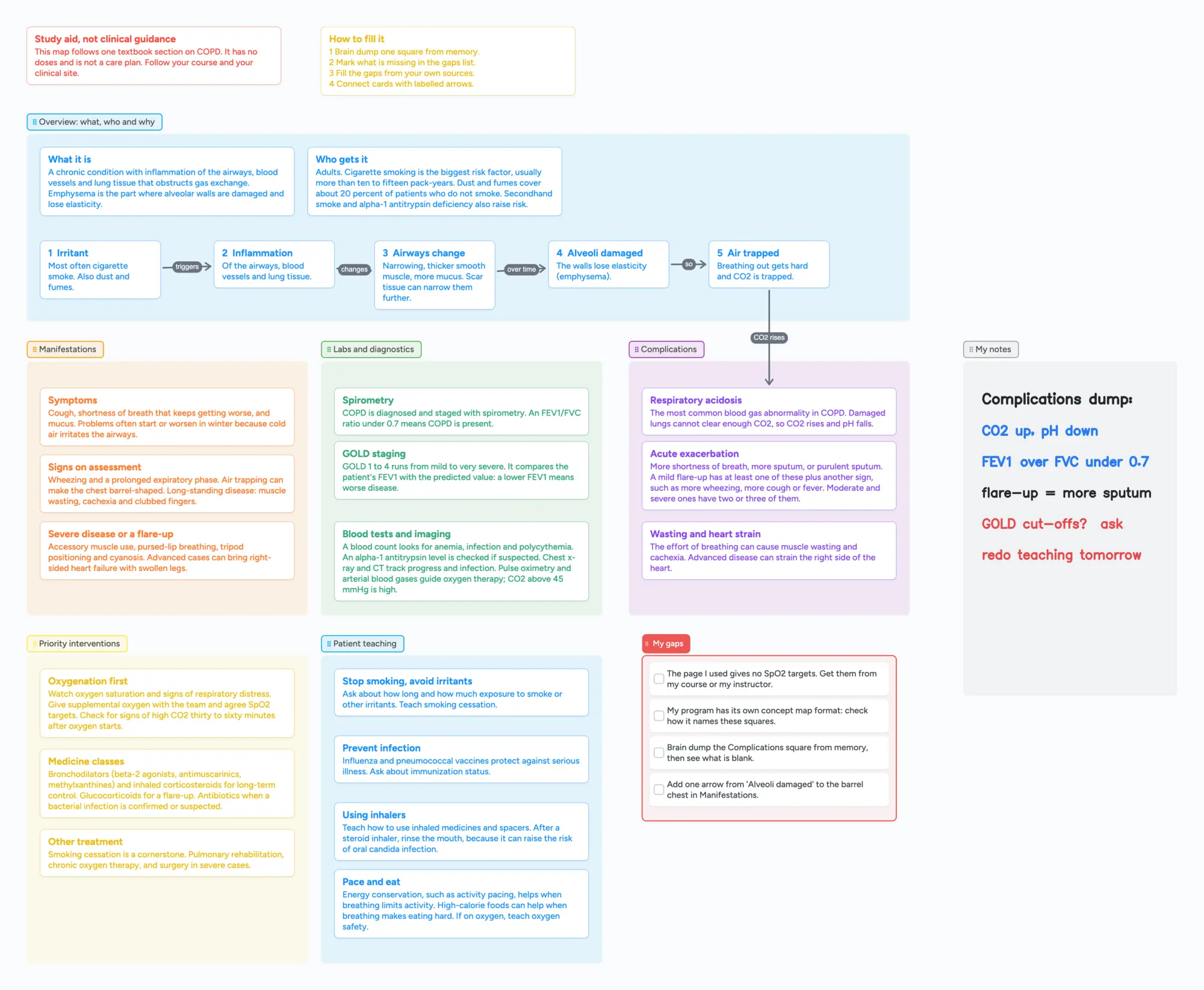
Study aid, not clinical guidance. A pathophysiology concept map is the assignment where one disease gets one page: what it is, what it looks like, how it is found, what goes wrong, what the nurse does first and what the patient is taught. This board lays that out for COPD as an example. Overview, manifestations, labs and diagnostics, complications, priority interventions and patient teaching each get a square, a cause chain with labelled arrows runs across the overview, and a gaps list and a notes section are yours to rewrite. It has no doses, is not a care plan, and follows one textbook section. If your program gives you its own format, use that one and treat this as practice.
Updated
The short answer
- The shape is six squares. Overview (what, who, why), manifestations, labs and diagnostics, complications, priority interventions and patient teaching. One r/StudentNurse commenter (2022) lists these six squares and says they get their best grades with it: fill it from the lecture slides, skim the textbook for blanks, then do practice questions. That is one student's view, not a studied method.
- The disease is COPD, as an example. The cards are paraphrased from OpenStax Medical-Surgical Nursing, section 11.5 (COPD). Swap the cards for your own disease and keep the squares. Doses are left out and medicines appear as classes only.
- The arrows carry the logic. A five-step chain (irritant, inflammation, airways change, alveoli damaged, air trapped) shows how the disease gets going, and a captioned arrow leads from it into the complications square. Add your own between squares, for example from "alveoli damaged" to the barrel chest under manifestations.
- It is a study aid, not clinical guidance. It does not replace your course, your instructor or your clinical site.
- The free plan covers it. The ready board is 30 of your 150 free items (our count: 29 cards and 1 list; sections, arrows and pen strokes don't count) and uses no images. Making your own copy takes 1 of your 5 free boards.
How the board is laid out
Everything on the board is an editable card, list or section, and nothing on it is a photo.
- Two cards at the top: a red study-aid note and four steps for filling the board in.
- An overview section holds a what-it-is card, a who-gets-it card and the five-card cause chain, with captions on the arrows between them (triggers, changes, over time, so).
- Three squares in a row: manifestations (symptoms, signs on assessment, severe disease), labs and diagnostics (spirometry, GOLD staging, blood tests and imaging) and complications (respiratory acidosis, acute exacerbation, wasting and heart strain).
- Two squares below: priority interventions (oxygenation first, medicine classes, other treatment) and patient teaching (stop smoking, prevent infection, using inhalers, pace and eat).
- A red gaps list with four checkbox cards and a grey notes section with an example brain dump in ink.
Arrows stay attached when you move a card or a section. Pen strokes drawn inside a section move with it.
Fill it from memory, then from your sources
The r/StudentNurse thread (posted 2022-08-26, 37 points, 20 comments, read in full on November 11, 2026) is a first-week nursing student saying the pathophysiology textbook feels like another language. Replies suggest YouTube channels, working practice questions and reading the rationales, and one commenter describes the six-square map. We cite the six-square comment as that one person's view. Other commenters in the same thread recommend different routes.
- Pick the disease your course assigned and keep the six squares.
- Brain dump one square from memory before you open the book. The gaps list is for what you could not recall.
- Fill the gaps from your own sources: lecture slides, your textbook, your instructor's example. The board gives you a worked disease to compare against, not your course's content.
- Draw arrows between squares and caption them with the relationship, for example from a complication to the intervention that answers it.
- Check the result against your assignment's rubric. If your program names the squares differently, rename the sections.
The worked example: COPD
The cards paraphrase OpenStax Medical-Surgical Nursing, section 11.5, Disorders of the Lower Respiratory System: Chronic Obstructive Pulmonary Disease (published October 16, 2024; read in full on November 11, 2026). It describes COPD as a chronic condition with inflammation of the airways, blood vessels and lung tissue, with cigarette smoking as the biggest risk factor; about 20 percent of people with COPD don't smoke, and in them dust and fumes at work or around them are the cause. Diagnosis and staging rest on spirometry, and an FEV1/FVC ratio under 0.7 means COPD is present. The section names respiratory acidosis as the most common blood gas abnormality, and lists exacerbations, muscle wasting and right-sided heart strain as complications. For treatment it names medicine classes (bronchodilators, inhaled corticosteroids, glucocorticoids for a flare-up, antibiotics for a confirmed or suspected bacterial infection), smoking cessation, pulmonary rehabilitation and chronic oxygen therapy.
The page gives no oxygen saturation target, so the gaps list tells you to get yours from your course or instructor. It also does not give doses, and the board adds none.
When something else is the better choice
These lines come from each source's own page, read on November 11, 2026.
- Your program gives you a format. The American Association of Colleges of Nursing posts a Pathophysiology Concept Map toolkit page (posted April 28, 2025) built on five headings: causes, clinical manifestations, consequences, collateral and considerations, with a hypertension map as its example. It says students may use the attached template or their own. If your school hands out its own template, use it. Ours is a practice shape, not a format any program asked for.
- You want practice questions and rationales. The most upvoted reply in the Reddit thread is about working study questions, wrong answers included, and reading the rationales. A board can't test you.
- You want spaced repetition. Instaboard has no flashcard, quiz or scheduling mode. Use a flashcard program next to the board.
- You want the content itself. The OpenStax section is free to read and is the source of the cards; your own course notes are the source you will be graded on.
What this board doesn't do
- It is not clinical guidance, a care plan or a drug reference. It holds no doses and no orders.
- It holds one disease from one textbook section. Another textbook may organise COPD differently.
- No quizzes, spaced repetition or scores.
- The free plan: 5 boards and 150 items per account (cards, lists, images and text boxes count; pen strokes, sections and arrows don't), 3 images and 1 file per board. The ready board leaves about 120 items free, so a second disease fits on the same board or in a new copy, but a whole course of diseases will pass 150. Pro ($5 a month billed yearly, $59.99, or $7.99 monthly) has no image limit.
- Writing needs a free sign-in. Anyone with the link can view; set Share to "Anyone with the link can edit" if a study partner should write on it.
- Written for adult learners. Instaboard's terms say users are not minors.
Start from the ready board
It opens in your browser in a few seconds, with nothing to install. Sign in for free when you want to save it and share it.
Questions
Is there a template for a pathophysiology concept map?
This board is one: six squares for one disease (COPD as the example), a labelled cause chain, a gaps list and a pen notes section. It is a practice shape. If your program supplies its own template, use that for the assignment. Making your own copy takes 1 of your 5 free boards.
Is it a care plan?
No. It is a study aid with no doses and no orders, and it follows one textbook section. Follow your course and your clinical site for anything clinical.
Can I use it for a different disease?
Yes. Keep the six squares, delete the COPD cards and write your own. The arrows and sections stay where they are, and the cards you add count toward your 150 free items.
Does it use the AACN toolkit headings?
No. The AACN toolkit uses five headings (causes, clinical manifestations, consequences, collateral and considerations). This board uses six squares from one student's description. Rename the sections if your program asks for the AACN or its own headings.
Can a study partner edit it with me?
Yes. Set Share to "Anyone with the link can edit"; new boards start view-only. Your partner signs in free to write. The board counts as 1 of their 5 free boards, and cards they add count toward their own 150 items.
Is Instaboard free?
Yes. The free plan includes 5 boards, 150 cards and items across your account (pen strokes, arrows and sections don't count), 3 images and 1 file per board, unlimited collaborators and video calls up to an hour. Pro is $5 a month billed yearly ($59.99 a year), or $7.99 monthly, and the people you invite join free.
Sources
- OpenStax Medical-Surgical Nursing, 11.5 Chronic Obstructive Pulmonary Disease (published Oct 16, 2024; read in full, Nov 11, 2026)
- AACN: Pathophysiology Concept Map toolkit page (posted Apr 28, 2025; read in full, Nov 11, 2026)
- Reddit r/StudentNurse: pathophysiology is killing me (2022-08-26, 20 comments, read in full, Nov 11, 2026)
Related
Build a nursing concept map for your patient
How to build a nursing concept map from your clinical notes, step by step: patient, pathophysiology, assessment data, labs, meds, priority problems, interventions and outcomes. A worked heart failure example you can open and edit.
A pharmacology concept map you can edit: one list per drug class
A filled pharmacology concept map you can open and edit: five blood pressure drug classes with the prototype drug, how it works, side effects, what to watch for and what to teach. How to build your own, and where a printable template is better.
How to take anatomy & physiology notes (with a filled example board)
How to take anatomy and physiology notes on a board you can edit: draw the feedback loop first, then terms, examples and a self-quiz. A filled homeostasis example built from OpenStax A&P 2e, for college and nursing students.
Make a biology concept map from your own notes
Turn your lecture notes into a biology concept map: concepts on cards, labelled arrows, feedback loops and a recall check. Worked example on the HPA axis, a ready board to copy, and a nursing version.