For college graduates applying to medical school, and the advisor who reads along
A medical school application tracker board: a card per school, moved stage by stage
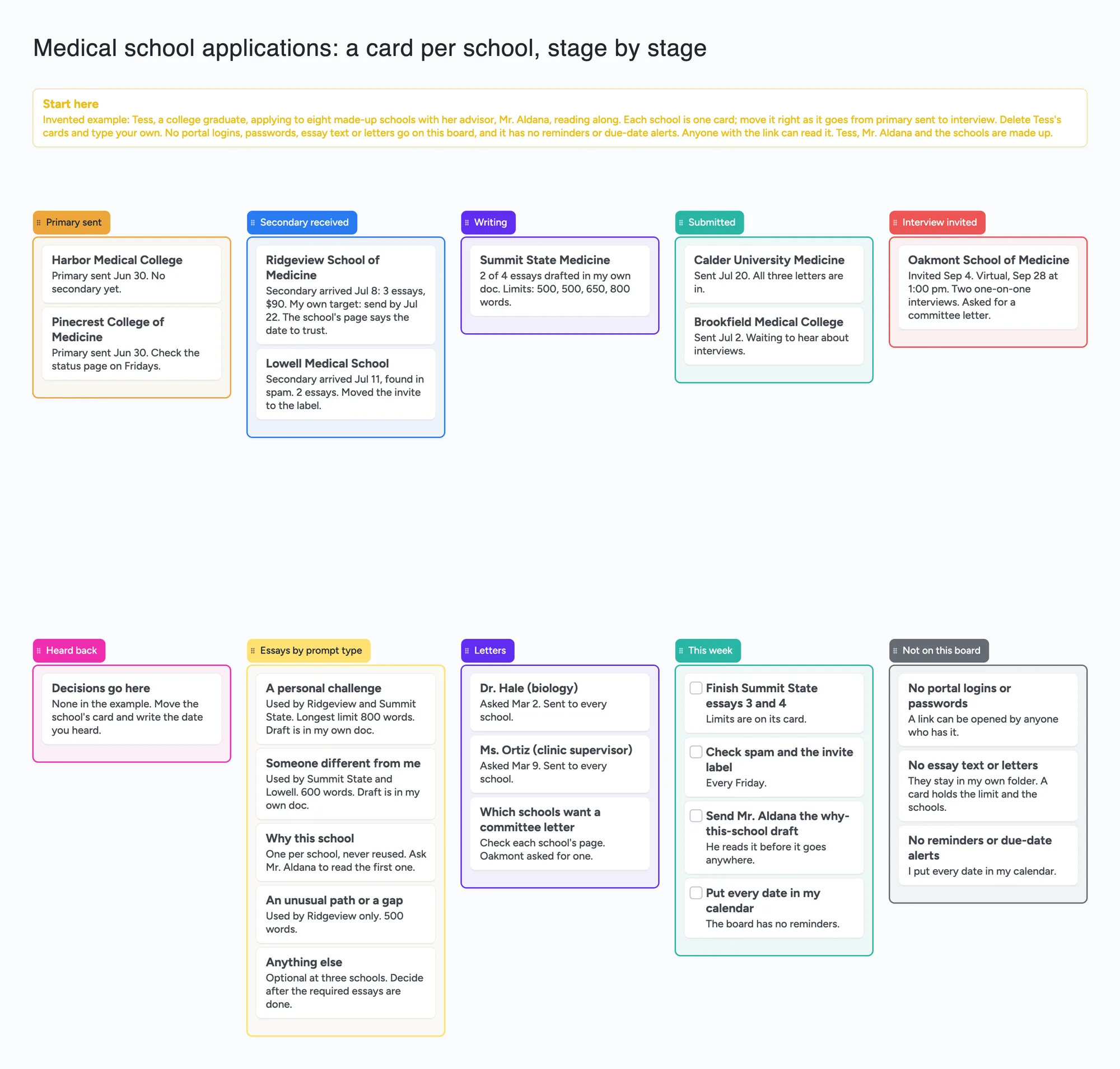
We make Instaboard, an online board. This page gives you a medical school application tracker laid out on it and filled in for an invented applicant, Tess, who has eight made-up schools and an advisor, Mr. Aldana, reading along. Each school is one card, and the lists are stages: primary sent, secondary received, writing, submitted, interview invited and heard back. Three more lists hold the reusable essays by prompt type, the recommenders and a weekly tick list. The board does not check any school's portal, it holds no logins, passwords, essay text or letters, and it has no reminders or due-date alerts. Tess, Mr. Aldana and the schools are made up.
Opens in your browser. Anyone can view; a free sign-in lets you edit.
Updated
Read this first: what the board does and doesn't do
- It does not check any portal for you. You open each school's status page and type what it says on that school's card. The date you checked goes on the card too.
- No essay text, letters, logins or passwords go on it. A secondary essay often asks about a personal challenge, and anyone with the link can read the board. Keep the writing in your own folder; the board holds the limit, the schools and who has read it.
- It has no reminders or due-date alerts. The weekly list has tick boxes only. Put every deadline in your calendar yourself.
- Each school's own page decides the dates, fees and what it asks for. The five pages we read are summarised below; the example cards are invented.
- What it is: one place where every school sits at its stage, so you can see what is waiting on you. The example uses 36 of your 150 free items.
- Free plan: 5 boards, 150 items, 3 pictures per board. Copying the board takes 1 of your 5 boards. Writing on it needs a free sign-in. New boards start with "Anyone who joins can view".
A card per school, moved right as it goes
The spreadsheets in the threads below are a table with a row per school (in r/premed 1d7z8iy, schools run down the first column). This board turns the table on its side: the lists are the stages, and a school's card is dragged from one list to the next. You see at a glance how many schools are waiting for you to write (the Secondary received and Writing lists) and how many are waiting for the school (Submitted).
- Primary sent. The school has your primary application and has not yet asked for more. Tess has two cards here.
- Secondary received. The school asked for a secondary. The card holds the date it arrived, the number of essays, the fee and the date you aim to send it by.
- Writing. You are drafting. The card holds how many essays are done and each word limit.
- Submitted. The secondary and the letters are in. The card holds the date you sent it.
- Interview invited. An invitation came. The card holds the date, whether it is virtual and the format.
- Heard back. Move a school's card here with the date you heard, so the earlier lists show only what is still open.
What five school pages say about the same cycle
We read five medical school admissions pages on November 24, 2026. A date is printed only where a page shows one; each school's own deadlines are in its row. Our reading: the stage names are the same, but the dates, fees and who gets a secondary are not.
| School page | Dates and fees it prints | Secondaries and interviews, in its words |
|---|---|---|
| Vanderbilt (page data: published and modified April 9, 2025) | National application data can be sent between May 31 and November 1 (the page gives May 30 in another place); the secondary application is due no later than November 15 | About two-thirds of applicants are offered a school-specific secondary, invitations go out as early as mid-July and the essay prompts are published in advance; about 600 are invited to a virtual interview on Zoom; the secondary fee is waived with a fee-assistance voucher; a committee letter with extra faculty letters meets its letter requirement |
| Michigan (no update date found) | Primary due September 15; secondary due October 15; secondary fee $95, waived for approved fee assistance and active-duty military | Its May timeline entry tells applicants to check its secondary essay prompts; it says to submit as soon as you get one and that you do not have to wait for your letters; interview notifications are rolling |
| Missouri (no update date found) | Primary due October 15, 2026; secondary and materials due November 15, 2026; secondary fee $85; early decision: August 1 and September 1, 2026 | In-state applicants who meet its minimums receive a secondary; out-of-state applicants first send a preliminary form; plans 400 interview slots, all virtual, at least two one-on-one interviews, interviews from October to early March for the regular route |
| Georgia (page data: published March 24, 2025, modified November 12, 2026) | Regular route: application due October 15 (September 1 strongly encouraged); all materials due November 15; interviews October 2026 to January 2027; decisions April 2027 | A secondary is required for applicants who meet a minimum GPA and a minimum test score; interviews are multiple mini interviews by video, six stations |
| Case Western Reserve (page prints "Updated June 3, 2026") | Secondary invitations are emailed the week of July 13 | Prompts are published in advance; you pick the MD programs after receiving the secondary and that choice decides which prompts show; one answer covers a prompt shared by programs; spaces count as characters |
Swipe the table sideways to see every column.
From the pages named, read November 24, 2026. Our wording, not theirs. Application-service and test names are left out on purpose.
Secondary materials, school by school
Three of the five pages above say the secondary prompts are published ahead or that the same answer can serve several programs. That is why the board has an Essays by prompt type list next to the stage lists: one card per kind of prompt (a personal challenge, someone different from you, why this school, an unusual path, anything else), with which schools use it and the longest limit. The drafts stay in your own folder.
In r/premed ("Is There a Better Way to Organize Secondaries?", OP u/epicpotato69, June 4, 2024), the OP makes a folder per school with its prompts in a Word document. u/pm-me-tardigrades describes a spreadsheet with schools down the first column and prompt categories across the top, writing the word count in each cell, so you can see which essays come up most; u/SpeakMed kept a master list with a heading per prompt type and pasted each finished essay under it; u/acar4aa kept one running document and says they should have done what the OP describes. Replies are single accounts, and these are the comments we read; all were read on November 24, 2026.
The Essays by prompt type list does the same job on a board, minus the cells and the pasted text: a card says which schools share a prompt and the longest limit.
Interview invitations on the board
The Interview invited list is where a school's card lands when an invitation arrives. The pages we read say the formats differ: Missouri's page lists at least two one-on-one interviews, Georgia's says multiple mini interviews, and Vanderbilt's and Missouri's say virtual. So Tess's Oakmont card holds the date, the time, the format and a note that the school asked for a committee letter. When the interview is done, the card moves to Heard back once the school answers.
Interview slots at one school run on a rolling basis (Michigan and Missouri both say so), so the date you submitted can matter. The board shows the date you submitted on each Submitted card; it does not tell you when a school will respond.
When a secondary is found late
In r/premed ("Found secondary email 30 days later :(", OP u/snowy-llama, August 2, 2026), the OP found a school's secondary invitation a month after it arrived and asks whether it is worth submitting and whether there is a way to keep track of everything coming in. Replies say the two weeks is not a hard rule: u/Neither_Captain2615 says that school does not have one, u/MChelonae calls it flexible and u/splattercat360 calls it a general recommendation. u/Background_Wafer5919 found a school's invitation in spam 12 days late. On tracking, u/splattercat360 also moved all secondary invites into one email label, and u/Kitchen-Diamond-2095 keeps a spreadsheet with the date each secondary was received and the date to submit by, and uses a separate email address only for medical school applications. Replies are single accounts, and these are the comments we read.
That is why Tess's Secondary received cards carry the date the email arrived and her own target date, and why her weekly list has a Friday check of spam and the invite label. The school's own page, not her target, says the date to trust.
What applicants say they use
In r/premed ("might be a dumb question, but how do you guys track all of your stuff for applications?", OP u/vain--, December 4, 2021), the OP is a freshman asking how people track hours and activities. u/orionnebula54 used Google Sheets with a list of schools and colour-coded status (working on it, submitted, interview, rejection); u/ihatefirealarmsbu uses Notion and shares a template; u/Alive-Tonight used Google Sheets with a column for the status-page URL and another for user names and passwords (we advise against passwords on a link-shared board). A few replies name sites: u/Alch1245 names MedAppTrack and u/unrulyradiance09 names mappd; we did not open either. These are single accounts, and these are the comments we read.
How much of the 150 it uses
Our arithmetic: the example is 10 lists, 25 cards and a title, 36 items. Eight of the cards are schools, so 28 items stay fixed. At one card per school, 8 schools make 36 and 122 schools would reach 150. If each school gets three cards (the school, its secondary notes and its interview notes), 40 schools make 148 and the 41st goes over. Someone who writes on your board adds the cards they type to their own 150. A copy takes 1 of your 5 free boards. Pro removes the item limit.
What a board can't do
- No status checks. The board never opens a school's portal. You type each status by hand.
- No logins, essays or letters. Do not put portal passwords or essay text on a board that anyone with the link can read.
- No reminders or due-date alerts. A card can carry a due date, but nothing alerts you. Use your calendar.
- No totals across lists. A list can be sorted or filtered on its own; nothing counts how many schools sit at each stage.
- No import from a school's portal or a spreadsheet. Every card is typed by hand.
- Ticks don't say who or when. Anyone with edit access can untick a box, and a copy keeps its ticks, so untick the weekly list before you reuse the board.
- A copy takes 1 of your 5 free boards, and the example uses none of the 3 pictures allowed per board.
Where other tools do this better
Read on November 24, 2026; pages change, so check them.
| Tool | What we read | Better for |
|---|---|---|
| A spreadsheet | Commenters in the r/premed threads above keep schools in a sheet with colour-coded status, prompt categories or the date a secondary arrived | Sorting and filtering many schools, counting words and comparing prompts side by side |
| A Notion template | One commenter in the 2021 thread says they use Notion and share a template; we did not open it | A database with a view per stage if you already work in Notion |
| A dedicated tracking site | Two commenters name MedAppTrack and mappd; we did not open either, and we found no page date | A tool built for the cycle, if you want one |
| Instaboard board | Free plan: 5 boards, 150 items, 3 pictures per board. Lists and cards you type, shared by link. No status checks, import, reminders or due-date alerts | Seeing every school at its stage in one place that an advisor can read and write on |
Swipe the table sideways to see every column.
From the threads named, read November 24, 2026. Our wording, not theirs.
Where these win
Use a spreadsheet when you want to count, sort or compare many schools, and your calendar for dates. Use this board when you want to see where every school stands, what is waiting on you, and have an advisor read along.
How to use it, in about twenty minutes
- Open the board and sign in free when it asks you to write. Delete Tess's cards and keep the lists.
- Make a card for each school and put it in the list that matches where it is now.
- Read each school's own page and write its deadlines and fee on its card, with the date you read it.
- Fill the Essays by prompt type list from the prompts the schools publish. Keep the drafts in your own folder.
- Fill the Letters list with who agreed, when you asked and which schools want a committee letter.
- When something changes, drag the card one list to the right and edit its date.
- Fill the weekly list and put every deadline in your calendar. Untick it each week.
- To share it, set Share to "Anyone who joins can edit" if an advisor should write. Each person who writes signs in for free. Keep logins, essay text and letters off it.
Start from the ready board
It opens in your browser in a few seconds, with nothing to install. Sign in for free when you want to save it and share it.
Questions
What should a medical school application tracker include?
For each school: where it is in the process (primary sent, secondary received, writing, submitted, interview invited, heard back), the dates you received and sent things, the fee and the interview details. Shared across schools: your essays by prompt type, who is writing your letters and a weekly list. On this board each school is a card that moves between stage lists.
Does the board check my application status?
No. It never opens a school's portal. You type each status and the date you checked it. It holds no logins.
Should I put my secondary essays on the board?
It is not meant for them. Secondary essays often ask about personal experiences, and anyone with the link can read the board. A card holds the word limit and which schools share the prompt; the drafts stay in your own folder.
Do all schools use the same dates?
No. In the five school pages we read, the last day for the primary ranged from September 15 to November 1 and secondary and materials dates from October 15 to November 15, and fees and who receives a secondary differ. Read each school's own page.
Can my advisor read it?
Yes. New boards start with "Anyone who joins can view", so anyone with the link can read it. Set it to "Anyone who joins can edit" if they should write; each person who writes signs in for free. Keep logins, essay text and letters off it.
Is Instaboard free?
Yes. The free plan includes 5 boards, 150 cards and items across your account (pen strokes, arrows and sections don't count), 3 images and 1 file per board, unlimited collaborators and video calls up to an hour. Pro is $5 a month billed yearly ($59.99 a year), or $7.99 monthly, and the people you invite join free.
Sources
- Vanderbilt University School of Medicine: MD admissions process (page data: published and modified April 9, 2025; read November 24, 2026)
- University of Michigan Medical School: MD admissions timeline (no update date found; read November 24, 2026)
- University of Missouri School of Medicine: medical school application process (no update date found; read November 24, 2026)
- University of Georgia School of Medicine: admissions process (page data: published March 24, 2025, modified November 12, 2026; read November 24, 2026)
- Case Western Reserve University School of Medicine: 2026-2027 secondary application questions (page prints "Updated June 3, 2026"; read November 24, 2026)
- r/premed: Is There a Better Way to Organize Secondaries? (OP u/epicpotato69, June 4, 2024; replies are single accounts; read November 24, 2026)
- r/premed: Found secondary email 30 days later (OP u/snowy-llama, August 2, 2026; replies are single accounts; read November 24, 2026)
- r/premed: how do you guys track all of your stuff for applications? (OP u/vain--, December 4, 2021; replies are single accounts; read November 24, 2026)