For the small team behind a church weekend away
A church retreat planning board for the team that books and runs the weekend
We make Instaboard, an online board. This page is for the few people who plan a church weekend retreat and need one place that says who books the center, who holds the speaker, and what happens at 9:00 on Saturday. The board is filled in for an invented retreat: Cedar Grove's adult weekend, about 36 people, Friday evening to Sunday noon at a rented retreat center, planned by Lois, Marcus, Anita, Joel and Ruth with Pastor Ellen. It holds the planning team, the purpose and theme, the two things to book first, meals and rooms, a typed Friday, Saturday and Sunday, a checkout list and notes for next year. It takes no registrations, holds no money and keeps no health, food or emergency details.
Opens in your browser. Anyone can view; a free sign-in lets you edit.
Updated
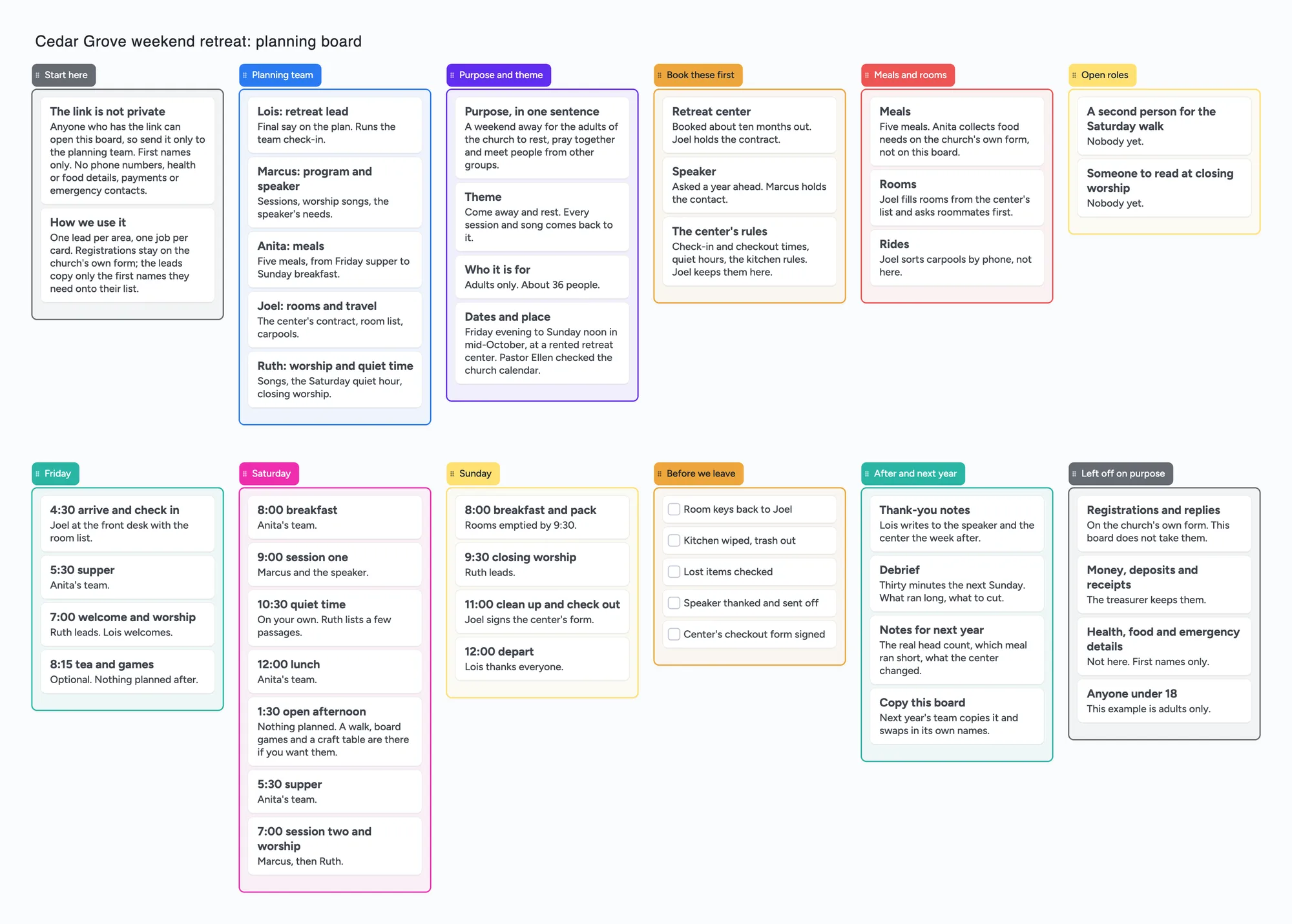
What the board holds and what your church keeps
- It holds a plan the team types. Leads, the two bookings, meals, rooms and the weekend's times are cards. Nothing takes registrations, assigns rooms for you, sends a reminder or tells a lead the speaker has not replied; the times are words in the card titles.
- Registrations and payments stay on your church's own form and books. The board has a last list that says so. Health, food and emergency details are left off on purpose, and the example is adults only.
- A link is not private. Anyone who has the link can open the board. New boards start as "Anyone who joins can view". Send it only to the planning team. To let the leads add or move cards, switch Share to "Anyone who joins can edit"; each person signs in free to write, and the board then counts as 1 of their 5 free boards.
- Free plan limits: 5 boards, 150 items across your account and 3 pictures per board. A copy of this board takes 1 of your 5. Pro removes the item limit and costs $5 a month billed yearly ($59.99 a year), or $7.99 monthly.
- Everyone with edit access can tick or untick any card. Agree who ticks the checkout list.
Who says to book what first
Two of the three sources below name something to book: one the place, one the place and the speaker. The third, an r/pastors thread, is about planning ministry events in general. Read November 25, 2026; each is one writer's view.
- Ministry Leadership Center's "Successful Retreat Planning 101" (a youth and camp guide) says you need to "BOOK a place for your retreat six to nine months in advance because retreat centers fill up". It names the place, not a speaker.
- Christina Fox's "Tips for Planning a Women's Ministry Retreat" (a PCA women's ministry blog post) says "There are two things you need to plan far in advance: the speaker and the retreat center", and that the later you start contacting speakers, the harder it is to find one.
- In r/pastors, "What do you to plan for ministry events?" (1u3chud, posted June 11, 2026 (UTC); Reddit shows 12 comments and we read 14 in an archived copy), an associate pastor at a church of 150 to 200 asked how others handle the weekly scramble to plan events; the thread is not about retreats. u/jugsmahone wrote "We lay out our plans for big events 3-6 months in advance", and u/beardtamer wrote that bigger events such as summer camps, VBS and major mission projects "are planned up to a year ahead of time".
So the board's fourth list is called "Book these first" and has three cards, putting both bookings first as our own choice, since Fox names both and the other two sources name only the place or only a time frame: the center (Joel holds the contract), the speaker (Marcus holds the contact) and the center's rules, which Joel keeps on the card so everyone reads the same check-in time. The example says about ten months out for the center and a year for the speaker. Ten months is longer than the youth guide's six to nine months for the center; that is the invented team's choice, not a rule.
Make your copy: five steps and the 150-item count
Each card and each list is 1 of the 150 free items across your account. The example is 60: 12 lists, 47 cards and the title. Arrows, sections and pen strokes don't count. Our arithmetic: 36 people in twin rooms are 18 rooms, so replacing the one Rooms card with a card per room makes 60 − 1 + 18 = 77 items, and adding a card for each of 9 carpool cars (36 people, 4 to a car) makes 86. Your other boards count toward the same 150.
- Write the purpose in one sentence and put the dates and place in the third list.
- Open the board and make your copy. "Make a copy" takes 1 of your 5 free boards; replace Lois, Marcus, Anita, Joel, Ruth, Pastor Ellen and the rest with your own people.
- Book the center and speaker first and write who holds each in the "Book these first" list.
- Type the weekend's times as card titles, with the lead's name in the line under each.
- Share the link with the leads only. To let them write, tick "Anyone who joins can edit" in Share; each signs in free to add or move cards.
A copy keeps its ticks, so untick the "Before we leave" list when next year's team copies the board. The board has no reminders or due-date alerts.
How much open time? The sources disagree
Whether to leave a Saturday afternoon empty is the question the example's schedule has to answer, and the places we read answer it differently. Two of the four (Ministry Leadership Center and r/youthministry) are about youth retreats, one is a women's retreat post and one is a venue's general guide; ours is adults only, so read them as views on retreat structure, not as a rule for grown-ups.
- Ministry Leadership Center says "Too much free time can lead to folks being left out and cliques doing their own thing", and that you can cancel a planned activity but will "have a hard time getting them to do a required activity that wasn't already planned".
- Christina Fox (women's retreat) says to "include empty space for women to connect with one another", with volunteers taking groups on a hike or to explore the local town.
- Refreshing Mountain, a retreat center that sells group stays, has a retreat schedule guide with the tip "Balance programmed sessions with open time to recharge and build community."
- r/youthministry, "First Year Ministry - Retreat Structure Advice" (1fzw146, u/cowbellion-de-rakin, posted October 9, 2024 (UTC); Reddit shows 5 comments and we read 6 in an archived copy): u/gt0163c wrote "Having all Saturday afternoon free sounds scary, but that's not a bad thing" and "Don't worry if the kids are bored." u/redarcher99 proposed a day with both structured free time and unstructured free time.
The example takes the middle: a 1:30 open afternoon with "Nothing planned. A walk, board games and a craft table are there if you want them", and a separate card for a second person to lead the Saturday walk. A team that agrees with the first source would fill the afternoon; the board is the same either way, and it is a plain card to drag.
Friday, Saturday and Sunday, typed
Refreshing Mountain's page prints a sample weekend that starts with group arrival and check-in at 7:00 PM on Friday and ends with departure at 11:15 AM on Sunday; it is the venue's own sample. The example here is its own: arrival at 4:30 Friday, supper 5:30, welcome and worship at 7:00, tea and games at 8:15 as an option, then Saturday breakfast, session one, quiet time, lunch, the open afternoon, supper and session two, and Sunday breakfast, closing worship, checkout and departure at noon.
- Friday (4 cards), Saturday (7 cards) and Sunday (4 cards): one card per block with the time in the title and the lead's name in the line under it. Anita's name is on the Friday and Saturday meals and Ruth's on the worship blocks she leads, so a lead sees their own times at a glance.
- The times are words. The board does not move them or warn a lead that lunch is running late. If session one runs over, drag the cards.
- The center's schedule wins. Refreshing Mountain's guide asks whether the plan "match[es] the retreat center's timing and rules"; the example's rules card is where Joel writes the real check-in, checkout and quiet-hour times.
Who holds what: the planning team and the rooms
Christina Fox's post puts it plainly: "Planning a retreat is a lot of work, don't try to do it all on your own", and it says to recruit a team, assign tasks by strengths and set a schedule of tasks a year, six months and three months ahead. Refreshing Mountain's guide says "the best course of action is to delegate" the schedule to someone who likes details.
- Planning team (5 cards): Lois (retreat lead), Marcus (program and speaker), Anita (meals), Joel (rooms and travel), Ruth (worship and quiet time).
- Purpose and theme (4 cards): one sentence for the purpose, the theme ("Come away and rest"), who it is for (adults only, about 36) and the dates and place. Ministry Leadership Center says "You MUST have a theme or focus" and a primary purpose; the example copies the habit, not the wording.
- Meals and rooms (3 cards): meals (food needs collected on the church's own form), rooms (Joel fills them from the center's list and asks roommates first) and rides (carpools sorted by phone). The board names the owner; the sensitive part stays off it.
- Open roles (2 cards): jobs nobody has yet, each saying "Nobody yet", so a lead can see a gap and write a name in once someone says yes.
What stays off the board, and where something else does the job better
- Registrations and replies. Kept on the church's own form. The board does not take them or count them.
- Money, deposits and receipts. Christina Fox's post says a retreat budget includes items such as speaker fees and expenses, center fees, food, activities, handouts, decorations and gifts (not a full list here), and suggests offering scholarships for women who need it. The example leaves all of that to the treasurer; a link-shared board is not where deposits go.
- Health, food and emergency details. Not on the board. Meals say that Anita collects food needs on the church's form, not here.
- Anyone under 18. The example is adults only. A retreat with children or teens needs your church's own safeguarding rules, and a link-shared board is not the place for names, ages or parents' details.
Other tools can do part of this better. In r/pastors 1u3chud, u/Least-Movie-4045 suggested "a simple shared Google Sheet with event name, date, owner, and status columns" for the staff's event calendar; this board is for one event and the sheet is for the year. If your church already runs its events in church-management software or an online form, registration, rooms and payments belong there, not here. Refreshing Mountain's page says its guide "Includes a Church Retreat Program Sample + Free Template"; we did not open that template, so we cannot say how it compares with this board.
Start from the ready board
It opens in your browser in a few seconds, with nothing to install. Sign in for free when you want to save it and share it.
Questions
Can the board take retreat registrations or payments?
No. It has no registration forms, replies, polls, payments or reminders. Keep registrations on your church's own form and money with the treasurer; the leads copy only the first names they need onto their list.
Is it safe to put people's names on it?
Anyone who has the link can open the board and see every card, so the example uses first names only and leaves off phone numbers, health and food details and emergency contacts. Send the link only to the planning team.
Do my team leads need an account to edit?
To write on the board, yes: they open the link and sign in free, and you tick "Anyone who joins can edit" in Share. The board then counts as 1 of their 5 free boards. Someone who only wants to read can open the link without signing in.
Can it hold a retreat with teenagers or children?
The example is adults only and has no children's names. A retreat with young people should follow your church's own safeguarding rules, and a link-shared board is not the place for their names, ages or parents' details.
How many cards fit on the free plan?
150 items across your account, where each card and each list is one item. This board is 60. With a card for each of 18 rooms in place of the one Rooms card it is 77, and with a card for each of 9 carpool cars as well it is 86 (both together). That is our arithmetic, and your other boards share the same 150.
How far ahead should we book?
The sources we read differ. One youth guide says to book the place six to nine months ahead because retreat centers fill up, a women's ministry post says the speaker and the center are the two things to plan far ahead, and one r/pastors commenter wrote that larger events are planned up to a year ahead. Your center's own booking rules decide.
Sources
- Ministry Leadership Center: Successful Retreat Planning 101 (a youth and camp guide; the page shows "(c) 2025" and no article date; read November 25, 2026)
- Christina Fox, PCA Christian Discipleship Ministries (women's ministry): Tips for Planning a Women's Ministry Retreat (the page shows "Copyright 2026" and no article date; read November 25, 2026)
- Refreshing Mountain Retreat and Adventure Center: Retreat Schedule Ideas & Examples (a retreat center that sells group stays; prints "Jan 20, 2026"; read November 25, 2026)
- r/pastors: "What do you to plan for ministry events?" by u/shibalnom93 (posted 2026-06-11 (UTC), 21:45Z; Reddit shows 12 comments, we read 14 in an archived copy, November 25, 2026)
- r/youthministry: "First Year Ministry - Retreat Structure Advice" by u/cowbellion-de-rakin (posted 2024-10-09 (UTC); Reddit shows 5 comments, we read 6 in an archived copy, November 25, 2026)