For a small team that keeps having good ideas and losing them
A kaizen board template: ideas from the floor, changes tried for two weeks and counted, and what the team keeps, on one shared board
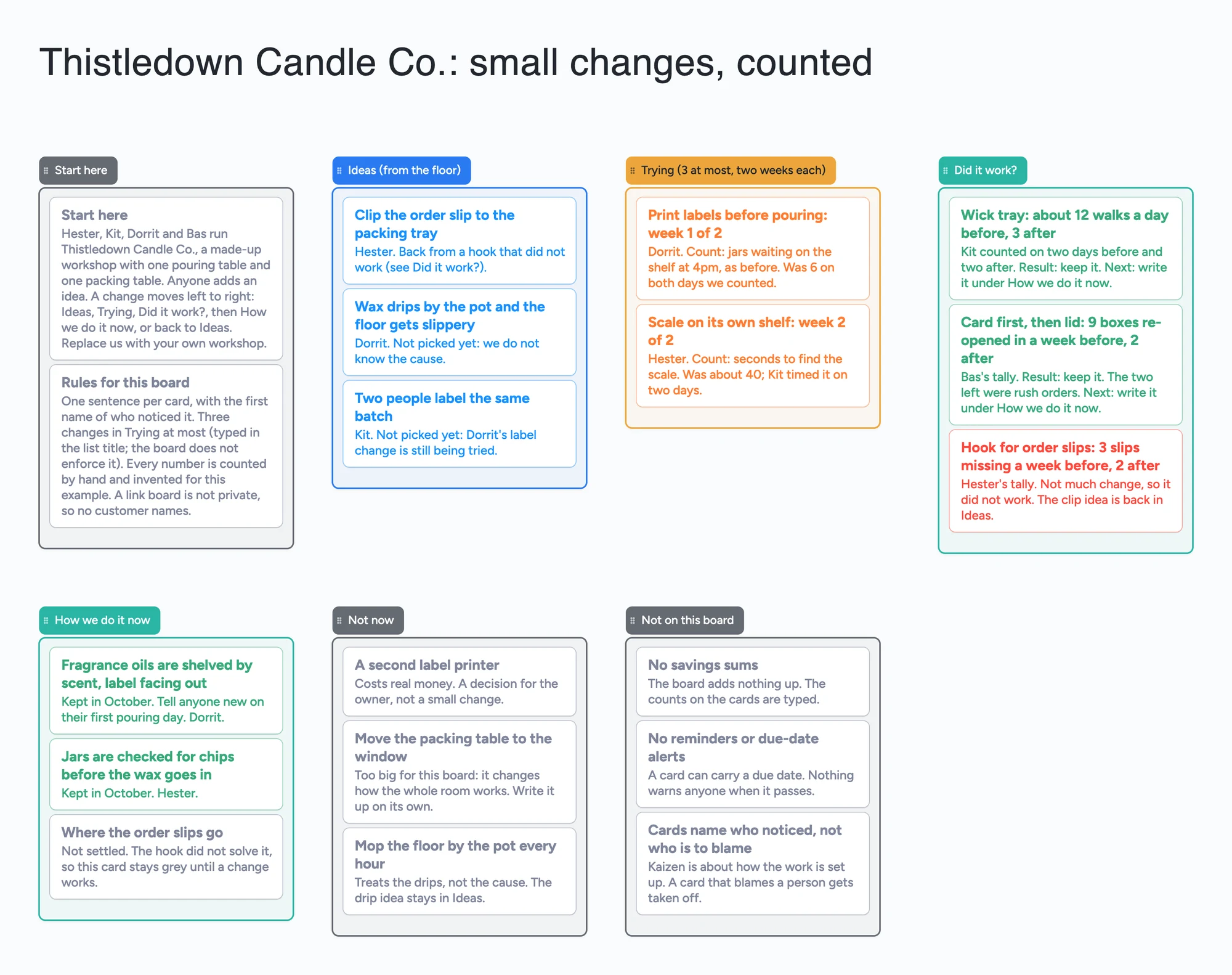
Small fixes get talked about and then lost. This is a kaizen board already laid out on Instaboard, our online board, filled in for an invented four-person workshop: Hester, Kit, Dorrit and Bas run Thistledown Candle Co., which has one pouring table and one packing table. The board has seven lists and 19 cards: two cards that explain it, three ideas, two changes being tried, three results, three cards on how the team works now, three ideas left for later and three cards on what the board does not do. The honest picture comes first. A kaizen board keeps track of changes; it doesn't find them, count them or remind anyone. Every count on the cards was typed by a person, and every number is invented.
Opens in your browser. Anyone can view; a free sign-in lets you edit.
Updated
The short answer
- What it is: a shared page where a small team puts its improvement ideas, picks a few to try, writes down a count before and after, and records what it keeps. Each change is one card that moves left to right. The example uses 27 of your 150 free items.
- What it is not: a tracker that does any of the work. Nothing adds up for you, there are no reminders or due-date alerts, and nothing stops a fourth change going into the Trying list; the limit of three is typed in the list's title.
- Where other tools win: an Excel or Notion template gives every idea its own columns, and the Notion one adds formulas and flags; a community template on Miro runs a facilitated kaizen event with votes; KaiNexus's blog post says a good board sends notifications and alerts, which ours doesn't. All four are in a table below.
- Where this board may help: our view: a small team that already talks about small fixes and keeps losing track of which ones were tried and what they showed.
- Keep off it: real customer names, a card that blames a person, and anything that needs a formal record, such as a safety incident. The example is invented. A link board is not private.
Is a kaizen board just a kanban board?
The Cleveland State University open textbook "Applying Lean Six Sigma for Operational Excellence" (Michael D. Okrent, Sc.D.), in its chapter 5, calls a kaizen board "a type of Kanban Board used to manage and visualize continuous improvement activities" and says its focus is "identifying, tracking, and implementing improvements to processes, systems, or products". AgileFever's article, which prints January 9, 2025 and "Last reviewed: October 2026", says the boards "bear visual similarities" but that a kanban board manages work items and workflow stages while a kaizen board "tracks ongoing improvement initiatives and monitors their progress". AgileFever sells training courses, so we read it as the article of a training vendor.
The textbook lists common columns for a kaizen board as Ideas/Opportunities, To Do, In Progress and Completed, with a Results column for what each change did, and gives a plant tracking suggestions for machine efficiency as its example. ProjectManager's page describes stages such as "review, approval, implementation and completion".
Thistledown's board follows the same idea in four stages and one parking list: Ideas, Trying, Did it work? and How we do it now, plus Not now. The two we added on purpose are Did it work?, where a card has to say what was counted before and after, and Not now, where a turned-down idea keeps its reason. That is our design, not a rule from the pages we read.
Four other ways to run one, read November 25, 2026
"Not listed" means not on the page we read, not that the tool lacks it. No ranking: they suit different teams.
| Page | What it says | Better than a board at | Where a board fits |
|---|---|---|---|
| ProjectManager's Excel template (page by Brenna Schwartz, Jun 3, 2026) | Offers a "free Excel kaizen board template" with fields for improvement opportunities, problem descriptions, proposed solutions, ownership, department, submission dates, priority levels, expected benefits and status updates; the page also promotes ProjectManager's software and a free 30-day trial | A column for every field, including priority and expected benefit | Ideas read as cards by stage, with one link for the whole team |
| Notion marketplace: Kaizen Board & Continuous Improvement Tracker by NorthPage (listing shows "Last updated 8 days ago", a relative date read November 25) | $29.00, and the listing says to purchase through Etsy; five connected databases; ideas move Submitted, Reviewed, Approved, In progress, Done, Standardized; a quick-win formula sorts ideas by impact and effort; savings become an annual figure from each area's labour rate; "Overdue reviews and late ideas are flagged"; "A Notion account is required"; says assigning an owner doesn't send a notification | Formulas, flags and savings figures | Nothing to buy and no formulas to keep up; counts are typed |
| Miro: Kaizen template, a community template by Ed Adams on Miro's site (no date printed; shows 6.5K views, 685 uses, 70 likes) | "over twenty ready-to-use templates" in sequential order for a team kaizen, with virtual sticky notes and votes, worked through Bruce Hamilton's toast example; plan limits not listed on that page | A facilitated kaizen event with stickies and votes | The list of small changes that carries on between events |
| KaiNexus blog post (Feb 24, 2017; vendor of improvement software) | Says an effective board assigns ownership, plans action, tracks progress, reports results and sends notifications and alerts; we did not read KaiNexus's product or pricing pages | Notifications and alerts, per the post | A shared page with nothing to set up beyond the board |
Swipe the table sideways to see every column.
From each page as read November 25, 2026. ProjectManager, NorthPage on Notion and KaiNexus are vendor pages; the Miro one is a community template on Miro's site. Instaboard isn't affiliated with any of them. KAIZEN is a trademark of the Kaizen Foundation, which is not affiliated with and does not endorse this page.
Thistledown Candle Co., list by list
- Start here (2 cards). Who the four people are, and the rules: one sentence per card with the first name of whoever noticed it, three changes in Trying at most, every number counted by hand.
- Ideas from the floor (3 cards). "Clip the order slip to the packing tray" is Hester's, back here after a hook did not work; "Wax drips by the pot and the floor gets slippery" is Dorrit's and is parked because nobody knows the cause; "Two people label the same batch" is Kit's and waits while Dorrit's label change is tried.
- Trying, 3 at most, two weeks each (2 cards). "Print labels before pouring" (Dorrit) is in week 1 of 2, counting the jars waiting on the shelf at 4pm, which was 6 on both days counted before. "Scale on its own shelf" (Hester) is in week 2 of 2, counting the seconds to find the scale, about 40 before, timed by Kit on two days.
- Did it work? (3 cards). The wick tray cut walks from about 12 a day to 3 (Kit counted on two days before and two after). Putting the card in before the lid cut boxes re-opened from 9 in a week to 2 (Bas's tally; the two left were rush orders). The order-slip hook went from 3 slips missing a week to 2, which the card calls not much change.
- How we do it now (3 cards). Fragrance oils shelved by scent with the label facing out (kept in October, Dorrit); jars checked for chips before the wax goes in (kept in October, Hester); and a grey card, "Where the order slips go", which says it is not settled and stays grey until a change works.
- Not now (3 cards). A second label printer (costs real money, an owner's decision), moving the packing table to the window (too big for this board) and mopping the floor by the pot every hour (treats the drips, not the cause).
- Not on this board (3 cards). No savings sums, no reminders or due-date alerts, and cards that name who noticed an idea, not who is to blame.
The two changes in Did it work? marked "keep" say what comes next: write them under How we do it now. Until someone moves them, the board still shows them in Did it work?.
One change from idea to routine: the wick tray
The board shows each card where it is now, so here is the wick tray's path in words, as our telling of the example. Kit put the wick tray idea in Ideas and the team picked it. In Trying the card said what would be counted: walks a day, on two ordinary days. The count was about 12 a day before the tray and 3 after, on two days each. The card now sits in Did it work? with a line saying to write it under How we do it now.
The Cleveland State textbook describes the PDCA cycle (Plan, Do, Check, Act) as a four-step iterative process for continuous improvement. The lists fit it: Ideas and the choosing of a card are Plan, Trying is Do, Did it work? is Check, and How we do it now or back to Ideas is Act. That mapping is ours; the textbook doesn't mention a board like this. AgileFever, writing about IT delivery, says to review cycle time and aging work each week, pick the single biggest bottleneck, change one thing and measure again.
The order-slip hook is the useful card. Hester hung a hook, and a week later the count of missing slips had gone from 3 to 2, which is not much. The card says it did not work, the idea went back to Ideas as a clip, and the matching card under How we do it now stays grey and says nothing is settled. A board that showed only what worked would lose that.
Why a kaizen board stalls, and what this one does about it
KaiNexus, which sells improvement software, posted "The World's Saddest Kaizen Board?" on Feb 24, 2017, written by Maggie Millard. It describes a photo of a board in a hospital emergency department hallway, taken on January 27, 2017, with a date on the board of April 20, 2016. The post says the board seems temporary, appears neglected, has vague headers such as "Comments" and "Concerns", and "doesn't assign ownership, provide for a plan of action, track progress or report results". It then says an effective board "does all of this and ensures that progress is maintained with notifications and alerts". Read it as a vendor's view. Our answers, which are our view and not KaiNexus's:
- Looks neglected. A link board can be neglected too. The only sign on ours is a Trying card that says "week 2 of 2"; someone has to look.
- Vague headers. The lists are named for a stage, and the cards in Trying and Did it work? carry a count.
- Ownership, plan, progress, results. A first name on the card says who noticed the idea (the board has no owner field), the plan is the count written down before the try starts, progress is which list the card is in, and the result is the card in Did it work?.
- Notifications and alerts. None. The board doesn't nudge anyone, so a team that needs that should use a tool that does.
Start yours in seven steps
- Open the board and rewrite Start here with your own team and your own rules, so it is never half a candle workshop.
- Delete our ideas and keep the lists. Rename any list that doesn't fit how you work.
- Let ideas collect for a week. One sentence per card, the first name of whoever noticed it.
- Pick as many as your Trying list allows, and write on each card what you will count and how often before you start, with the "before" number.
- After the two weeks, write the "after" number and move the card to Did it work? with a one-line result.
- Move a kept change to How we do it now, or send a failed one back to Ideas with what you learned.
- Share it. Set the share setting so anyone who joins can edit ("Anyone who joins can edit"); new boards start view-only, and each person signs in to write.
How many ideas fit, and what the free plan limits
Each card and each list is 1 of your 150 free items, across all your boards, and the title text box counts too. Arrows, sections and pen strokes don't. Moving a card from one list to another adds nothing. Our arithmetic:
- As built: 7 lists + 19 cards + the title = 27, which leaves 123.
- Three new ideas a week, nothing deleted: 27 + 3 x 41 weeks = 150 in week 41. A team that clears Not now every quarter lasts longer.
- Four people each adding one idea a week: passes 150 in week 31 (27 + 4 x 31 = 151).
- Copies: two copies of the example as built are 2 x 27 = 54. A copy takes 1 of your 5 free boards.
Pro removes the item limit: $5 a month billed yearly ($59.99 a year), or $7.99 monthly.
Limits of the free plan for this board:
- Boards. 5 on the free plan. "Make a copy" takes 1 of them.
- Pictures. 3 per board. The example has none, so a photo of a fixed workstation is a card of words.
- Writing needs a free sign-in. Anyone who joins can view the board; to change it they sign in, and the board then counts as 1 of their 5.
- No reminders or due-date alerts, no sums, no progress meter.
- Private details. A link board is not the place for customer names or incident records; invite-only boards are a Pro feature.
KAIZEN is a trademark of the Kaizen Foundation, which is not affiliated with and does not endorse this page.
Start from the ready board
It opens in your browser in a few seconds, with nothing to install. Sign in for free when you want to save it and share it.
Questions
What is a kaizen board?
A board a team uses to collect improvement ideas, follow the ones it tries and see what happened. ProjectManager's page calls it a visual management tool used to "identify, prioritize, track and implement continuous improvement ideas", and the Cleveland State textbook calls it a type of kanban board for continuous improvement activities.
Is a kaizen board a kanban board?
They look alike. AgileFever's article says a kanban board manages work items and workflow stages while a kaizen board tracks improvement initiatives and monitors their progress, and the Cleveland State textbook calls the kaizen board a type of kanban board. Ours is made of lists and cards, so it looks like either.
Does the board add up savings or remind anyone?
No. It adds nothing up, so every count on a card is typed by a person, and there are no reminders or due-date alerts. A card can carry a due date, but nothing warns anyone when it passes. The Notion listing in the table describes formulas and flags if you want them.
How many changes should be in Trying at once?
The example uses three, typed in the list's title; the board doesn't enforce it. For work-in-progress limits on a kanban phase, the Cleveland State textbook gives a common starting point of slightly fewer than the people working in that phase. Thistledown has four people, so three. That is our borrowing: the textbook's section is about kanban boards, and its closing line says "Kaizen Board" once.
Who can add an idea?
Anyone you share the link with can read the board. To add a card they sign in for free, and if the share setting is "Anyone who joins can edit" they can edit. A board opened from your link counts as 1 of their 5 free boards. Our view: if some of your team won't sign in, keep a paper box for ideas beside the board.
Should a card say who made the mistake?
Our view: no. The example uses a first name for who noticed an idea, never for who caused the problem, and its last card says a card that blames a person gets taken off. A link board is not private, so keep customer names and anything that needs a formal record off it.
Sources
- Michael D. Okrent, Sc.D.: Applying Lean Six Sigma for Operational Excellence, chapter 5, Kaizen Philosophy and Tools for Continuous Improvement (MSL Academic Endeavors, imprint of Cleveland State University, Michael Schwartz Library; licensed CC BY-NC-SA 4.0; read November 25, 2026; open textbook)
- AgileFever: Kanban vs Kaizen: A Comprehensive Analysis for Process Improvement (January 9, 2025; Last reviewed: October 2026; read in full November 25, 2026; training vendor)
- ProjectManager: Kaizen Board: Quick Guide with Example & Free Template (by Brenna Schwartz, Jun 3, 2026; read in full November 25, 2026; vendor content)
- KaiNexus: The World's Saddest Kaizen Board? (Maggie Millard, Feb 24, 2017; read in full November 25, 2026; vendor content)
- Notion Marketplace: Kaizen Board & Continuous Improvement Tracker by NorthPage (listing shows "Last updated 8 days ago", a relative date, on the day read; says to purchase through Etsy; read in full November 25, 2026; vendor listing)
- Miro: Kaizen Template by Ed Adams (community template by Ed Adams on Miro; no date printed; read November 25, 2026)
- Kaizen Institute: terms of use, Trademarks section (read in a browser November 25, 2026; read for the trademark owner only; nothing copied)
- Kaizen Institute: home page (read November 25, 2026; it shows "KAIZEN™ Culture" in its menu, nothing else used)