For medical students planning a Step 1 dedicated study period, alone or with a partner
A USMLE Step 1 study plan you can copy and edit as one board
We make Instaboard, an online board. This page gives you a Step 1 study plan already laid out on it and filled in for two invented medical students, Dev and Sana, who share it. It has an eight-week dedicated period, a tick-list of the exam's systems, a wrong-answer log you type by hand, practice-exam notes, a tick-box week, exam logistics and questions for an advisor. Most people who search for a Step 1 study plan want a PDF or a plan for a set number of months, and this is neither of those: it does not build the weeks for you, send reminders or due-date alerts, give you questions or count scores. Dates on it are typed from your registration emails. It is a study aid, not medical or clinical advice, and Dev, Sana and their numbers are made up. USMLE® is a joint program of the Federation of State Medical Boards (FSMB) and the National Board of Medical Examiners (NBME), which are not affiliated with and do not endorse this page.
Opens in your browser. Anyone can view; a free sign-in lets you edit.
Updated
Read this first: what the board does and doesn't do
- If you want a file, use a file. Searches for a Step 1 study plan mostly ask for a PDF or a plan for a set number of months. A prep company publishes an 8-week schedule and a school's slides show a method (see the table below). This board has no generator: you type every week and every date.
- No reminders or due-date alerts, no auto-built plan. The board does not know your test date. Nothing warns you about it, and nothing rearranges your weeks when you fall behind.
- No questions, no scores, no prediction. The wrong-answer log and the practice-exam notes hold what you type. The board does not count, grade or predict anything. Use a question bank and the practice exams your school or the exam owners provide for that.
- What it is: one screen where you and a study partner can both read and write the plan, the systems list, the log and the week's tick boxes. The example uses 48 of your 150 free items.
- A study aid, not medical or clinical advice. Nothing on the board is clinical guidance. Free plan: 5 boards, 150 items, 3 pictures per board. Copying the board takes 1 of your 5 boards. Writing on it needs a free sign-in. New boards start with "Anyone who joins can view". If you are under 18, check with a parent or your school before you put anything on a shared board.
What the exam is, as its own pages describe it
The USMLE Step 1 page (usmle.org; shows no date, read in full November 25, 2026) says Step 1 is a one-day exam divided into fourteen 30-minute blocks in one 8-hour testing session, with no more than 20 questions in a block, a minimum of 55 minutes of break time and a 5-minute optional tutorial. It says break time can grow if you finish a block or the tutorial early, and that Step 1 is given at Prometric test centers.
One school's slides disagree on the shape. A Tulane School of Medicine learning-specialist slide deck titled "Dedicated Study Plan - Step 1, Class of 2026" (page shows no date, read November 25, 2026) describes 280 questions in 7 blocks of 60 minutes, with 40 or fewer questions a block and 45-60 minutes of break. The slides link to the exam's own page. The two differ, and we don't say why. Check the Bulletin of Information, which the exam's pages say you must read before you apply, and not a board or a slide deck. The block sizes in Dev and Sana's plan (a practice block of 40 questions) are their own choice for practice, not the exam's.
What pass/fail changes for a plan
The exam's scoring page (usmle.org; shows no date, read in full November 25, 2026) says Step 1 results are reported as pass/fail only, for exams taken on or after January 26, 2022. It says results are typically available within four weeks of the test date and that you should allow at least eight weeks to be notified, and that the score report stays on the website of the organization that registered you for about 365 days.
- No score card on the board. The Practice exams list has a note on the weakest systems, not a target number, and the page does not repeat any passing standard or predict an outcome.
- The after-the-exam card holds your school's rules for results, since schools vary, plus the timing the scoring page gives.
- What to type, then: which systems each practice exam showed as weak and which misses recur, not a number to chase.
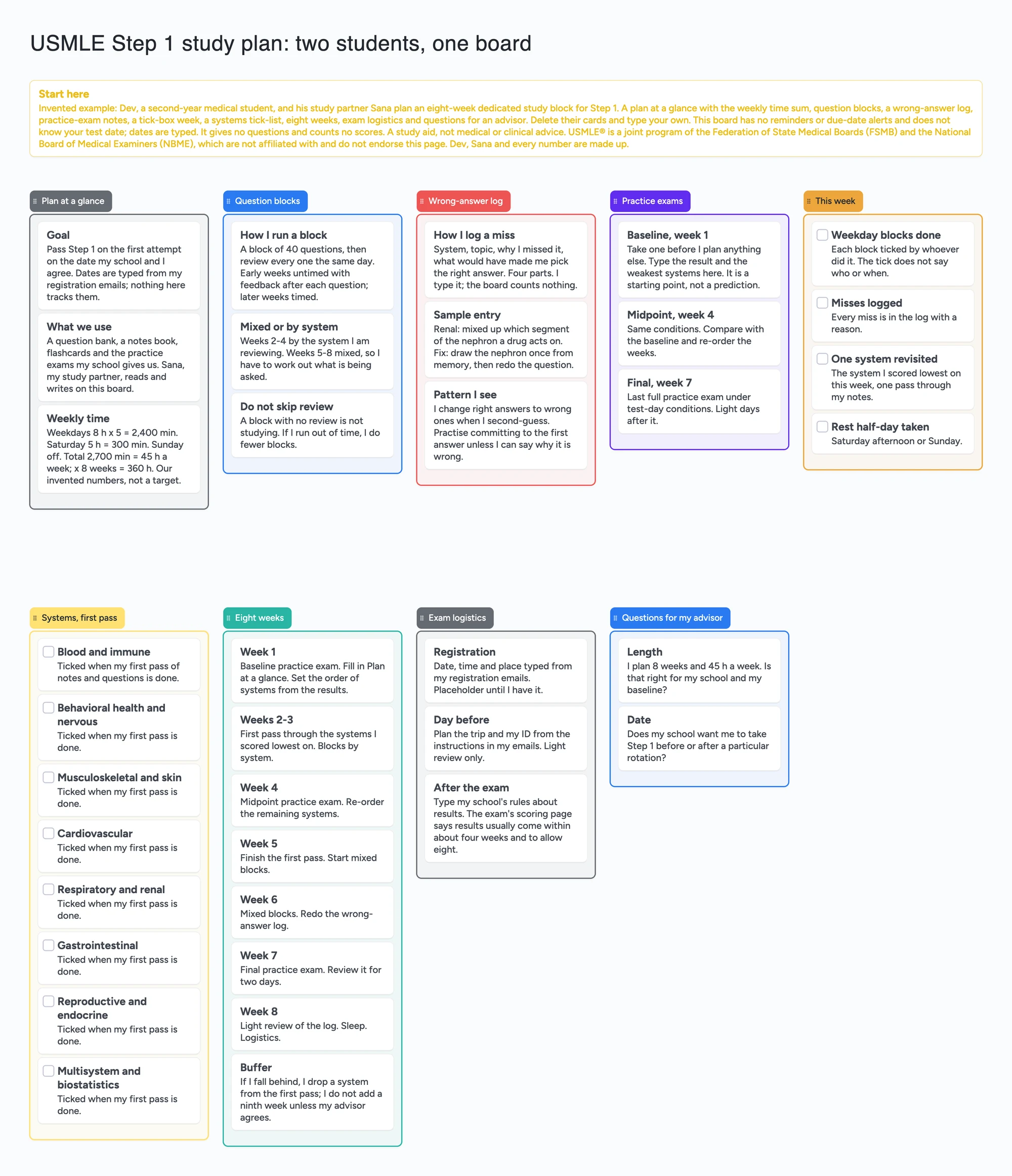
Dev and Sana, list by list
Dev and Sana are invented. Every number on their board is made up, including the 45 hours a week, and none of it is a benchmark. Read it left to right, top row then bottom row.
- Plan at a glance. The goal, what they use (a question bank, a notes book, flashcards and the practice exams their school gives them) and a weekly time budget with the sum shown: five weekdays of 8 hours is 2,400 minutes, plus 300 on Saturday is 2,700 minutes, or 45 hours; eight weeks of that is 360 hours.
- Question blocks. How Dev runs a block of 40 questions, review the same day, and when he switches from blocks by system to mixed blocks.
- Wrong-answer log. How to log a miss, a sample entry and a pattern card. They type it; the board counts nothing.
- Practice exams. Three cards: a baseline in week 1, a midpoint in week 4 and a last one in week 7. Each holds a note, not a target number.
- This week. Four tick-box cards: blocks done, misses logged, one system revisited and a rest half-day. The tick does not say who or when.
- Systems, first pass. Eight tick-box cards, one per group of systems.
- Eight weeks. One card per stretch, plus a Buffer card that says what to drop when you fall behind.
- Exam logistics. Dates and rules copied from registration emails, a day-before card and an after-the-exam card.
- Questions for my advisor. Length and date, as cards the advisor can answer on the card.
Why the tick-list goes by system
The exam's content page (usmle.org; shows no date, read in full November 25, 2026) says questions are built from an outline that sorts content by organ system, and that foundational science is spread through the systems by disease process. It lists eleven groupings, from human development to biostatistics and social sciences, each with a percentage range. It says percentages are subject to change at any time, and describes the outline as a structure for building the test, not as a curriculum or a study guide. We copy none of its tables.
The board's Systems list has eight cards that combine and shorten those groupings in our own words; they are our grouping, not the exam owners' list. Human Development and the social-sciences grouping have no card of their own, and biostatistics sits with Multisystem. The point of a tick-list is simple: you can see at a glance which systems have had a first pass and which have not, and your study partner sees it too. It does not weight the systems or tell you which to do first. That comes from your own practice-exam results.
The same page lists disciplines as well, and says Step 1 items are built to be integrative, so many are classified to more than one discipline and the totals add to more than 100%. That is why the board has no list per subject: a miss goes in the log with its system and topic, and you can see the pattern there.
The wrong-answer log: the card that does the work
Tulane's slides put the weight on wrong answers: process them to pull out what would have let you choose correctly, and review those notes daily. On the board it is one list: how to log a miss, a sample entry and a pattern card.
- A miss, in four parts: the system, the topic, why you missed it, what would have made you pick the right answer. Dev's sample: "Renal: mixed up which segment of the nephron a drug acts on. Fix: draw the nephron once from memory, then redo the question." It is an invented example, not a study note to learn from.
- A pattern card: after a few weeks Dev sees that he changes right answers to wrong ones when he second-guesses, and writes a rule for himself.
- What a spreadsheet does better: it can count your misses by system and sort the whole log at once. The board has no totals, and its Sort and Filter work on one list at a time, so if you want counts, keep the log in a sheet.
The eight weeks, and what two plans say about them
The eight weeks on the board are Dev's invention. Two published plans we read lay a dedicated period out in a similar shape, and each is a single view.
- MedSchoolBro (a company that promotes its own Step 1 Bundle; page dated June 18, 2026; read in full November 25, 2026) publishes an 8-week schedule: content first in weeks 1-2, heavy question practice in weeks 3-5 with a first practice exam in week 4, a reset around weak systems in week 6, two more practice exams in week 7 and consolidation, not cramming, in week 8. It says most students aim for 8-10 hours of focused study a day and to set the exam date before day 1. Its post says 8 weeks is enough for most students who kept reasonable retention and suggests 10-12 weeks for those further from their target.
- Tulane's slides (a medical school's learning specialists; read November 25, 2026) tell students to block the exam date, life events, buffer days, rest (two half-days or one full day a week) and practice-exam days with time to review the misses, and to start with questions by system and move toward mixed ones. The same deck says to process wrong answers to pull out what you need rather than review everything.
Dev's Eight weeks list uses the same bones (baseline, midpoint and final practice exams; by-system blocks then mixed blocks; a rest half-day; a buffer). It is one invented plan, and it does not say that eight weeks is right for you. Your school's own dedicated-period rules come first.
How long: what students on r/step1 say
This page does not tell you how many weeks to study. Three r/step1 threads show how far apart people are. Each reply is one person's account, not research. We read each post and the comments listed in its source line.
- r/step1 "6 week dedicated" (OP u/Ladyjetfuel, December 12, 2023; 8 comments, 6 read): the OP has about six weeks after a school assessment and asks how to study in a shorter time. u/Free_Calligrapher283, who says they took Step 1 pass/fail with six weeks of dedicated study, suggests topic areas by day and a weekly practice test to get used to the speed and detail. u/Hisokax513 says you can delay your first rotation if you need a few more weeks and that schools don't always say so; the OP replies that their school spelled out what happens: students from the year above who did not pass are now in their class.
- r/step1 "IMGs: how long should prep time for step 1 be?" (OP u/vesperiaeveningstar, January 7, 2024; 20 comments, 17 read): u/ykawai says it is subjective and would say a minimum of six months; u/Plastic_Grand6185 says 3 months; u/Nice_Falcon_7379 says it can be three months or nine and to start and book when practice results and comfort say you are ready; u/madecausebored suggests a self-assessment practice exam to gauge readiness and says some schools require passing one before you can book.
- r/step1 "Can I study in 4 weeks?" (OP u/tswiftmd, March 17, 2024; 44 comments, 25 read): u/hapoo91 says take a practice exam first to see your baseline before anyone can guide you; u/chemicallycozy had six weeks and says they probably used only three or four of them, and says to start questions rather than finish all review first.
What these show is that people with similar plans give different lengths, and that several say to get a baseline first. They do not show that any number of weeks works for you. The board's Practice exams list is where the baseline goes.
How much of the free plan does an eight-week plan use?
Each card and each list is 1 of your 150 free items, across all your boards. The title text box counts too. Arrows, sections and pen strokes don't. Our arithmetic from the example, counted as if one account made everything:
- As built: 9 lists + 38 cards + 1 title = 48 items.
- Eight weeks of use: four new wrong-answer cards a week is 32 more, so 48 + 32 = 80.
- A second plan on a copy (for example a retake): another 48, so 96. Three plans in all come to 144 and four to 192, which is over 150. Each copy takes 1 of your 5 boards.
- Past 150: Pro removes the item limit.
Where the exam's pages, a school or a spreadsheet do this better
Read on November 25, 2026; pages change, so check them. A date is printed only where the page shows one.
| Resource | What the page says | Better for |
|---|---|---|
| USMLE Step 1 pages on usmle.org (no date) | Exam shape and timing, the content outline by system and discipline, the scoring and results timing, and a link to the Bulletin of Information | What the exam is, how it is scored and reported, and the rules you agree to |
| USMLE Bulletin of Information (landing page only; it rendered in part) | Says you must review the Bulletin before you complete your application, and offers a checklist. We did not read the Bulletin itself | Eligibility, registering, scheduling and the rules |
| Tulane School of Medicine, Dedicated Study Plan - Step 1 (slides, no date) | Scheduling around the exam date, rest and buffer days, practice exams and how to work through wrong answers. Its block count differs from the exam's page | A school's own method for its students, with one-to-one help |
| MedSchoolBro 8-week schedule (June 18, 2026) | Week-by-week outline with practice exams in weeks 4 and 7, a daily timetable and an FAQ; the company promotes its own study products | A finished week-by-week plan you follow as written |
| A school's own dedicated-period plan or an advisor | Not read for this page | Rules for your school: how long, when, and what happens if you delay |
| A spreadsheet | Not read for this page | A log you can count and sort as a whole, with sums that calculate themselves |
| Instaboard board | Free: 5 boards, 150 items, 3 pictures per board. Lists per purpose and per week, cards you type, shared by link. No generator, reminders or scoring | Your plan, systems, misses and week on one screen that a study partner can read and write on |
Swipe the table sideways to see every column.
From each page, read November 25, 2026: usmle.org, medicine.tulane.edu, medschoolbro.com. Our wording, not theirs.
Where these win
Use the exam's pages for what the exam is and how you register, your school for its rules and its method, a finished schedule when you want the weeks laid out for you, and a spreadsheet when you want to count your misses. Use this board when you want your plan, your systems list and your week where a study partner can see them.
What a board can't do
- No reminders or due-date alerts. It does not know your test date, and nothing warns you about it.
- No generated plan. It does not turn a date and a number of weeks into days. You type the weeks.
- No questions, no grading, no scores, no prediction. The log and the practice-exam notes are text you type.
- No totals or counts. The weekly time sum on the first card is typed and checked by you. Sort and Filter work on one list at a time, not across the board.
- Ticks don't say who or when. Anyone with edit access can untick a box, and a copy keeps its ticks, so untick the twelve tick-box cards before you reuse the board.
- Not private by default. New boards start with "Anyone who joins can view". Anyone you give the link to can read it. Put no personal details, ID numbers, score reports or patient information on it.
- A copy takes 1 of your 5 free boards, and the example uses none of the 3 pictures allowed per board.
How to use it, in about fifteen minutes
- Open the board and sign in free when it asks you to write. Delete Dev and Sana's cards and keep the lists.
- Fill in Plan at a glance: your goal, what you will use and your weekly minutes with the sum shown.
- Rename or reorder the weeks to fit your school's dedicated period. Move a week card by dragging it.
- Take a baseline practice exam, then type the weakest systems on its card and tick nothing yet on the Systems list.
- After each block of questions, put every miss on the log with its four parts.
- Once a week, go down the four tick-box cards, then untick them.
- Copy dates and rules into Exam logistics only from your registration emails and the Bulletin.
- To share it with a partner, set Share to "Anyone who joins can edit" if they should write. Each person who writes signs in for free. Keep personal details off it.
A note on the exam's name
USMLE® is a joint program of the Federation of State Medical Boards (FSMB) and the National Board of Medical Examiners (NBME), which are not affiliated with and do not endorse this page. We copy no text, tables or images from the exam's pages and describe their facts in our own words, with the page and the day we read it.
Start from the ready board
It opens in your browser in a few seconds, with nothing to install. Sign in for free when you want to save it and share it.
Questions
How many weeks should a Step 1 dedicated study period be?
This page does not say. The sources we read differ: one prep company publishes an 8-week schedule and suggests 10-12 weeks for some students, and students on r/step1 give anything from about six weeks to several months, each speaking for themselves. Your school's rules and your advisor come first.
Does the board build a study plan from my test date?
No. It has no generator. You type the weeks, and the board does not know your test date. A schedule or generator from a school or a company does that.
Does the board send reminders or predict whether I will pass?
No. It has no reminders or due-date alerts, counts nothing and makes no prediction. The log and the practice-exam notes hold what you type. Use a question bank and the practice exams your school provides for that.
Is a spreadsheet better than a board for a Step 1 plan?
For counting and sorting your misses, yes. For one screen where a study partner reads and writes the plan, the systems list and the week's tick boxes alongside you, a board can be easier. The page says where each wins.
Can a study partner write on it?
Yes. New boards start with "Anyone who joins can view", so anyone with the link can read it. Set it to "Anyone who joins can edit" if your partner should write too; each person who writes signs in for free. Keep personal details off it.
Is Instaboard free?
There is a free plan: 5 boards, 150 cards and items across your account (pen strokes, arrows and sections don't count), and 3 pictures and 1 file per board. Anyone with the link can read a board; writing on it takes a free sign-in. Pro removes the item limit and adds invite-only boards: $5 a month billed yearly ($59.99 a year), or $7.99 monthly.
Sources
- USMLE: Step 1 (usmle.org; page shows no date; read in full November 25, 2026; USMLE® is a joint program of the Federation of State Medical Boards (FSMB) and the National Board of Medical Examiners (NBME), which are not affiliated with and do not endorse this page)
- USMLE: Step 1 Exam Content (usmle.org; page shows no date; read in full November 25, 2026; no text or tables copied)
- USMLE: Examination Results and Scoring (usmle.org; page shows no date; read in full November 25, 2026)
- USMLE: Bulletin of Information (landing page only, rendered in part; read November 25, 2026)
- USMLE: Privacy Policy, copyright and permission notice (usmle.org; "Copyright © 1996-2021 FSMB and NBME"; read in full November 25, 2026)
- Tulane School of Medicine: Dedicated Study Plan - Step 1, Class of 2026 (slides; page shows no date; read in full November 25, 2026)
- MedSchoolBro: The 8-Week USMLE Step 1 Study Schedule (page dated June 18, 2026; read in full November 25, 2026; the company promotes its own study products)
- r/step1: 6 week dedicated (OP u/Ladyjetfuel, December 12, 2023; replies are single accounts; 6 of 8 comments read November 25, 2026)
- r/step1: IMGs: how long should prep time for step 1 be? (OP u/vesperiaeveningstar, January 7, 2024; replies are single accounts; 17 of 20 comments read November 25, 2026)
- r/step1: Can I study in 4 weeks? What were your absolutely necessary resources? (OP u/tswiftmd, March 17, 2024; replies are single accounts; 25 of 44 comments read November 25, 2026)