For an author and an illustrator making a picture book together
A picture book dummy on one board: every spread sketched, with its words underneath
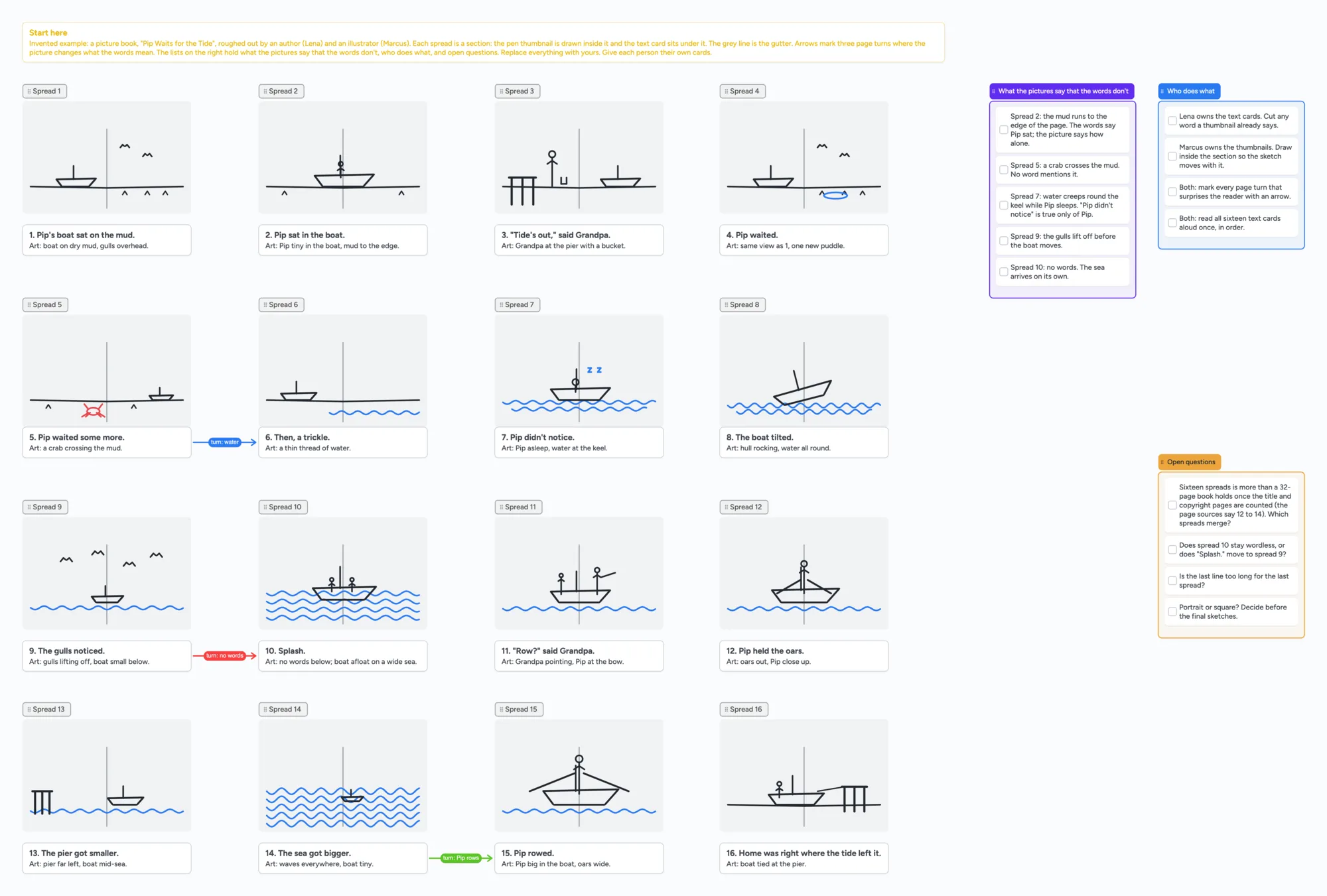
A picture book dummy is the whole book in small: every spread, with the words and a rough picture. This page shows one way to build it on a shared board, so an author and an illustrator can both work on it from different places. Each spread is a section, the pen thumbnail is drawn inside the section, and a text card sits under it. Drag a section and its sketch goes with it, so you can re-order the book without redrawing. The example is an invented book, "Pip Waits for the Tide", in sixteen spreads. It is for pacing and page turns. It doesn't lay out a 32-page book, set a trim size, add gutter or bleed guides, or export the pages in order, so the dummy you send to an editor belongs in a layout tool or on paper (below).
Updated
The short answer
- What it is: one board with a section for each spread, a pen thumbnail drawn inside it, and a text card under it. The words and the pictures sit together, and a section moves with the ink inside it.
- What it isn't: no ordered PDF of the pages, no 32-page or spread view, no trim size or gutter guides, and no print layout. The grey line in the example is ink drawn in each section.
- Free plan: the example is 33 of your 150 free items (30 cards and 3 lists, our count). Sections, arrows and pen strokes don't count. Pro is $5/mo billed yearly.
- To get it out, select the spreads and use Copy as image. On Chrome, Save as image downloads a PNG too (tested 11-11 on the web app; Safari and Firefox not tested).
What this board can't do for a picture book
- Spreads are sections, not pages. A section is any size you drag it to. There is no 32-page count, no left and right page, no trim size and no snap, so you match the spreads by eye.
- No ordered export. What you get out is a picture of the selected spreads: Copy as image, or Save as image on Chrome. There is no PDF of the pages in order and no page numbers.
- Drawing is free ink, not an object. Ink drawn inside a section moves with it. Ink drawn over a card or a list does not, so draw each thumbnail in its section and keep the words in a card.
- 3 images per board and 150 items on the free plan. A hand-drawn board uses none of the 3. Each text card is 1 of the 150. Pro is $5 a month billed yearly ($59.99 a year).
- 5 boards on the free plan. One board per book is the simplest way to keep them. Making your own copy of the example uses 1 of the 5.
- Drawing needs a pen. A finger works for boxes and stick figures; a stylus or tablet makes it feel like sketching.
How to rough a picture book on one board
- Make a section for each spread. Use the Section tool and drag out the spreads in rows. Keep them roughly the same shape; there is no snap. The example has sixteen, four to a row.
- Draw each thumbnail inside its section. Use the pen. Ink that starts inside a section stays attached to it. Keep it to a few shapes: Debbie Ridpath Ohi's page says she uses stick figures "so I don't get too wedded to art details yet".
- Put the words in a card under the spread. One card per spread, numbered, with the line of text and one line about the picture. A card is a separate item, so it doesn't move with the section; select both to move them together.
- Mark the page turns. An arrow from one spread's card to the next takes a caption and its own colour, and stays attached when you move the cards. The example marks three turns. Katie Dwyer's guide says to keep page turns in mind while thumbnailing, and Ohi uses her thumbnails to work out pacing, arc and page turns.
- List what the pictures say that the words don't. The example's first list holds one line per spread where the picture carries something the text leaves out, like a crab that no word mentions. If a spread repeats its words, cut the words.
- Re-order by dragging. Select a section and its card, then drag. To try another order and keep the first, select every spread and press Cmd+D; the copy comes with its ink and cards.
When you want the spreads somewhere else (an email, a chat, a slide), select them, right-click, and choose Copy as image, then paste it. On Chrome, Export > Save as image downloads a PNG instead. We haven't tested Save as image on Safari or Firefox, and a board this size is a big picture.
An author and an illustrator on the same board
- In the share menu, set "Anyone with the link can edit". New boards start view-only.
- Send the link, or the 4-digit join code. The code expires after 2 hours of inactivity.
- Your partner signs in free (Google, Apple or email) to write. Someone who isn't signed in can open the link and read the board, but can't change anything.
- Split the work by card. In the example the author owns the text cards and the illustrator owns the thumbnails. If two people type in the same card at the same time, the text merges as you go with no lock and the words end up interleaved, so give each person their own cards.
- Each person's changes show for the other within a second or two. The board counts as one of their 5 free boards, and the cards they add count toward their own 150.
Free calls on the board run up to 60 minutes per call, with a warning 10 minutes before the end; everyone signs in free, calls aren't recorded, and Pro has no limit. So you can talk through the page turn at spread 10 while one of you redraws it. If you are roughing the story as a film or comic instead, see the hand-drawn storyboard board.
Where to make the dummy you send out
Each row is from the page named, read on November 11, 2026. A page is dated only where it shows a date.
| Tool | What its page says | Where it fits |
|---|---|---|
| Instaboard board | Sections with pen thumbnails and text cards; free 5 boards, 150 items; Pro $5 a month billed yearly | Pacing and page turns with a partner; no page layout or ordered export |
| Reedsy children's book template | Its blog says a storyboard, "often called a dummy book", maps the story page by page; it offers a downloadable template you can edit and a 32-page planning template | A ready 32-page grid to fill in |
| Google Slides (Taylor Woolley's templates, April 24, 2026) | One deck for each orientation and format, with a slide per spread; she says most people will have access to Slides | A dummy in page order that you can share as a file |
| Adobe InDesign (same post) | Woolley is a graphic designer and uses it; she notes not every writer or illustrator has a licence | Final layout with real trim sizes |
| Procreate (Katie Dwyer's guide, May 15, 2026) | She makes lots of tiny squares for thumbnails on one canvas; she has also used paper and sticky notes; downloadable templates at the end of her post | Drawing and painting the thumbnails on a tablet |
| Debbie Ridpath Ohi's print-ready templates | 32- and 40-page thumbnail templates as PDFs to print; she says hers are for her own pacing and she doesn't send them to her art director or editor | A paper thumbnail sheet |
| Blurb | Its blog says to lay out the manuscript and illustrations in an editor (it names Photoshop, Illustrator and its BookWright) and to use print-on-demand to order a printed dummy | A printed copy you can hold |
Swipe the table sideways to see every column.
Sources are listed at the bottom of the page, all read on November 11, 2026. We name no tool as the best; they do different jobs.
When another tool is the better choice
- You need to send a dummy in page order. Use Slides, InDesign or a printable template, then export a PDF. This board exports a picture, not the pages in order.
- You want to feel the book in your hands. Boyds Mills' how-to describes a paper dummy: eight folded sheets stapled or sewn into a 32-page book, with the text taped in so it can move from page to page. A printed copy shows page turns that a screen doesn't.
- You need the page count right. The guides count the story spreads differently: Woolley says 14 with separate ends and 12 with self ends, Dwyer says 14 spreads plus two single pages, and Blurb's blog says 13. Use a 32-page template to count; the board will happily hold sixteen.
- You need finished art or print-ready files. Procreate or your usual drawing app, then a layout tool.
Ohi's page advises new picture book authors who don't yet have a contract to stick with the 32-page format if at all possible, and says her templates are for her own pacing, not for submission. If you are outlining the words before you draw, see outlining a story with a co-writer or outlining with index cards.
Start from the ready board
It opens in your browser in a few seconds, with nothing to install. Sign in for free when you want to save it and share it.
Questions
Can I make a picture book dummy on Instaboard?
You can rough one. Make a section for each spread, draw a thumbnail inside it with the pen and put the words in a card under it. It is a board for pacing and page turns, not a layout tool: it has no trim size, no 32-page view and no ordered PDF.
Can an author and an illustrator work on it together?
Yes. Set "Anyone with the link can edit" and send the link. Your partner signs in free to write, and what each of you draws and types shows up for the other within a few seconds. Give each person their own cards, because two people typing in the same card get their words mixed together.
How do I get the spreads out of the board?
Select them, right-click and choose Copy as image, then paste it. On Chrome, Export > Save as image downloads a PNG. We haven't tested Save as image on Safari or Firefox. There is no PDF of the pages in order.
Does it count against the free limits?
Each text card is 1 of your 150 free items. The example's 30 cards and 3 lists come to 33 (our arithmetic). Sections, arrows and pen strokes are free. Free also means 5 boards and 3 images per board.
How many spreads should a picture book have?
The guides we read disagree, because they count front matter differently: 12 to 14 story spreads for a 32-page book. Check the template you plan to use. The board has no limit on the number of spreads.
Sources
- Reedsy: Children's Book Template: Create a Perfect Layout (read November 11, 2026)
- Taylor Woolley: Making a Picture Book Dummy (April 24, 2026; read November 11, 2026)
- Katie Dwyer: Updated: How To Make a Picture Book Dummy + Free Downloadable Templates (May 15, 2026; read November 11, 2026)
- Debbie Ridpath Ohi: Templates For Book Creators (read November 11, 2026)
- Boyds Mills: How to Craft a Picture Book Dummy (read November 11, 2026)
- Blurb: What is a book dummy and how to make one (read November 11, 2026)
Related
Sketch a rough storyboard by hand, with a co-writer or director on the same board
Sketch a rough storyboard by hand on one shared board: a frame is a section, the pen sketch sits inside it, a caption card goes under it. A filled example to copy.
Outline a story with a co-writer, on one board you both edit
Outline a story with a co-writer on one shared board: ideas lists for each of you, an agreed outline, a decide-by list. A filled example to copy. Not a drafting tool.
Outline a novel or screenplay with index cards, on a board you can share
Outline a novel or screenplay on digital index cards: one list per act, 40 short cards, subplot arrows, a co-writer on the same board. Free to start; TV pilot too.