For the person who got handed the offsite and wants the plan in one place
A team offsite planning template: the brief, the venue, two agenda days and the follow-up, on one shared board
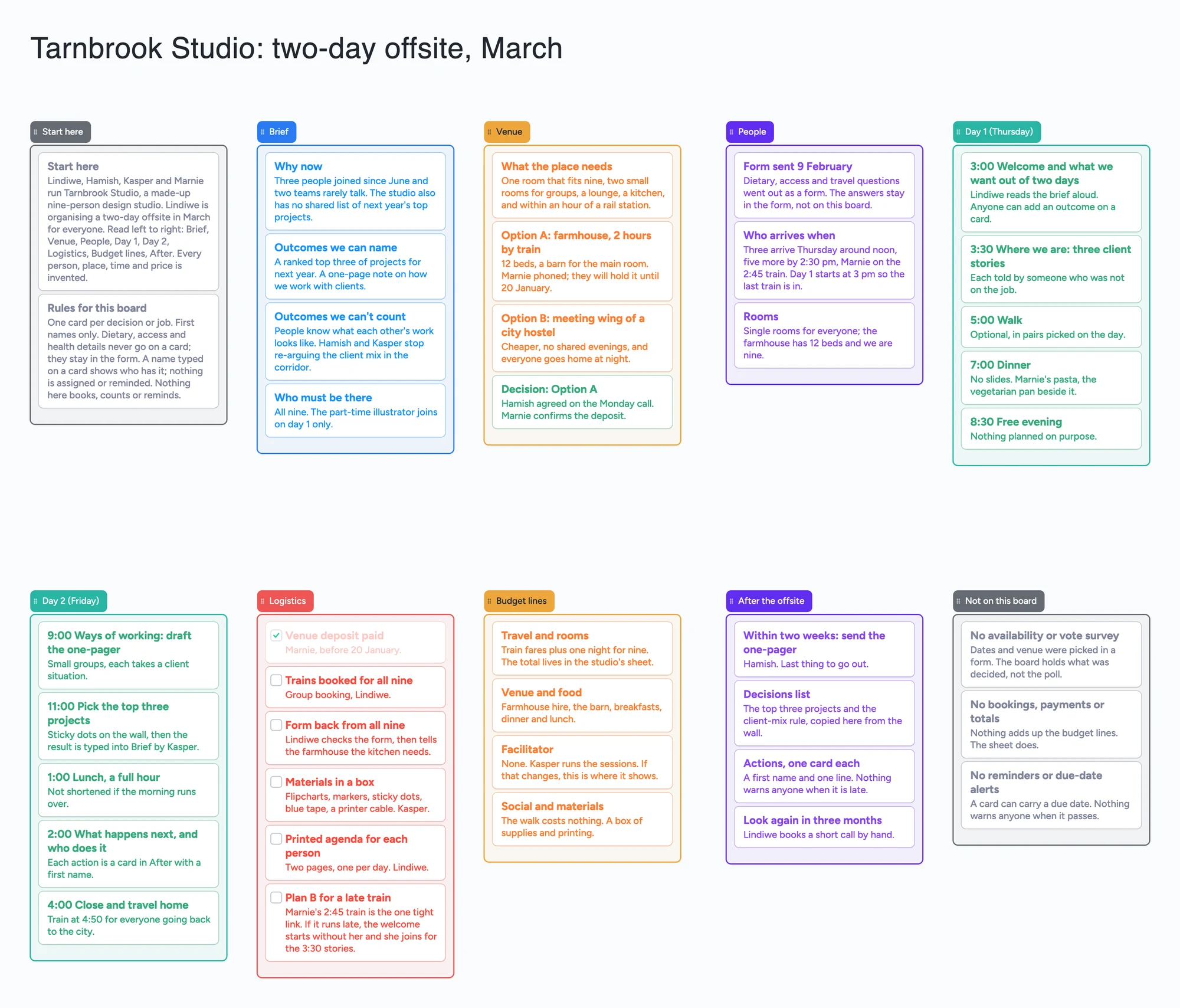
An offsite has a work purpose, a venue, a travel chain and an agenda, and our view is that the person organising it often keeps those in separate documents. This is a team offsite planning board already laid out on Instaboard, our online board, filled in for an invented nine-person design studio: Lindiwe, Hamish, Kasper and Marnie plan two days at a farmhouse in March. The board has ten lists and 40 cards: two cards that explain it, then Brief, Venue, People, Day 1, Day 2, Logistics, Budget lines, After the offsite and three cards on what the board does not do. A board keeps the decisions and the running order in one place. It does not poll the team, book a room, add up a budget or remind anyone. Every person, place, time and price is invented.
Opens in your browser. Anyone can view; a free sign-in lets you edit.
Updated
The short answer
- What it is: a shared page where one organiser and a few helpers keep the offsite's purpose, the chosen venue, who arrives when, the agenda for each day, the jobs still open and what happens after, as lists. The example uses 51 of your 150 free items.
- What it is not: a booking or polling tool, or a budget. It books nothing, collects no votes, adds up no costs and sends no reminders or due-date alerts. Each of those happens somewhere else.
- Not a social event: this is a work event for a team. A company picnic, an office holiday party and a church retreat are different jobs with different boards.
- Where other tools win: the guides from Perk, PostHog, Readwise and SessionLab go much further on venues, budgets and facilitation, and a spreadsheet does the sums. All are in a table below.
- Keep off it: dietary, access and health details, salaries and anything confidential. The example keeps those in a form. A link board is not private.
An offsite is a work event: how this differs from a picnic, a party or a retreat
A company picnic, an office holiday party and a church retreat are social or community events; the plan is a run of food, places and helpers. An offsite has an outcome the organiser has to name, a decision someone wants made, and a follow-up two weeks later. So the board starts with a Brief list and ends with an After list, and the two agenda days sit between them.
It also differs from a trip. Readwise, which has run offsites for a remote team, describes its process as a chain of steps from holding dates to buying swag; a board does not run a chain. It holds where you are in it.
Where the board stops, and who does the rest
- No polling. Readwise sends the team a survey for dates and another for the vote on venues. The board holds the result as a card, not the poll.
- No booking or payments. A card can say the deposit is paid; nothing pays it.
- No totals. The Budget lines list names the lines. The sum lives in a spreadsheet.
- No reminders or due-date alerts. A card can carry a due date, but nothing warns anyone when it passes.
- No private fields. Dietary and access details stay in the form you sent. They do not belong on a link board.
- No facilitation. The board holds an agenda; it does not design one. SessionLab describes its own agenda tool as built for that (a vendor claim).
Room on the free plan: 51 of your 150 items, and what else it limits
Each card and each list is 1 of your 150 free items, across all your boards, and the title text box counts too. Arrows, sections and pen strokes don't. Moving a card from one list to another doesn't add an item.
- As built: 10 lists + 40 cards + the title = 51, which leaves 99.
- Two offsites a year as two copies: two copies of the example as built are 2 x 51 = 102 (Readwise describes two offsites a year); a third makes 153. A copy takes 1 of your 5 free boards.
- Delete when done: cards of a finished offsite can go, which frees the items.
Limits of the free plan for this board:
- Boards. 5 on the free plan.
- Pictures. 3 per board. The example has none, so a venue photo goes in as a link card.
- Writing needs a free sign-in. A person who joins can view the board; to change it they sign in, and the board then counts as 1 of their 5.
- No reminders or due-date alerts, no sums, no polls.
- Private details. Invite-only boards are a Pro feature, so keep health and salary details off a link board.
Tarnbrook Studio, list by list
- Start here (2 cards). Who Lindiwe, Hamish, Kasper and Marnie are and how to read the board, and the rules: one card per decision or job, first names only, no health details.
- Brief (4 cards). Why now, the outcomes the team can name (a ranked top three of projects, a one-page note on how they work with clients), the outcomes it can't count, and who must be there.
- Venue (4 cards). What the place needs, two options with the reason for each, and the decision with who confirmed it.
- People (3 cards). The form that went out, who arrives when (day 1 starts at 3 pm so Marnie's 2:45 train is in) and rooms.
- Day 1 and Day 2 (5 cards each). One card per slot with the time in the title, from a welcome and three client stories to the pick of the top three projects, a full-hour lunch and a train home.
- Logistics (6 cards, tick boxes). Deposit, trains, form, materials, printed agendas and a plan B for a late train; the first is ticked.
- Budget lines (4 cards). Travel and rooms (train fares plus one night for nine), venue and food, facilitator, social and materials. Names, no sums.
- After the offsite (4 cards). Send the one-pager within two weeks, a decisions list, one card per action with a first name, and a look-again in three months.
- Not on this board (3 cards). No poll, no bookings or totals, no reminders or due-date alerts.
Two days that one person can read at a glance
Each agenda slot is its own card, with the time typed in the title. A card can carry a due date, but it is a whole day, so a time of day goes in the words and the cards stay in the order you drag them.
Our telling of the example: Lindiwe set the 3 pm start so Marnie's 2:45 train is in, with a plan B card for a late train, Kasper typed the result of the dot vote into Brief, and every action from the closing slot became a card in After with a first name. SessionLab's guide puts the brief before the agenda, and the board keeps the two side by side.
What two public threads on offsites say
Two public threads, read November 26, 2026 (live comment counts from Reddit, text from an archive of Reddit comments). Each person is one view.
- r/ExecutiveAssistants, "Help! Offsite Planning Template" (2024-08-28 UTC; 1f3hj1f). The poster had tried many ways to stop the team creating a spreadsheet each and wanted attendees, cost per person, dinner requests and outcomes in one template. Reddit shows 9 comments; an archived copy has 11, two of them since deleted by their author, which we do not quote. u/No_Cauliflower_5071 uses Excel, with separate sheets for tasks, attendees and hotel pricing, and says the forms run through a separate tool (Cognito). Later two people ask for a blank copy; No_Cauliflower_5071 says they have none and has not made one.
- r/ProductManagement, "Ideas for an offsite for a new product team?" (2023-02-18 UTC; 115h22a). Reddit shows 12 comments; an archived copy has 12 with text; we quote 3, one comment each. u/LessAd2827 says to build a shareable agenda with time allocations. u/areopagitic suggests letting team members run time-boxed sessions. u/Grrr_poise writes that nobody will remember what was said in a room and that team building is underweighted. One person's view each; the thread asks for ideas, not a board.
Our reading: the one explicit ask for a template is from someone who wanted a team to fill in one page without each making their own spreadsheet, and the replies that give detail are spreadsheets. A board is the same shared page, with cards instead of rows.
What five offsite guides and listings say, read November 26, 2026
Three of these are from companies that sell something and two describe the writers' own offsites. A cell says what the page says, not what any tool can do. No ranking.
| Guide or listing | What it covers | Strongest at | What stays on the board |
|---|---|---|---|
| Perk: The complete guide to planning a company offsite (vendor; no date shown in a browser) | Walks through nine steps, a two-day agenda template, a list of budget categories and a 20-30 minute limit on a speaker | A full guide to goals, venues and budget | Holding the plan the guide leads you to, with the team |
| PostHog: How to plan a killer company offsite in just 8 weeks (Grace McKenzie, Aug 17, 2022) | An eight-week checklist, budget benchmarks (for example $200 a night per person for rooms, 10% contingency) and a tip to decide who records the notes | A timeline you tick off and benchmark numbers | A shared page for a short offsite where the eight weeks do not apply |
| Readwise: How we planned our Norwegian team offsite as a remote startup (Daniel Doyon, 21 May 2024) | Six offsites in three years; a ten-step process from dates to swag; about $4,000 a person for Norway and $3,000 to $3,500 in the Americas | A case study with costs | Keeping this offsite's decisions where the team sees them |
| SessionLab: How to plan a team offsite (James Smart, May 1, 2026; vendor) | A brief, a logistics layer, a proposal, then agenda design; templates for 1-day, 2-day and 4-day offsites | Facilitation and agenda design with timing | The result, plus logistics and follow-up cards |
| Notion: Team Offsite Planner with Map (marketplace listing by PamPam; showed "Last updated 2 years ago" when read November 26) | A Notion page for sharing offsite plans that makes a map from the document | Maps and a Notion-native planner | Teams who do not use Notion |
Swipe the table sideways to see every column.
From each page as read November 26, 2026. Perk, SessionLab and the Notion listing are vendors; PostHog and Readwise describe their own offsites. Instaboard isn't affiliated with any of them.
Make it yours in seven steps
- Open the board and rewrite Start here with your team and the offsite's name.
- Write the brief first: the outcomes you can name and the ones you can't, and who must be there.
- Keep the venue to two options and one decision. Put the reason on each card.
- Send the questions as a form and keep the answers there, not on the board.
- Write each agenda slot as a card with its time in the title, then add the logistics as tick boxes.
- Fill After before you go, so the actions have a place to land.
- Share it. Set the share setting so anyone who joins can edit ("Anyone who joins can edit"); new boards start view-only, and each person signs in to write.
Start from the ready board
It opens in your browser in a few seconds, with nothing to install. Sign in for free when you want to save it and share it.
Questions
What goes on a team offsite planning board?
The purpose and the outcomes you want, the venue and the decision, who arrives when, an agenda card per slot for each day, the logistics jobs as tick boxes, the budget lines by name and what happens after. Dietary and access details stay in a form.
How is an offsite different from a company picnic or a holiday party?
An offsite is a work event with an outcome, a decision and a follow-up. A picnic or a party is a social plan. Our example therefore starts with a Brief list and ends with an After list rather than with food and helpers.
Can the board poll the team or book the venue?
No. Polling, booking and payment happen in other tools, such as the forms and surveys the guides above use. The board keeps the result as a card.
How many offsites or items fit on one board?
Our arithmetic: as built the example is 51 of your 150 free items; two copies make 102 and a third passes 150. Pro removes the item limit, at $5 a month billed yearly ($59.99 a year) or $7.99 monthly.
Should I put dietary or access needs on it?
Our view: no. Keep them in the form you sent, and put only the decisions that come from them, such as "the kitchen needs a vegetarian pan", on a card. A link board is not private: whoever you send the link to can read it.
Who can add to the board?
Anyone you share the link with can read the board. To add a card they sign in for free, and if the share setting is "Anyone who joins can edit" they can edit. A board opened from your link takes 1 of their 5 free boards, and a copy takes 1 of yours.
Sources
- Perk: The complete guide to planning a company offsite (no date shown in a browser; read in full November 26, 2026; vendor content)
- PostHog: How to plan a killer company offsite in just 8 weeks (Grace McKenzie, Aug 17, 2022; read in full November 26, 2026)
- Readwise: How we planned our Norwegian team offsite as a remote startup (Daniel Doyon, 21 May 2024; read in full November 26, 2026)
- SessionLab: How to plan a team offsite, a complete guide (James Smart, May 1, 2026; read in full November 26, 2026; vendor content)
- Notion Marketplace: Team Offsite Planner with Map (showed "Last updated 2 years ago" when read November 26, 2026; vendor listing)
- r/ExecutiveAssistants: Help! Offsite Planning Template (2024-08-28 UTC; Reddit shows 9 comments, archived copy 11, two since deleted and not quoted; read November 26, 2026)
- r/ProductManagement: Ideas for an offsite for a new product team? (2023-02-18 UTC; Reddit shows 12 comments, archived copy 12 with text, 3 quoted; read November 26, 2026)