For a small team that wants one shared picture of a process before it changes anything
A SIPOC diagram template: the five lists of one process, and what the customer expects, on one shared board
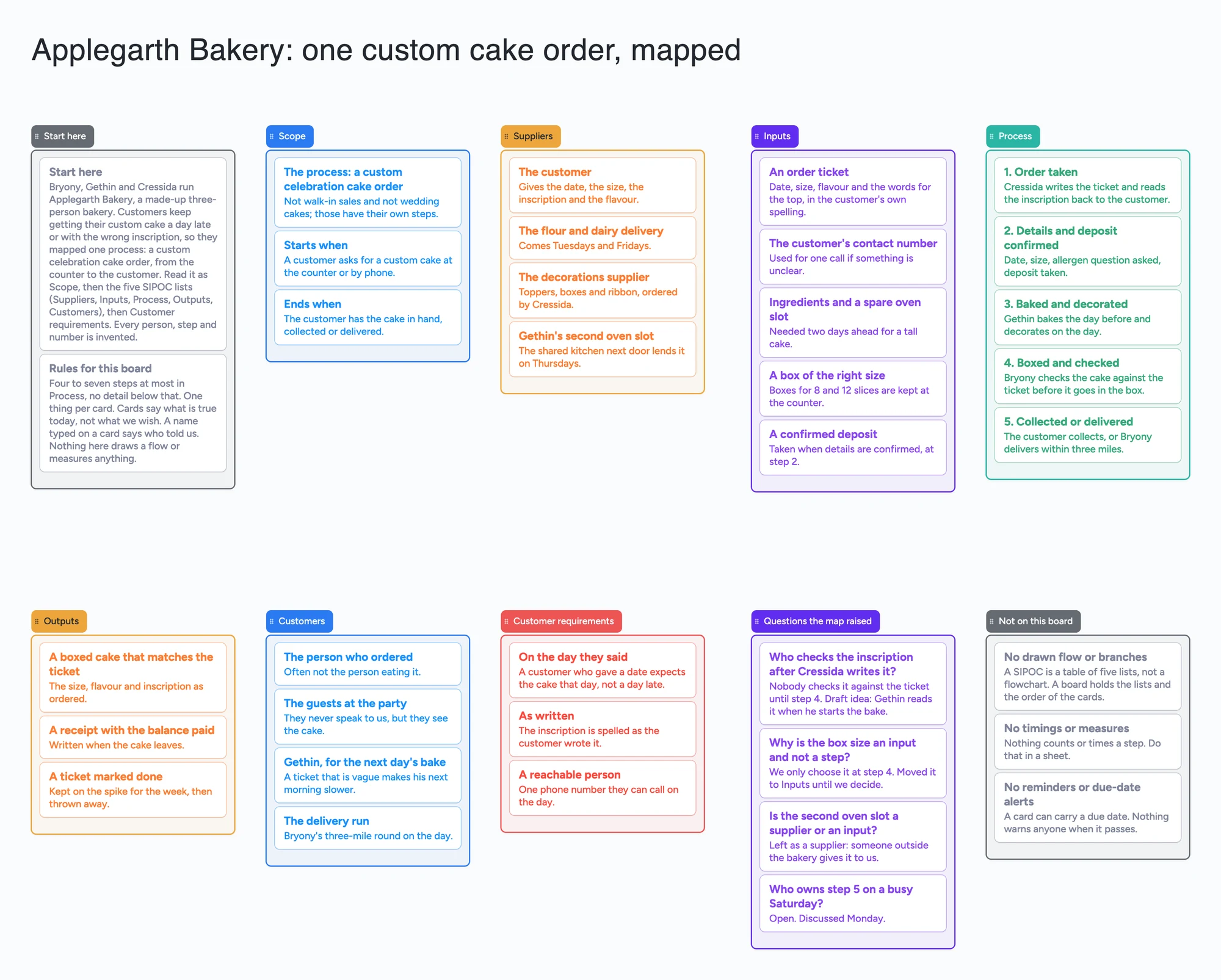
A SIPOC diagram is a one-page summary of a process: who supplies it, what goes in, the few steps in the middle, what comes out and who gets it. This is a SIPOC board already laid out on Instaboard, our online board, filled in for an invented three-person bakery: Bryony, Gethin and Cressida map one process, a custom celebration cake order from the counter to the customer, because cakes keep arriving a day late or with the wrong words on top. The board has ten lists and 36 cards: two cards that explain it, Scope, the five SIPOC lists, what the customer expects, four questions the map raised and three cards on what the board does not do. A SIPOC is thin on purpose, so this is a small page. The board keeps the five lists where the whole team can edit them. It does not draw a flow, time a step or measure anything. Every person, step and number is invented.
Opens in your browser. Anyone can view; a free sign-in lets you edit.
Updated
The short answer
- What it is: a shared page where a team writes down one process as five lists (suppliers, inputs, process, outputs, customers), with a scope card and the customer's expectations beside them. The example uses 47 of your 150 free items.
- What it is not: a flowchart, a measure or a table of numbers. It draws no flow, times no step and counts nothing. A spreadsheet, a slide or a drawing tool does those better, and the table below says where.
- Where this board may help: our view: a team that wants everyone to edit the same five lists while they argue about the process, and to keep the questions the map raised next to the map.
- Weakest fit: a one-person map. A page you print or a sheet you fill in alone is enough.
- Keep off it: customer names and contact details, prices and anything confidential. The example uses an invented bakery. A link board is not private.
Start in the middle: fill in Process first
The name says suppliers first, but the guides we read tell you to start elsewhere. Asana's page (Caeleigh MacNeil, March 16th, 2026; vendor) says it is best practice not to follow the acronym in order, recommends starting with the process and says teams sometimes call the tool COPIS. Its step is to break the process into 4 to 5 high-level steps. Invensis Learning (Lucy Brown, Published Oct 10, 2025; a training company) also begins with the process, then the outputs, the customers, the inputs and last the suppliers, and suggests 4 to 7 main steps.
The board is laid out in the usual S-I-P-O-C order so it reads the way the acronym does. Our telling of the example: it was filled in the other way, and Cressida wrote the five steps first, then what comes out, then who gets it, then what goes in, then who supplies it. The five Process cards are numbered so their order survives on the board.
What this board can't do
- No drawn flow. A SIPOC is five lists, not a flowchart. Invensis Learning's comparison table calls the flowchart the tool that shows every decision point and action step; the board holds the lists and the order of the cards, with no branches.
- No timing or measures. Smartsheet's detailed template adds columns for key performance indicators and the duration of each step. The board has none, and nothing counts a card.
- No reminders or due-date alerts. A card can carry a due date, but nothing warns anyone when it passes.
- No stakeholder sign-off. Invensis lists reviewing the draft with process owners, suppliers and customers as a step. The board is where the draft lives; whoever approves it does so somewhere else.
- Up to 3 pictures; the lists are text. The free plan takes 3 pictures per board and the example has none, so a photo of a whiteboard map can sit on the board, but the lists stay cards.
Applegarth Bakery, list by list
- Start here (2 cards). Who Bryony, Gethin and Cressida are and why they mapped this process, and the rules: one thing per card, the process kept to four to seven steps, nothing here draws or measures.
- Scope (3 cards). The process in a sentence, what starts it (a customer asks for a custom cake) and what ends it (the cake is in the customer's hand).
- Suppliers (4 cards). The customer, the flour and dairy delivery, the decorations supplier and a neighbouring kitchen's oven slot on Thursdays.
- Inputs (5 cards). An order ticket, the contact number, ingredients with a spare oven slot, a box of the right size and a confirmed deposit.
- Process (5 cards). Order taken, details and deposit confirmed, baked and decorated, boxed and checked, collected or delivered.
- Outputs (3 cards). A boxed cake that matches the ticket, a receipt with the balance paid and a ticket marked done.
- Customers (4 cards). The person who ordered, the guests at the party, Gethin for the next day's bake and the delivery run. Not every customer is outside the bakery.
- Customer requirements (3 cards). On the day they said, as written, and one phone number they can call.
- Questions the map raised (4 cards). Who checks the inscription after it is written, why the box size is an input and not a step, whether the oven slot is a supplier or an input, and who owns step 5 on a busy Saturday.
- Not on this board (3 cards). No drawn flow, no timings, no reminders or due-date alerts.
Room on the free plan: 47 of 150 items, and the other limits
Each card and each list is 1 of your 150 free items, across all your boards, and the title text box counts too. Arrows, sections and pen strokes don't. Moving a card from one list to another doesn't add an item.
- As built: 10 lists + 36 cards + the title = 47, which leaves 103.
- More processes as copies: two copies of the example as built are 2 x 47 = 94, three are 141 and a fourth makes 188. Each copy takes 1 of your 5 free boards.
- One board for several processes: a second process with five lists of about 20 cards adds roughly 25 items (our estimate), so three processes on one board would come to about 97.
Limits of the free plan for this board:
- Boards. 5 on the free plan. "Make a copy" takes 1 of them.
- Pictures. 3 per board. The example has none.
- Writing needs a free sign-in. A person who joins can view the board; to change it they sign in, and the board then counts as 1 of their 5.
- No reminders or due-date alerts, no sums, no timings.
- Private details. Invite-only boards are a Pro feature, so keep customer names and contact details off a link board.
When a table or a slide is the better SIPOC
Smartsheet's page is all files. Its roundup (Lulu Richter, July 13, 2024; vendor) offers a basic SIPOC template for Excel, Microsoft Word, Google Docs and Google Sheets, a slide version for PowerPoint and Google Slides, a detailed version with extra columns and swimlane versions. If you are presenting the result to people who were not in the room, or you want one page to print, a slide or a sheet is the right file. The board is for the part before that, when several people are still adding and moving cards.
Miro's template (no date printed; vendor) is the nearest thing to drawing one: the Process section is a chain where, once the first step is entered, a blue circle adds the next one. If your team wants a chain that grows as you click, use a canvas tool built for that. The board keeps the chain as numbered cards in a list.
What Asana, Miro, Smartsheet and Invensis offer, read November 26, 2026
These are four pages about SIPOC that we read, not a ranking. A cell says what the page says, not what the tool can do.
| Source | What is on the page | Reach for it when | Reach for the board when |
|---|---|---|---|
| Asana: SIPOC diagram guide (Caeleigh MacNeil, March 16th, 2026; vendor) | A seven-step how-to, a shipping example and the advice to start with the process; says you can build a SIPOC as a Kanban board in Asana | You already run the work in Asana and want owners and deadlines on the follow-up tasks | The team is not on Asana, or only needs the five lists |
| Miro: SIPOC template (no date printed; vendor) | A canvas with the five sections, sticky notes and a process chain you extend by clicking a blue circle | You want a drawn chain on a large canvas | You want the lists as cards that stay in order, and the questions beside them |
| Smartsheet: SIPOC templates in all formats (Lulu Richter, July 13, 2024; vendor) | Files: basic, slide, detailed with KPI and step-duration columns, swimlanes | You need a file to present, print or add numbers to | You want to edit the five lists together before there is a file |
| Invensis Learning: What is a SIPOC diagram (Lucy Brown, Published Oct 10, 2025; training company) | A seven-step guide, a comparison with flowcharts and value stream mapping, and a use case | You want the background and the comparison tables | You want a place to do the mapping the guide describes |
Swipe the table sideways to see every column.
From each page as read November 26, 2026. All four are vendors or a training company that sells courses, not independent studies. Instaboard isn't affiliated with any of them.
Fill in your own, process first
- Open the board and rewrite Start here with your team and the process you are mapping.
- Write the Scope cards first: the process, what starts it and what ends it.
- Fill in Process, four to seven steps, numbered in the card titles.
- Then Outputs and Customers, then Inputs and Suppliers, and finally what the customer expects.
- Delete the bakery's cards and keep the lists. Rename a list if your process needs it.
- Write what you don't know as a card in the questions list, with a first name beside it if you want to remember who raised it.
- Share it. Set the share setting so anyone who joins can edit ("Anyone who joins can edit"); new boards start view-only, and each person signs in to write.
From the map to the questions
Asana's page says a SIPOC helps you ask how to make the process easier, "Are we delivering a quality product to our customers?" and "Are our suppliers delivering what we need?". Applegarth's team turned the map into four questions instead of answers, and left them on the board in their own list. The first one is the one that mattered: Cressida reads the inscription back to the customer at step 1, but nobody checks it against the ticket until step 4.
Our telling of the example: Gethin proposed reading the ticket when he starts the bake, which became a draft idea on the card, not a change to the process. Nothing on the board checks that anyone did it; the team does. Invensis's guide says to validate the draft with the people involved before detailed mapping, and a card per question is where that conversation sits until then.
Start from the ready board
It opens in your browser in a few seconds, with nothing to install. Sign in for free when you want to save it and share it.
Questions
What does SIPOC stand for?
Suppliers, Inputs, Process, Outputs, Customers. Asana describes it as a visual tool that gives a high-level view of a process and says it is often used in Six Sigma's Define step. On the board each word is a list.
Which list do I fill in first?
The Process list, according to the guides we read. Asana and Invensis Learning both start with the process and work outward, and Asana says teams sometimes call the tool COPIS for that reason.
Is a SIPOC the same as a flowchart or a process map?
No. Asana says a SIPOC doesn't map dependencies and Invensis Learning's table calls the flowchart the more detailed tool. The board has five lists and no drawn flow.
How many processes can one account hold?
Our arithmetic: as built the example is 47 of your 150 free items, so three copies make 141 and a fourth passes 150. Pro removes the item limit, at $5 a month billed yearly ($59.99 a year) or $7.99 monthly.
Can I time the steps or track measures on it?
No. Nothing on the board times a step or counts a card. Smartsheet's detailed template has columns for step duration and key performance indicators, and a spreadsheet is the better place for those.
Who can add to the board?
Anyone you share the link with can read the board. To add a card they sign in for free, and if the share setting is "Anyone who joins can edit" they can edit. A board opened from your link takes 1 of their 5 free boards, and a copy takes 1 of yours.
Sources
- Asana: SIPOC diagram, what it is and how to create one (Caeleigh MacNeil, March 16th, 2026; read in full November 26, 2026; vendor content)
- Miro: SIPOC template (no date printed; read in full November 26, 2026; vendor content)
- Smartsheet: Free SIPOC diagram templates, all formats (Lulu Richter, July 13, 2024; read in full November 26, 2026; vendor content)
- Invensis Learning: What is a SIPOC diagram? A beginner's guide with examples (Lucy Brown, Published Oct 10, 2025; read in full November 26, 2026; training company)