For engineers four or more years out, fitting PE study around full-time work and home
A PE exam study plan board for a working engineer
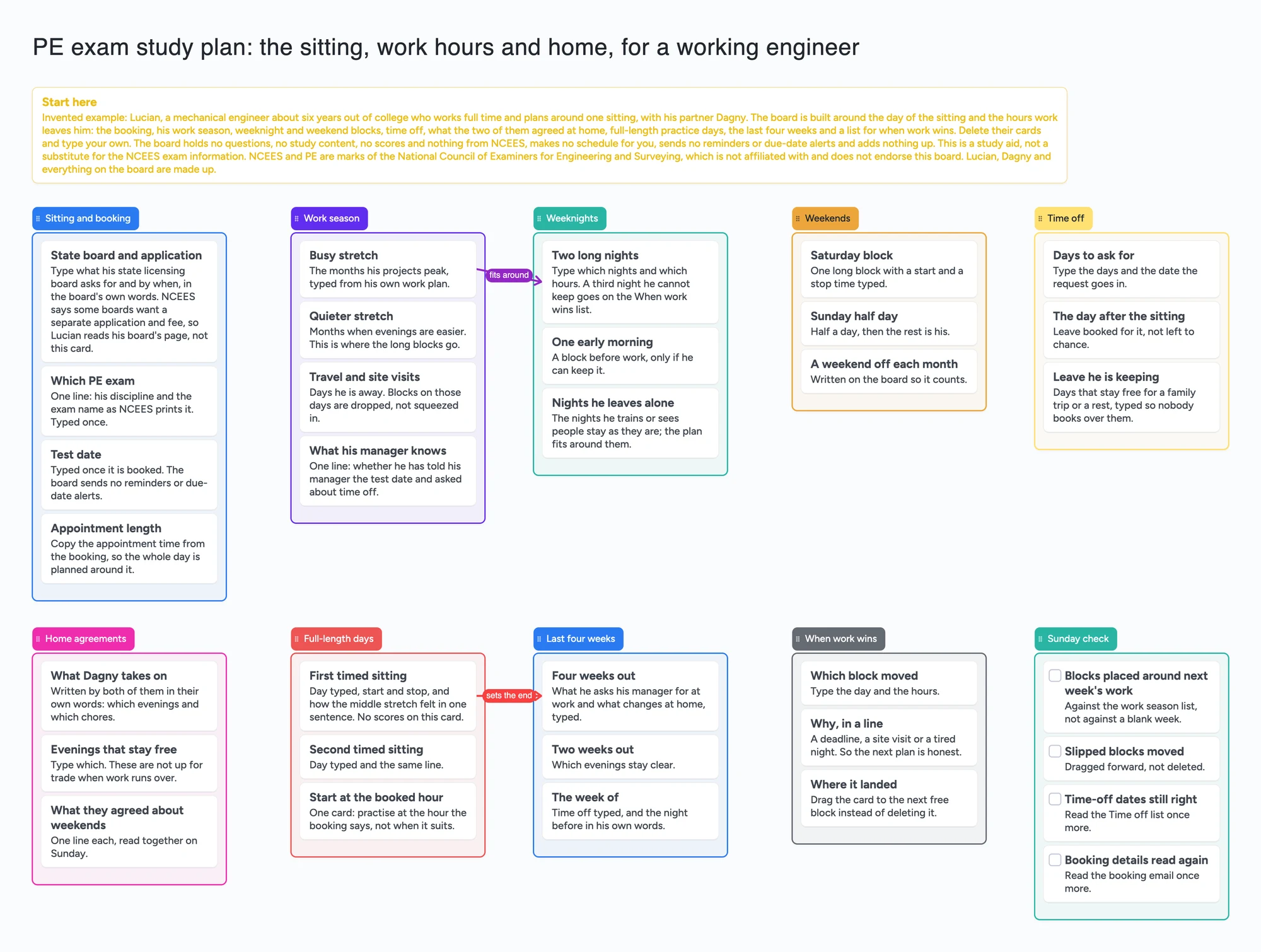
Most PE study plans start from the material. This one starts from the two things that do not move: the day of the sitting and the hours your job leaves you. We make Instaboard, an online board. This page gives you a PE exam study plan already laid out on it, filled in for one invented engineer, Lucian, a mechanical engineer about six years out of college who works full time and shares the plan with his partner Dagny. It has a list for the booking and his state board's own wording, one for his work season, one each for weeknights, weekends and time off, a list of what the two of them agreed at home, full-length practice days, the last four weeks, a list for when work wins and a Sunday tick list. It holds no questions, no study content, no scores and nothing from NCEES, makes no schedule for you, sends no reminders or due-date alerts and adds nothing up. It is a study aid, not a substitute for the NCEES exam information. NCEES and PE are marks of the National Council of Examiners for Engineering and Surveying, which is not affiliated with and does not endorse this page.
Opens in your browser. Anyone can view; a free sign-in lets you edit.
Updated
A tracker for your sitting and your work hours, not a study guide
- It holds your plan, not the exam. There are no questions, no lessons and no scores on it, and nothing from NCEES.
- It makes no schedule. You type the blocks yourself, around the work season you type in first.
- It sends no reminders or due-date alerts. A card can carry a due date (a whole day, no time of day), but nothing warns you. Put the test date in a calendar app that does.
- What it is: one screen where you, your partner and anyone you choose can read and write the booking, the work season, the weekly blocks and what you agreed at home. The example uses 45 of your 150 free items.
- Free plan: 5 boards, 150 items, 3 pictures per board. Copying the board takes 1 of your 5 boards. Writing on it needs a free sign-in. New boards start with "Anyone who joins can view".
Plan around the sitting and your work season first
NCEES says the PE exam is for engineers with "a minimum of four years post-college work experience in their chosen engineering discipline", so many people who sit it are working engineers (our reading), and the plan has to fit inside their work. NCEES also says it offers "more than 20 different PE exams" and prints a separate page for each. We read two of them on November 26, 2026 (no date shown in the text we read): Mechanical and Chemical. Each shows 80 questions, a 9-hour appointment (a 2-minute nondisclosure agreement, an 8-minute tutorial, 8 hours of exam and a 50-minute scheduled break), a $400 exam fee, year-round availability and NCEES-approved Pearson test centers. Yours may differ, so read your own exam's page and type its figures on the first list.
Both exam pages say your state licensing board may require a separate application and fee, and tell you to read your state licensing board's own registration procedures; the PE page has a by-state lookup. That is why Lucian's first list has a card for his state board's wording and another for the appointment length copied from his booking. The board does not know any of it; the NCEES page, his state board and his booking email do.
The rest of the board is built on two questions that the study material cannot answer: which months at work are busy, and what the person you live with has agreed to. The Work season list comes before the weekly blocks, so the blocks are placed against a real calendar of deadlines and site visits instead of an empty week.
What it won't do, and what stays off it
- No study content. It will not teach a subject, quiz you or hold flashcards, and it has no question bank.
- No schedule. It will not turn a test date into a plan or a work season into blocks.
- No reminders or due-date alerts. It does not know the sitting is next month.
- No scores or counts. It adds nothing up and will not tell you how many hours you have done; you type that if you want it.
- Sort and Filter work on one list at a time, not across the board.
- Ticks don't say who or when, and a copy keeps its ticks, so untick them before you reuse the board.
- Not private by default. New boards start with "Anyone who joins can view". Keep off it exam questions or answers, anything copied from NCEES or a prep company, ID numbers, logins or passwords for a booking or application, and your employer's confidential project details. A partner appears by first name.
Lucian's board, list by list
Lucian, Dagny and everything on the board are invented, including the work season, the nights and the notes. None of it is a benchmark or a plan to copy. Every card is about when, where or who agreed to what, never about the subject itself. Read it left to right, top row then bottom row.
- Sitting and booking. Four cards: what his state board asks for, typed from the board's own page; which PE exam; the test date once it is booked; and the appointment length copied from the booking.
- Work season. Four cards: the busy stretch, the quieter stretch where the long blocks go, travel and site visits, and one line on whether his manager knows the date.
- Weeknights and Weekends. Three cards each: two long weeknights, one early morning and the nights he leaves alone; a Saturday block, a Sunday half day and a weekend off each month.
- Time off. Three cards: the days to ask for and the date the request goes in, the day after the sitting, and leave he is keeping free.
- Home agreements. Three cards that he and Dagny write in their own words: what she takes on, the evenings that stay free and what they agreed about weekends.
- Full-length days. Three cards: a first and a second timed sitting, each with a day and one sentence and no score, and a card to practise at the hour the booking says.
- Last four weeks. Three cards: four weeks out, two weeks out and the week of.
- When work wins. Three cards: which block moved, why in a line, and where it landed, dragged to the next free block instead of deleted.
- Sunday check. Four tick boxes: blocks placed around next week's work, slipped blocks moved, time-off dates still right and the booking details read again. A tick does not say who or when, and anyone with edit access can untick it.
- Two arrows with captions. One runs from the first Work season card to the first Weeknights card ("fits around"), the other from the first Full-length days card to the first card in Last four weeks ("sets the end").
Set it up around your week
- Open the board and sign in free when it asks you to write. Delete Lucian's cards and keep the lists.
- Fill Work season first, then type the exam page's figures and your state board's wording on the first list.
- Place the blocks on Weeknights and Weekends only where the work season leaves room, one block per card.
- Sit down with your partner and have them type their own words on Home agreements, so nobody is reading your version of the deal.
- On Sunday, go through the ticks, move whatever slipped to When work wins, then untick for next week.
- To share it, set Share to "Anyone who joins can edit" only if the other person should write; each person who writes signs in for free.
Counting to 150: the PE board
Each card and each list is 1 of your 150 free items, across all your boards. The title text box counts too. Arrows, sections and pen strokes don't. Our arithmetic from the example:
- As built: 10 lists + 34 cards + 1 title = 45 items.
- Five timed sittings logged instead of two: three more cards, so 45 + 3 = 48.
- Twelve moved blocks typed as cards instead of the three on the board: 9 more cards, so 45 + 9 = 54.
- More than one copy: a second copy is another 45, so three copies come to 135 and four to 180, which is over 150. Each copy takes 1 of your 5 boards. Pro removes the item limit.
What the study-time pages say
Read on November 26, 2026 in a browser. We print what each page says and a date only where the page shows one. PPI and School of PE sell PE prep, and the Miami Herald article says it may earn a commission on its links, so each line is its own claim.
| Page | What it says about time | Better for |
|---|---|---|
| Miami Herald, "How Long Do I Need to Study for the PE Exam?" ("Written By Bryce Welker McClatchy Careers Team", "Updated November 20, 2026"; the page says it may earn a commission and that the article "has involved AI in its creation") | Under "Key Takeaways": "At least 150 hours: The PE exam requires at least 150 hours of study, typically over three to six months. However, the closer you can get to 300, the better." | A rough hours range from a commerce-content article |
| PPI, "Preparing for the NCEES PE Exam" ("By: PPI a Kaplan Company, January 12, 2022"; PPI sells PE prep) | "We recommend at least three months of study time." Its tips "assume that you have already applied to take the PE exam" and "have sufficient time to prepare for it" | A course-maker's minimum |
| School of PE, PE exam prep collection page (no date shown; School of PE sells courses) | Offers Live Online and OnDemand courses. For anyone "building a flexible PE exam study schedule or need the ability to study during off-hours, the OnDemand option may offer more convenience" | A taught course with recorded lectures |
Swipe the table sideways to see every column.
From each page, read November 26, 2026. Our wording except the quotes. We did not buy or open any course or download.
In the text we read on those pages we did not find a place for your work season, your manager's yes or what your partner agreed to. That is what the board holds, and you can fill it with whichever course or book you use.
What working engineers say about fitting it in
These are single accounts in public threads, not research. Our view: the routines and the months differ widely, and a few people said they changed their routine once work or home pushed back.
- In r/PE_Exam, "Give me your daily routine that balanced the holy trinity of PE study, work, & life" (OP u/Feeling-Toast, July 29, 2025 UTC; Reddit shows 48; the archived copy has 50, none removed, so we read 50 with text), u/ambienttrough writes "Work 9-5. Gym 5-7. Eat 7-8. Study 8-10." and "Weekends: study all day", and u/Fresh_Aside1710 answers "I tried this routine to start, and it didn’t work for me personally. I had to study immediately after work, and before I eat." u/Ok-Sherbet7583 writes "Study 6am-8am / Work 8:30am-5:30pm" and "if I studied first thing in the morning then the hardest part of the day was already over". u/Overall-Grade-8219 writes "For me I found that studying at home just didn't work" and "I preferred to stay back at work". u/Laande writes "~22 hours of study per week, did this for approx. 3 months for FE and again 3 months for PE." u/koliva17 writes "After 7 months of this, I scheduled 1.5 weeks off work to study daily (8 hour days) to mimic the exam." u/Texan-EE writes "I failed my PE once, so I had to revamp my studying. Did it for 4 months and then passed." and "chores got shifted to my wife". u/jon_mx5 writes "I managed 320+ hours of studying after 5.5 months of that cycle" and thanks a prep company, EET, which is a vendor.
- In r/PE_Exam, "Best way to study for PE exam. How many hours a week (outside of class)?" (OP u/m767b, January 19, 2022 UTC; Reddit shows 17; the archived copy has 17 with text, 1 of them the OP's own reply), u/usernametbd1 writes "I spent about 2-3 hrs per day M-F after work plus a few hours of practice problems over the weekend. Did that for about 3 months before the test." and "block out a full day a couple weeks before the test to run through a new practice test". u/rmg20 writes "About 20 hours a week for 5 months." u/David-E6 writes "I just worked the NCEES practice exam and reviewed the provided solutions the week before the exam" and "About 7 days studying. This was for thermal and fluids", and later says they had been out of college 9 years.
Lucian's board has a When work wins list for the plan that did not survive a busy month, and a Time off list for the days some people in these threads took before the sitting. It does not say how many hours you need.
Marks and sources
NCEES and PE are marks of the National Council of Examiners for Engineering and Surveying, which is not affiliated with and does not endorse this page. This page uses no NCEES logo, question, handbook text or pass rates. The facts about the exam come from NCEES's PE page and its Mechanical and Chemical exam pages, cited as plain text, none showing a date, read November 26, 2026. It is a study aid, not a substitute for the NCEES exam information.
Start from the ready board
It opens in your browser in a few seconds, with nothing to install. Sign in for free when you want to save it and share it.
Questions
Can this board make my PE exam study schedule?
No. You type the blocks yourself, after the work season. A course or book gives you the material and an order; the board is where you keep the booking, the work season, the weeks that slip and what you agreed at home.
How many hours or months should I plan for the PE exam?
It varies. The Miami Herald article says at least 150 hours over three to six months, and PPI says at least three months; PPI sells PE prep and the Miami Herald article says it may earn a commission. In the two threads we read, people gave anything from about a week for one exam to 7 months plus 1.5 weeks off work.
Does the board hold PE questions or study material?
No. It holds a plan and notes you type. It has no questions, lessons or scores, and you should not type exam questions on a board you share.
Should I take a prep course instead?
A course gives you material and an order of study, which the board does not. The board is for the parts a course does not hold: your work season, your manager, your time off and what your household agreed. Use it beside whichever course you pick.
Can my partner write on it?
Yes. New boards start with "Anyone who joins can view", so anyone with the link can read it. Set it to "Anyone who joins can edit" if your partner should write too; each person who writes signs in for free.
Is Instaboard free?
There is a free plan: 5 boards, 150 cards and items across your account (pen strokes, arrows and sections don't count), and 3 pictures and 1 file per board. Anyone with the link can read a board; writing on it takes a free sign-in. Pro removes the item limit and adds invite-only boards: $5 a month billed yearly ($59.99 a year), or $7.99 monthly.
Sources
- NCEES and PE are marks of the National Council of Examiners for Engineering and Surveying, which is not affiliated with and does not endorse this page. Miami Herald: How Long Do I Need to Study for the PE Exam? (Written By Bryce Welker McClatchy Careers Team, "Updated November 20, 2026"; a commerce-content article that says it may earn a commission and involved AI; read in a browser November 26, 2026)
- PPI: Preparing for the NCEES PE Exam ("By: PPI a Kaplan Company, January 12, 2022"; a company that sells PE prep; read in a browser November 26, 2026)
- School of PE: PE Exam Prep Courses (no date shown; a company that sells courses; read in a browser November 26, 2026)
- r/PE_Exam: Give me your daily routine that balanced the holy trinity of PE study, work, & life (OP u/Feeling-Toast, July 29, 2025 UTC; replies are single accounts; Reddit shows 48; the archived copy has 50, none removed, so we read 50 with text; November 26, 2026)
- r/PE_Exam: Best way to study for PE exam. How many hours a week (outside of class)? (OP u/m767b, January 19, 2022 UTC; replies are single accounts; Reddit shows 17; the archived copy has 17 with text, 1 of them the OP's own reply; November 26, 2026)