For romance writers outlining two leads, alone or with a co-author
A romance novel outline board: one list for each lead, one for the beats they share
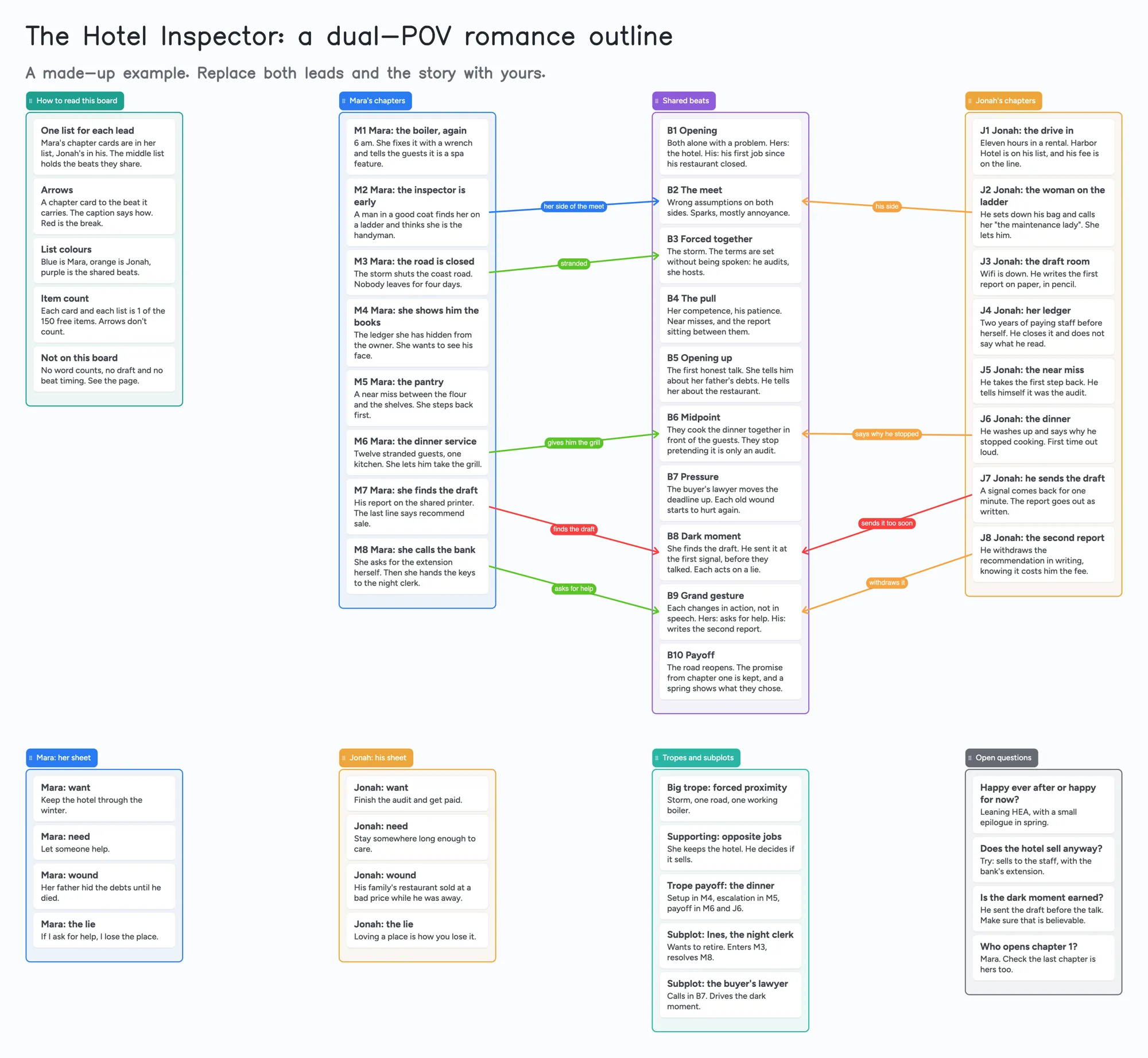
This is a way to outline a romance with two points of view: a list of chapter cards for each lead, a list of the beats the two of them share in the middle, and an arrow from each chapter to the beat it carries. It is an outline, not a draft and not a beat-sheet template. It has no word-count marks, no timeline and no manuscript. PlotProse and Plottr give you the beat sheets with placements, and the next section says how. Use the board for the part a spreadsheet does badly: seeing both leads' chapters side by side against the same beats, and letting a co-author or critique partner write in the other lead's list from a link.
Updated
The short answer
- What it is: one board with a list of chapter cards for each lead, a middle list of ten shared beats, a character sheet for each lead, a list of tropes and subplots, and a list of open questions. Each chapter card carries its lead's initial and a number, so you can see whose scene comes next.
- What it isn't: not a beat-sheet template with word-count marks, not a draft, no timeline and no manuscript. PlotProse's template has the placement marks and Plottr's Romancing the Beat template has twenty beats in a timeline. The board has the ten beats as cards you can move.
- Arrows: an arrow can join a card in one list to a card in another, takes a caption and its own colour, and stays attached when a card is reordered or a list moves. The example draws an arrow from each lead's chapter to the beat it carries; red marks the break.
- Free plan: the example is 56 of your 150 free items (48 cards and 8 lists, our count). Arrows, sections and pen strokes don't count. A book outlined with a card for every scene passes 150 (Pro is $5/mo billed yearly).
What this board doesn't do, and where PlotProse and Plottr are better
Read on November 11, 2026 from each tool's own pages. PlotProse's romance outline template has a ten-beat sheet with placement marks for an 80,000-word novel, a 24-chapter plan with a POV column, a character worksheet for two leads, a subplot grid and a blurb scaffold, and says you can copy it from the page; its separate printable PDF workbook sits behind an email form. Savannah Gilbo's guide fits the same ten story moments into three acts, with each moment given a share of an 80,000-word book.
Plottr's Romancing the Beat template, after Gwen Hayes's book, has twenty beats in four phases (setup, falling in love, retreating from love, fighting for love) and opens in timeline view; Plottr's page offers a 30-day free trial. Its pricing page, read the same day, lists Plottr at $60 a year for the desktop app, and Plottr Pro at $9.99 a month or $99 a year with the browser app, cloud sync and real-time collaboration.
Where these tools win
If you want placement marks for your word count, a timeline of twenty beats, a chapter grid with a POV column you fill in, or a series bible, use PlotProse or Plottr. Use this board when the question is how two leads' chapters line up against the same beats, and you want a co-author in the same place from a link.
How to outline a dual-POV romance on the board
A 2024 thread in r/writing asks for tips on outlining a dual-POV contemporary romance. One reply says to add whose chapter it is to the notes. Another keeps a spreadsheet with one lead's chapters highlighted in blue and the other's in pink, and gives both leads separate but intertwining arcs. A third says to be able to answer for each lead what they want, why, and why they can't have it, and to plan each lead's arc alongside the main plot. These are three people's methods, not rules.
- Make a list for each lead and one in the middle. Chapter cards go in their lead's list, in order, and each title starts with the lead's initial and a number (M3, J3).
- Put the shared beats in the middle list. Ten cards, in order, in your own words. PlotProse and Savannah Gilbo both use ten, with different names and marks; pick one and say which in the card.
- Draw an arrow from each chapter to the beat it carries. Caption it in a few words. Colour the break red. A beat with arrows from both leads is a scene both leads feel; a beat with an arrow from one lead only is a gap in the other's list.
- Fill in a sheet for each lead. Want, need, wound and the lie they believe. At the least, answer what they want, why, and why they can't have it, as one r/writing reply puts it. Keep it to four cards.
- Name your tropes and subplots. One card for the big trope, and where its setup, escalation and payoff land; one card per subplot with the chapter it enters and resolves.
- Put what you don't know in Open questions. HEA or happy for now? Is the dark moment earned? Move a question into a list the day you answer it.
- Share it. In the share menu set Share to "Anyone with the link can edit" (new boards start view-only). A co-author or critique partner signs in free and writes live, and you each see the other's changes within seconds. If you each own one lead's list, you never type into the same card; two people typing in one card merge keystroke by keystroke.
When a lead pulls the story somewhere else
A board is easy to rearrange, which suits a plan that your characters will pull on. Drag a chapter card to a different place in its list. Move a whole list. An arrow stays attached to its two cards. If you move a beat earlier, the arrows into it show which chapters now sit in the wrong order.
Our reading: that is also the limit. The board shows the order you chose, not whether the pacing works. It doesn't count words or tell you the dark moment landed at three quarters. For that, use the placement marks in a template from PlotProse or Savannah Gilbo's guide. For plotting a different shape of book, see outlining with index cards, a mystery outline, or outlining with a co-writer.
This board vs PlotProse vs Plottr vs a spreadsheet
| Tool | What we read (Nov 11, 2026) | Good at | Not what you get |
|---|---|---|---|
| Instaboard board | Free: 5 boards, 150 items. Pro $5/mo billed yearly | Both leads' chapters against the same beats on one screen; arrows from chapter to beat; a co-author on the same link after a free sign-in | Word-count marks, a timeline, a manuscript |
| PlotProse template | Ten-beat sheet with placement marks, 24-chapter plan with a POV column, worksheets; copy from the page; PDF workbook behind an email form | A structured fill-in plan with word-count marks | Arrows or a live board |
| Savannah Gilbo's guide | Ten story moments in three acts, each with a share of an 80,000-word book | Explaining the structure | A place to write your own plan |
| Plottr | Romancing the Beat template, twenty beats in timeline view; Pro $9.99/mo or $99/yr (browser app, real-time collaboration); desktop $60/yr; 30-day free trial | Timelines, templates and a series bible | A free board a partner opens from a link |
| Spreadsheet | One reply in the r/writing thread colours one lead's chapters blue and the other's pink | Sorting, counts, word totals | Seeing two leads against the same beats |
Swipe the table sideways to see every column.
From each tool's own pages, read November 11, 2026. The spreadsheet row is one reply in a 2024 thread, not a measurement.
Limits of the free plan for a romance outline
- Items. Each card and each list is 1 of your 150 free items, across all your boards. The example is 48 cards and 8 lists, 56 in all. Arrows, sections and pen strokes don't count.
- A full book passes 150. Our arithmetic: the example has 16 chapter cards, and a book outlined with a card for every scene, plus the sheets and the beats, can reach 150 on cards alone. Pro is $5 a month billed yearly.
- Boards. The free plan includes 5 boards. A card that opens its own board uses one of them, so the example keeps everything on one board.
- Photos. 3 images per board. The example has none. A mood board of pictures for the setting fills those 3 quickly.
- No word counts or sorting. Nothing adds up your chapter lengths. Card colour is the border and text only.
- No manuscript. Put a one-line summary on the card and keep the chapter in your writing app.
- Writing needs a free sign-in. A co-author who joins by link or code can add cards and arrows, and the board counts as one of their 5.
Start from the ready board
It opens in your browser in a few seconds, with nothing to install. Sign in for free when you want to save it and share it.
Questions
Is there a free romance novel outline template?
Yes. Open the board, replace the example leads with yours and turn on "Anyone with the link can edit" if a co-author needs to write on it. It is a board of cards, lists and arrows, not a beat sheet with word-count marks; PlotProse's template has those.
How do I outline a dual-POV romance?
One way is a list of chapters for each lead and a list of shared beats between them, with an arrow from each chapter to the beat it carries. Other writers use a spreadsheet with one lead's chapters in each colour, or just add whose chapter it is to their notes. All three are single accounts in a 2024 r/writing thread.
Can my co-author or critique partner work on it with me?
A person who opens the link and signs in free can write on it live; you each see the other's changes within seconds. The board counts as one of their 5 free boards, and the cards they add count toward their own 150 items.
How many cards fit on the free plan?
Each card and each list is one item of the 150 across all your boards. The example is 56. That is our arithmetic. Arrows are free.
Sources
- PlotProse: free romance novel outline template + beat sheet (read November 11, 2026)
- Savannah Gilbo: how to outline a romance novel (read November 11, 2026)
- Plottr: Romancing the Beat template (read November 11, 2026)
- Plottr: pricing (read November 11, 2026)
- r/writing: any tips on outlining dual pov? (April 2024, replies are single accounts)
Related
A mystery novel outline board for suspects, clues and red herrings
Outline a mystery novel on one board: a list per suspect, clues, red herrings and reveal order. A free ready board, and where Plottr and Sheets do more.
Outline a novel or screenplay with index cards, on a board you can share
Outline a novel or screenplay on digital index cards: one list per act, 40 short cards, subplot arrows, a co-writer on the same board. Free to start; TV pilot too.
Outline a story with a co-writer, on one board you both edit
Outline a story with a co-writer on one shared board: ideas lists for each of you, an agreed outline, a decide-by list. A filled example to copy. Not a drafting tool.
Character relationship map: a filled template two people can edit
A filled character relationship map to copy: factions, a card per character and captioned arrows for who wants what. Edit it together with a co-writer. Free plan limits stated.