For a small product team that wants a roadmap without dates
A now next later roadmap template on one shared board
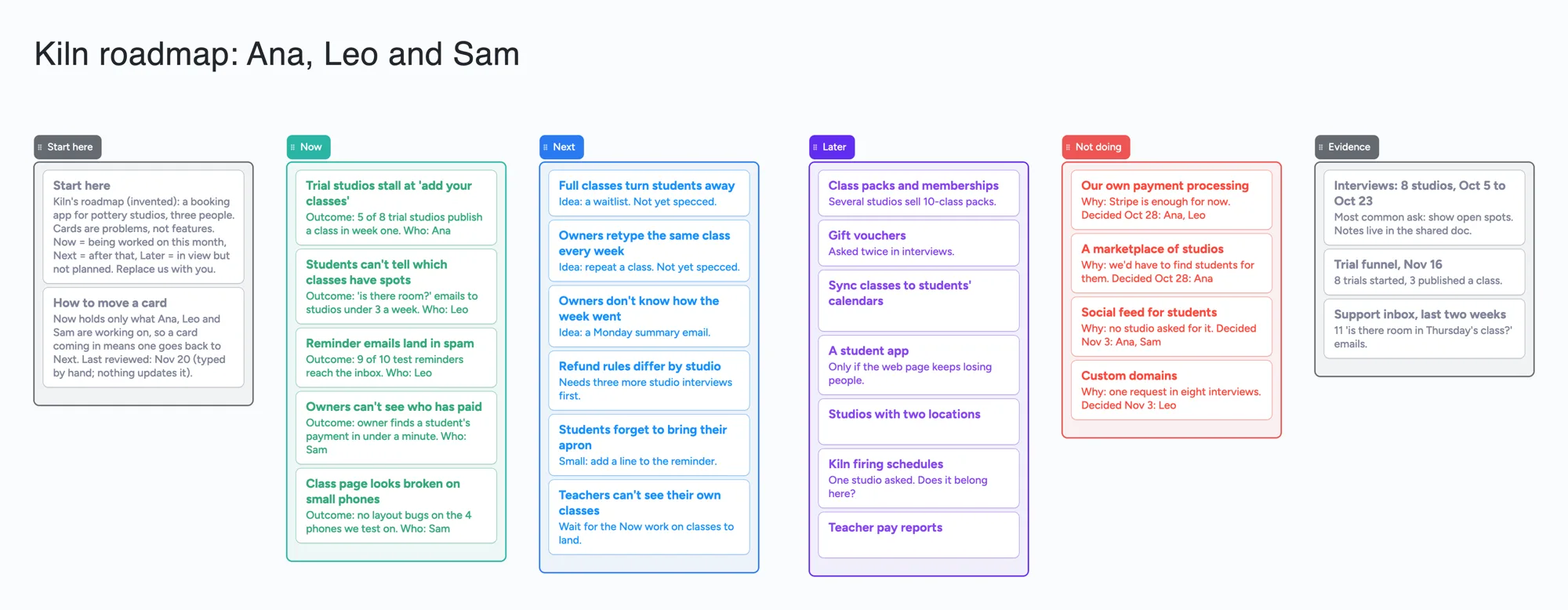
We make Instaboard, a free online board. This page gives you a now next later roadmap already laid out on it, filled in for an invented three-person team, Kiln (Ana, Leo and Sam), who build a booking app for pottery studios. Six lists: Start here, Now, Next, Later, Not doing and Evidence. Each card is a problem with an outcome, not a feature. Open it, swap Kiln for your product and send the link to the people who decide. It is a roadmap you read by eye: no date axis, no timeline, no votes, no reminders. If you need those, tools built for roadmaps do them better, and below we say which.
Opens in your browser. Anyone can view; a free sign-in lets you edit.
Updated
Read this first: what the board does and doesn't do
- What it is: one screen where a small team sees what it is working on now, what comes after, what is only in view, and what it decided not to do. Kiln's board uses 34 of your 150 free items.
- What it is not: no date axis or timeline, no votes, no effort or priority fields, no reminders. Months and review dates are text you type in a card.
- The one rule that keeps it honest: Now holds only what the team is working on this month. A card coming in means one goes back to Next. Nothing enforces that; the team does.
- Why a board at all: everyone you share it with sees the same roadmap and can add or move a card live. Anyone who joins can view it; to change it they sign in free.
- Free and Pro: Free keeps 5 boards, 150 items and 3 pictures per board. Pro is $5 a month billed yearly ($59.99 a year), or $7.99 monthly, and adds no image limit, invite-only boards and per-person permissions.
What a now next later roadmap is, in two lines
It sorts work into three horizons instead of dates: Now (being worked on), Next (after that), Later (in view, not planned). ProdPad's founder describes the format on ProdPad's blog as organizing initiatives into three horizons rather than fixed delivery dates; Atlassian's roadmap guide suggests mapping initiatives to Now, Next and Later to keep prioritization talks on goals rather than timelines (both pages read November 22, 2026; ProdPad's page shows no date we could read). The ProdPad page is a vendor describing its own format.
What the board adds is the part most templates leave out: a Not doing list and an Evidence list, so the reasons stay beside the plan.
Kiln's board, list by list
The example is invented. Ana, Leo and Sam build a booking app for pottery studios. Here is what each list holds.
| List | What goes in it | In Kiln's roadmap |
|---|---|---|
| Start here (grey) | Two cards: what the board is, and the rule for moving a card | "Now holds only what Ana, Leo and Sam are working on" |
| Now (green) | A problem, the outcome you will check, and one first name | "Trial studios stall at 'add your classes'" Outcome: 5 of 8 trial studios publish a class in week one. Who: Ana |
| Next (blue) | A problem plus one line: an idea, or what it waits for. Not specced yet | "Full classes turn students away" Idea: a waitlist. Not yet specced |
| Later (purple) | A thing you can see coming. Title only, or one line of why it is here | "Class packs and memberships" Several studios sell 10-class packs |
| Not doing (red) | What you decided against, why, when and who | "Our own payment processing" Why: Stripe is enough for now. Decided Oct 28: Ana, Leo |
| Evidence (grey) | The few facts the roadmap rests on, each with a date | "Trial funnel, Nov 16": 8 trials started, 3 published a class |
Swipe the table sideways to see every column.
The board's own wording. Dates and the Last reviewed line are text typed by hand; nothing updates them.
One problem, start to finish
- Later. Leo hears "is there room in Thursday's class?" from studio owners and adds "Students can't tell which classes have spots" to Later, title only.
- Evidence. Sam counts 11 of those emails in two weeks and adds an Evidence card with the date. Now there is a reason to move it.
- Next. At the monthly review Ana moves the card to Next and adds one line: what it waits for.
- Now. When a Now card is finished, one Next card moves up and the team writes the outcome they will check ("'is there room?' emails to studios under 3 a week") and who owns it.
- Not doing, with the reason. When a request is turned down (a social feed for students), the card goes to Not doing with Why, the date and who agreed, so it is not reopened by accident.
Everyone with edit access can change any card, so agree a rule between you: for example, only the person named in Who rewrites an outcome, and a card is moved only at the review. That is a team agreement, not something the board enforces.
No dates: where a timeline tool is better
The format exists to avoid dates, so a board without a date axis fits it. But say what that costs. If a stakeholder asks "which month does this ship?", the board has no answer except what you type. One person on r/ProductManagement said stakeholders who ask for a roadmap often mean a release plan, and a different format does that job (u/whitew0lf, see below). For release dates, a timeline or Gantt view in a roadmap tool or a spreadsheet is the better home.
- You need a date axis or a Gantt view with dependencies.
- You need a roll-up for leadership, with votes, effort or scores.
- You want it connected to tickets. The board has no link to your issue tracker.
- You need to be told when something changes. The board sends no notifications.
Does it fit in 150 items?
Each card and each list is 1 of your 150 free items, across all your boards. The title text box counts too. Arrows, sections and pen strokes don't. Our arithmetic from Kiln's lists:
- As built: 6 lists + 27 cards + the title = 34.
- Fixed items: 6 lists + 2 Start here cards + the title = 9, which leaves 141 problem and evidence cards.
- A second product on its own board of the same size adds another 34: 68 across the account.
- The pile grows at the back. If Later gets 3 new cards a week and nothing is pruned, 34 + 116 = 150 is reached in about 39 weeks. The Not doing list is a reason to prune.
A three-person team that prunes at its monthly review stays well inside Free. A team that never prunes Later will meet the limit within the year, and a pruned Later is also a better roadmap.
What a board can't do for a roadmap
- Show time. No date axis, timeline or Gantt. A month in a card is text.
- Vote or score. No voting, effort or priority fields. A vote means a different tool or a conversation.
- Remind or notify. No reminders, due dates or alerts. Atlassian's roadmap guide describes tools that notify all participants of a project when the roadmap changes; this board does not.
- Show who changed what. We make no claim of an edit history. Type owners and decision dates into the cards.
- Link to tickets. No connection to an issue tracker.
- Enforce Now. Nothing stops the team putting twelve cards in Now. That is the whole discipline of the format.
- Offline. Changes made offline are kept and sync when you're back online.
Where other tools do this better
Read November 22, 2026. Prices change, so check the page before you buy. No ranking: they suit different teams.
| Tool | What its page says | Better than a board at | Where a board fits |
|---|---|---|---|
| Miro | Its Now Next Later templates collection lists several templates, including a Product Roadmap Now/Next/Later/Trash. Free is 3 editable boards; Starter is $8 per member a month billed yearly, with timer and voting | Voting and timer, many templates, a big canvas for workshops | A single fixed roadmap that sits next to the call; Miro's free boards stop at 3 |
| ProdPad | Vendor of roadmap software; its blog describes the format as three horizons rather than fixed dates | Roadmaps tied to objectives and ideas, built for product teams at scale | A free, copyable layout for two to five people |
| Jira Product Discovery | Atlassian's pricing page: Free for 3 creators, Standard $10.50 per creator a month, Premium $26.25 (the text we read doesn't say which billing setting was shown) | Linking ideas to Jira work, fields, views, notifications | Teams that don't use Jira |
| Trello | Free: 10 collaborators and 10 boards per Workspace, with assignee and due dates. Timeline is Premium at $10 per user a month billed annually | Due dates, assignees, automation, a timeline view | A roadmap read by eye, with no due dates to maintain |
| Notion | Notion's Simple Roadmap 2026 template is listed free (price 0 USD on its marketplace page); the page text we read doesn't describe its structure | A Notion workspace around the roadmap | One screen, no setup, link only |
Swipe the table sideways to see every column.
From each vendor's own pages, read November 22, 2026. Only the Miro, Trello and Atlassian pricing pages state prices; the ProdPad blog and the Notion template page show no date we could read (the Notion page shows only review dates). Instaboard isn't affiliated with any of these.
What product managers say
On r/ProductManagement (thread posted December 2, 2024; read November 22, 2026, every comment the page loaded, 25 of 32; the original poster's account is deleted), people were asked which roadmap format they use. Replies, each one person's view:
- u/whitew0lf: "Now, next, later"; says stakeholders who ask for a roadmap often mean a release plan.
- u/foobar0001: says now, next, later is the best format and not to use a Gantt timeline because timeframes keep changing; starts from the two or three most important problems.
- u/PawelHuryn: "Do not overcomplicate it"; favourite format is now, next, later.
- u/kashin-k0ji: a Google Sheet with Now, Next and Later segments.
- u/Sea-College-9621: uses Miro templates.
- u/GeorgeHarter: a simple one-year timeline slide instead.
- u/kgglobocorpintlinc: uses Aha! and likes now, next, later, but says a company with legacy process may find anything but hard dates a challenge.
- u/PocketCPO: says now, next, later is good for roadmap columns but risks looking like a list of stuff to executives.
So the format is liked for staying simple, with two cautions from these replies: it can look like a list to executives, and some companies still expect hard dates. This board is the simple end: it makes the list visible and gives it a Not doing list, and that is all.
Set up your own, in order
- Open the board and replace Kiln. Delete the Kiln cards as you go so the roadmap is never half theirs.
- Write problems, not features. "Trial studios stall at 'add your classes'", not "Class wizard".
- Fill Now first, and keep it small. Each Now card gets an outcome you can check and one first name.
- Put the rest in Next and Later. Next cards are not specced yet; Later is title-only.
- Move what you turned down to Not doing, with why, the date and who agreed.
- Add three or four dated Evidence cards. If a card has no evidence, it belongs in Later.
- Share it. Set the share setting so anyone who joins can edit ("Anyone who joins can edit"); new boards start view-only, and each person signs in free to write.
- Pick a review habit. For example, the first Monday of the month: finished Now cards out, Next cards up, Later pruned, and the Last reviewed line retyped.
Limits of the free plan for this board
- Items. Each card and each list is 1 of 150 free items across your account; the example is 34. Arrows, sections and pen strokes don't count.
- Boards. 5 on the free plan. "Make a copy" takes 1 of them.
- Pictures. 3 per board. The example has none; link to a mockup instead.
- Writing needs a free sign-in. Anyone with the link can read the board; to change it they sign in free, and the board then counts as 1 of their 5.
- Private roadmaps. A link board is not the place for unannounced plans you don't want shared; invite-only boards are a Pro feature.
Start from the ready board
It opens in your browser in a few seconds, with nothing to install. Sign in for free when you want to save it and share it.
Questions
Is there a free now next later roadmap template?
Yes, several: Miro's collection of Now Next Later templates, a free Notion roadmap template, and the ready board here. The board here has six lists (Start here, Now, Next, Later, Not doing, Evidence) and is free within 5 boards and 150 items. You read it and move cards; it has no timeline, votes or reminders.
What goes in Now, Next and Later?
Now is what the team is working on this month, with an outcome you will check and an owner. Next is what comes after, not yet specced. Later is what you can see coming but have not planned. On this board a card moving into Now sends one back to Next, so Now stays small.
Do now next later roadmaps have dates?
The format is described as using three horizons rather than fixed delivery dates (ProdPad's blog, Atlassian's roadmap guide). This board follows that, so it has no date axis. If someone needs a release date, a timeline tool or a spreadsheet is the better home.
Why a Not doing list?
It keeps turned-down ideas and the reason beside the plan, so the same request is not reopened by accident. Each card says why, when it was decided and who agreed. The date is text you type.
Can the board vote or remind us to review?
No. Instaboard has no voting, due dates or reminders. Put the review date in your calendar app, and type a Last reviewed line on the Start here card. For voting, use a tool that has it, such as Miro's Starter plan.
How many cards fit on the free plan?
Each card and each list is 1 item of the 150 across your account. The example is 6 lists, 27 cards and the title, 34 items, so 116 more items fit within 150. A second product on its own board takes 34 more. That is our arithmetic, and your other boards share the 150.
Sources
- r/ProductManagement: roadmap formats thread (posted 2024-12-02; replies by u/whitew0lf, u/foobar0001, u/PawelHuryn, u/kashin-k0ji, u/Sea-College-9621, u/GeorgeHarter, u/kgglobocorpintlinc, u/PocketCPO; every comment the page loaded read November 22, 2026)
- ProdPad: Why I Invented the Now-Next-Later Roadmap (a vendor's description of its own format; read November 22, 2026; page shows no date we could read)
- Atlassian: Product roadmaps guide (initiatives mapped to Now, Next and Later; tools that notify participants; read November 22, 2026; no date seen)
- Atlassian: Jira Product Discovery pricing (Free 3 creators, Standard $10.50, Premium $26.25; read November 22, 2026)
- Miro: Now Next Later templates collection (read November 22, 2026; page shows no date)
- Miro: pricing (Free 3 editable boards, Starter $8 per member a month billed yearly; read November 22, 2026)
- Trello: pricing (Free 10 collaborators and 10 boards per Workspace; Timeline on Premium; read November 22, 2026)
- Notion Marketplace: Simple Roadmap 2026 template (listed free; read November 22, 2026; page shows review dates only)
Related
A decision log template on one shared board: open, decided, revisit, reversed
A decision log template on one shared board for two to five people: open questions, decided with the why, revisit on a date, reversed. When a spreadsheet or Notion is the better home.
A GTD template on one shared board: inbox, next actions, projects and a Friday review
A Getting Things Done style template on one shared board: inbox, next actions by context, projects, waiting for, someday and a Friday review. What a board can't do, and the apps that can.
An online course outline on one shared board: outcomes, then a list per module
An online course outline on one shared board: outcomes first, then a list per module with its lessons, activity, quiz and resource. Open it, swap in your course and share the link.