For game masters running a campaign
DnD NPC tracker online: a filled board you can share with your table
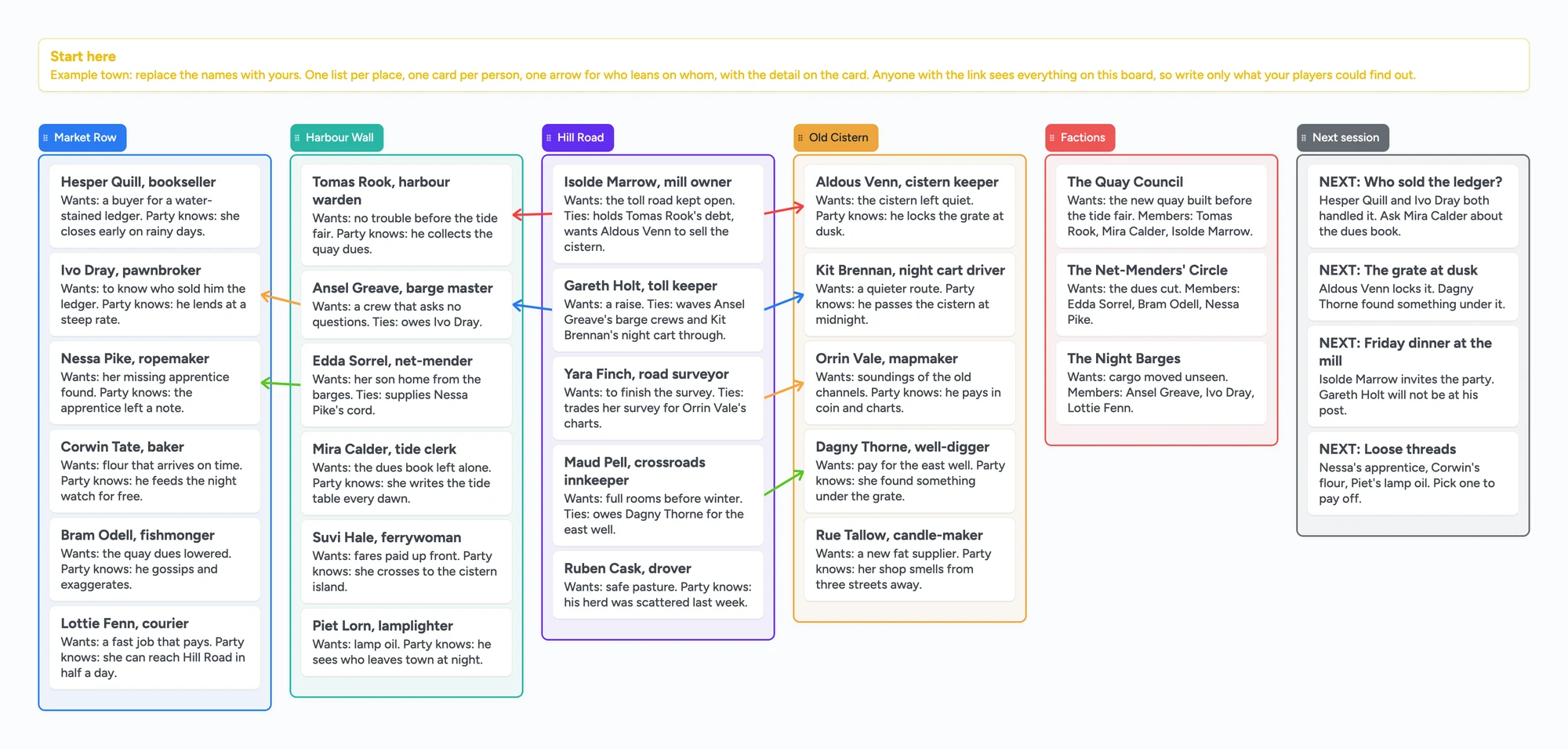
Most NPC trackers are a printed sheet or a wiki you have to set up. This page gives you a filled board to copy: a town of 22 invented people sorted by place, three factions, a next-session list, and arrows for who leans on whom. Open it, swap in your own people, and send one link to your table. One thing first: everyone who has the link sees everything on the board, so this is a tracker for what your players could find out, not for your secrets. The section below says what to use for those.
Updated
The short answer
- One list per place, one card per person. Each card has two lines: what they want, and what the party knows. A Factions list says who belongs to which group, and a Next session list keeps the threads you want to pick up.
- Everyone with the link sees everything. There are no hidden DM notes on the free plan, and a card can't be hidden from one person. Per-person permissions and invite-only boards are on Pro. Write only what your players could find out.
- Players can read it without an account. Anyone with the link sees every list, card, arrow and caption. To write, a player signs in free; until then their edits are blocked. Set Share to "Anyone with the link can edit" if players or a co-DM should add cards, and they can add their own arrows and captions too.
- Free plan limits, up front: 5 boards, 150 items across all your boards, 3 pictures per board. Every card and every list is one item. The ready board is 36 items.
- Where others are better: Kanka is free with unlimited entries and has private relations, World Anvil and LegendKeeper keep secrets, LegendKeeper has search and maps, and Obsidian is free and local.
What this board is for, and what it isn't
The board is a set of lists and cards. A place is a list, a person is a card, and an arrow shows who leans on whom. You move things by hand. That makes it a good fit for one job: a cast of people you want to see all at once, where your players can look at the same board between sessions.
It isn't a campaign manager. It has no search, no links between pages, no map with pins, no dice and no rules content, and it doesn't hold stat blocks. If you're tracking a cast of a few dozen people by where to find them, that is enough. If you want a wiki, see below. For a cast of characters in a novel or a screenplay rather than a campaign, see the character relationship map.
How to set it up
- Open the ready board above. Rename the lists to your places: towns, districts, dungeons, courts or ships. Replace the example people with yours.
- Write two lines on each card. What they want, and what the party knows. Add a "Ties" line for who they deal with.
- Put each group in the Factions list. A faction card names its members, so you can find them without scrolling every list.
- Draw arrows between people who lean on each other. An arrow from one card to another shows who is leaning on whom.
- Keep a Next session list. Start each card with "NEXT:", and delete it once you've used it.
- Share the link. Set Share to "Anyone with the link can edit" only if you want players to write. Players open the link and read everything with no account; they sign in free if they want to add a note, an arrow or a caption of their own.
Keep the yellow "Start here" card until you've replaced the example town, then delete it.
The free-plan limits, before you build
Instaboard's free plan allows 5 boards and 150 items per account, with 3 pictures and 1 file per board. Each card and each list is one item; arrows and pen strokes don't count. The ready board has 30 cards and 6 lists, so it is 36 items. Pro is $5 a month billed yearly ($59.99), or $7.99 monthly.
Our own arithmetic: eight places with about twelve people each is 96 cards plus 8 lists, about 105 items before factions and session cards. That fits on one board. A second campaign board of the same size passes 150, because the limit counts all your boards together. A card that opens into its own board counts toward your 5, so keep a campaign on one board rather than one board per town.
A board someone opens from your link takes one of their own 5 free board slots. A card a player adds counts toward their own 150, not yours.
Maps and portraits: three pictures per board
The free plan allows 3 pictures per board, so the ready board has none: each person is a text card. A map is a picture, so it takes one of the 3. A link card that shows a picture preview, such as a link to a character page, also takes one. For maps with pins, Kanka and LegendKeeper are built for it (below).
When something else is the better choice
- You want a free wiki with no entry cap. Kanka's pricing page (read November 7, 2026) lists the free plan as unlimited entries and unlimited campaigns, with 3 MiB uploads. Its features page (same date) says you can control what each member sees, set a relation to private, and add maps with pins you can hide from players. A visual explorer for relations is listed under premium campaigns, and its Owlbear plan is $4.99 a month.
- You want secrets and a published world. World Anvil's pricing page (read November 7, 2026) lists a free plan with 2 worlds, and Master at $7 a month or $54 a year with private worlds and articles, secrets, whiteboards, 4 co-authors and 10 subscribers.
- You want search, maps and secrets in one wiki. LegendKeeper's features page (read November 7, 2026) lists full-text search, maps with pins, timelines, whiteboards, real-time collaboration, and granular permissions and secrets. Its pricing page (same date) says creating a project needs a subscription, $9 a month or $7.50 a month billed annually after a 14-day trial with no card, and guests join free.
- You want a campaign site with hidden content. dndcampaignplanner.com's home page (read November 7, 2026) lists network diagrams, hidden content for players and a GM screen. Its pricing page (same date) lists a free Basic plan with 1 campaign and 50 campaign items, and paid plans at $5, $10 and $15 a month.
- You want free, local notes you can link. Obsidian's pricing page (read November 7, 2026) says it is free with no sign-up, and its Sync add-on, $4 per user per month billed annually, lets people collaborate on shared vaults. In r/DMAcademy threads from 2023 and 2025, several game masters name it for linked NPC notes and a graph; those are their own views.
- You want an official printable sheet. D&D Beyond's Tracking Sheets page (read November 7, 2026) offers an NPC Tracker as a free PDF to download. Its fields include a stat block reference and a secret for each person, which this board doesn't have.
What the board doesn't do
- No hidden notes. Everyone with the link sees every card. Per-person permissions are on Pro.
- No search, no links between cards and no wiki pages.
- No maps with pins, no timeline and no calendar.
- No stat blocks, dice or rules content.
- No session scheduling or reminders.
- Writing needs a free sign-in.
- 3 pictures per board, 5 boards and 150 items on the free plan.
About the name
Instaboard is not affiliated with Wizards of the Coast. "D&D" and "DnD" are used on this page only to name the game this board is meant for. The people, places and factions on the ready board are invented, and the board holds no rules content from any game.
Start from the ready board
It opens in your browser in a few seconds, with nothing to install. Sign in for free when you want to save it and share it.
Questions
Is there a free DnD NPC tracker online?
Yes. The ready board on this page is free to open and copy; you sign in free with Google, Apple or email to edit it. The free plan has 5 boards, 150 items and 3 pictures per board. Kanka is a free wiki with no entry cap.
Can I hide notes from my players?
Not on the free plan. Everyone who has the board link sees the whole board, and a card can't be hidden from one person. Per-person permissions and invite-only boards are on Pro. Kanka, World Anvil, LegendKeeper and dndcampaignplanner.com each say they can hide content from players.
How many NPCs fit on the free plan?
The free plan allows 150 items across all your boards, and each person is one card. A campaign with about 100 people on one board fits; a second campaign board of the same size does not.
Can my players add notes?
Yes, if you choose "Anyone with the link can edit" in Share. They sign in free to write, and a card a player adds counts toward their own 150. They can add arrows and captions too.
Can I put stat blocks on it?
The ready board has none, and the board has no rules content or dice. You can type anything on a card yourself, but the free plan's 150 items go quickly if every person gets several cards. For a printable sheet with a stat block reference, see D&D Beyond's free PDF.
Can I add maps and portraits?
Up to 3 pictures per board on the free plan, and a link card with a picture preview counts as one of them. Pro has no picture limit.
Is Instaboard free?
Yes. The free plan includes 5 boards, 150 cards and items across your account (pen strokes, arrows and sections don't count), 3 images and 1 file per board, unlimited collaborators and video calls up to an hour. Pro is $5 a month billed yearly ($59.99 a year), or $7.99 monthly, and the people you invite join free.
Sources
- Kanka: plans and pricing (read Nov 7, 2026)
- Kanka: features (read Nov 7, 2026)
- World Anvil: Guild membership pricing (read Nov 7, 2026)
- LegendKeeper: pricing (read Nov 7, 2026)
- LegendKeeper: features (read Nov 7, 2026)
- RPG Campaign Planner: home page (read Nov 7, 2026)
- RPG Campaign Planner: pricing (read Nov 7, 2026)
- Obsidian: pricing (read in full Nov 7, 2026)
- D&D Beyond: Tracking Sheets (read Nov 7, 2026)
- D&D Beyond: NPC Tracker sheet, PDF (read in full Nov 7, 2026)
- r/DMAcademy: "I need to create a relationship web" (read in full Nov 7, 2026)
- r/DMAcademy: "As a DM, how do you organise and track your NPCs?" (read in full Nov 7, 2026)
Related
Character relationship map: a filled template two people can edit
A filled character relationship map to copy: factions, a card per character and captioned arrows for who wants what. Edit it together with a co-writer. Free plan limits stated.
Outline a novel or screenplay with index cards, on a board you can share
Outline a novel or screenplay on digital index cards: one list per act, 40 short cards, subplot arrows, a co-writer on the same board. Free to start; TV pilot too.
A mystery novel outline board for suspects, clues and red herrings
Outline a mystery novel on one board: a list per suspect, clues, red herrings and reveal order. A free ready board, and where Plottr and Sheets do more.