For a small team that has one recurring problem and several theories about it
A fishbone diagram template made of lists: one problem, six lists of possible causes, and what to look at first
A fishbone, or cause and effect, diagram sorts the possible causes of one problem into named groups. This board does it with lists instead of bones, and it says so first: there is no fish, no spine and no ribs, only a problem card, six lists of causes and two lists that record what the group did with them. We make Instaboard, and the example is filled in for an invented print shop. Lidia, Osmund and Ivo at Tallowmere Copy & Print, with Pia who joined this year, ask why rush orders go out after the time promised at the counter. It has eleven lists and 33 cards, and every person and business on it is invented.
Opens in your browser. Anyone can view; a free sign-in lets you edit.
Updated
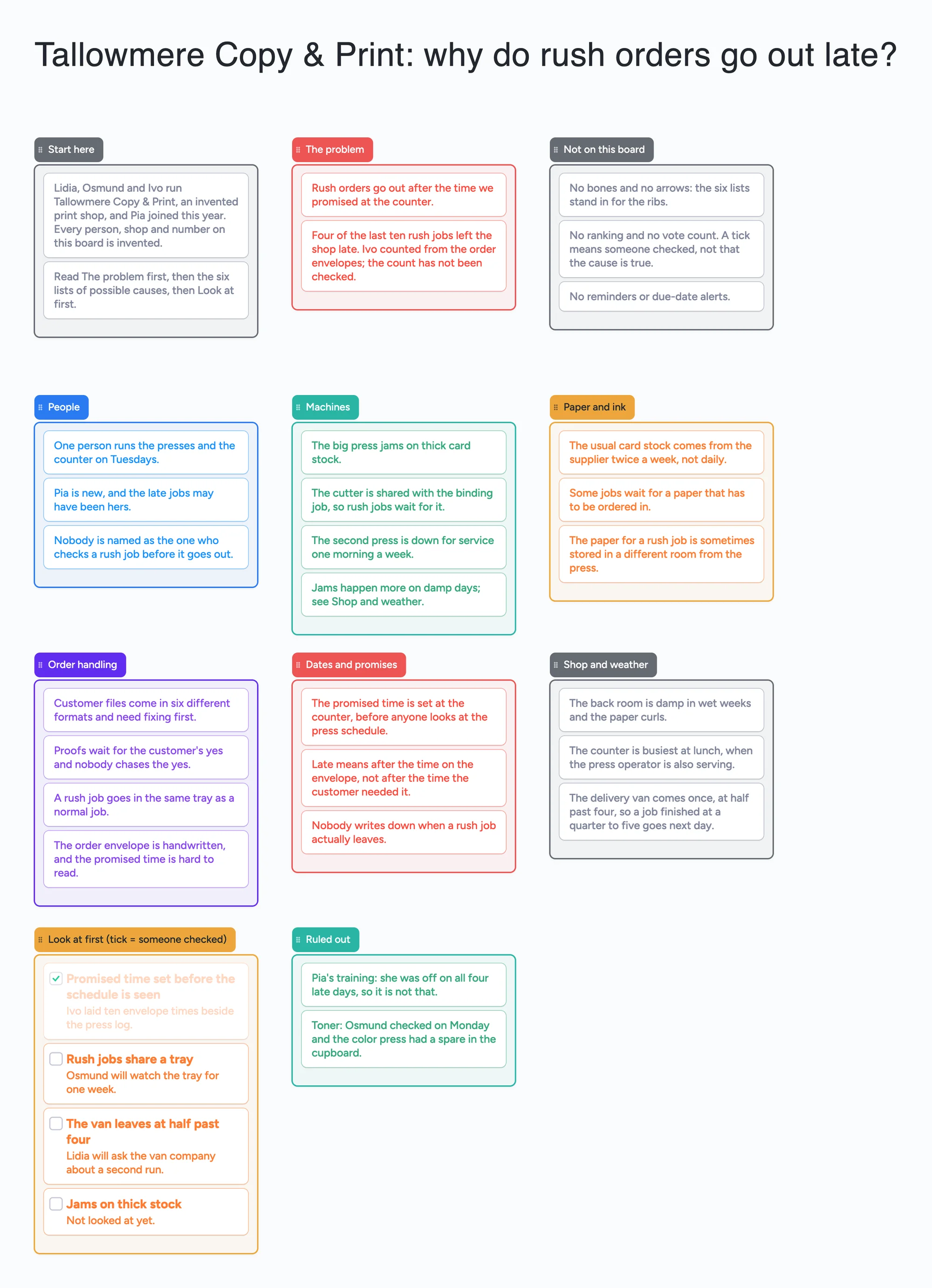
This board at a glance
- Use: one place where a few people who know a problem write each possible cause under a named group, then pick the causes to check first and park the ones they have ruled out. It takes 45 of the free plan's 150 items.
- Not: a drawn fish. Each cause is a card in one list, there is one level of cause, and nothing ranks or scores them.
- Where it fits (our view): three to eight people with a problem that keeps returning and no agreement about where to look.
- Poor fit: a problem whose cause you can already name, a safety incident that needs a formal record, or a team that wants the diagram on a slide.
- Privacy: leave customers and staff out by name; whoever holds the link can read the board.
These are lists, not bones: what you keep and what you give up
The pages we read describe a fish: ASQ says to "draw a horizontal, right-facing arrow in the center of the page" for the spine, write the problem at its end like the fish's head, and draw the main categories as ribs. A board of lists does not do that. The problem sits in a list called The problem, each category is a list, and each cause is a card under its category.
- Kept: sorting causes into named groups, writing one cause per card, letting several people add to the same view, and carrying the result forward to the checks the group will make.
- Given up: the picture of a fish, causes branching off causes, and any line from a cause to the problem. A card is a cause or it is not on the board.
- Added: a Look at first list with tick boxes and a Ruled out list, so the board also records what happened to each cause.
If the picture is what you need, for a slide or for a room that thinks in shapes, a drawn template is the better tool; the section on that is below.
Which lists? The pages disagree about six, and one says to name your own
ASQ's page, which says it was reviewed October 2024, gives Ishikawa's six categories as Materials, Machinery, Methods, Measurement, Manpower and Mother Nature, mentions a seventh, Money, as "less commonly included but useful for contemporary diagrams", and adds that he "also encouraged creativity in naming these categories to communicate more clearly to those who would be using the diagram". The Institute for Healthcare Improvement (IHI) says to use the classic diagram "when causes group naturally under the categories of Materials, Methods, Equipment, Environment, and People". Figma's page lists six ribs: People, Machines, Materials, Environment, Method and Measurement. GoLeanSixSigma gives the 6 Ms and a 6 Ps version: People, Process, Program, Product, Policy and Place.
Tallowmere's group used its own names: People, Machines, Paper and ink, Order handling, Dates and promises, and Shop and weather. Our reading is that Paper and ink stands where Materials would, Order handling where Methods would, and Shop and weather where the environment would. Dates and promises has no match in any of the lists above; it is there because the problem is about a promise made at the counter. Measurement has no list of its own: the card "Nobody writes down when a rush job actually leaves" sits under Dates and promises.
What each of the eleven lists holds
- Start here. Two cards: who runs the shop and that Pia is new, a note that everything on the board is invented, and the order to read it in.
- The problem. Two cards. The effect, in one line: rush orders go out after the time promised at the counter. The second card says four of the last ten rush jobs left late, counted by Ivo from the order envelopes, and that the count has not been checked.
- Not on this board. Three cards: no bones or arrows, no ranking or vote count, and nothing that sends a reminder.
- People. Three cards: One person runs the presses and the counter on Tuesdays; Pia is new; nobody is named as the one who checks a rush job before it goes out.
- Machines. Four cards: A press that jams on thick card stock, a cutter shared with the binding job, a second press down for service one morning a week, and a pointer to the damp card.
- Paper and ink. Three cards: Card stock delivered twice a week, some jobs waiting for paper that has to be ordered in, and paper stored in a different room from the press.
- Order handling. Four cards: Customer files in six formats, proofs waiting for a yes nobody chases, rush jobs sharing a tray with normal ones, and a handwritten envelope.
- Dates and promises. Three cards: The time is promised before anyone looks at the press schedule, "late" is measured from the envelope and not from when the customer needed it, and nobody records when a job leaves.
- Shop and weather. Three cards: A damp back room, a busy lunchtime counter, and one van run at half past four.
- Look at first (tick = someone checked). Four cards, one ticked. Four causes. Three carry a name and a next step; the fourth, jams on thick stock, says it has not been looked at yet. Only the promised-time card is ticked, because Ivo laid ten envelope times beside the press log.
- Ruled out. Two cards: Pia's training and the toner, each with the reason it was set aside. Pia's training is a cause card under People that stays where it was written; the toner was raised in the room and never got a cause card. Ruled out records why neither needs a look.
A cause that belongs in two lists
ASQ's procedure says "Causes can be written in several places if they relate to several categories", and its second example shows it: in a plant looking for the source of iron contamination, "Calibration" appears under Methods as part of the analytical procedure and under Measurement as a cause of lab error, and "Iron tools" appears under both Methods and Manpower.
On this board a card lives in one list. Tallowmere's jams on damp days are a Machines problem and a Shop and weather problem, so the damp-room card sits under Shop and weather and the Machines card about jams ends "see Shop and weather". That keeps the item count down and keeps one card to edit, but nothing links the two except those words. If you would rather connect them, an arrow from one card to the other is possible and arrows do not count toward the 150; the example does not use any.
From a long list to Look at first: a tick is not a verdict
Figma's page warns that "a problem's main causes aren't necessarily ranked ahead of minor ones. It's up to you and your team to prioritize issues that will have the most impact versus those that won't", and that fishbone diagrams can reflect human biases. IHI's page says the diagram helps teams understand that "there are many causes that contribute to an effect", and the Iowa Department of Management describes it as a process that "assists a team to get beyond symptoms to address root causes of a problem". On choosing where to look first, ASQ says to "analyze the identified causes to determine those that should be addressed further" and names a responsibility matrix and, in its second example, a check sheet as follow-up tools.
The board does not choose either. It does not count votes, rank or add anything up. The Look at first list is where the group types its own choices, each with a name and a plain next step, and the tick means that someone looked, not that the cause is real. In the example the ticked card is the promised-time cause: Ivo compared ten envelope times with the press log. The other three are still guesses. Ruled out keeps the reasons so that a later reader does not raise the same cause again; Pia's training still sits under People, and the toner never had a cause card. Nobody is prompted to do what a card says.
When a drawn diagram or a form to fill in is better
- You need the fish. Miro's fishbone page shows 34 templates and Canva's shows 187 (we saw the first 50), and ASQ offers a downloadable template, all for drawing the fish. If the output goes on a slide or a poster, start there.
- You need a form for the record. IHI's tool is a PDF template behind a short form, and its page says to save the file to your computer before filling it in or the changes will not be saved. The Iowa page offers a copy in Google Docs or a DOCX download.
- You need sub-causes. ASQ says to write sub-causes as branches off the causes and to "Continue asking 'Why?' to generate deeper levels of causes", so that layers of branches show how causes relate. This board has one level. A chain that goes deeper belongs in a method built for it, such as five whys, or in a drawn diagram.
- You already know the cause. If everyone agrees where the problem starts, a fishbone only delays the fix.
Five pages, what each gives you
All five were read start to finish in a browser on November 27, 2026. The order is not a ranking. Columns two to four report the page; the last column is our opinion.
| Page | What it gives you | Categories it names | What lists on a board add (our view) |
|---|---|---|---|
| ASQ: Fishbone (reviewed October 2024; professional body) | Procedure, two worked examples, variants such as a process fishbone | The 6 Ms and a seventh, Money; names may be your own | A shared place for the cards; the page's deeper branches stay on paper |
| IHI: Cause and Effect Diagram (no date printed) | Instructions, an example and a PDF template behind a short form | Materials, Methods, Equipment, Environment, People; or a process version | Cards in lists in place of a PDF; the PDF is better when you need a form for the record |
| Iowa Department of Management: Fishbone Diagram Template (no date printed) | A definition and a template to copy or download | Not listed on the page | The same sorting, with several people writing at once |
| Figma: What is a fishbone diagram (no date printed; vendor) | Five steps and a six-rib list | People, Machines, Materials, Environment, Method, Measurement | A board of lists for teams that do not need the picture; FigJam is better for drawing |
| GoLeanSixSigma: Fishbone Diagram (no date printed; training company) | A short summary of the method | The 6 Ms, or the 6 Ps | Somewhere to try the categories on one problem |
Swipe the table sideways to see every column.
Each row is the page as it looked on November 27, 2026. ASQ, Figma and GoLeanSixSigma all sell training or software, so those three are seller views, and none of the five is independent research. ASQ invites requests to reuse its material, so we took no text beyond short attributed quotations and no diagram. None of them pays us or is paid by us.
What 45 items leave of your 150
The free plan allows 150 items across everything you own. Cards and lists count, and so does the title text box. Arrows, sections and pen strokes do not.
- This board: 11 lists + 33 cards + 1 title = 45, leaving 105.
- Another problem in the same board: leave out Start here and Not on this board (2 lists, 5 cards) and a problem is 9 lists + 28 cards = 37 (our arithmetic). Add the 8 items for Start here, Not on this board and the title once, and two problems come to 82, three to 119 and a fourth to 156.
- Whole copies: three copies are 3 x 45 = 135; a fourth passes the limit.
- Every copy is one of your five free boards.
- A link lets anyone read the board. Writing needs a free sign-in, and the board then counts as one of that person's five.
- It is not private by default, so keep customers and staff off it; a paid plan adds invite-only boards.
- A card can have a due date, but nothing sends a reminder or an alert when the date passes.
Making your own copy, step by step
- Open the board, sign in with a free account and make your copy (it uses one of the five free boards).
- Rewrite The problem as one effect you can recognize, such as a late order, and add the one number you have, saying whether anyone checked it.
- Replace the six cause lists with your own names, or keep ours until the first pass shows what does not fit.
- Ask each person to add cards, one cause per card, in whichever list it belongs, without arguing about it yet.
- Count the cards in each list. ASQ's advice is to focus on the places where there are fewer ideas, so ask what else could be in the thinnest list.
- Add a card to Look at first for each of four or five causes the group wants to check, with a name and a next step.
- When one is checked, tick its card, or add a card to Ruled out with the reason. Remove Start here and Not on this board when everyone knows the rules.
Start from the ready board
It opens in your browser in a few seconds, with nothing to install. Sign in for free when you want to save it and share it.
Questions
What is a fishbone diagram?
A way to sort the possible causes of one problem into named groups. ASQ calls it one of the seven basic quality tools and says it is also known as a cause and effect or Ishikawa diagram, after Kaoru Ishikawa. It is called a fishbone because the finished chart is shaped like a fish skeleton. On the board each group is a list and each cause is a card.
Is "fishbone" a trademark, and do you need permission?
None of the five pages we read shows a mark line for fishbone or Ishikawa diagram, and we have not looked at a trademark register. ASQ says it considers requests to use its intellectual property, so we copied none of its diagrams and quote only short lines, each credited to ASQ. The method name is used here to describe a method, and the board and page are our own.
How many lists should there be?
IHI names five, Figma six, ASQ six plus a seventh, and the Iowa page names none; ASQ says Ishikawa encouraged naming them in the way that is clearest to the people using the diagram. The example uses six. The number matters less than whether your group's causes fit the names; if many cards sit in a list called Other, rename it.
Does a fishbone board use up the free plan?
Not on its own. One copy is 45 of the 150 items (our arithmetic) and a fourth copy would go over. Pro removes that cap; it is $5 a month billed yearly ($59.99 a year) or $7.99 billed monthly.
Should we use a fishbone or a five whys chain?
GoLeanSixSigma says the fishbone is used in tandem with five whys, and the Iowa Department of Management lists both among its tools. Our view: a fishbone helps when nobody agrees where to look, because it lays out many possible causes at once; a chain suits a problem where you already suspect one cause and want to follow it down.
Who can write on it?
The people you send the link to can read it straight away. To write they sign in with a free account, and they can edit if the share setting says "Anyone who joins can edit". The board then counts as one of their five free boards.
Sources
- ASQ: Fishbone (reviewed October 2024; read in full November 27, 2026; professional body, reprint requests invited)
- Institute for Healthcare Improvement: Cause and Effect Diagram (no date printed; read in full November 27, 2026)
- Iowa Department of Management: Fishbone Diagram Template (no date printed; read in full November 27, 2026)
- Figma: What is a fishbone diagram (no date printed; read in full November 27, 2026; vendor)
- GoLeanSixSigma.com: Fishbone Diagram (no date printed; read in full November 27, 2026; training company)
- Miro: Fishbone diagram templates (34 templates, no date printed; looked at November 27, 2026; vendor content)
- Canva: Fishbone diagram templates (187 templates, we saw the first 50, no date printed; looked at November 27, 2026; vendor content)