For one person, or two who plan their days side by side, and for nobody who just wants a printable
An Ivy Lee method template on one shared board
We make Instaboard, an online board. This page gives you the Ivy Lee method already laid out on it as four lists, filled in for one invented person, Tove, a freelance translator, on one Thursday evening. The method is a daily to-do list with a hard limit of six tasks, ranked, done in order, with whatever is left moved to tomorrow's list. It is one of the simplest systems there is, and for one person a sheet of paper does exactly the same job; this board only adds that you can open it on a phone and a laptop, and share it with a partner or a colleague who plans their own day beside you. It does not enforce the limit of six, reset itself at night, remind you of anything or keep a record of past days. Ivy Lee is a historical name; we are not affiliated with or endorsed by anyone named on this page.
Opens in your browser. Anyone can view; a free sign-in lets you edit.
Updated
Read this first: when a board is worth it, and when it isn't
- A paper list is enough if you plan alone. The method needs one list and a pen. James Clear, whose article is one of the pages we read, writes that he doesn't think there is "anything magical" about the number six and that five could do as well. Tweek's guide says any kind of calendar will do, even a paper one. Use the board if you want the same list on two devices, or want to plan beside someone.
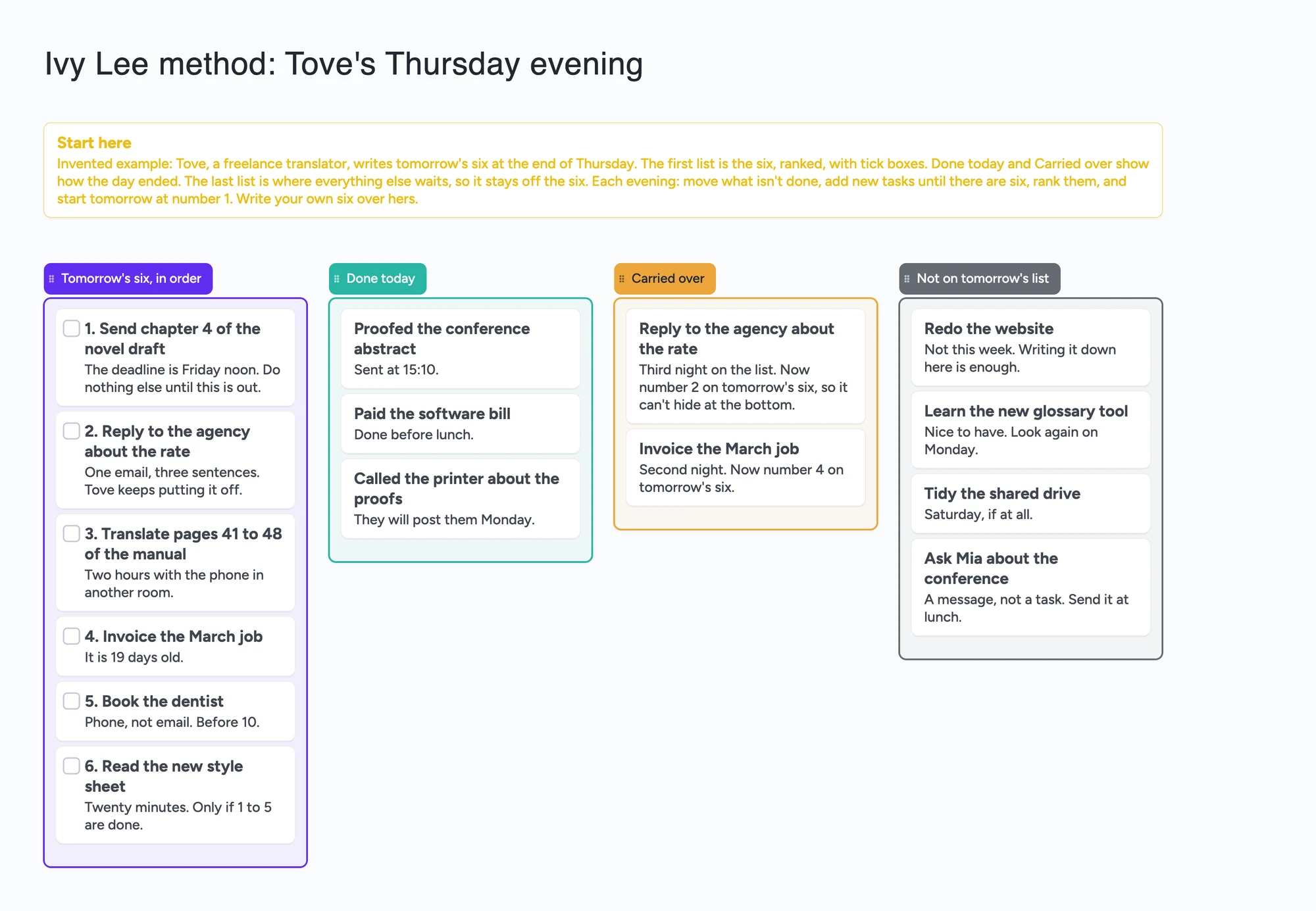
- What the board is: four lists. Tomorrow's six, in order, is a tick-box list; Done today and Carried over record how the day ended; Not on tomorrow's list holds everything else so it stays off the six. The example uses 21 of your 150 free items.
- What it isn't: nothing stops you adding a seventh card, nothing moves unfinished cards overnight, and nothing reminds you to write tomorrow's list. There are no reminders or due-date alerts, no streaks and no history of past days. Anyone with edit access can tick or untick a card, and nothing records who or when. Names typed in a card are plain text.
- A true story or not? Treat the Schwab origin as a story. Clear's own footnote says the earliest reference he found is from the 1960s, so we don't present the 1918 meeting or the fee as proven history.
- Free plan: 5 boards, 150 items, 3 pictures per board. Copying the board takes 1 of your 5 boards. Writing on it needs a free sign-in. New boards start with "Anyone who joins can view". Pro adds invite-only boards and removes the item limit.
Tove's Thursday evening, list by list
Tove, the work, the clients and the times are invented. She translates for agencies and works from home.
- Tomorrow's six, in order, 6 tick-box cards. A chapter draft due Friday noon is number 1, and the card says to do nothing else until it is out. An email about her rate is number 2 because it has been sitting on her list for three nights. Pages 41 to 48 of a manual, an invoice 19 days old, a dentist call and a style sheet fill the rest. Number 6 says to read the style sheet only if 1 to 5 are done.
- Done today, 3 cards. A proofreading job, a bill paid and a call to the printer. Each has the time or the outcome in a line.
- Carried over, 2 cards. The rate email on its third night and the invoice on its second. Each says what number it now holds on tomorrow's list, so an unfinished task can't quietly drop out of sight. Tove still ranks by importance, so a Friday deadline sits above both.
- Not on tomorrow's list, 4 cards. Redo the website, learn a new glossary tool, tidy a shared drive, and a message to a colleague about a conference. One of them is marked as a message, not a task. Writing these down is what lets them stay off the six.
Fifteen cards in four lists is one evening for one person. Tove clears Done today, edits the numbers, adds new tasks until the first list is back to six, and goes to bed. Tomorrow she starts at number 1 and nowhere else.
What four lists can't do
- No limit of six. The method's one hard rule lives in your head. Instaboard doesn't stop a seventh card or warn you. A Workflowy community documentation post describes the list as a strict limit of six where no new item is added until there is an empty slot; here that is a habit, not a setting.
- No overnight reset. Each evening you drag the unfinished cards to the top of tomorrow's list yourself and clear Done today by hand.
- No reminders or due-date alerts. Cards can carry a due date, but nothing alerts you that it's time to plan tomorrow's six.
- No history. Once you delete yesterday's cards they are gone from the board. If you want to look back at how many tasks you finished each week, keep that somewhere else.
- No who or when on a tick. Anyone with edit access can tick or untick a card, everyone sees it live, and nothing records who or when.
- No private lists. New boards start with "Anyone who joins can view", so anyone with the link can read your list. Set Share to "Anyone who joins can edit" only if the other person should write on it, and each person who writes signs in free.
The method in four pages' words
Each page below was read on November 25, 2026. The summaries are ours.
| Source | What it says (our summary) | What the board takes |
|---|---|---|
| James Clear, "The Ivy Lee Method" (page shows no date) | Five steps: write down the six most important tasks for tomorrow and no more, rank them by true importance, start tomorrow with the first and finish it before the second, move anything unfinished to a new list of six, repeat every working day. He writes that there is nothing magical about six and that five could do as well. His footnote says the story's earliest source he tracked down is from the 1960s and that 1905 is the wrong year most tellings give; he cites a 1918 date to a public relations history by Scott M. Cutlip | The steps and the limit. It does not repeat the fee, which his own sources give in different dollar equivalents |
| Tweek, "The ultimate guide to the Ivy Lee Method" (page shows Oct, 2020) | Four rules; unfinished tasks move to the top of tomorrow's list and keep their priority above the new ones, and you still stop at six overall. Its example carries tasks 5 and 6 forward as tasks 1 and 2. Says any calendar works, even a paper one | Carried-over cards say the number they now hold. Tove ranks all six by importance, as Clear does, so a deadline can sit above a carried-over card |
| Todoist, "The Ivy Lee Method" (page shows no date) | Four core rules, with the idea that six is a constraint that forces you to name your priorities, and a nightly check on whether an unfinished task still matters. Says to make the list the night before | The nightly check: carried-over cards say whether they still matter, and the parking lot holds the rest |
| Workflowy community documentation, "Ivy Lee Method" (post dated late October 2026) | Describes the list as a strict six with no new item until there is an empty slot, and suggests picking the six with the Eisenhower method, adding items from its first three quadrants and mostly from quadrant 2 | The strict limit, as a habit |
Swipe the table sideways to see every column.
Pages read November 25, 2026: jamesclear.com/ivy-lee, tweek.so/calendar/ivy-lee-method, todoist.com/productivity-methods/ivy-lee-method, community.workflowy.com/t/ivy-lee-method/1717. Todoist's and Clear's pages give different dollar figures for the Schwab fee, so none is repeated here.
Where other tools do this better
Read on November 25, 2026. Plans and pages change, so check the page.
| Tool | What the page says | Better for |
|---|---|---|
| Paper and a pen | Clear and Tweek both describe the method with a plain list; Tweek says a paper calendar works | One person who plans at one desk |
| Tweek (page shows Oct, 2020) | A weekly to-do planner; the guide shows the method set up in it | People who want a calendar view of the week with tasks dropped on days |
| Todoist (page shows no date) | Has a section on using Todoist for the method: the Today view, priority levels, an @Ivy Lee label and a recurring task to plan the next day; plan and price terms not read | People who want those built into a to-do app |
| Instaboard board | Four lists you edit together by link: 5 boards, 150 items and 3 pictures on the free plan | Two people planning their days side by side, or one person on two devices |
Swipe the table sideways to see every column.
From each page, read November 25, 2026: jamesclear.com/ivy-lee, tweek.so/calendar/ivy-lee-method, todoist.com/productivity-methods/ivy-lee-method. Our wording, not theirs. Prices are not given because none were read.
Where these win
If you plan alone, use paper or the to-do app you already have; Todoist's page suggests a recurring task to plan the next day. If you want a week laid out on a calendar, use Tweek. Use this board when two people want to see each other's six, or you want your own list open on your phone and your laptop with no extra app.
What people say about six tasks a day
Each reply below is one person's view; counts are of the comments the page showed us, read November 25, 2026.
From an r/productivity thread on the method (OP u/Awakening1983, November 6, 2024; 25 of 60 comments read). u/malcallm wrote that there are one to three important but unpleasant tasks that they postpone over and over. u/StrainPristine5116 keeps a weekly overall list and picks five or six from it each day.
Two things follow for this board. The unpleasant task that keeps moving is why the Carried over list says which number each card now holds: an unfinished task stays in view. And a bigger list of everything else is why the board has a parking list, Not on tomorrow's list, instead of asking you to keep it in your head.
How many cards fit in 150 items?
Each card and each list is 1 of your 150 free items, across all your boards. The title text box counts too. Arrows, sections and pen strokes don't. Our arithmetic from the example:
- As built: 4 lists + 15 cards + the Start here card + 1 title = 21.
- Two people, one board: each keeping their own six plus a Done, Carried over and parking list is 8 lists + 30 cards + the Start here card + 1 title = 40.
- Never clearing it: five new cards a day without deleting anything passes 150 on day 26 (21 + 5 x 26 = 151). Clearing Done today each evening keeps the board near 21.
This is a small board by design. Those items count against the same 150 as your other boards.
How to use it, in about ten minutes
- Open the board and sign in free when it asks you to write. Delete Tove's cards.
- At the end of your working day, write six tasks on cards in Tomorrow's six. No more. Put the rest in Not on tomorrow's list.
- Rank them. Drag the most important to the top and number the titles so the order survives.
- Next morning, start at number 1 and tick it only when it is finished. Then number 2.
- Each evening, drag the ticked cards to Done today, and the unfinished ones to Carried over with the number they now hold. Clear Done today.
- Rebuild the six: carried-over cards first, then new ones until there are six again, then rank all six by importance. Untick everything.
- To plan beside someone, set Share to "Anyone who joins can edit" and each of you keeps your own list on the same board. Each person who writes signs in free.
Start from the ready board
It opens in your browser in a few seconds, with nothing to install. Sign in for free when you want to save it and share it.
Questions
What is the Ivy Lee method?
It is a daily planning routine: at the end of each work day, write down the six most important tasks for tomorrow and no more, rank them, work through them in order without starting the next one early, and move whatever is unfinished to the next day's list. The sources on this page describe the same four or five steps.
Is the story about Charles Schwab and a big fee true?
We can't say. The article by James Clear that spread it says in a footnote that the earliest reference he tracked down is from the 1960s, and that the year in most tellings is wrong. This page uses the method and not the story.
Why six tasks and not five or ten?
Clear writes that he doesn't think there is anything magical about six and that five could work as well; what he values is that a limit forces you to choose. On Reddit one commenter picks five or six a day from a longer weekly list. Pick the number you will actually finish.
Does the board stop me adding a seventh task?
No. Nothing enforces the limit, resets the list overnight or reminds you to plan. The board holds the list; you keep the rule.
What do I do with tasks that aren't in the six?
Park them. The example has a list for them, Not on tomorrow's list, so they stay out of sight until you pick the next six. A message you can send in a minute is better sent than parked.
Is Instaboard free?
There is a free plan: 5 boards, 150 cards and items across your account (pen strokes, arrows and sections don't count), and 3 pictures and 1 file per board. Anyone with the link can read a board; writing on it takes a free sign-in. Copying this board takes 1 of your 5. Pro removes the item limit and adds invite-only boards: $5 a month billed yearly ($59.99 a year), or $7.99 monthly.
Sources
- James Clear: The Ivy Lee Method (page shows no date; read November 25, 2026)
- Tweek: The ultimate guide to the Ivy Lee Method (page shows Oct, 2020; read November 25, 2026)
- Todoist: The Ivy Lee Method (page shows no date; read November 25, 2026)
- Workflowy community documentation: Ivy Lee Method (post dated late October 2026; read November 25, 2026)
- r/productivity thread on the Ivy Lee method (OP u/Awakening1983, November 6, 2024; replies are single accounts, 25 of 60 comments read, read November 25, 2026)