For adults and college students planning to learn one language
A language learning plan you can copy and edit as one board
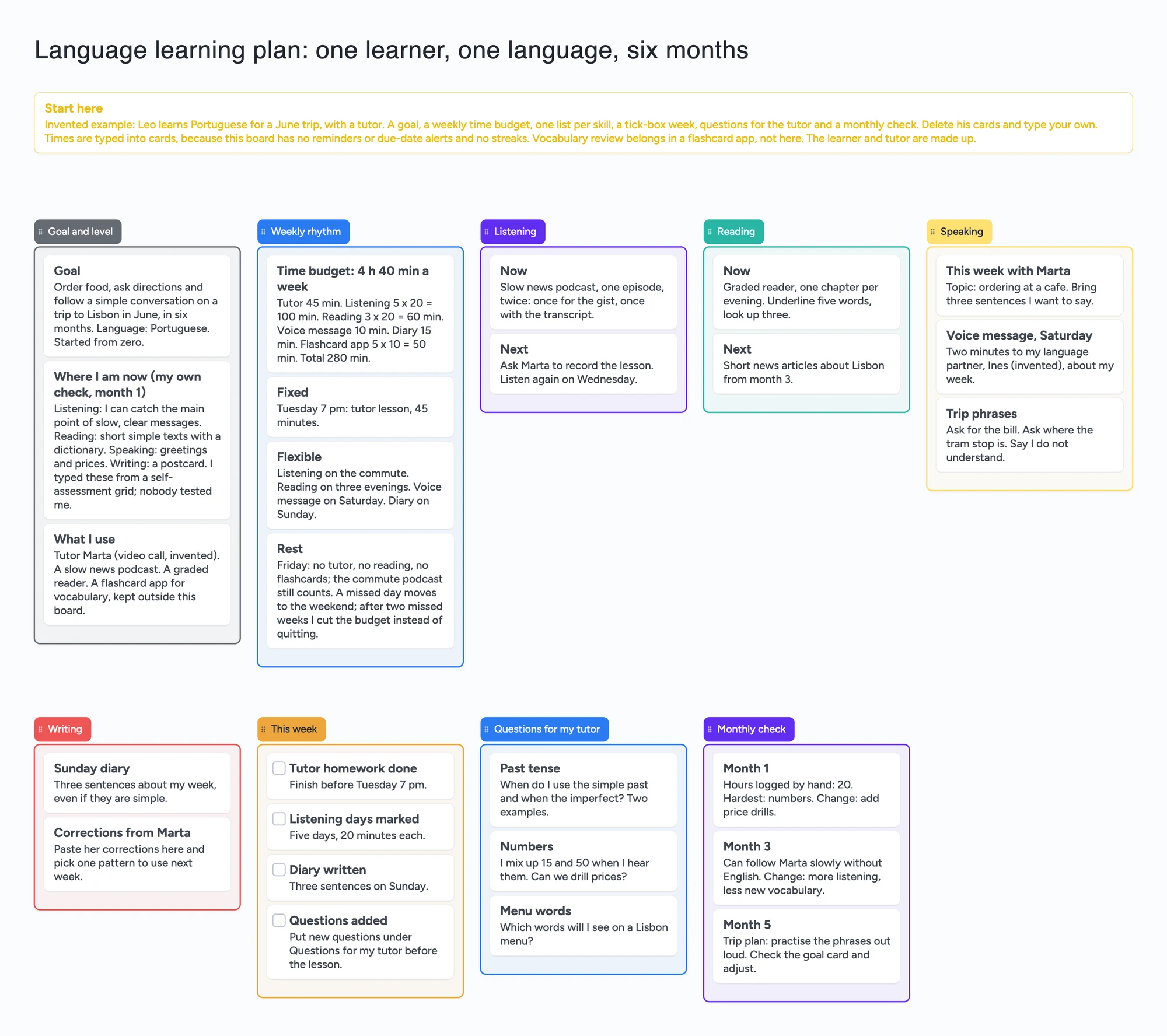
We make Instaboard, an online board. This page gives you a language learning plan already laid out on it and filled in for one invented learner, Leo, who studies Portuguese for six months before a trip to Lisbon, with a tutor named Marta. It has a goal and a self-check of his level, a weekly time budget, one list each for listening, reading, speaking and writing, a tick-box week, questions for the tutor and a monthly check. Open it, replace Leo's cards with yours and, if you work with a tutor, share the link. It is not a flashcard, quiz or streak tool: it does not plan vocabulary reviews, count study days, send reminders or log hours for you. The learner, the tutor and the trip are made up.
Opens in your browser. Anyone can view; a free sign-in lets you edit.
Updated
Read this first: what the board does and doesn't do
- What it is: a plan for one language on one screen: why you are learning it, how many minutes a week you can give it, what you do for each skill, what to ask your tutor and how you check in each month. The example uses 37 of your 150 free items.
- What it isn't: not a flashcard, quiz or spaced-repetition tool, and no streaks, no reminders or due-date alerts and no hour log. In the example, minutes and dates are text you type. The four tick boxes in "This week" are shared: anyone with edit access can tick or untick them.
- Vocabulary stays in a flashcard app. The board has a card that says which app you use and nothing more. If you only want to review words, a flashcard app does that better.
- Keep private things off it: a free board is shared by link. Put no passwords or private details about your tutor or partner on it. If you are under 18, check with a parent or your school before using any online tool for coursework.
- Free plan: 5 boards, 150 items, 3 pictures per board. Copying the board takes 1 of your 5 boards. Writing on it needs a free sign-in. New boards start with "Anyone who joins can view".
When a flashcard app or a roadmap site is the better choice
Two things people call a language learning plan are really other tools. Remembering words is a job for a flashcard program: Anki's own site says it is "a flashcard program that helps you spend more time on challenging material, and less on what you already know", and that you rate your recall and Anki schedules the next review (read November 24, 2026, page shows no date). Its desktop app is described as free and AnkiMobile as the official iOS app that is purchased. Following a method step by step is a job for a guide: Refold describes a roadmap through each stage of language acquisition, a tracker that logs daily study time and a free 10-day starter course, all behind a free account, and paid decks and courses (page shows no date, read November 24, 2026). This board does neither.
What a board can do is hold the plan around them: the goal, the weekly time you have, what you do for each skill, what you will ask a tutor and what you changed after each month.
What learners say about routines and tracking
Four r/languagelearning threads show how people actually plan. Replies are single accounts, not research, and we read the comments in each thread.
- "What does your weekly schedule look like for language learning?" (OP u/PalmTreePhilosophy, May 12, 2021): u/edelay, 20 months into French, posts a daily schedule that includes a voice recording to HelloTalk and iTalki, an hour of a native podcast while walking and an hour with a tutor or preparing for the tutor. u/FalseChoose replies "I can't stick to a study plan" and asks whether others have a schedule.
- "What's your daily routine for language learning?" (OP u/Happy-Debate1857, July 2, 2023): u/ya_kuuu lists an hour of kanji and vocabulary and an hour each of reading novels, playing games, watching anime and reading manga, "trying to keep it diverse". u/LanguageIdiot says they don't stick to a routine and squeeze in study when possible.
- "I built a language tracking system to stay motivated" (OP u/Kadedraven, October 18, 2025): the OP built a spreadsheet that logs hours by skill, streaks and rewards. u/Impossible_Fox7622 says they can't bring themselves to add more admin to their life. u/asurarusa keeps a spreadsheet with two tabs, a study log and a word list. u/AntiAd-er uses a daily timetable, reflective notes and a checklist in a daily Obsidian note.
- "If there was a free 'How to learn a language' template…" (OP u/IdentityOperator, November 27, 2021): u/scamper_ says people have different priorities, reasons and amounts of time, so something that guides a learner to make their own system would help. u/NastroAzzurro says a perfect method doesn't exist.
The pattern is that people want a plan they will keep, and many of them find tracking heavy. That is why the board is short: a time budget, a list per skill and a monthly look back, with no log to feed.
Leo's plan, list by list
Leo is an invented adult learner of Portuguese with six months before a trip. Every name, time and note on the board is made up. Read it left to right, top row then bottom row.
- Goal and level. The goal in one sentence (order food, ask directions and follow a simple conversation), a self-check of where he is now and what he uses. The level card was typed by him from a self-assessment grid; nobody tested him.
- Weekly rhythm. A time budget with the sum shown (45 + 100 + 60 + 10 + 15 + 50 = 280 minutes, 4 hours 40 minutes), what is fixed, what is flexible and a rest day with a rule for missed days.
- Listening, Reading, Speaking, Writing. One list per skill, with a Now card and a Next card, so the same list says what he does this month and what comes after.
- This week. Four tick-box cards: tutor homework, listening days, the diary and new questions for the tutor.
- Questions for my tutor. Cards the tutor can answer on the card before the lesson, instead of by message.
- Monthly check. One card per check-in with what he logged by hand, what was hardest and what he changes.
A level check from the Europass grid
The Europass page for the Common European Framework of Reference (CEFR) self-assessment grid describes six levels, A1 to C2, in "I can" statements for listening, reading, speaking and writing (the page shows no date, read November 24, 2026). For example, its listening A1 statement is "I can recognise familiar words and very basic phrases concerning myself, my family and immediate concrete surroundings when people speak slowly and clearly".
Leo copies the statement that fits each skill onto his Where I am now card, which is one person's honest self-rating, not a test result. If you need a certificate or an exam level, use a test; the board can't give you one.
How much of the free plan does a language plan use?
Each card and each list is 1 of your 150 free items, across all your boards. The title text box counts too. Arrows, sections and pen strokes don't. Our arithmetic from the example:
- As built: 9 lists + 27 cards + 1 title = 37 items.
- Six months: one new card a week under Questions for my tutor for 26 weeks is 23 more than the 3 already there, and three more monthly cards (months 2, 4 and 6) bring the Monthly check to 6. That is 37 + 23 + 3 = 63.
- A second language on a copy: another 37, so 74. A third is 111, a fourth 148 and a fifth 185, which is over 150. Each copy takes 1 of your 5 boards.
- Past 150: Pro removes the item limit.
What a board can't do
- No flashcards, quizzes or spaced repetition. Nothing on the board tests you or schedules a review.
- No streaks, no hour log and no reminders. The "hours logged by hand" in the Monthly check is a number you type.
- No reminders or due-date alerts. Tuesday 7 pm is text on a card; nothing knows when the lesson starts.
- No audio and no recording. You can paste the address of a recording into a card.
- No grammar or pronunciation help. The board doesn't read what you write on it.
- Ticks don't say who or when. Anyone with edit access can untick a box, and a copy keeps its ticks, so untick the four cards before you reuse the board.
- Not private by default. New boards start with "Anyone who joins can view". Anyone you give the link to can read it; writing needs a free sign-in.
- A copy takes 1 of your 5 free boards, and the example uses none of the 3 pictures allowed per board.
Where Anki, Refold or a spreadsheet does this better
Read on November 24, 2026; pages change, so check them. A date is printed only where the page shows one.
| Tool | What the page says | Better for |
|---|---|---|
| Anki (apps.ankiweb.net, no date) | A flashcard program: rate your recall and it schedules the next review. Desktop version described as free; AnkiMobile is the official iOS app and its purchases fund development; AnkiDroid is free | Remembering words and phrases with scheduled reviews |
| Refold (refold.la, no date) | A free account gives a roadmap through each stage of language acquisition, a tracker that logs daily study time and a 10-day starter course; vocabulary decks and courses are paid | Following one named method with a tracker and a course |
| A spreadsheet | Not read for this page. Two r/languagelearning commenters keep one: u/asurarusa a study log and a word list, the OP of the tracking thread a larger system with streaks | A log with dates, sums and hours per skill |
| Instaboard board | Free: 5 boards, 150 items, 3 pictures per board. A list per skill, cards you type, shared by link. No reviews, streaks, reminders or hour log | A plan on one screen that you and a tutor can both read and write on |
Swipe the table sideways to see every column.
From each page, read November 24, 2026: apps.ankiweb.net, refold.la. Our wording, not theirs. The spreadsheet row is Reddit commenters' views.
Where these win
Use a flashcard app for words, a roadmap site if you want a method to follow, and a spreadsheet if you want a log with sums. Use this board when you want the goal, the weekly time, the skills and your tutor's questions on one screen you can share.
How to use it, in about fifteen minutes
- Open the board and sign in free when it asks you to write. Delete Leo's cards and keep the lists.
- Write your goal in one sentence with a date or season, and your own level check for each skill.
- Work out your weekly minutes and write the sum on the Time budget card. Cut it before you fill it in if it is more than you can keep up.
- Give each skill one Now card and one Next card. Keep them to what you do, not what you wish to learn.
- Before each tutor lesson, add questions to the tutor list and tick the four cards in This week. Untick them afterwards.
- Once a month, add a Monthly check card: what you logged by hand, what was hardest and one change.
- To share it with a tutor, set Share to "Anyone who joins can edit" if they should write, and keep your private details off it. Each person who writes signs in for free.
Start from the ready board
It opens in your browser in a few seconds, with nothing to install. Sign in for free when you want to save it and share it.
Questions
What should a language learning plan include?
There is no single right answer. This board holds a goal, a self-check of your level, a weekly time budget, what you do for listening, reading, speaking and writing, questions for a tutor and a monthly look back. Vocabulary review is better kept in a flashcard app.
Is this a flashcard or spaced repetition tool?
No. Nothing on the board tests you or schedules a review, and it has no streaks or reminders. Use a flashcard program for that and keep a card here that says which one you use.
Can my tutor see it and write on it?
Yes. New boards start with "Anyone who joins can view", so anyone with the link can read it. Set it to "Anyone who joins can edit" if your tutor should write too; each person who writes signs in for free. Keep private details off it.
Does it track my study hours or streaks?
No. The Monthly check has a card where you type the hours you logged elsewhere or counted by hand. Nothing counts time or study days for you.
How much of the free plan does it use?
The example is 37 of your 150 free items. A new Questions card each week for six months and three more monthly cards bring it to 63. Copying it for a second language makes 74, and a fifth copy goes past 150 (our arithmetic).
Is Instaboard free?
Yes. The free plan includes 5 boards, 150 cards and items across your account (pen strokes, arrows and sections don't count), 3 images and 1 file per board, unlimited collaborators and video calls up to an hour. Pro is $5 a month billed yearly ($59.99 a year), or $7.99 monthly, and the people you invite join free.
Sources
- r/languagelearning: What does your weekly schedule look like for language learning? (OP u/PalmTreePhilosophy, May 12, 2021; replies are single accounts; read November 24, 2026)
- r/languagelearning: What's your daily routine for language learning? (OP u/Happy-Debate1857, July 2, 2023; replies are single accounts; read November 24, 2026)
- r/languagelearning: I built a language tracking system to stay motivated (OP u/Kadedraven, October 18, 2025; replies are single accounts; read November 24, 2026)
- r/languagelearning: If there was a free 'How to learn a language' template (OP u/IdentityOperator, November 27, 2021; replies are single accounts; read November 24, 2026)
- Europass: Common European Framework of Reference for Language skills, self-assessment grids (page shows no date; read November 24, 2026)
- Anki: home page (page shows no date; read November 24, 2026)
- Refold: home page and Roadmap (vendor pages; show no date; read November 24, 2026)