For a small group of adult volunteers running one fundraising event
A fundraising committee board for volunteers: jobs, asks by kind, the evening in order and a thank-you list
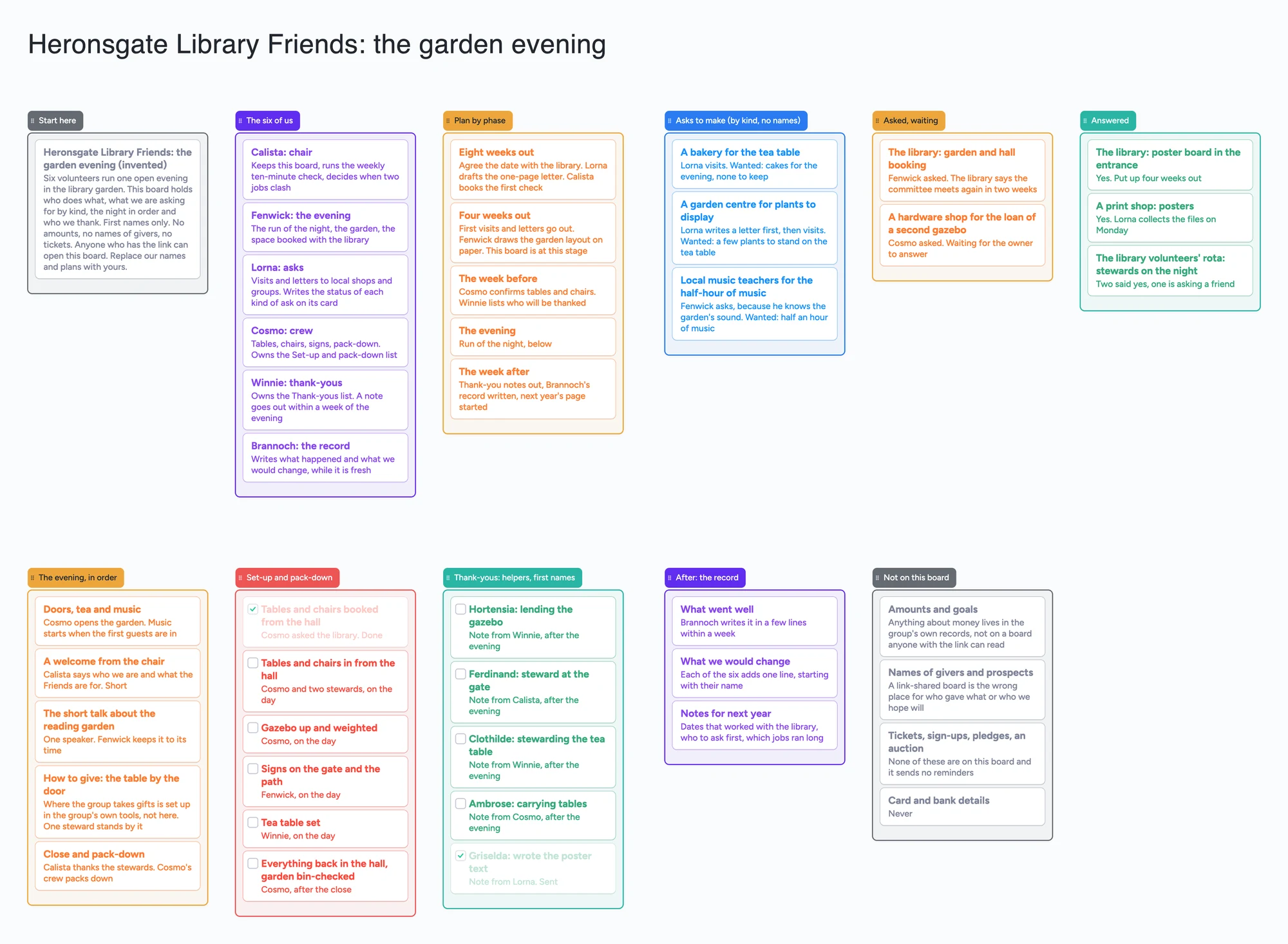
We make Instaboard, an online board. This page is for a handful of adult volunteers, a library friends' group, a club, a neighbourhood group, who are putting on one fundraising event together and want the jobs, the asks, the evening and the thank-yous in one place. The board is filled in for six invented volunteers, Calista, Fenwick, Lorna, Cosmo, Winnie and Brannoch, planning a garden evening for the Heronsgate Library Friends. It deliberately holds no amounts, no goal, no names of people who give or might give, no tickets, no pledges and no auction. It sends no reminders. Fundraising platforms do all of those things and the table below says which ones we read.
Opens in your browser. Anyone can view; a free sign-in lets you edit.
Updated
What this board leaves out, and what a copy costs
- It is an event crew's board, not a donor database. The example has no amounts, no goal, no names of givers or hoped-for givers, no tickets, no pledges and no auction. Anyone who has the link can open the board, so keep who gave what elsewhere.
- Givebutter and Zeffy do the money part. Both say on their pricing pages (read November 26, 2026 in a browser) that they offer donations, events or ticketing and auctions, with donor management; details in the table below. This board does none of that.
- It holds what you type. No reminders or due-date alerts, no sign-up slots, no totals. A card can carry a due date and the app has a calendar view, but nothing nudges anyone.
- Writing needs a free sign-in. New boards start as "Anyone who joins can view"; to let a volunteer add and edit cards, switch Share to "Anyone who joins can edit". Each person signs in free, and the board counts as 1 of their 5 free boards.
- Free plan limits: 5 boards, 150 items across your account and 3 pictures per board. The example is 55 items, and a copy takes 1 of your 5 boards. Pro removes the item limit and costs $5 a month billed yearly ($59.99 a year), or $7.99 monthly.
Which kind of fundraising committee do you mean?
In the search results we read, most pages for "fundraising committee" are about a nonprofit's board. One such guide, from board-room.org ("Updated: April 1, 2026", a site that sells board software), says a fundraising committee "provides strategic oversight of fundraising" and "does not run campaigns directly"; its table lists, under things the committee does not do for events, "Plan logistics, manage vendors, or staff event tables", and it gives 6-12 members as the "optimal committee size". That is a different job from the one on this board. The six volunteers here are the crew that does the logistics.
Two r/nonprofit threads, each reply one person's view credited per account, show the same split. In "What exactly should a Fundraising Committee do when a nonprofit has paid staff?" (posted 2025-10-21 21:53 UTC by u/notwho_shesays_sheis; Reddit shows 29 comments; the archived copy has 29, 26 with text, and we read all 26). Of the 11 top-level replies with text, 9 describe board-level work: prospects, sponsors, introductions and board giving. In replies, the poster describes a small museum moving from a working board to a governance board, and says that when the board leaned into membership "the GM got very upset and told them it was operations". u/the_north_place answered that the committee should be "Identifying new prospects and evaluating personal connections with them"; u/29563mirrored wrote that it "assumes the org is large enough to be at the level of a governance board, versus a working board"; u/tracydiina7 wrote that fundraising committees "can also serve as chairs for any event that you are having"; and u/SecurityFit5830 wrote that "this is going to look a lot different at a small nonprofit". u/SchoolAuction answers as a vendor (their own later reply says "There are rules here about what I can post, as a vendor"), so that account's advice is a vendor's view. If your group has no staff and no governance board, you are the working crew, which is who this page is for.
The second thread, "Utilizing a Development Committee & Board" (posted 2025-12-08 16:56 UTC by u/kaylathefundraiser; Reddit shows 16 comments; the archived copy has 17, all with text, and we read all 17), is a new fundraising director asking what to do with an inactive committee. u/metmeatabar wrote "I got rid of our development committee. All board members are the development committee." u/SesameSeed13 wrote that the best use of the group "AS A GROUP is oversight (report results, get feedback), and gratitude". Neither thread names a shared board.
What this board never holds
A link-shared board is the wrong place for money and for people's giving, so the example's last list, Not on this board, says what is left out.
- Amounts, goals and pledges. The example has none. Joan Garry's "10 Rules for a Successful Small Fundraiser" (read November 26, 2026; we saw no date for the article itself) puts a dollar goal at rule 4 and says the pitch should include "a SPECIFIC AMOUNT OF MONEY" with pledge cards by the door. Keep those in your group's own records; the board has no place for them.
- Names of givers and hoped-for givers. Greater Giving's committee guide describes a sponsor committee that tracks sponsorships "from lead to completion" and enters guest contact details in a database. That belongs in a tool built for it, not on a board anyone with the link can read.
- Tickets, sign-ups and an auction. The example has no tickets or bid sheets and no sign-up slots. Greater Giving's guide lists an auction procurement committee and bid sheets; Givebutter and Zeffy both list auctions.
- Card and bank details. Never on any board.
- Children. The example is adults running an evening. We don't suggest naming children on it.
Asks by kind, not by name
The three ask lists are the part of the board that is ours. Each ask card says what kind of ask it is (a bakery for the tea table, a garden centre for plants to display, local music teachers for the half hour of music), who makes it (Lorna for the first two, Fenwick for the music) and what is wanted, in words. A card moves from Asks to make, to Asked, waiting, to Answered. The waiting cards say who asked (Fenwick, Cosmo); an Answered card holds the answer in a line. None carries an amount or a person's name. That is our own layout, not taken from the guides. Greater Giving's guide splits the same work across several committees (item procurement, sponsors, volunteers); a group of six can hold it as three lists.
A card is moved by hand, and nothing tells Lorna that an answer has arrived. The example's Asked, waiting list has a hardware shop that has not replied yet; the board does not chase it.
Working back from the evening, and the six jobs
| List | What goes in it | In the example |
|---|---|---|
| Start here (grey) | What the board is and that the link is not private | One card |
| The six of us (purple) | One card per volunteer with the one job they hold | 6 cards: chair, the evening, asks, crew, thank-yous, the record |
| Plan by phase (orange) | What happens when, working back from the evening | 5 cards: eight weeks out, four weeks out, the week before, the evening, the week after |
| Asks to make (by kind, no names) (blue) | Kinds of ask, not names | 3 cards |
| Asked, waiting (orange) | Asks made and not answered | 2 cards |
| Answered (green) | Asks answered, with the answer in a line | 3 cards |
| The evening, in order (orange) | The run of the night | 5 cards: doors and tea, a welcome, a short talk, the table by the door, pack-down |
| Set-up and pack-down (red, tick boxes) | Crew jobs with an owner and a time | 6 cards, one ticked |
| Thank-yous: helpers, first names (green, tick boxes) | One card per helper with who writes the note | 5 cards, one ticked |
| After: the record (purple) | What went well, what to change, notes for next year | 3 cards |
| Not on this board (grey) | What stays off | 4 cards: amounts and goals, names of givers, tickets and sign-ups, card and bank details |
Swipe the table sideways to see every column.
Counted from the board: 11 lists, 43 cards and one title text box (55 items). A tick box records no name or time, and anyone who can edit can untick it.
The board is at the "four weeks out" stage: three asks are still to make, two are waiting, three are answered, one crew job is ticked and one thank-you is already sent. The week-by-week phases are typed in a card each, and nothing moves a card between them.
Four pages and two platforms, read side by side with this board
Read November 26, 2026. Each row is what the page says, not something we tried. Greater Giving, board-room.org, Givebutter and Zeffy are all vendors.
| Page read | In its own words | Does more than a board | Where this board still fits |
|---|---|---|---|
| Greater Giving: "Fundraising Event Committee Roles and Responsibilities" by Tamara Varner (June 29, 2022; a fundraising-software vendor) | Lists committees: planning and logistics, auction procurement, sponsor, registration and checkout, entertainment and program, media and public relations, decor, and a volunteer coordinator. Suggests a previous chair write a "Best Practices" hand-off guide | Auctions, bidder numbers, sponsor tracking and check-in, which it ties to its own software | The six jobs, the run of the night and the crew list for a group too small for eight committees |
| board-room.org: Fundraising Committee guide ("Updated: April 1, 2026"; a board-software vendor) | A committee gives oversight and does not run campaigns; 6-12 members; named roles with hours a month (chair 6-10 hours/month); a charter and a monthly agenda | A board's charter, agenda and reporting | A working crew's own jobs for one evening |
| Joan Garry: "10 Rules for a Successful Small Fundraiser" (no article date seen) | Ten rules for a house-party style event: a lovely space, a pitch, a host with a stake, a goal, prospects in the room, a day-after call and an event debrief "Within 48 hours" | The fundraising craft: the pitch, the goal and the host | The debrief written down as lessons, which is the After list |
| Givebutter pricing (no date seen) | "Free forever" with donation forms, events, auctions and a donor CRM; unlimited users; optional donor tips, or a flat 3% platform fee plus processing fees when tips are off; Plus from $29 a month billed annually ($348), or $33.80 a month billed monthly, for 250 or fewer contacts, with task management | Taking gifts, running an auction, donor records | Who does what for the evening, which the page does not claim to do |
| Zeffy pricing (no date seen) | "100% free, always", with ticketing, donations, peer-to-peer, raffles, auctions and donor management; says it makes money from optional donor tips | Tickets, raffles, auctions and donor records | A plain crew list next to it |
Swipe the table sideways to see every column.
We did not read any of these tools' limits for small unregistered groups, so we make no claim about who qualifies. A group chat or a shared document may do the crew job too; we did not test either.
Thank-yous by first name, and the record for next year
The two last lists are the quietest and the ones groups skip. Winnie's Thank-yous list has a card per helper, first name only, with who writes the note; the ticks are by hand. In the r/nonprofit development-committee thread, u/damutecebu wrote that they used to ask the committee "to write a couple thank you notes to donors during the meeting", and u/SesameSeed13 put gratitude beside oversight as the group's best use. On this board the thank-yous are for helpers, not givers: giver names stay off a board anyone with the link can read.
After: the record holds three cards: what went well, what we would change (each of the six adds one line, starting with their name) and notes for next year. Joan Garry's tenth rule is a debrief within 48 hours, "Capture them as lessons and use them all for next time"; the example's card says within a week. Greater Giving suggests a departing chair write a hand-off guide, which is what next year's notes card is for.
Set up your own in six steps
- Open the board and make your copy. "Make a copy" takes 1 of your 5 free boards. Replace the six names and the library with your group, and clear the ticks.
- Give each volunteer one card in The six of us with the one job they hold.
- Write the phases first, working back from the evening, before any ask is made.
- Add each kind of ask once, with who is making it, then move the card to Asked, waiting and Answered by hand.
- Type the evening in order and give each crew job an owner and a time.
- Share the link. To let the others write, switch Share to "Anyone who joins can edit"; they sign in free and the board counts as 1 of their 5. Keep amounts, names of givers and card details out.
How many items does the free plan allow?
- Items. 150 across your account, where each card and each list is one item. The example is 55. If you keep each year's cards in the same lists and add about 24 cards a year (asks, evening, crew and thank-yous), the board reaches 79, 103 and 127 in years two to four and passes 150 in year five at 151, our arithmetic, with nothing deleted. A fresh copy each year takes 1 of your 5 boards instead. Your other boards share the same 150, and Pro removes the limit.
- Boards. 5 on the free plan. A copy takes 1, and so does a board you open from someone's link.
- Pictures. 3 per board. The example has none.
- Reading is open, writing is not. A link opens the board for reading; adding or moving a card takes a free sign-in.
- Ticks are by hand. Nothing records who ticked or when, anyone who can edit can clear a tick, and a copy keeps the ticks it had.
- No amounts, no totals, no reminders or due-date alerts, no sign-up slots, and nothing that records who gave. A card can carry a due date and there is a calendar view, but the app does not nudge anyone.
Start from the ready board
It opens in your browser in a few seconds, with nothing to install. Sign in for free when you want to save it and share it.
Questions
Can I put the amount we want to raise on the board?
You can type anything on a card, but the example leaves amounts and goals off on purpose: anyone who has the link can open the board. Joan Garry's small-fundraiser rules put a specific goal at the centre of the pitch, so keep that in your group's own records.
Does it keep track of who gave?
No. It records no gifts and no donors, and the example has no names of givers. Givebutter's pricing page lists a donor CRM and Zeffy's lists donor management; use one of those or your group's own records for that.
Does it send reminders or sign up volunteers for slots?
No. It sends no reminders or due-date alerts and has no sign-up slots. A card can carry a due date and the app has a calendar view, but nothing nudges anyone. The tick boxes are moved by hand.
Do the other volunteers need an account?
To write on the board, yes: they open the link, sign in free, and you switch Share to "Anyone who joins can edit". The board counts as 1 of their 5 free boards. Someone who only wants to read can open the link without signing in.
Is this for a nonprofit's board committee?
No. Guides for board-level committees, such as board-room.org's, describe oversight, a charter and monthly agendas. This board is for the working crew of a small group putting on one event, so it holds jobs, asks by kind, the evening and the thank-yous.
How many events fit on the free plan?
The example is 55 of your 150 items. Adding about 24 cards for each later event in the same lists gives 79, 103, 127 and then 151 in year five, our arithmetic with nothing deleted. A new copy each year takes 1 of your 5 boards. Your other boards share the same 150, and Pro removes the item limit.
Sources
- Greater Giving: Fundraising Event Committee Roles and Responsibilities, by Tamara Varner (June 29, 2022; a fundraising-software vendor; the body text is in the page's HTML, the browser view showed only the header; read November 26, 2026)
- board-room.org: Fundraising Committee: Roles, Responsibilities & How to Build One That Works ("Updated: April 1, 2026"; a board-software vendor; read in a browser November 26, 2026)
- Joan Garry Consulting: 10 Rules for a Successful Small Fundraiser (no article date seen; read in a browser November 26, 2026)
- Givebutter pricing (no date seen; read in a browser November 26, 2026)
- Zeffy pricing (no date seen; read in a browser November 26, 2026)
- r/nonprofit: "What exactly should a Fundraising Committee do when a nonprofit has paid staff?" by u/notwho_shesays_sheis (posted 2025-10-21 UTC; Reddit shows 29 comments; the archived copy has 29, 26 with text, all 26 read; read November 26, 2026)
- r/nonprofit: "Utilizing a Development Committee & Board" by u/kaylathefundraiser (posted 2025-12-08 UTC; Reddit shows 16 comments; the archived copy has 17, all read; read November 26, 2026)