For two or three owners making one business decision together, not for a printed strategy document
A SWOT analysis template on one shared board
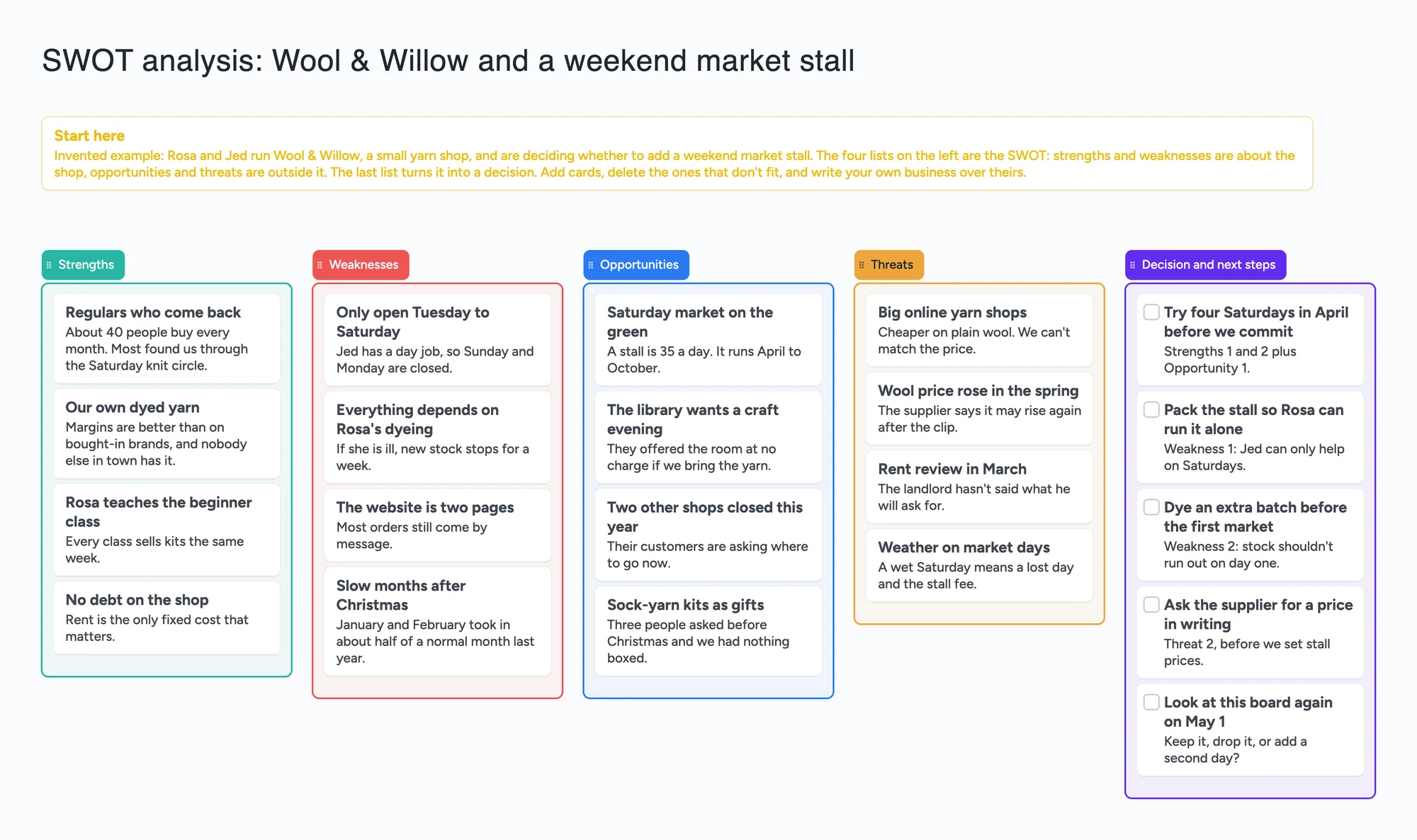
We make Instaboard, an online board. This page gives you a SWOT analysis already laid out on it as five lists, filled in for one invented pair, Rosa and Jed, who run a small yarn shop and are deciding whether to add a weekend market stall. Four lists are the SWOT; the fifth turns it into a decision with next steps. Copy it, replace their shop with your business, and send the link to whoever decides with you. It is a shared list board, not a chart: there is no voting, no scoring and no 2x2 grid, and it does not hand you the Word, PowerPoint or PDF file most people type into a search box. If you want a file, a presentation or a voting round, the tools named below do those better. This page's summaries are ours and rest on pages we read; no one named here reviewed the board.
Opens in your browser. Anyone can view; a free sign-in lets you edit.
Updated
Read this first: what the board does and doesn't do
- Our edge is small, and we say so first. Miro, Lucid and Canva all offer a SWOT you can edit with other people, and their pages say more about templates and presenting than ours does. What this page adds is one filled small-business example with the decision written out under the four lists, and the limits listed before you open anything.
- What it is: four lists named Strengths, Weaknesses, Opportunities and Threats, plus a fifth list, Decision and next steps, with 21 example cards from one invented shop. You move a card by dragging it. The example uses 28 of your 150 free items.
- What it isn't: not a chart or a file. There are no voting dots, no scores, no axes and no reminders or due-date alerts. Nothing exports a Word, PowerPoint or PDF version. The Decision list has tick boxes you tick yourselves; nothing records who ticked or when. Names typed in a card (Rosa, Jed) are plain text, not assignments.
- Who it's for: two or three people deciding something about one business together, who would rather argue over cards on a screen than over a document. If you work alone and want a printable page, a free template file is enough.
- Free plan: 5 boards, 150 items, 3 pictures per board. Copying the board takes 1 of your 5 boards. Writing on it needs a free sign-in. New boards start with "Anyone who joins can view". Pro adds invite-only boards and removes the item limit.
What five lists can't do
- No file. Google's suggestions for "swot analysis template" on November 25, 2026 were mostly file words: Word, PowerPoint, Excel, Google Docs, PDF. This board is a link, not a document. Canva's page offers PowerPoint and Word downloads; use that if you need one.
- No voting and no scoring. Lucid's SWOT template page, read November 25, 2026, ends with "Start a voting session in Lucidspark" to pick the most important opportunities and threats. Here, if you want to rank the cards, you reorder them by dragging or add a number in the text yourselves.
- No 2x2 grid. The four lists sit side by side. Nothing places a card on an axis or sorts it by impact.
- No reminders or due-date alerts. The next-steps cards say "this week" or "May 1" in their text. Cards can carry a due date, but nothing alerts anyone when it passes.
- No who or when on a tick. Anyone with edit access can tick or untick a card, everyone sees it live, and nothing records who or when.
- No private lists. New boards start with "Anyone who joins can view", so anyone with the link can read the lot. Set Share to "Anyone who joins can edit" only if the people deciding should write on it, and each person who writes signs in free. Keep anything you wouldn't send in a group chat off it.
- 3 pictures per board. The example has none.
Rosa and Jed's shop, list by list
The shop, the names, the stall fee and every number are invented. Rosa dyes and sells yarn and teaches a beginner class; Jed has a day job and helps on Saturdays.
- Strengths, 4 cards. Regulars who come back every month, their own dyed yarn with better margins, Rosa's beginner class that sells kits the same week, and no debt on the shop. Each is something the shop already has.
- Weaknesses, 4 cards. Open only Tuesday to Saturday, everything depends on Rosa's dyeing, a two-page website where most orders arrive by message, and slow months after Christmas. Each is a problem inside the shop that they could change.
- Opportunities, 4 cards. A Saturday market stall (a made-up 35 a day, April to October), a library craft evening, two other shops closing, and sock-yarn gift kits that three people asked for. Each comes from outside the shop.
- Threats, 4 cards. Big online yarn shops that win on plain wool, a spring wool price rise, a rent review in March, and wet market days. Each is outside the shop and out of Rosa and Jed's hands.
- Decision and next steps, 5 tick-box cards. Try four Saturdays in April before committing, pack the stall so Rosa can run it alone, dye an extra batch first, get the supplier's price in writing, and look at the board again on May 1. Four of the five say which strength, weakness, opportunity or threat they answer, in plain text; the last is the date to look again.
Twenty-one cards in five lists is a Wednesday evening for two people. They tick the next steps as they go and either edit the same cards for the next decision or copy the board and start again.
Inside the business or outside it? The sorting test
Asana's SWOT guide (page shows June 1st, 2026; read in a browser November 25, 2026) sorts the four parts by where they sit: strengths and weaknesses are internal, threats are external and out of your control, and opportunities come from your strengths and weaknesses together with outside changes. For each part it lists questions to ask, for example "What do we do well?" for strengths and "What changes in the industry are cause for concern?" for threats. That is the test the example follows.
- If you could change it next week, it's a weakness. Rosa and Jed's two-page website is theirs to fix. A single slow Tuesday is a weakness only if something inside the shop causes it; if it is just the weather, it is background, not a card.
- If it is happening to you, it's a threat. The rent review is the landlord's call, so it is a threat even though it costs them money.
- An opportunity is something outside you could act on. The library offering a free room is one. "Sell more yarn" is a wish, not an opportunity, and goes nowhere in the lists.
- Nothing in Decision and next steps without a source card. Rosa and Jed's action cards name the card they answer. If you can't point to one, the step may not belong.
Does a SWOT actually help? What people on Reddit say
Each reply below is one person's view; counts are of the comments the pages showed us, read November 25, 2026.
From an r/strategy thread (OP u/chriscfoxStrategy, who links his own SWOT articles in the post, July 24, 2024; 25 of 41 comments read). u/Hatallica said they had never found SWOTs to produce an insight that would guide new choices. u/sidyabl quoted the OP's suggestion to rank strengths and weaknesses by impact and opportunities and threats by impact and likelihood, asked whether internal factors should also be rated by how likely they are to continue, and wrote that people often put solutions in the Opportunities list instead of outside conditions.
From an r/smallbusiness thread (September 10, 2023; 6 of 7 comments read). u/iEatSwampAss, writing from seven years in business, said SWOT had fed into nearly every important decision, such as choosing a niche, whether a client was worth signing and which upgrade would pay off most. u/Bob-Roman described its purpose as helping you identify strategy and marketing tactics.
Two things follow for this board. The example ends in a decision list because one commenter's complaint is a SWOT that never produces an insight to guide a choice; and its cards are facts about one shop, not solutions, because of the Opportunities warning. Nobody in these threads asked for a shared board.
Where other tools do this better
Read on November 25, 2026; plans and pages change, so check the page. Where a page showed no date we say so.
| Tool | What the page says | Better for |
|---|---|---|
| Miro (SWOT page, no date) | Says a SWOT can be shared with stakeholders, downloaded as an image or PDF, or presented in Presentation mode; mentions 7,000+ templates and 250+ integrations. Account limits and price are not on the page | A SWOT you will present, export or connect to other tools |
| Lucid (SWOT template page, no date) | Describes a Lucidspark template with four containers (Strengths, Weaknesses, Opportunities, Threats) filled with sticky notes, marked "For all Lucid plan types", and tells you to start a voting session to pick the most important opportunities and threats | A group that wants to vote on the cards |
| Canva (SWOT templates page, no date) | Says templates are easy to edit and collaborate on, that you can grant others editing access, download for PowerPoint or Word, and use Present. Limits are not on the page | The Word or PowerPoint file, styled to look finished |
| Asana (SWOT guide, page shows June 1st, 2026) | A guide with questions for each part and a button to create a SWOT analysis template in Asana; plan terms not read | Teams that already work in Asana and want the SWOT created there |
| Instaboard board | Five lists you edit together by link: 5 boards, 150 items and 3 pictures on the free plan | Two or three owners deciding together, with the decision written under the lists |
Swipe the table sideways to see every column.
From each page, read November 25, 2026: miro.com/strategic-planning/swot-analysis, lucid.co/templates/swot-analysis-template, canva.com/graphs/templates/swot-analysis, asana.com/resources/swot-analysis. Our wording, not theirs. Prices and limits are not stated on these pages as read, so none are given.
Where these win
If you need a file to attach or present, use Canva or Miro. If the group wants to vote, use Lucid. If your team already works in Asana, its guide has a button to create the SWOT there. Use this board when two or three people want to fill in the lists together, in short cards, and finish with a written decision on the same screen.
How to use it, in about half an hour
- Open the board and sign in free when it asks you to write. Delete the yarn shop cards.
- Fill the two internal lists first. Each of you adds cards to Strengths and Weaknesses without reading the other's. One fact per card, with a number where you have one.
- Then the two outside lists. Opportunities and Threats are about things you don't control. Move a card between lists if you disagree about which side it sits on.
- Cut it down. Delete duplicates and anything you couldn't act on. If you want ranking, number the cards in their titles.
- Write the decision. In Decision and next steps, add one card per step and say which card it answers. Tick them as you go.
- To share it, set Share to "Anyone who joins can edit" if the other person should write on it. Each person who writes signs in free.
- Next decision, edit the same cards or copy the board. A copy takes 1 of your 5 boards and keeps its ticks, so untick them first.
How many cards fit in 150 items?
Each card and each list is 1 of your 150 free items, across all your boards. The title text box counts too. Arrows, sections and pen strokes don't. Our arithmetic from the example:
- As built: 5 lists + 21 example cards + the Start here card + 1 title = 28.
- A fuller SWOT: 8 cards in each of the four lists and 6 next steps is 5 lists + 38 cards + the Start here card + 1 title = 45.
- One copy per decision: five copies of the example use 140 items and all 5 of your free boards, so a sixth decision needs you to delete a board or move to Pro.
A SWOT is a small board by design. Those items count against the same 150 as your other boards.
Start from the ready board
It opens in your browser in a few seconds, with nothing to install. Sign in for free when you want to save it and share it.
Questions
What is a SWOT analysis?
It is a way of listing what helps and hurts a business or a decision in four groups: strengths and weaknesses inside the business, opportunities and threats outside it. Asana's guide describes it as a way to see where you are before you decide what to do next. This page's board adds a fifth list for the decision itself.
Is there a free SWOT analysis template I can edit online with someone else?
Yes. Open the board, replace the example with your business and write on it after a free sign-in. It is five lists, not a file or a chart. Miro, Lucid and Canva also offer templates you can edit with other people, and Canva offers Word and PowerPoint downloads.
Can my business partner edit the same board?
Yes. New boards start with "Anyone who joins can view", so anyone with the link can read it. Set it to "Anyone who joins can edit" if the other person should write too; each person who writes signs in free.
Does the board vote on or score the cards?
No. There are no voting dots, scores or axes. You reorder the cards by dragging or number them in their titles, and nothing ranks them by impact for you.
What goes in Opportunities and what goes in Threats?
Both are outside your business. An opportunity is an outside change you could act on, such as a venue lending a room at no charge. A threat is an outside change that could hurt you, such as a rent review. One Reddit commenter warned that people often put their own solutions in Opportunities; the example keeps solutions in the Decision list instead.
Is Instaboard free?
There is a free plan: 5 boards, 150 cards and items across your account (pen strokes, arrows and sections don't count), and 3 pictures and 1 file per board. Anyone with the link can read a board; writing on it takes a free sign-in. Copying this board takes 1 of your 5. Pro removes the item limit and adds invite-only boards: $5 a month billed yearly ($59.99 a year), or $7.99 monthly.
Sources
- Asana: SWOT Analysis: Examples and Templates (page shows June 1st, 2026; read in a browser November 25, 2026)
- Miro: SWOT analysis tool (page shows no date; read November 25, 2026)
- Lucid: SWOT analysis template (page shows no date; read November 25, 2026)
- Canva: SWOT analysis templates (page shows no date; read November 25, 2026)
- r/strategy thread (OP u/chriscfoxStrategy, who links his own SWOT articles in the post, July 24, 2024; replies are single accounts, 25 of 41 comments read, read November 25, 2026)
- r/smallbusiness thread (September 10, 2023; replies are single accounts, 6 of 7 comments read, read November 25, 2026)