For adults applying to optometry school, studying alone or with a friend
An OAT study plan board you can copy and edit
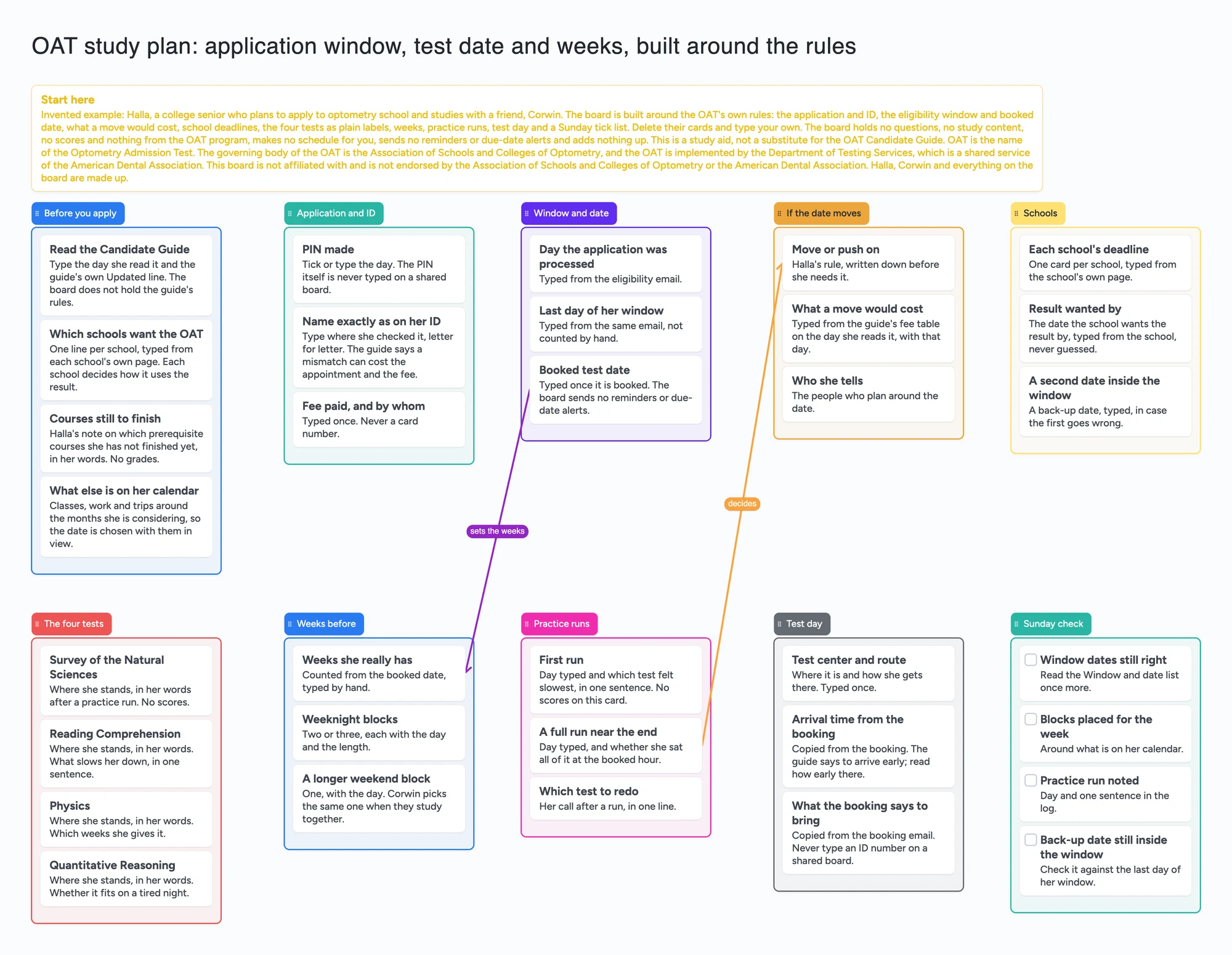
Most OAT study plans start from the material. This one starts from the test's own rules: you apply, you get a window to test in, and moving the date can cost money. We make Instaboard, an online board. This page gives you an OAT study plan already laid out on it, filled in for one invented student, Halla, a college senior who plans to apply to optometry school and studies with a friend, Corwin. It has a list for what to read and decide before applying, one for the application and ID, one for the window and booked date, one for what happens if the date moves, one for school deadlines, the four tests as plain labels, weeks before, practice runs, test day and a Sunday tick list. It holds no questions, no study content, no scores and nothing from the OAT program, makes no schedule for you, sends no reminders or due-date alerts and adds nothing up. It is a study aid, not a substitute for the OAT Candidate Guide. OAT is the name of the Optometry Admission Test. The governing body of the OAT is the Association of Schools and Colleges of Optometry, and the OAT is implemented by the Department of Testing Services, which is a shared service of the American Dental Association. This page is not affiliated with and is not endorsed by the Association of Schools and Colleges of Optometry or the American Dental Association.
Opens in your browser. Anyone can view; a free sign-in lets you edit.
Updated
A tracker for your test window, not a study guide
- It holds your plan, not the test. There are no questions, no lessons and no scores on it, and nothing from the OAT program. The four tests are only list labels.
- It makes no schedule. You type the blocks yourself, after you type the dates from your own eligibility email.
- It sends no reminders or due-date alerts. A card can carry a due date (a whole day, no time of day), but nothing warns you. Put the test date in a calendar app that does.
- What it is: one screen where you, a friend and anyone you choose can read and write the application steps, the window, the weeks and the practice runs. The example uses 45 of your 150 free items.
- Free plan: 5 boards, 150 items, 3 pictures per board. Copying the board takes 1 of your 5 boards. Writing on it needs a free sign-in. New boards start with "Anyone who joins can view".
Start from the application and the window
The 2026 OAT Candidate Guide ("©2026 Optometry Testing Program. All rights reserved. Updated: 11/19/2026", read in full on November 26, 2026) says candidates must get an OAT Personal Identification Number (PIN) and submit an application before each testing attempt, and that once the application is processed the candidate is eligible to test for six months, unless retest rules or program requirements shorten it. It says the name on the application must exactly match the IDs brought to the test center or the candidate "will NOT be permitted to test" and the appointment and application fee are forfeited.
That is why Halla's board begins with the application and the window, not with the subjects. The "Apply to Take the OAT" page on the OAT site says the Department of Testing Services "will process your application and send you an email notification with eligibility information and instructions for appointment scheduling". The booked date and the last day of the window are typed from that email, so every other block is placed inside them. The guide, not this page, is where the rules are: read it, and type only the days you read it and the dates your own email gives you.
The guide's fee table shows what a move can cost. It lists a $535 examination fee for 7/1/2026-6/30/2027; rescheduling fees of $50 (30 or more business days ahead), $70 (5 to 29) and $150 (1 to 4); and an eligibility extension of 45 days for $150, once per application. Fees can change, so Halla's board has a card that says to type the fee from the guide on the day she reads it, with that day.
Left out on purpose
- No study content. It will not teach a subject, quiz you or hold flashcards, and it has no question bank.
- No schedule. It will not turn a test date into a plan or a window into blocks.
- No reminders or due-date alerts. It does not know your window closes next month.
- No scores or counts. It adds nothing up and will not tell you which test is weakest; you type that.
- Sort and Filter work on one list at a time, not across the board.
- Ticks don't say who or when, and a copy keeps its ticks, so untick them before you reuse the board.
- Not private by default. New boards start with "Anyone who joins can view". Keep off it OAT questions or answers, anything copied from the OAT program or a prep company, your PIN, ID numbers, card numbers and passwords, and scores you want private. A friend appears by first name. This page is for adults applying to optometry school.
Halla's board, list by list
Halla, Corwin and everything on the board are invented, including the schools, the order and the notes. None of it is a benchmark or a plan to copy. Every card is about when, where or what she noted, never about a subject itself. Read it left to right, top row then bottom row.
- Before you apply. Four cards: the day she read the Candidate Guide and its Updated line, which schools want the OAT (typed from each school's own page), prerequisite courses still to finish, and what else is on her calendar.
- Application and ID. Three cards: the PIN made (the PIN itself is never typed on a shared board), her name exactly as on her ID, and the fee paid and by whom.
- Window and date. Three cards: the day the application was processed, the last day of her window and the booked test date, all typed from the eligibility email.
- If the date moves. Three cards: her rule for moving or pushing on, what a move would cost typed from the guide's fee table with the day she read it, and who she tells.
- Schools. Three cards: each school's deadline, the date each school wants the result by, and a back-up date inside the window.
- The four tests. Four cards, one per test, named as plain labels. Each says where she stands in her words after a practice run. No card says what a test covers.
- Weeks before. Three cards: the weeks she really has, weeknight blocks and a longer weekend block she shares with Corwin.
- Practice runs. Three cards: a first run, a full run near the end and which test to redo. No scores.
- Test day. Three cards: test center and route, arrival time copied from the booking and what the booking says to bring.
- Sunday check. Four tick boxes: window dates still right, blocks placed for the week, practice run noted and the back-up date still inside the window. A tick does not say who or when, and anyone with edit access can untick it.
- Two arrows with captions. One runs from the booked test date to the first Weeks before card ("sets the weeks"), the other from the second Practice runs card to the first card in If the date moves ("decides").
What Halla's 45 items use of your 150
Lists, cards and the title text box each take 1 of the 150 items on a free account, across every board you have. Arrows, sections and pen strokes take none. Our arithmetic, starting from the example as built:
- As built: 10 lists + 34 cards + 1 title = 45 items.
- Six practice runs logged instead of three: three more cards in Practice runs, so 45 + 3 = 48.
- Eight schools with two cards each (deadline and result date) instead of the Schools list's first two cards: 16 cards instead of 2, so 45 + 14 = 59.
- More than one copy: a second copy is another 45, so three copies come to 135 and four to 180, which is over 150. Each copy takes 1 of your 5 boards. Pro removes the item limit.
Fill it in, in this order
- Open the board, sign in when it asks you to write, and clear out Halla's cards. Keep the lists as they are.
- Read the Candidate Guide first, then type the day you read it and each school's own wording on the first list.
- Apply first. When the eligibility email arrives, fill Window and date from it before you place any weekly block.
- Place your blocks between today and the last day of the window, and pick a back-up date that also falls inside it.
- After each practice run, add a line to the log and decide on the If the date moves list whether the date still holds.
- To share it, set Share to "Anyone who joins can edit" only if your friend should write; each person who writes signs in for free.
What the study-plan pages say
Read on November 26, 2026 in a browser. We print what each page says and a date only where the page shows one. Kaplan, Bootcamp and Booster sell OAT prep, so each line is its own claim. The Candidate Guide says "The OAT Program does not endorse any specific test preparation courses and has no data on the content or efficacy of test preparation courses designed to prepare candidates for the OAT."
| Source | Its own words | Where it helps |
|---|---|---|
| Kaplan, "How to Study for the OAT" (no date shown on the page; it mentions "OAT Prep Plus 2019-2020"; Kaplan sells OAT prep) | "it is recommended that you spend somewhere in the range of 150-250 hours preparing before taking the official OAT". One way is "three hours per day, five days per week, for three months. But this is just one approach." | A published hours range from a prep company |
| Bootcamp, "OAT Study Schedule" (no date shown; Bootcamp sells OAT prep) | "Select your start date, exam date, and you’ll have a personalized, day-by-day study schedule that’s easy to adjust at any time." We did not use the tool | A generated schedule inside its own course |
| Booster, OATBooster (no date shown on the page we read, which says "UPDATED FOR 2027"; Booster sells OAT prep) | Lists a "Custom Study Schedule Builder": "Build a personalized OAT study plan in seconds, based on your test date and availability." We did not use the tool | A generated plan inside its own course |
Swipe the table sideways to see every column.
From each page, read November 26, 2026. Our wording except the quotes. We did not buy or open any course, tool or download.
In the text we read on those pages we did not find a place for your eligibility window, your back-up date or what a move would cost. That is what the board holds, and you can fill it with whichever course or book you use.
What people say about studying while working
These are single accounts in public threads, not research. Our view: the hours and the months differ widely, and several people say it was hard.
- In r/PreOptometry, "working while studying for the OAT" (OP u/adorejamba, April 13, 2024 UTC; Reddit shows 9; the archived copy has 10, none removed, so we read 10 with text), u/upsetspaget writes "I'd study for 1-3 hours after work everyday and more on the weekends for about 10 weeks. I also took the whole week that I took the OAT off". u/MythicalNacho18 writes "I worked around 30 hours a week while studying" and later "I spent right around 2.5 months studying. Tried studying right around 25ish hours a week on average". u/southerngirlie2 writes "i worked 40 hrs full time". u/These-Forever-3566 writes "I worked 40hours a week and studied for about 8 weeks typically 3 hours after work M-F and all day Saturday and Sunday." u/Capital-Rain8266 writes "i had 6 weeks to study for the OAT and did so while working full time" and "atleast one day off".
- In r/PreOptometry, "Studying for OAT while working" (OP u/Sophia_394, November 23, 2025 UTC; Reddit shows 17; the archived copy has 17 with text, none removed, and the OP wrote none of them), u/PlantainFalse2732 writes "I averaged about 2-3 hours of studying 6 days a week - I allotted 1 night to not study for my sanity" and, asked how long, "12 weeks or so". u/awbmas writes "For the next 3.5 months, I studied about 3 hours a day Monday-Friday after work" and names OAT Bootcamp, a company on this page. u/Remarkable_Trade_212 writes "I used OAT BOOSTER and did the 3 month plan", a company on this page, and "was starting to burnout towards the end".
Halla's board has an If the date moves list for the plan that stops fitting, and a Weeks before list typed by hand. It does not say how many hours you need.
Names and sources
OAT is the name of the Optometry Admission Test. The governing body of the OAT is the Association of Schools and Colleges of Optometry, and the OAT is implemented by the Department of Testing Services, which is a shared service of the American Dental Association. This page is not affiliated with and is not endorsed by the Association of Schools and Colleges of Optometry or the American Dental Association. This page uses no ADA or OAT logo, question, specification text or pass rates. The facts about the test come from the 2026 OAT Candidate Guide ("Updated: 11/19/2026"), the OAT program's home page and its "Apply to Take the OAT" page (the source for the eligibility email), and its Terms of Use page (dated March 10, 2025), cited as plain text, read November 26, 2026. It is a study aid, not a substitute for the OAT Candidate Guide.
Start from the ready board
It opens in your browser in a few seconds, with nothing to install. Sign in for free when you want to save it and share it.
Questions
Can this board make my OAT study schedule?
No. You type the blocks yourself, inside the window your eligibility email gives you. Some OAT prep companies publish or generate schedules inside their own courses; the board is where you keep the application steps, the window, the back-up date and the weeks that slip.
How long should I study for the OAT?
It varies. Kaplan, which sells OAT prep, recommends somewhere in the range of 150-250 hours. In the two threads we read, working people gave from 6 weeks to 3.5 months. The Candidate Guide says the OAT Program has no data on how well prep courses work.
Does the board hold OAT questions or study material?
No. It holds a plan, a practice log and notes you type. It has no questions, lessons or scores, and the Candidate Guide says exam and practice questions are copyrighted, so do not type them on a board you share.
Does the board know when my window ends?
No. You type the last day of your window from your eligibility email, and the board sends no reminders or due-date alerts, so put the date in a calendar app as well.
Can a friend write on it?
Yes. New boards start with "Anyone who joins can view", so anyone with the link can read it. Set it to "Anyone who joins can edit" if your friend should write too; each person who writes signs in for free.
Is Instaboard free?
There is a free plan: 5 boards, 150 cards and items across your account (pen strokes, arrows and sections don't count), and 3 pictures and 1 file per board. Anyone with the link can read a board; writing on it takes a free sign-in. Pro removes the item limit and adds invite-only boards: $5 a month billed yearly ($59.99 a year), or $7.99 monthly.
Sources
- OAT is the name of the Optometry Admission Test. The governing body of the OAT is the Association of Schools and Colleges of Optometry, and the OAT is implemented by the Department of Testing Services, which is a shared service of the American Dental Association. This page is not affiliated with and is not endorsed by either of them. OAT 2026 Candidate Guide ("©2026 Optometry Testing Program. All rights reserved. Updated: 11/19/2026"; cited as plain text; read in full November 26, 2026)
- OAT program: Apply to Take the Optometry Admission Test (page shows no date; cited for the eligibility email; read in a browser November 26, 2026)
- Kaplan: How to Study for the OAT (no date shown; a company that sells OAT prep; read in a browser November 26, 2026)
- Bootcamp: OAT Study Schedule (no date shown; a company that sells OAT prep; read in a browser November 26, 2026; the schedule tool not used)
- OATBooster by Booster Prep (page says "UPDATED FOR 2027"; a company that sells OAT prep; read in a browser November 26, 2026; the schedule builder not used)
- r/PreOptometry: working while studying for the OAT (OP u/adorejamba, April 13, 2024 UTC; replies are single accounts; Reddit shows 9; the archived copy has 10, none removed, so we read 10 with text; November 26, 2026)
- r/PreOptometry: Studying for OAT while working (OP u/Sophia_394, November 23, 2025 UTC; replies are single accounts; Reddit shows 17; the archived copy has 17 with text, none removed, and the OP wrote none of them; November 26, 2026)