For novelists outlining chapter by chapter
24-chapter novel outline board: acts, chapters and beats on one shared board
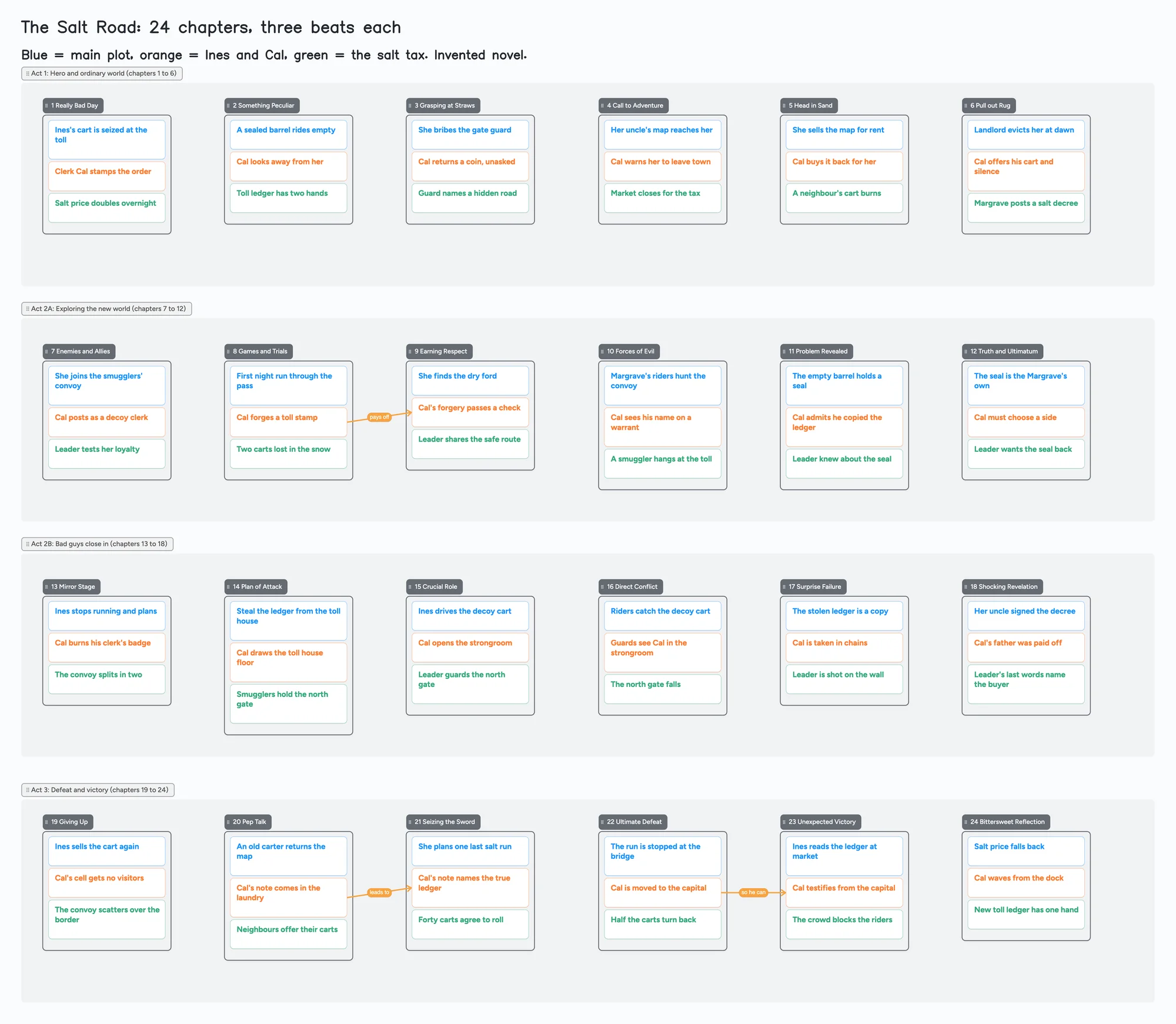
We make Instaboard, a free online board. This page gives you a 24-chapter novel outline already laid out on it: four act sections, one list per chapter, and three beat cards in each list, one for the main plot, one for the relationship and one for the subplot. The story is invented and the chapter names follow Derek Murphy's 24-chapter outline. Open it, replace the story with yours, and send one link to a co-writer, a coach or an editor. Before you build: every card and every list counts toward the free plan's 150 items, and a 36-chapter book in this shape is 144 of them.
Opens in your browser. Anyone can view; a free sign-in lets you edit.
Updated
The short answer
- Acts are sections, chapters are lists, beats are cards. Section frames group the chapters without costing anything, each chapter is a list you can drag, and each beat is a card with its own colour. Move a card to another list when a beat belongs to a different chapter.
- Count the items before you copy it. Each list and each card is one item; sections, arrows and pen strokes aren't. 24 chapters with 3 beats each is 24 lists plus 72 cards, 96 items. 27 chapters is 108, and 36 chapters is 36 lists plus 108 cards, 144 of the free 150 (our arithmetic). A character list or a setting note on the same account takes some of what is left.
- Leaner shape: one card per chapter with the beats as lines inside it. 36 chapters in four act lists is 40 items (our arithmetic). The index-card page has that shape.
- Pro lifts the limit: $5 a month billed yearly ($59.99), or $7.99 monthly. The free plan keeps 5 boards, 150 items and 3 pictures per board.
- Anyone with the link can read it; writing takes a free sign-in. New boards start view-only. Set "Anyone with the link can edit" if a co-writer or editor should add cards.
- What it doesn't have: a timeline axis, word counts, beat-sheet guidance, a manuscript editor, and export to Plottr or Scrivener. It holds the outline, not the book.
What this board doesn't do, before you build
- No timeline axis and no word counts. Plottr and Dabble show the story along a timeline or grid; here the order is the order of the lists and cards.
- No beat guidance. The board is filled with an example, not with prompts. Reedsy Studio's template adds guided questions to each beat (below).
- No manuscript. There is nowhere to draft the chapters. Write in your word processor, Scrivener, Dabble or Campfire.
- No export to Plottr, Scrivener or Word. You can copy a selection as a picture; cards don't turn into files.
- No hidden notes on the free plan. Everyone with the link sees every card.
- 3 pictures per board. The ready board has none.
What the 24-chapter outline is, and the 27-chapter one
The 24-chapter outline is Derek Murphy's way of laying a novel out as a three-act story in 24 numbered chapters. Plottr's page (June 24, 2024) offers it as a template with four plotlines, 34 scene cards and 25 spaces for beats, and Murphy's own page gives it away as a one-page Word, PDF or Google Docs file. Plottr's page splits it into Act 1 (chapters 1 to 6), Act 2A (7 to 12), Act 2B (13 to 18) and Act 3 (19 to 24), which is the split this board uses.
Campfire's blog has a separate 27-chapter method, "The 27-Chapter Outline and the Power of Three: Setup, Conflict, Resolution" (last updated May 13, 2024). Its subtitle calls it a way to outline a story with the simplicity of the three-act structure and the nuance of something more detailed. The body of that article didn't load for us, so we don't describe how it divides the chapters. To lay out 27 chapters on a board, make three sections of nine chapter lists each; the split is our arithmetic, not Campfire's, and it is 27 lists plus 81 cards, 108 items, with three beats each.
How many items a chapter outline uses
The free plan allows 150 items across all your boards. Each card and each list is one item. Section frames, arrows and pen strokes don't count. Our own arithmetic for the layout on this page:
| Book | Layout | Lists | Cards | Items | Of the free 150 |
|---|---|---|---|---|---|
| 24 chapters, 3 beats each | A list per chapter | 24 | 72 | 96 | 54 left |
| 27 chapters, 3 beats each | A list per chapter | 27 | 81 | 108 | 42 left |
| 36 chapters, 3 beats each | A list per chapter | 36 | 108 | 144 | 6 left |
| 36 chapters, 4 beats each | A list per chapter | 36 | 144 | 180 | Over 150 |
| 36 chapters, one card each | One list per act | 4 | 36 | 40 | 110 left |
Swipe the table sideways to see every column.
Our arithmetic from the free plan's 150 items. Items are counted across all your boards, so a character list or notes on another board use the same 150.
If you reach the limit, you can move to one card per chapter, or upgrade: Pro is $5 a month billed yearly ($59.99) or $7.99 monthly and has no item limit.
How the ready board is laid out
Derek Murphy's 24-chapter outline (his own page, read November 15, 2026) numbers its sections 1 to 24 and notes that the downloads are called the 24-chapter outline although the list on the page has 25 numbered sections, with Death of Self as the 25th. Plottr's page groups the same chapters into four parts, and so does the board here:
- Act 1, chapters 1 to 6: the hero and the ordinary world, from Really Bad Day to Pull out Rug.
- Act 2A, chapters 7 to 12: exploring the new world, from Enemies and Allies to Truth and Ultimatum.
- Act 2B, chapters 13 to 18: the bad guys close in, from Mirror Stage to Shocking Revelation.
- Act 3, chapters 19 to 24: defeat and victory, from Giving Up to Bittersweet Reflection. Add a 25th list if you want the optional Death of Self chapter.
The chapter names are Murphy's. The story, the characters and every beat on the board are invented for this page, and the three beats per chapter are our choice, not part of his outline: the main plot (blue), the relationship between the two leads (orange) and a subplot, here a salt tax (green). Use different colours for your own plotlines. Three arrows show a planted detail and where it pays off; they stay attached when a card is moved or a list is reordered.
How to set it up for your own novel
- Open the ready board and sign in free to edit it. Rename the chapter lists if your structure isn't Murphy's.
- Fill the main-plot cards first, one line each, top to bottom through the 24 chapters. If a chapter has no main-plot beat, that is the gap to fix.
- Add the relationship and subplot cards and give each plotline its own colour.
- Draw an arrow when a detail is planted and when it pays off. Give it a caption so you can read it later.
- Move cards rather than rewriting them. A beat that arrives too early goes into the next list; a chapter you cut leaves its list empty, so delete the list to free the item.
- Share the link. Anyone with it can read; writing needs a free sign-in, and a signed-in co-writer or editor writes live. Give each person their own cards, because two people typing in the same card at once are merged keystroke by keystroke with no lock.
A board someone opens from your link counts as one of their own 5 free boards; the cards they add count toward their own 150 items, not yours.
3-act structure in plain terms
A three-act outline splits the book into a beginning (the setup), a middle (the conflict) and an end (the resolution). The 24-chapter outline cuts the middle in two, which is why this board has four act sections. If you want plain thirds, use three sections: 8 chapters each for a 24-chapter book, or 9 each for a 27-chapter book (our arithmetic). A bare nine-beat three-act outline, three beats a section, is 9 cards in three lists, 12 items.
Reedsy Studio's free three-act template (read November 15, 2026) is that nine-beat shape with guided questions on each beat; use it if you want prompts, because this board has none.
Who the 24-chapter outline is for, and who it isn't
Plottr's page says the outline serves writers who want to produce commercial fiction and like step-by-step guides. StorytellingDB (May 20, 2025) says it was designed for commercial genres and works best for 50,000 to 75,000 words, roughly 2,000 to 3,000 words a chapter, and that longer epics need extra scenes for other points of view and subplots. If your book is literary, very long or heavily multi-POV, use the board for the spine and add lists for the rest, and keep the item count in mind.
Writers disagree about templates like this. In r/writing in January 2021, u/monsterfurby (score 346) said a template is a good tool but not a cure-all, and that the most value came from outlining or drafting first and then using it to reshuffle scenes and chapters; u/laxnut90 disagreed with making each stage its own chapter and thought the first six should fit in three chapters at most. In r/writing in 2019, u/Curliness described a plain list of chapter numbers with one line on what happens in each. Each is one person's view.
A board suits the reshuffling part well: a beat is a card you drag, not a paragraph you cut and paste.
When something else is the better choice
Each line is from the maker's own page, read on November 15, 2026. Plans change, so check the page before you pay.
| Tool | What it does well for a chapter outline | What its page says about cost | Where this board is different |
|---|---|---|---|
| Instaboard | A chapter outline as lists and cards you drag, with colour per plotline and arrows between beats; shared by one link | Free: 5 boards, 150 items, 3 pictures per board. Pro $5 a month billed yearly, or $7.99 monthly | No timeline, no guidance, no manuscript, no export. Writing takes a free sign-in |
| Plottr | A 24 Chapter Novel Outline template with four plotlines, 34 scene cards and 25 spaces for beats, plus a timeline view and series tools (its 24-chapter page) | Needs a Plottr plan or a free 30-day trial. The pricing page lists Plottr at $60 a year for Windows and Mac and Plottr Pro at $99 a year or $9.99 a month, with a browser app, cloud sync and real-time collaboration on Pro | Plottr is better for a timeline, templates and a series. Real-time collaboration is on Pro |
| Reedsy Studio | A Three-Act Structure template: 9 beats across an Outline board plus Characters and Places boards, 19 cards, guided questions and a worked Pride and Prejudice example; a manuscript editor and export in the same app | Its template page calls Studio a free app | Reedsy Studio is better for guided beats and for drafting in the same place. It is a three-act, nine-beat template, not 24 chapters |
| Dabble | A Plot Grid and a three-act worksheet (a PDF to download); drafting, co-authoring and goals | Writer $15 a month billed annually ($180 a year), with a 14-day trial and no card (pricing page); no free plan listed | Dabble is better if you want to plot and write in one app. A subscription |
| Campfire | Arcs, characters, timeline and a manuscript module; a 27-chapter plotting article on its blog | A free plan with limited modules, including Manuscript 25,000 words and Arcs 3; Standard is $12 a month, shown beside a struck $19 (pricing page) | Campfire is better for a story bible and a draft. Its free plan caps arcs and words |
| Murphy's free template | The 24-chapter outline as a one-page Word, PDF or Google Docs file with an expanded Word version for notes, and a video walkthrough (his page) | Free download | The template is better if you work alone and want it on paper. It isn't shared or movable |
| Bransford's spreadsheet | A 50-chapter Google Sheet: a column per character, a row per chapter, colour-coded plot framework (his 2019 post) | Free to copy or download as Excel; he asks people not to request edit access | A sheet is better for character columns and sums. Its cells can't be dragged around like cards |
Swipe the table sideways to see every column.
Read November 15, 2026. Bransford's post is from June 2019. Campfire's 27-chapter article didn't load in full for us, so only its title is cited. The Reedsy page doesn't say how Studio is paid for beyond calling it free.
- You want the outline and the manuscript in one place. Reedsy Studio, Dabble, Campfire and Scrivener keep both; this board holds only the outline.
- You want a timeline. Plottr's template runs along a timeline. This board has none. For what Plottr costs and how it compares, see Plottr and its free alternatives.
- You want one printed page. Murphy's one-page download is made for that.
- You are outlining a screenplay or TV pilot. See the index-card outline page, which uses four act lists and a card per scene.
Limits, in one list
- 150 items, 5 boards and 3 pictures per board on the free plan; Pro removes the limit.
- No timeline axis, no word counts, no beat prompts, no manuscript.
- No export to Plottr, Scrivener or Word, and no import from them.
- No hidden lists on the free plan: everyone with the link sees everything.
- Writing needs a free sign-in; reading doesn't.
Once the first draft exists and you have reader notes, the novel revision board turns them into a plan. For a partner plotting with you, see the Plottr alternatives page.
Start from the ready board
It opens in your browser in a few seconds, with nothing to install. Sign in for free when you want to save it and share it.
Questions
Is there a free 24 chapter novel outline template online?
Derek Murphy's own page offers the outline free as a Word, PDF or Google Docs file. The board on this page is a filled version you can open, move around and share by link; it is free to open, and editing takes a free sign-in. The free plan has 150 items, and the ready board is 96 of them.
How many items does a chapter-by-chapter outline use?
Each list and each card counts as one item. 24 chapters with three beats each, one list per chapter, is 96 items; 36 chapters is 144. One card per chapter in four act lists is 40 items for 36 chapters (our arithmetic). Sections, arrows and pen strokes don't count.
Can I use it for a 3 act structure novel outline?
Yes. Make three sections and one list per chapter or per beat. The ready board uses four act sections because Murphy's outline splits the middle in two. A nine-beat three-act outline is 9 cards in three lists, 12 items.
What goes in a chapter outline for a novel?
What changes in the chapter, in a line or two, plus which plotline it moves. The ready board has three cards per chapter: the main plot, the relationship and a subplot. Some writers keep only one line per chapter, which is the leaner shape above.
Can a co-writer or editor work on it with me?
Yes. Set "Anyone with the link can edit" and send the link. They sign in free to write, and what they move shows up for you within a few seconds. Give each person their own cards: two people typing in the same card at once are merged keystroke by keystroke with no lock.
Can I export the outline to Plottr or Scrivener?
No. There is no export to Plottr, Scrivener or Word. You can copy a selection as a picture. If you need the outline in those apps, build it there.
What if I go past 150 items?
On the free plan you can't add more items. Move to one card per chapter, delete cards you no longer need, or upgrade: Pro is $5 a month billed yearly ($59.99) or $7.99 monthly and has no item limit.
Is Instaboard free?
Yes. The free plan includes 5 boards, 150 cards and items across your account (pen strokes, arrows and sections don't count), 3 images and 1 file per board, unlimited collaborators and video calls up to an hour. Pro is $5 a month billed yearly ($59.99 a year), or $7.99 monthly, and the people you invite join free.
Sources
- Plottr: 24 Chapter Novel Outline (Jun 24, 2024; read Nov 15, 2026)
- Plottr: pricing (read Nov 15, 2026)
- Creativindie (Derek Murphy): free 24-chapter novel outline template (read Nov 15, 2026)
- StorytellingDB: 24 Chapter Novel Outline (May 20, 2025; read Nov 15, 2026)
- Reedsy Studio: Three-Act Structure template (read Nov 15, 2026)
- Dabble: pricing (read Nov 15, 2026)
- Dabble: three-act structure worksheet (Jan 6, 2026; read Nov 15, 2026)
- Campfire: pricing (read Nov 15, 2026)
- Campfire: The 27-Chapter Outline and the Power of Three (last updated May 13, 2024; title and intro only, read Nov 15, 2026)
- Nathan Bransford: How to outline a novel (Jun 2019; read Nov 15, 2026)
- r/writing: "I just found the most complete 24-Chapter/3-Act-Structure…" (Jan 2021, read in full Nov 15, 2026)
- r/writing: "When outlining a novel how do you organize your outline?" (Jan 2019, read in full Nov 15, 2026)
Related
Outline a novel or screenplay with index cards, on a board you can share
Outline a novel or screenplay on digital index cards: one list per act, 40 short cards, subplot arrows, a co-writer on the same board. Free to start; TV pilot too.
A novel revision board: your reader and editor notes, sorted into a plan
A shared novel revision board: reverse outline, beta reader notes sorted into must fix and consider, an editor's letter, and three passes. Free to open.
A mystery novel outline board for suspects, clues and red herrings
Outline a mystery novel on one board: a list per suspect, clues, red herrings and reveal order. A free ready board, and where Plottr and Sheets do more.
A free Plottr alternative for plotting with a partner, and where Plottr is better
Plottr's live collaboration needs Pro for each person. A free shared plotting board for two writers, and where Plottr, Scyn and Kindling do better.
A novel beat sheet on one shared board: 15 beats, three acts, scenes under each beat
A 15-beat novel outline to open and edit: 3 act sections, a list per beat, scene cards under each. Free-plan item counts and where other tools are better.