For math and SAT tutors
A math mistake log template: one card per mistake, redone in ink, filled in so you can see how it reads
Most test-prep advice agrees on one habit: write down every mistake, say why it happened, and come back to it. Most templates for that are spreadsheets. This page offers a different version for tutoring: a board where tutor and student redo the mistake in ink on its own card during the lesson. It comes filled in with invented problems, so you can see what a good entry looks like. It also says plainly when a spreadsheet is the better log, because for a big, long-running log it usually is.
Updated
The short answer
- One card per mistake, with the cause first. Magoosh's error-log guide says to record why you missed a question, not just what the answer was.
- Redo it in ink on the card, in the lesson. Move the card from To redo to Redone, and to Secure once the student gets a similar problem right alone.
- Look for a pattern. satmistakelog.us suggests that the same root cause showing up three times is one pattern, not three mistakes.
- A big log belongs in a spreadsheet. A board has no sorting, filtering, counts or review dates. Use it for the mistakes you work on together this month.
What a mistake log holds
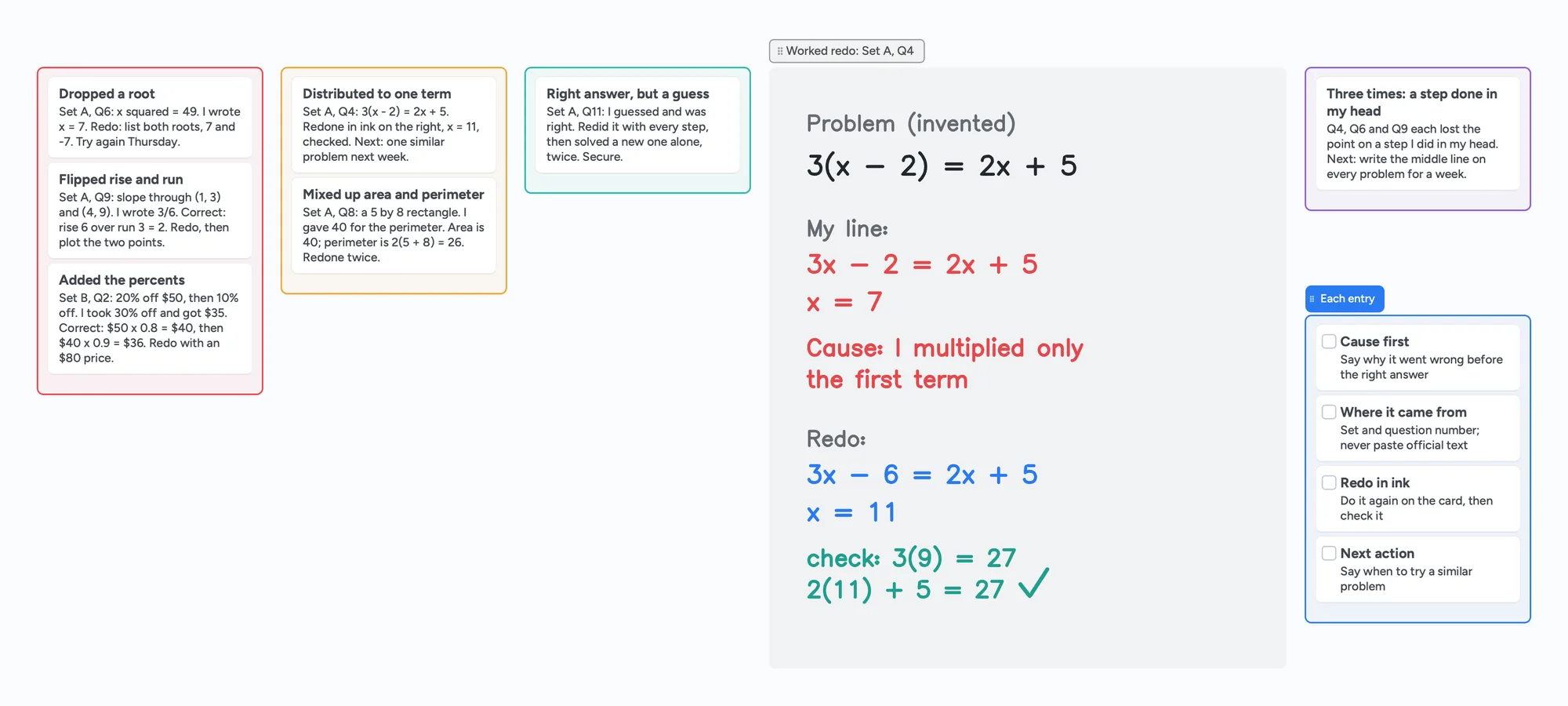
Published logs agree on a short core. satmistakelog.us keeps one row per missed or guessed question, with columns for source, section, topic, error type, why I missed it, the correct approach, a next action, a review date and a status. Magoosh's template (a Google Sheet made for the GRE and adaptable to other tests) asks for the question's source and the reason it was missed. One calculus site's mistakes-journal post lists the topic and date, the problem, my error, the correct solution, why, the missed concept and what I'll do next time. Our board keeps four things on every card:
| On the card | What to write | Why |
|---|---|---|
| Cause first | Why it went wrong, in plain words, before the right answer. | The cause is what you can fix; the answer only fixes one problem. |
| Where it came from | The practice set and question number, for example "Set A, Q6". | You can find it again. Never paste official test text. |
| Redo | The problem done again, in ink on the card, and checked. | Doing it again is the point of the log. |
| Next action | When to try a similar problem. | Turns a mistake into a plan. |
Swipe the table sideways to see every column.
Fields adapted from satmistakelog.us, the Magoosh help center article "Formatting and organizing your error log (with template)" and the iacedcalculus.com mistakes-journal post; read November 2, 2026. Which four we keep, and the right-hand wording, are ours.
How the board works in a lesson
- After a practice set, add one card per mistake to the To redo list. Add a card for a lucky guess too: satmistakelog.us says to log correct guesses as well.
- Write the cause first. On the board, Set A, Q6 reads "Dropped a root" as the card title, with the details below it.
- Redo it together in ink. The tutor and the student write the corrected steps next to or under the card. On the board, the student's redo of Q4 is in blue and the check is in green.
- Move the card to Redone when the redo is checked, and to Secure after the student solves a similar problem alone.
- When three cards share a cause, write one pattern card. In the example, three problems each lost the point on a step done in the student's head, so the next action is to write the middle line on every problem for a week.
The problems on the board are invented: an equation, a slope, two discounts in a row and a rectangle's area. Replace them with your student's. Keep the source as a set and question number, and don't paste official test questions. satmistakelog.us warns against putting copyrighted official question text into a public sheet, and a board shared by link is public too. If you tutor SAT math, how to tutor SAT math online shows a lesson on the same kind of board.
Use a spreadsheet when…
A spreadsheet is the better log in several cases, and most published templates are spreadsheets for good reason:
- You want to sort and filter by topic or error type to see where most points go.
- You want to count patterns across many rows. A board has no counts or charts; you would be counting cards by eye.
- You want a review-date column and a status you can filter. A board has no reminders.
- You want to export the log. satmistakelog.us offers a Google Sheet copy and a CSV. Planning boards on Instaboard can't be exported; you can save selected cards as a picture.
- The log will run to dozens or hundreds of entries. One card per mistake adds up quickly against Free's 150-item limit (below).
A sensible split is a sheet for the long-running, cross-student record and a board for the mistakes you work on together this month. Instaboard fits when you already teach on a board and the log is for one student at a time.
What students say about keeping a log
Writing everything down is the part people dislike. In a July 2026 r/Sat thread, one poster said it feels time-consuming and inconvenient, and the replies split. One suggested a screenshot in a Google doc with the reason typed under it. One preferred a red pen on binder paper, saying that writing it helps and reading it doesn't. One listed five fields: question number, topic, my mistake, the correct explanation and a fix strategy. One said they never re-read the log. These are individual posters' habits, not data.
That is the case for redoing the mistake with a tutor during the lesson: the writing happens once, with someone checking it, instead of afterwards on your own. The cost is that a board is slower to fill in than a row in a sheet.
Test corrections are a different job
Teachers also use "test corrections". A 2018 post on the Scaffolded Math blog describes a sheet where students list the problem number, the correct answer and an explanation of the error, and earn half credit back for revised problems. That is a grading routine for a class, not a tutor's working log. You can use the same board for it, with the student's explanation as the card's detail line, but the credit and grading are the teacher's.
What Instaboard doesn't do for a mistake log
- No sorting, filtering, counts or charts. You find patterns by reading the cards.
- No reminders or review dates. Write the date yourself, or use a calendar.
- Free covers 5 boards and 150 items across your account. Cards and lists count toward the 150; pen strokes don't. One card per mistake uses the allowance faster than a spreadsheet row would. The example board uses 16 cards and lists. Pro lifts the limits.
- Free allows 3 images per board. So entries here are text cards plus ink, not screenshots of the problems.
- Students sign in only to write. Anyone with the link can view; writing needs a free sign-in.
- Free boards are shared by link. Use first names only. Invite-only boards are on Pro.
- The eraser removes a whole stroke. To fix part of a line you redraw it.
- It is manual. Nothing marks a mistake or finds a pattern for you, and there is no AI.
Start from the ready board
It opens in your browser in a few seconds, with nothing to install. Sign in for free when you want to save it and share it.
Questions
What is the difference between a mistake log and an error log?
Mostly the name. "Error log" is the usual word in SAT, GMAT and MCAT prep; "mistake log" or "mistakes journal" turns up for school math. The idea is the same: write down each mistake, why it happened and what to do about it.
What should a math mistake log include?
The source (set and question number), the cause, the correct approach, and a next action. Published templates add the topic, an error type, a review date and a status.
Should I log questions I guessed correctly?
satmistakelog.us says yes: log correct guesses too. A right answer you can't reproduce is still a gap.
Can I use official SAT questions in my log?
Note the test and question number so you can find it, but don't paste the question text into a board you share. satmistakelog.us warns against putting copyrighted official question text into a public sheet. The problems on our board are invented.
When is a spreadsheet better than a board?
When you need to sort, filter or count across many rows, track review dates, or export the log. A board is better for the handful of mistakes you redo together in a lesson.
Is Instaboard free?
Yes. The free plan includes 5 boards, 150 cards and items across your account (pen strokes, arrows and sections don't count), 3 images and 1 file per board, unlimited collaborators and video calls up to an hour. Pro is $5 a month billed yearly ($59.99 a year), or $7.99 monthly, and the people you invite join free.
Sources
- satmistakelog.us: SAT Error Log Template
- Magoosh Help Center: Formatting and organizing your error log (with template) (July 12, 2024)
- iacedcalculus.com: Why You Should Keep a Math Mistakes Journal (November 30, 2024)
- r/Sat: error log thread (July 16, 2026; one poster and the replies)
- Scaffolded Math: Simple math test corrections template (September 2018)
Related
How to tutor SAT math online on a whiteboard: one SAT-style lesson, step by step
How to tutor SAT math online on a shared whiteboard: what the College Board says the Math section tests, one SAT-style lesson worked step by step with the student doing the next one, and why Bluebook is the tool for timed practice. Ready lesson board included.
A tutoring session notes template, filled in so you can see how it reads
What to write after each tutoring session: outcome, what went wrong, evidence, next task and a short parent note. A copy-and-use template and a filled board you can send as one link.
How to teach math online: your first lesson, step by step
How to tutor math online as a beginner: what you need, how to run a first lesson on a board your student writes on too, with Zoom, Google Meet or no video app at all, and what to do without a whiteboard.
An online whiteboard for math: write, graph and let your student write too
What a math tutor needs from an online whiteboard: handwriting, typed equations, graphs and worksheets, and which tools have each. Free limits compared, plus a ready slope lesson board.
An online whiteboard for tutoring that works the way you teach
A free whiteboard for online tutoring: paste the worksheet, write with a pen, and your student answers on the same board. Call on it or beside Zoom.
Online tutoring setup: what you need before your first lesson
What you need to start tutoring online: sound, light, camera, internet, a way to write, and a board your student writes on too. A plain checklist with a five-minute test call and a ready board to open.