For a small team that wants to run one SCAMPER round on a product it already sells
A SCAMPER template: one list for each of the seven letters, filled in for one product, on a shared board
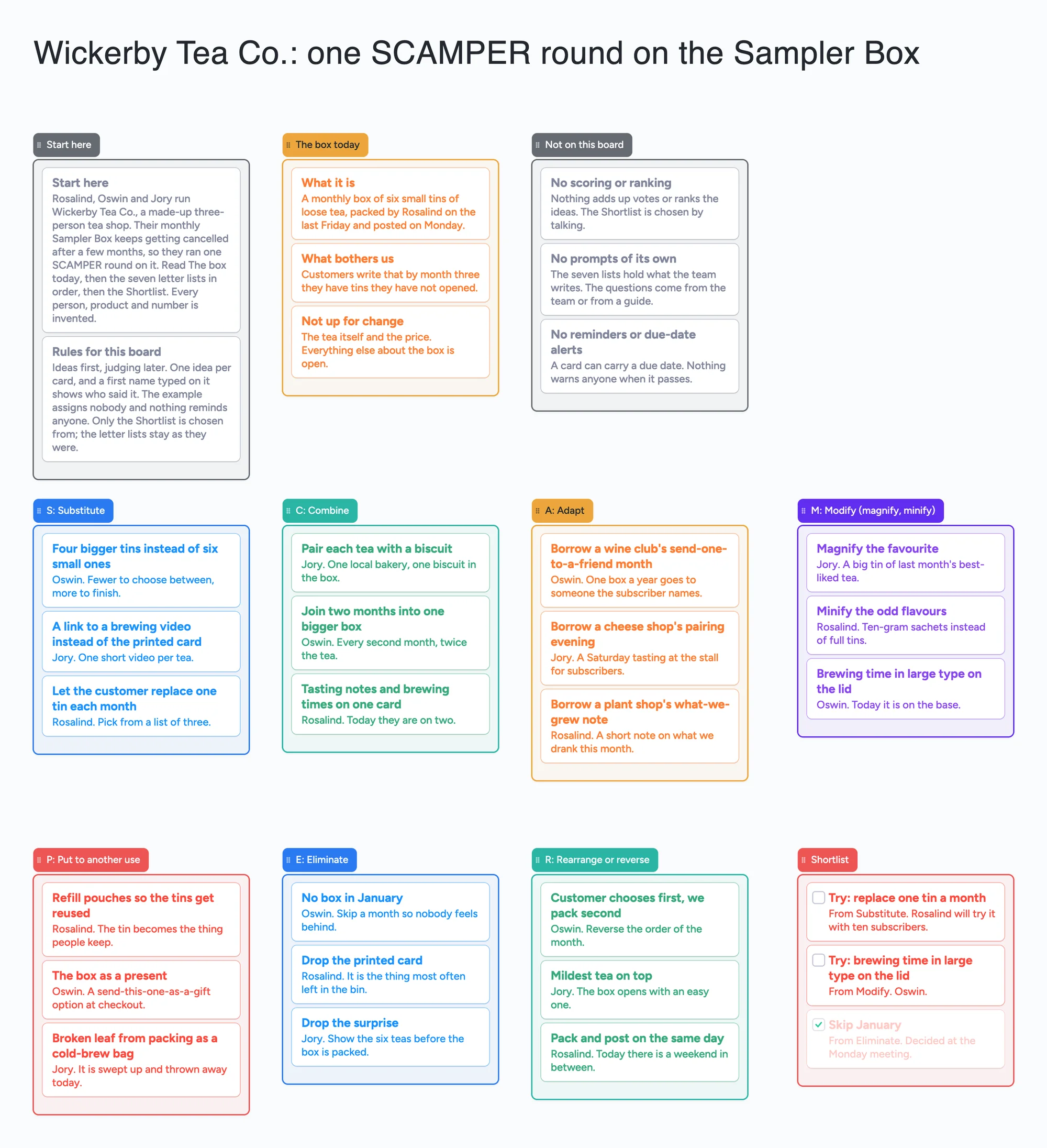
SCAMPER is a brainstorming method for improving something that already exists: you ask seven kinds of question about it, one for each letter. This is a SCAMPER board already laid out on Instaboard, our online board, filled in for an invented three-person tea shop: Rosalind, Oswin and Jory at Wickerby Tea Co. run one round on their monthly Sampler Box, because subscribers keep cancelling around month three. The board has eleven lists and 32 cards: two cards that explain it, three cards on the box as it is today, a list for each of the seven letters with three ideas each, a shortlist of three, and three cards on what the board does not do. The board holds the ideas and the shortlist. It does not ask the questions or score the ideas. Every person, product and number is invented.
Opens in your browser. Anyone can view; a free sign-in lets you edit.
Updated
The short answer
- What it is: a shared page where a team writes the ideas from one SCAMPER round into seven lists, one per letter, with the product described above them and a shortlist beside them. The example uses 44 of your 150 free items.
- What it is not: a prompt generator, a scoring sheet or a facilitator. It holds what your team writes. The questions come from you or from a guide, and a spreadsheet or a talk does the choosing.
- Where this board may help: our view: a team that wants everyone to add ideas to the same seven lists, at the same time, and to keep the few chosen ones in view afterwards.
- Weakest fit: a round you run alone on one sheet of paper, or a problem with no existing product or process to start from.
- Keep off it: customer details, prices and anything confidential. The example uses an invented tea shop. A link board is not private.
Seven letters, and the three ways the guides word them
SCAMPER is a list of prompts for changing something that already exists. IxDF's guide (Rikke Friis Dam and Yu Siang Teo; the page shows only a relative date, "2 years ago"; vendor, a design-education site) credits Alex Osborn, the originator of brainstorming, with many of the questions and Bob Eberle with arranging them into the SCAMPER mnemonic. Miro's template page (no date printed; vendor) and Toolshero (Patty Mulder; original publication April 7, 2018, last update November 11, 2026; a membership site) both say Eberle introduced it in a 1971 book.
The three pages do not word every letter the same way, so a board has to pick words and keep them:
| Letter | IxDF | Miro | Toolshero |
|---|---|---|---|
| S | Substitute | Substitute | Substitute |
| C | Combine | Combine | Combine |
| A | Adapt | Adapt | Adapt |
| M | Modify (also Magnify and Minify) | Modify (also Magnify and Minify) | Modify/Magnify |
| P | Put to another use | Put to another use | Purpose, also written Put to other uses |
| E | Eliminate | Eliminate | Eliminate/Minify |
| R | Rearrange in its list of seven and its step headings, Reverse in its closing summary | Reverse | Rearrange/Reverse |
Swipe the table sideways to see every column.
Letters only, as each page was read on November 26, 2026; no question lists are copied. IxDF's text carries a CC BY-NC-SA 3.0 licence, so we paraphrase it. SCAMPER is Bob Eberle's method; Instaboard isn't affiliated with him, IxDF, Miro or Toolshero.
Wickerby's lists are titled "M: Modify (magnify, minify)" and "R: Rearrange or reverse", which covers every column above. Choose your own wording once and leave it on the board.
Wickerby Tea Co., list by list
- Start here (2 cards). Who Rosalind, Oswin and Jory are, why they ran the round, and the rules: ideas first and judging later, one idea per card, a first name typed on a card shows who said it, the example assigns nobody and nothing reminds anyone.
- The box today (3 cards). What it is (six small tins, packed on the last Friday and posted on Monday), what bothers them (tins unopened by month three) and what is not up for change (the tea and the price).
- S: Substitute (3 cards). Four bigger tins instead of six, a brewing video instead of the printed card, and letting the customer replace one tin a month.
- C: Combine (3 cards). A biscuit with each tea, two months joined into one bigger box, and tasting notes and brewing times on one card.
- A: Adapt (3 cards). Three borrowed ideas: a wine club's send-one-to-a-friend month, a cheese shop's pairing evening and a plant shop's note on what was grown.
- M: Modify (3 cards). A bigger tin of the favourite, ten-gram sachets for the odd flavours and the brewing time in large type on the lid.
- P: Put to another use (3 cards). Refill pouches so the tins are kept, the box as a present, and broken leaf from packing as a cold-brew bag.
- E: Eliminate (3 cards). No box in January, no printed card and no surprise.
- R: Rearrange or reverse (3 cards). The customer chooses first and Wickerby packs second, the mildest tea on top, and packing and posting on the same day.
- Shortlist (3 cards, two tick boxes open, one ticked). Replacing one tin a month and the brewing time on the lid are to be tried; skipping January is ticked as decided.
- Not on this board (3 cards). No scoring or ranking, no prompts of its own, no reminders or due-date alerts.
From 21 ideas to a shortlist of 3: the choosing happens off the board
Seven lists of three ideas make 21 cards, and the round ends with three on the shortlist. Three ideas a letter is Wickerby's choice, not a rule of the method. Toolshero says SCAMPER is mainly a way to generate ideas and gives no full method for judging them. It suggests scoring each idea from 1 to 5 on customer value, feasibility, resource efficiency and expected impact, and itself calls the scoring "a practical evaluation aid rather than an official component" of the method.
Our telling of the example: Wickerby did not score. The three of them read the 21 cards aloud at the Monday meeting, ticked the one they all agreed on and left the other two as things to try. The board shows the result. It does not add up votes, rank the ideas or check that anyone follows through, so a team that wants numbers keeps them in a sheet beside it.
What the board leaves to you
- No prompts. The lists start empty of questions. Bring them from IxDF, Miro, Toolshero or your own head; the cards hold the answers.
- No scoring, ranking or sums. A shortlist is picked by the people in the room.
- No facilitator. Nothing on the board leads the session or sets the order of the letters.
- No reminders or due-date alerts. A card can carry a due date, but nothing warns anyone when it passes. A name typed on a card shows who said it; the example assigns nobody.
- SCAMPER itself can be the wrong tool. Toolshero says it is less suitable when a team is only hunting for the direct cause of a problem or has already chosen its solution, and warns that starting from what exists can hide wholly new paths.
- Up to 3 pictures; the lists are text. The free plan takes 3 pictures per board and the example has none.
What 44 items leave you, and what a copy costs
Every card and every list counts toward your 150 free items, and so does the title text box. Arrows, sections and pen strokes don't, and moving a card between lists adds nothing.
- As built: 11 lists + 32 cards + the title = 44, which leaves 106.
- The seven letters alone: 7 lists + 21 cards = 28 of the 44. A round with five ideas a letter would be 7 + 35 = 42 for the letters, our arithmetic.
- More rounds as copies: two copies of the example as built are 2 x 44 = 88, three are 132 and a fourth makes 176.
Before you copy it:
- A copy uses a board. Of your 5 free boards, each copy takes 1.
- Opening is not writing. Someone who opens your link can read it; to add a card they sign in for free, and the board then takes 1 of their 5.
- Keep it to the product. Customer details stay off a link board; invite-only boards are a Pro feature.
IxDF, Miro and Toolshero, read November 26, 2026
These are three pages about SCAMPER that we read in full, not a ranking. The second column says what the page says; the last two columns are our view.
| Guide | Gives you | Our view: better if | Our view: the board is better if |
|---|---|---|---|
| IxDF: SCAMPER, how to use the best ideation methods (page shows "2 years ago"; vendor) | A guiding-question set for each letter, a McDonald's example, a history note and a template download behind a name-and-email form | You want long question lists to read from while you work | You want the team's own answers side by side in one place |
| Miro: SCAMPER model template (no date printed; vendor) | A canvas with a pre-populated layout, a short explanation of each letter and a note that the order is not fixed | You want a large canvas to lay the letters out on | You want cards in lists that stay in order, with a shortlist to tick |
| Toolshero: SCAMPER technique (Patty Mulder, last update November 11, 2026; membership site) | A 60-minute session plan, sample questions, an onboarding example, scoring advice, advantages and limits, and a reading list | You want a facilitation plan and a way to evaluate the ideas | You want a shared place to keep the ideas and the shortlist while you talk |
Swipe the table sideways to see every column.
From each page as read November 26, 2026. All three are vendors or a membership site, not independent studies. Instaboard isn't affiliated with any of them.
A round of about an hour, and the order of the letters
Toolshero's example split for a 60-minute team session is 10 minutes to explain the aim and the current situation, 30 minutes for the seven categories (about four minutes each), 15 minutes to review and select, and 5 minutes to agree next steps. It adds that a simple improvement question may take about 30 minutes and calls its split a practical guideline, not a requirement of the method.
Miro's page says the way to SCAMPER is nonlinear and that a moderator can bounce between the questions. That fits the board: the seven lists sit side by side, so people can add to any of them in any order. Nothing on the board runs the round or holds a letter shut, so whoever leads the session brings the plan.
Run your own round
- Open the board and rewrite Start here with your team and the product you are improving.
- Fill in The box today: what it is, what bothers you and what is not up for change. Say that last one out loud.
- Decide the wording of the seven list titles (Rearrange or Reverse, Put to another use or Purpose) and edit them once.
- Run the round. Everyone adds cards to any letter, one idea per card, with a first name if you want to remember who said it.
- Read the cards aloud and talk, then move the few you want into Shortlist and tick what you have decided.
- Delete the tea shop's cards and keep the lists. Rename a list if your product needs it.
- Share it. Set the share setting so anyone who joins can edit ("Anyone who joins can edit"); new boards start view-only, and each person signs in to write.
Start from the ready board
It opens in your browser in a few seconds, with nothing to install. Sign in for free when you want to save it and share it.
Questions
What does SCAMPER stand for?
Substitute, Combine, Adapt, Modify, Put to another use, Eliminate and Rearrange. Miro ends with Reverse, IxDF's list says Rearrange and its summary Reverse, and Toolshero writes Rearrange/Reverse, so the last letter has two common readings. On the board each letter is a list.
Who came up with SCAMPER?
IxDF credits Alex Osborn, the originator of brainstorming, with many of the questions and Bob Eberle with arranging them into the mnemonic. Miro and Toolshero both give Eberle's 1971 book. None of the three pages shows a (R) or (TM) mark beside SCAMPER, and we did not search a trademark register. Instaboard isn't affiliated with Eberle, IxDF, Miro or Toolshero.
Does the board give me the questions for each letter?
No. The seven lists hold the ideas your team writes. The guiding questions come from you or from a guide such as IxDF, Miro or Toolshero, and we copy none of them here.
How many rounds can one account hold?
Our arithmetic: as built the example is 44 of your 150 free items, so three copies make 132 and a fourth passes 150. Pro removes the item limit, at $5 a month billed yearly ($59.99 a year) or $7.99 monthly.
Can the board score or rank the ideas?
No. Nothing adds up votes or ranks the ideas. Toolshero suggests scoring ideas from 1 to 5 and says that is an aid, not part of the method. Do it in a sheet, or choose by talking as Wickerby did.
Who can add to the board?
Anyone you share the link with can read the board. To add a card they sign in for free, and if the share setting is "Anyone who joins can edit" they can edit. A board opened from your link takes 1 of their 5 free boards, and a copy takes 1 of yours.
Sources
- IxDF: Scamper, how to use the best ideation methods (Rikke Friis Dam and Yu Siang Teo; page shows only "2 years ago"; read in full November 26, 2026; CC BY-NC-SA 3.0; vendor content)
- Miro: SCAMPER model template (no date printed; read in full November 26, 2026; vendor content)
- Toolshero: SCAMPER technique, definition, 7 steps and practical examples (Patty Mulder; original publication April 7, 2018, last update November 11, 2026; read in full November 26, 2026; membership site)