For one to three owners describing how a small business works, before or beside a written plan
A business model canvas for a small business, on one shared board
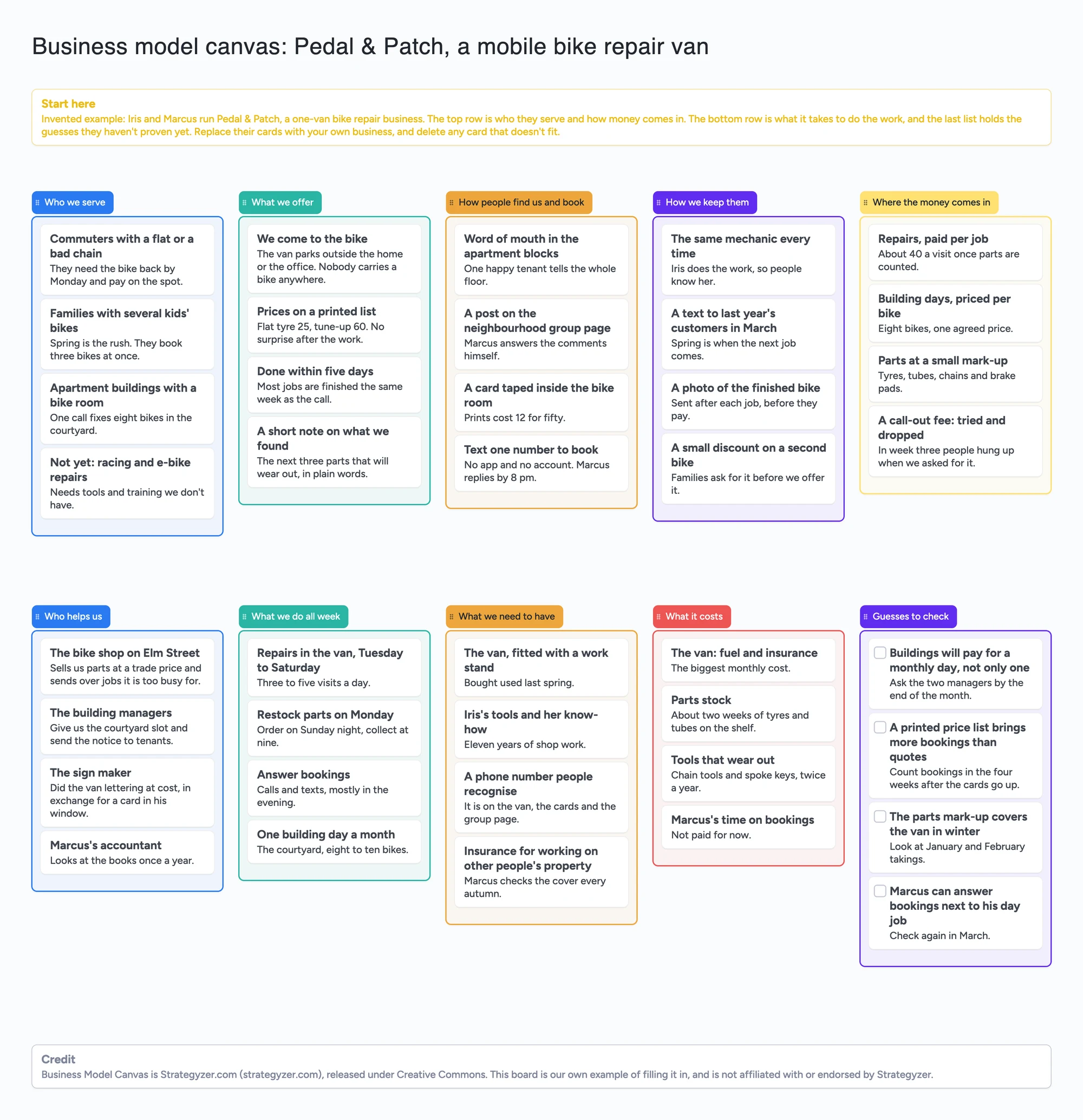
We make Instaboard, an online board. This page gives you a business model canvas already laid out on it, filled in for one invented business: Pedal & Patch, a one-van bike repair service run by Iris and Marcus. The canvas itself is Strategyzer's, and the board says so on its face; what is ours is this example and our own wording on its ten lists, nine for the canvas and a tenth for guesses you have not checked yet. Copy it, swap the bike van for your business, and send the link to whoever runs it with you. It is a shared board of lists, not the printed one-page sheet, it adds nothing up, and it does not hand you a PDF; the tools named below do those jobs better. Our summaries rest on pages we read, and nobody named here reviewed the board.
Opens in your browser. Anyone can view; a free sign-in lets you edit.
Updated
Read this first: what the board does and doesn't do
- Our edge is small, and we say so first. Strategyzer publishes the canvas, SCORE gives away a PDF of it, and Miro and Canva both offer editable versions. What this page adds is one filled small-business example you can edit with a partner, a tenth list for guesses, and the limits written before you open anything.
- What it is: ten lists in two rows, four cards each, filled in for one invented van business. You move a card by dragging it. The example uses 53 of your 150 free items.
- What it isn't: not Strategyzer's sheet, and not their product. It is two rows of lists rather than one nine-box page. There are no sums, no charts, no reminders or due-date alerts, and this page does not give you a file. The last list has tick boxes you tick yourselves; nothing records who ticked or when.
- Who it's for: one to three people who run a small business together and want to see how the whole thing hangs together on one screen. If you work alone and want a printed sheet to fill in by hand, SCORE's PDF is enough.
- Free plan: 5 boards, 150 items, 3 pictures per board. Copying the board takes 1 of your 5 boards. Writing on it needs a free sign-in. New boards start with "Anyone who joins can view".
Whose canvas this is
Strategyzer's usage page (read November 25, 2026; it shows no date) says the Business Model Canvas "was released under Creative Commons" and that anyone may use it for their own work or to support others in understanding, analyzing or changing their business models. It asks for full identification and credit of the source: "Business Model Canvas is Strategyzer.com". Separately, for variations of the canvas, it says the text and link Strategyzer.com should be clearly visible and legible under every canvas. We have put the credit line, with the link, under the board image above, on a card on the board itself, and in the sources below.
SCORE's template page (page shows November 16, 2023) says the canvas was developed by Alexander Osterwalder, founder and CEO of Strategyzer. Strategyzer's own library page says it comes from the book Business Model Generation. We did not copy their block questions, tables or pictures: every list name and card on the board is our own wording,. Nothing here is the official tool, and Strategyzer did not review or endorse this board. If you want the official canvas, Strategyzer's library page offers it as a download.
Pedal & Patch, row by row
The business, the names and every number are invented. Iris repairs bikes in a used van with a work stand; Marcus takes the bookings around his day job.
- Who we serve, 4 cards. Commuters with a flat or a bad chain, families with several kids' bikes, apartment buildings with a bike room, and one card for what they do not serve yet: racing and e-bike repairs.
- What we offer, 4 cards. The van comes to the bike, prices are on a printed list, most jobs are done within five days, and a short note says what the next three worn parts will be.
- How people find us and book, 4 cards. Word of mouth in the apartment blocks, a post on the neighbourhood group page, a card taped inside a bike room, and one number to text.
- How we keep them, 4 cards. The same mechanic every time, a text to last year's customers in March, a photo of the finished bike, and a small discount on a second bike.
- Where the money comes in, 4 cards. Repairs paid per job, building days priced per bike, parts at a small mark-up, and a call-out fee that was tried and dropped in week three. The dropped idea stays on the board, so nobody proposes it again next spring.
- Who helps us, 4 cards. The bike shop on Elm Street, the building managers, the sign maker, and Marcus's accountant.
- What we do all week, 4 cards. Repairs Tuesday to Saturday, a Monday parts run, answering bookings, and one building day a month.
- What we need to have, 4 cards. The van with its work stand, Iris's tools and know-how, a phone number people recognise, and insurance for working on other people's property.
- What it costs, 4 cards. The van's fuel and insurance, parts stock, tools that wear out, and Marcus's unpaid booking time.
Read the top row left to right and it is a story: who they serve, what they offer, how people find and book them, how they keep them, how the money arrives. The bottom row is what has to be true for that story to work. Moving a card on one side usually means checking a card on the other: if Marcus drops the neighbourhood group page, the booking list changes, and so does the time he spends on bookings.
The tenth list: guesses to check
Strategyzer's canvas has nine blocks and ours has ten lists. The tenth, Guesses to check, is our addition and is not part of the canvas. It holds four tick-box cards: buildings will pay for a monthly day and not only one, a printed price list brings more bookings than quotes, the parts mark-up covers the van in winter, and Marcus can keep up with bookings next to his day job. Each one says how or when to check it, such as asking the two managers by the end of the month or counting bookings in the four weeks after the cards go up.
- Why a separate list. A filled canvas reads like a set of facts. Most cards on a new business are hopes, and mixing them in with what is already true hides which is which.
- What ticking means. The tick box means the guess has been checked, whatever the result; write the result in the card text. Anyone with edit access can tick or untick a card, everyone sees it live, and nothing records who or when.
- Where a checked guess goes. Move it into the list it belongs to, or delete it. Pedal & Patch would move a confirmed monthly building day into What we do all week.
What 53 items leave you of the 150
Each card and each list is 1 of your 150 free items, across all your boards, and the title text box counts too. Arrows, sections and pen strokes don't. Our arithmetic from the example:
- As built: 10 lists + 40 example cards + the Start here card + the credit card + 1 title = 53.
- A fuller canvas: 8 cards in each of the nine canvas lists plus 6 guesses is 10 lists + 78 cards + the Start here card + the credit card + 1 title = 91.
- More than one copy: two copies of the example use 106 items and 2 of your 5 boards; a third would pass 150.
A canvas is a small board by design, so it leaves room for your other boards in the same 150.
Where this board stops
- No single sheet. The canvas is one page of nine boxes. This board is two rows of lists; the list order stays in your hands and nothing draws the box shapes.
- No file. Nothing on this page gives you a PDF, Word or PowerPoint version. SCORE offers a PDF to download and Canva's page offers designed templates.
- No sums. The money cards are text. Nothing adds revenue or costs or checks that the top row pays for the bottom row.
- No reminders or due-date alerts. The example says "check again in March" in plain text. Cards can carry a due date, but nothing alerts anyone when it passes.
- No who or when on a tick. Anyone with edit access can tick or untick a card, and nothing records who or when.
- No private lists. New boards start with "Anyone who joins can view", so anyone with the link can read the lot. Keep prices, contracts and anything you would not send in a group chat off it.
- 3 pictures per board. The example has none.
Strategyzer, Miro, Canva or SCORE: which fits which job
Read on November 25, 2026. Pages change, so check them. A cell says only what its page says.
| Tool | What the page says | Better for |
|---|---|---|
| Strategyzer (library page) | Offers the official canvas as a download, says it comes from the book Business Model Generation, and sells a playbook subscription at $299 a year with a 14-day money-back guarantee | The official sheet, and guided sessions for running it |
| Miro (templates page) | Lists many business model canvas templates, from a basic one to lean, sustainable and service versions, each with a Use template button, and calls them editable and collaborative. Plan limits and price are not on the page | A canvas for a workshop, with a template for your exact variation |
| Canva (whiteboard templates page) | Offers business model canvas templates, says to customise one with ease even without design experience. Many of the templates on its first screen carry a Pro tag; plan limits and price are not on the page | A canvas that looks designed |
| SCORE (template page, shows November 16, 2023) | A one-page canvas to download as a PDF and fill in, with a link to contact a SCORE mentor for help completing it | A printed sheet filled in by hand, with a mentor |
| Instaboard board | Ten lists you edit together by link: 5 boards, 150 items and 3 pictures on the free plan | Two or three owners editing the same cards, with a list of guesses beside the canvas |
Swipe the table sideways to see every column.
From each page, read November 25, 2026: strategyzer.com/library/the-business-model-canvas, miro.com/templates/business-model-canvas, canva.com/online-whiteboard/templates/business-model, score.org/templates/business-model-canvas-template. Our wording, not theirs. Prices and limits not stated on a page as read are not given.
Where these win
If you want the official sheet, use Strategyzer's download. If you want a polished or workshop-ready canvas, Miro and Canva have templates for it. If you want a printed form and a mentor to go through it, use SCORE. Use this board when two or three people want to edit the same cards, in plain words, and keep guesses apart from facts.
Your own canvas, step by step
- Open the board and sign in free when it asks you to write. Read the Start here card, then delete Iris and Marcus's cards list by list.
- Start with who you serve and what you offer. Two or three real groups of customers and what each one gets. If you cannot name a customer group, stop and find out before you fill the rest.
- Fill the money list and the cost list next. Short text only: "about 40 a visit" is a card, not a calculation. Nothing adds up for you.
- Then the other lists. If a card fits two lists, put it in the one you would look at first and say so in the text.
- Put every hope in Guesses to check. Tick one only after you have looked, and write what you found.
- To share it, set Share to "Anyone who joins can edit" if the others should write on it. Each person who writes signs in free.
- To redraw it later, edit the same cards or copy the board. A copy takes 1 of your 5 boards and keeps its ticks, so untick them first.
A canvas or a written plan? What people say
Every voice below is one person or one organisation, read November 25, 2026. Forum dates are month and year only, because they shift with the reader's time zone.
The Duquesne University Small Business Development Center blog post (page shows November 9, 2020, by Tunca Cali) says the canvas should come before your business plan, and that although some call it a one-page business plan, it should not replace the plan but be its foundation. SCORE's page takes a different angle: if writing a full business plan seems overwhelming, it says, start with a one-page canvas.
In an r/smallbusiness thread (October 2016; Reddit shows 27 comments; we read 26 with text in an archived copy, 2 more removed or deleted), the original poster u/PoRco1x argues for a canvas instead of a business plan and links the original of his post on his own site, skipmba.com, so treat it as his pitch. The thread is mostly about the lean canvas, a different canvas that changes several of the nine blocks, so it is evidence about canvases in general, not this one. u/Finkaroid said the lean canvas was good for checking an idea quickly and that you write a true plan once an idea looks real; they also found it takes more than the promised ten minutes if you do not know your audience. u/michaelrulaz wrote that if you need investors or loans a business plan is close to a requirement. u/SimpleLifePDX said a landlord they were dealing with wanted both a business plan and financials with a proposal for a space.
In an r/startups thread (January 2021; Reddit shows 56 comments; we read 52 with text in an archived copy, 10 more removed or deleted), u/code_monkey_wrench answered a poster asking for steps to write a business plan by saying not to spend time on a formal plan unless required and to try something like the business model canvas. u/farmingvillein told a poster who wanted to send a plan to investors that virtually no one with capital reads business plans. u/FreshlyStarting79 pointed to a SCORE template to copy into a Word document.
So the sources split: use a canvas first, or write the plan anyway if someone is going to ask for it. This board is for the first job. It has no financials, so it will not stand in for a plan a lender or landlord asks for.
Start from the ready board
It opens in your browser in a few seconds, with nothing to install. Sign in for free when you want to save it and share it.
Questions
What is a business model canvas?
It is a one-page way to describe a business in nine blocks: who you serve, what you offer, how you reach and keep customers, how money comes in, who and what you need, and what it costs. SCORE's page says it was developed by Alexander Osterwalder, founder and CEO of Strategyzer. This page's board is our own example of filling it in.
Is this the official Strategyzer canvas?
No. The canvas is Strategyzer's, released under Creative Commons, and the credit line is on the board and on this page. The list names and cards are our own wording, and this board is not affiliated with or endorsed by Strategyzer. The official canvas is on Strategyzer's own site.
Does a canvas replace a business plan?
Not when a lender, landlord or investor asks for a plan. Duquesne's small business center says a canvas should come before a plan and not replace it, while one commenter on r/startups says not to write a formal plan unless someone requires it. This board has no financials, so it will not stand in for one.
Can my business partner edit the same board?
Yes. New boards start with "Anyone who joins can view", so anyone with the link can read it. Set it to "Anyone who joins can edit" if the other person should write too; each person who writes signs in free.
Why does the board have a tenth list?
Guesses to check is our addition and is not part of the canvas. It keeps hopes you have not tested apart from facts you already know, with a tick box on each one for when you have looked.
Is Instaboard free?
There is a free plan: 5 boards, 150 cards and items across your account (pen strokes, arrows and sections don't count), and 3 pictures and 1 file per board. Anyone with the link can read a board; writing on it takes a free sign-in. Pro removes the item limit and adds invite-only boards: $5 a month billed yearly ($59.99 a year), or $7.99 monthly.
Sources
- Strategyzer: usage of our tools (page shows no date; read November 25, 2026). Credit: Business Model Canvas is Strategyzer.com (strategyzer.com), released under Creative Commons
- Strategyzer: The Business Model Canvas (library page shows no date; read November 25, 2026). Business Model Canvas is Strategyzer.com
- Miro: Business model canvas templates (read November 25, 2026)
- Canva: Business model canvas templates (read November 25, 2026)
- SCORE: Business Model Canvas Template (page shows November 16, 2023; read November 25, 2026)
- Duquesne University SBDC: What is Business Model Canvas? (page shows November 9, 2020, by Tunca Cali; read November 25, 2026)
- r/smallbusiness thread (October 2016; the original poster links his own site; replies are single accounts; Reddit shows 27 comments; we read 26 with text in an archived copy, 2 more removed or deleted; read November 25, 2026)
- r/startups thread (January 2021; replies are single accounts; Reddit shows 56 comments; we read 52 with text in an archived copy, 10 more removed or deleted; read November 25, 2026)