For one person planning a workday, in a browser or in the Instaboard app on a phone
A 1-3-5 rule board you can copy: nine cards a day
Disclosure: we make Instaboard, a shared board app. The 1-3-5 rule caps a day's to-do list at nine tasks: one big, three medium, five small. If you plan on your own at a desk, paper handles all of it, and below we say when that is the better choice. What a board adds is one list you can open in a browser or in the Instaboard app on a phone, or send to another person as a link. Our example belongs to Juno, an invented coordinator at a small furniture workshop, with a Today list, a Tomorrow list and a Later list. A card's colour gives its size. The board will not count to nine for you, nudge you, or roll the day over at midnight.
Opens in your browser. Anyone can view; a free sign-in lets you edit.
Updated
Before you copy it: who this suits
- Paper wins if you plan alone at one desk. The Muse's own post states the rule in one paragraph and offers a printable template. Pick the board when you want the day's list in the Instaboard app on a phone as well as in a browser, or want to send someone a link.
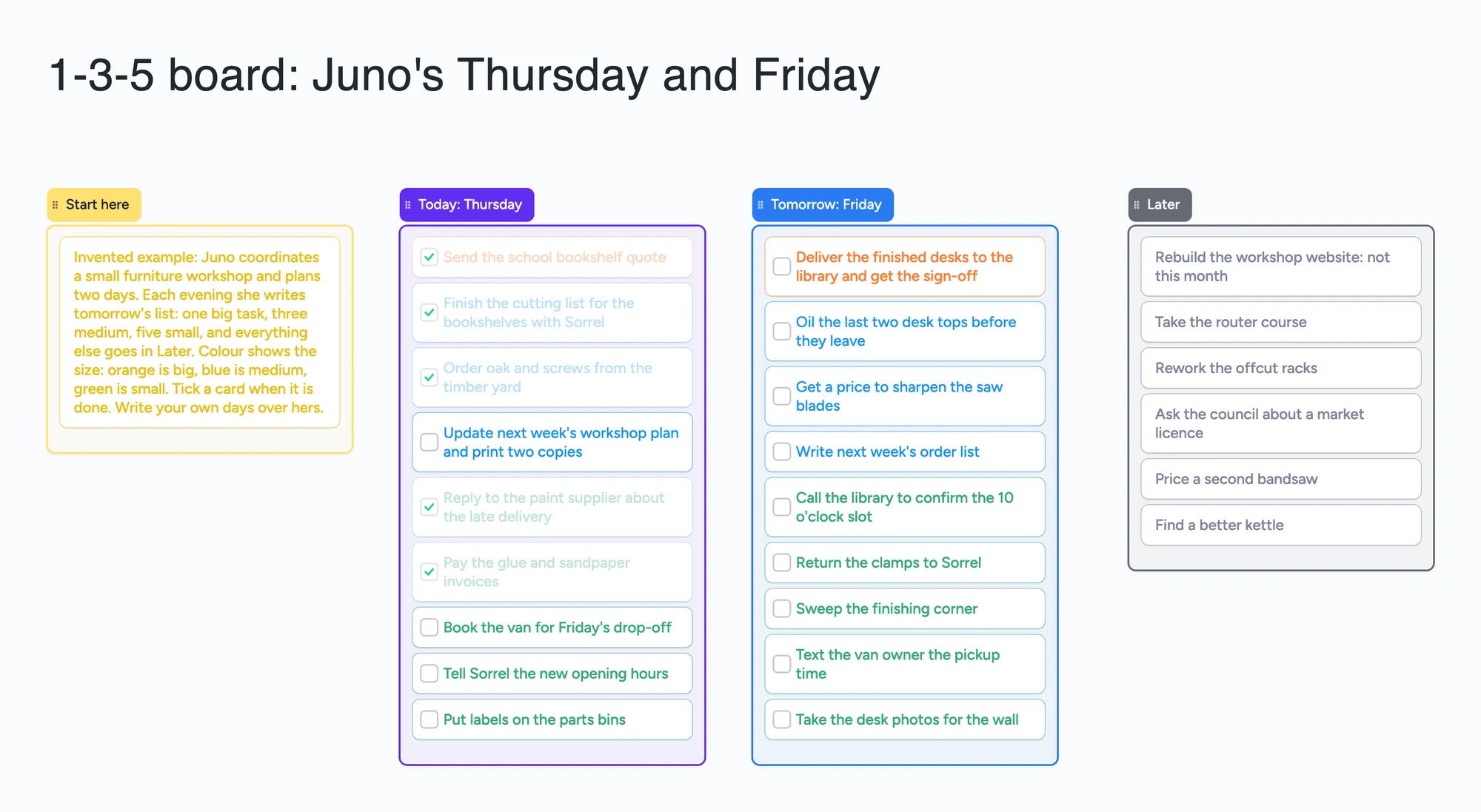
- What you get: two day lists of nine tick-box cards each, a Later list that holds everything else, and one Start here card. Colour carries the size: orange big, blue medium, green small. Juno's version uses 30 of the 150 items a free account allows.
- Where it stops: you can add a tenth card without a warning, unfinished cards stay where they are until you move them, and nobody is told to plan tomorrow. No reminder or due-date alert exists, and a tick shows neither who made it nor when, so any editor can undo it.
- Free-plan numbers: five boards, 150 items across the account, three pictures per board. A copy of this one uses a board slot, and editing it needs a free sign-in. A new board opens view-only to anyone holding the link.
Juno's Thursday and Friday, card by card
Juno, her colleague Sorrel, the workshop and the jobs are invented. She plans the evening before, so Thursday's list was written on Wednesday night.
- Today: Thursday, 9 tick-box cards. One orange card, the school bookshelf quote, is the big task. Three blue cards are medium: the cutting list, a timber order and next week's workshop plan. Five green cards are small, from a supplier reply to labelling the parts bins. Five are ticked and four are not, so the list reads as Thursday afternoon.
- Tomorrow: Friday, 9 cards, none ticked. The big task is delivering finished desks to the library and getting the sign-off. The three medium cards are oiling the last two tops, a price to sharpen saw blades and next week's order list. The five small ones are a call to the library, a text to the van owner, returning the clamps, sweeping the finishing corner and taking the desk photos.
- Later, 6 cards. A new website, a router course, the offcut racks, a market licence, a second bandsaw and a better kettle. None is on either day. Parking them in writing keeps them off both days.
- Start here, 1 card. Says what the colours mean and tells you to write your own days over hers.
Note what the example does not do: it doesn't tell Juno when to do the orange card. Todoist says Cavoulacos recommends finishing the big task before lunch; on the board that is Juno's habit, not a setting.
What three pages say the rule is
Dates below are the days we read each page; the paraphrase is ours.
| Page | Its claim, in our words | What we kept |
|---|---|---|
| The Muse, "A Better To-Do List: The 1-3-5 Rule" (by The Muse Editors; the page shows Updated 6/19/2020; read in a browser, the fetch was refused) | Says the Muse's founder and president Alex Cavoulacos shared the tip; one big thing, three medium things and five small things, and a daily list kept to those nine items. Adds that it can be flexible: if you spend much of the day in meetings, cut the number of items; if unexpected tasks land on you, leave some slots blank. Offers a printable template | The nine-item cap and the three sizes. Blank slots are allowed: delete the card and leave the colour out |
| Todoist, "How to Plan Your Day with the 1-3-5 Method & Be More Intentional" (by Anna Sonnenberg; the page text shows no date) | Calls it a daily planning framework and says it was developed by Alexandra Cavoulacos, co-founder of The Muse, and first appeared in a Muse blog post. Suggests big tasks of 2 to 4 hours, medium of 30 to 60 minutes, small of 5 to 15 minutes. Says to pick the nine the evening before, that Cavoulacos recommends finishing the big task before lunch, and to review at the end of the day. Calls the shape a guideline, not a rigid rule | The evening-before habit and the size guide, as ours to copy or change |
| Fibery, "1-3-5 focus" template page (the text shows no date) | Maps the rule onto a database: the one big task is an Objective, the three medium are Key Actions, the five small are Tasks. Suggests a 1-1-10 split (one big, one medium, ten small) on days of many small tasks | The 1-1-10 idea, which is twelve tasks: change the mix of sizes. The board leaves the total to you |
Swipe the table sideways to see every column.
Pages read November 27, 2026: themuse.com/advice/a-better-todo-list-the-135-rule (in a browser), todoist.com/productivity-methods/1-3-5-method, fibery.io/templates/1-3-5-focus. The Muse describes the founder as "founder and president" and Todoist as "co-founder"; we print each as written. We did not read the printable template or the book Todoist names.
What counts as big, medium or small?
This is where people on Reddit get stuck, so the board does not hide it. The counts are comments we could read on November 27, 2026.
One r/productivity thread on the rule (OP u/Mysterious_Command15, July 8, 2023 UTC; Reddit shows 49 comments; the archived copy has 53, 2 removed, 51 with text, several from bots). u/ExtentOdd wrote that deciding which task is big, medium or small can be harder than doing the task. u/Immediate_Grocery188 asked how you define size at all, since a major paper might count as small and cleaning a room as big if you go by mood. u/SCRULLEX guessed that sorting the sizes would take an hour or two. u/schotastic, who uses it, wrote that the big task takes a few hours of deep work, the medium ones about an hour each and the small ones about 15 minutes, that they cut it to 1-2-3 on weekends or when unwell, and that lately their big tasks were not always getting done. u/dannyfsantos, who pairs it with time boxing, guessed 2 to 3 hours for the big task, 1 to 2 hours a day for the three medium ones and an hour or less for the five small ones. u/ninesomething would call a big task something that takes maybe 3 to 4 hours or a lot of energy. u/jtid wrote that it wouldn't work for them: a big task could take a day while the most important task might take five minutes.
From an older r/productivity thread (OP u/runningSalmon, August 5, 2017 UTC; Reddit shows 10 comments; the archived copy has 12, none removed, including the poster's own reply): u/bobcat540 wrote that the method sorts tasks by size rather than by impact or value. u/kaizervonmaanen answered that big means big impact or value, or whatever else people consider important. The poster, u/runningSalmon, replied that the prioritising comes in deciding what goes on the list in the first place.
What that means here: size is a colour you set per card, so a second thought costs one click. Todoist's time guide (2 to 4 hours, 30 to 60 minutes, 5 to 15 minutes) and u/schotastic's are close enough to start from. The board cannot tell you which task matters most, and the rule alone doesn't either. If your most important task is a five-minute one, it still goes in the first list and gets the orange card.
When a day doesn't fit nine
Three of the sources above expect this. Here is what each says and what you do on the board.
- A day of meetings. The Muse says to cut the number of items. Delete the extra green cards and leave the rest.
- A day of interruptions. The Muse says to leave some slots blank. On the board a blank slot is a missing card; add it when something arrives, and keep the total at nine.
- A day of many small tasks. Fibery suggests one big, one medium and ten small, which is twelve tasks. Todoist says the structure is a guideline and warns against planning 1-3-15 or 2-5-8 as a habit. Whether to go past nine is your call; the board leaves the count to you.
- A day that goes wrong. Todoist says to review your nine and decide what to postpone. Drag the unfinished cards into Tomorrow, or into Later if they no longer matter.
Jobs this board leaves to you
- Counting to nine. The cap is a habit you keep. A tenth card goes in without a word.
- Rolling the day over. Moving what is left from one list to the next is a drag you do each evening.
- Telling you to plan. A card can hold a whole-day due date, and a card in a calendar list can repeat daily, but nothing on the board alerts you when it is time to review. Todoist's page suggests a recurring review task in Todoist; here you have to remember to look.
- Sorting by size. Sorting works one list at a time, by name (A-Z), due date or created date, but not by colour, so sizes stay where you put them.
- Counting finished days. If you want a running count of days or tasks done, keep it outside the board.
- Showing who ticked. Any editor can tick or untick, and the board stores neither name nor time.
- Keeping the list private. A board starts as "Anyone who joins can view", which means the link alone is enough to read it. Choose "Anyone who joins can edit" only for a person you want writing on it.
Other places to keep a 1-3-5 list
Checked on November 27, 2026; vendors change their pages, so look again before you rely on one.
| Option | What its page says | Suits (our view) |
|---|---|---|
| Paper and a pen | The Muse gives the whole rule in one paragraph and offers a printable template; Todoist says pen and paper will do | One person at one desk |
| Todoist (page text shows no date) | Maps its priority levels to the three sizes (one level for the big task, one for the three medium, one for the five small), suggests an @135 label and a filter of today and that label; its page also suggests time-blocking the big task in its calendar view and a shared project for a team | People who already live in a to-do app and want a view that shows only today's nine |
| Fibery 1-3-5 focus template (text shows no date) | A database with Objective, Key Actions and Tasks; the page mentions formulas and automations | People who already work in Fibery and want the rule tied to team goals |
| Instaboard board | Day lists shared by link; the free account allows five boards, 150 items and three pictures per board, and writing needs a sign-in | One person who wants the same list in the Instaboard app on a phone and in a browser, or wants to show it to someone |
Swipe the table sideways to see every column.
From each page, read November 27, 2026: themuse.com/advice/a-better-todo-list-the-135-rule, todoist.com/productivity-methods/1-3-5-method, fibery.io/templates/1-3-5-focus. Our wording, not theirs. No prices are given because none were read.
Who should skip this board
Skip it if one desk and one notebook is all you need, or if the to-do app you already use has the reminders you want. Skip it if your team lives in Fibery and wants the rule tied to its goals. Take it when you want nine tasks on two devices with no extra app, or want someone else to see your day.
Running it, evening by evening
- Open it, sign in when prompted, clear Juno's text and keep the four lists.
- The first evening, fill Tomorrow: one orange card, three blue, five green. Anything else goes in Later.
- Each morning, drag Tomorrow's cards into Today, start with the orange card if you can, and tick each card as it's done.
- Each evening, delete the ticked cards in Today. Move any card you didn't finish to Tomorrow if it still matters, or to Later if it doesn't.
- Trim Tomorrow back to nine. If carried-over cards push it past nine, send the least important to Later; if it is short, pull from Later. Change the weekday names in the list titles as you go.
- Change a card's colour if you judged its size wrong. Nothing else has to move.
- To show it to someone, send the link. A person who should type on it needs the edit setting and a free sign-in of their own.
Will it stay under 150 items?
On a free account every list and every card is one of the 150 items, shared with your other boards, and the title box is one too. Arrows, sections and pen strokes cost nothing. Our own sums:
- As filled in: 4 lists, 25 cards and 1 title add up to 30.
- Tidying each evening: removing ticked cards holds it near 30.
- Never deleting: a new list of nine cards for each day is 10 items. 30 + 10 x 12 = 150, so twelve more days fill the account and the thirteenth won't fit.
Start from the ready board
It opens in your browser in a few seconds, with nothing to install. Sign in for free when you want to save it and share it.
Questions
What is the 1-3-5 rule?
It is a way to plan a day: pick one big task, three medium tasks and five small tasks, nine in all, and keep the list to those. The Muse describes it as accepting that you can reasonably get one big, three medium and five small things done in a day.
Who came up with it?
The Muse's post credits tips shared by its founder and president Alex Cavoulacos, and Todoist's page says the rule was developed by Alexandra Cavoulacos, co-founder of The Muse, and first appeared in a Muse blog post. We did not read the book Todoist names, so we can't say more.
Can I add a tenth card?
Yes, and the board stays quiet about it. The cap is yours to keep; the board only holds the cards.
What counts as a big task?
The Muse's post gives no sizes. Todoist suggests about 2 to 4 hours for a big task, 30 to 60 minutes for a medium one and 5 to 15 minutes for a small one. On Reddit people disagree about how to judge size, and the board lets you change a card's colour when you do.
What happens to tasks I don't finish?
That is your call, and Todoist says as much: decide whether to put them first tomorrow, put them back on a longer list, or drop them. On this board you drag them to Tomorrow or to Later, or delete them.
Is Instaboard free?
A free account gives you five boards, 150 items in total (ink, arrows and sections aren't counted) and three images per board. You need a free sign-in to edit, and a copy of this board uses one board slot. Pro adds invite-only boards and lifts the item limit: $5 a month billed yearly ($59.99 a year), or $7.99 monthly.
Sources
- The Muse: A Better To-Do List: The 1-3-5 Rule (by The Muse Editors; page shows Updated 6/19/2020; read in a browser November 27, 2026)
- Todoist: How to Plan Your Day with the 1-3-5 Method (by Anna Sonnenberg; page text shows no date; read November 27, 2026)
- Fibery: 1-3-5 focus template (page text shows no date; read November 27, 2026)
- r/productivity thread on the 1-3-5 rule (OP u/Mysterious_Command15, July 8, 2023 UTC; replies are single accounts; Reddit shows 49 comments, the archived copy has 53, 2 removed, 51 with text, several from bots; read November 27, 2026)
- r/productivity thread on trying the 1-3-5 list (OP u/runningSalmon, August 5, 2017 UTC; Reddit shows 10 comments, the archived copy has 12, none removed, including the poster's own reply; read November 27, 2026)