For two to five people deciding one thing, not for a market report
A PESTLE analysis on one shared board
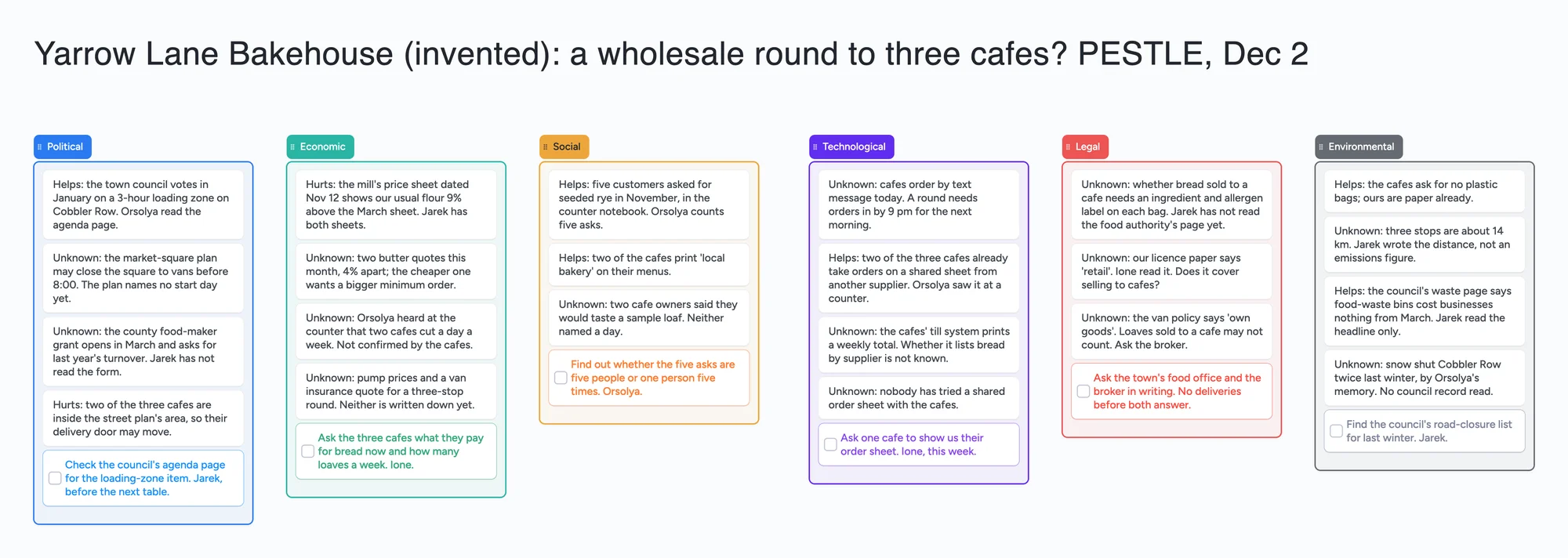
Instaboard is the online board this page runs on. Here is a PESTLE analysis already laid out on it: six lists for the outside forces, filled in for an invented bakery, Yarrow Lane Bakehouse, that is deciding whether to start a wholesale bread round to three cafes. Each card starts with one typed word, Helps, Hurts or Unknown, and says who read what. Nothing is scored. Copy it, put your own decision in the title, and send the link to the people deciding with you.
Opens in your browser. Anyone can view; a free sign-in lets you edit.
Updated
What the cards hold, and what the board leaves out
- What it is: six lists for outside forces, one per letter, holding 22 cards about one decision and 6 tick-box cards that turn the open questions into next steps. A card moves by dragging. The example uses 35 of your 150 free items.
- What is typed: the first word of each card, Helps, Hurts or Unknown, is text, and so is every name and date. Nothing totals the cards, ranks them or gives them a score, and nothing looks a fact up for you.
- What is not there: no reminders or due-date alerts, no record of who ticked a box or when, and no private lists. Anyone you share the link with can read all of it.
- Who it is for: two to five people with one decision on the table who want the outside facts and the gaps in one place. A manager writing a market report for a course or a board pack will want a document instead.
- Your plan: the free plan allows 5 boards, 150 items and 3 pictures on a board. A copy of this one uses a board slot, and typing on it asks for a sign-in that costs nothing.
One question first, then six lists
CIPD's factsheet calls a PESTLE analysis "a broad fact-finding activity around the external factors that could affect an organisation's decisions". We read it on November 27, 2026. The word that matters is decisions. Our view: a board of six lists with no decision above it fills up with news.
So the board's title is the decision: Yarrow Lane's is whether to start a wholesale round to three cafes. The invented bakery sells at its own counter today. Ione, Jarek and Orsolya run it, and the board is what they know before their December 2 table. Our view: if you cannot put your decision in the title in one line, the PESTLE is not ready to start.
Helps, Hurts or Unknown: how each card starts
CIPD's steps say to rate each item for "importance in relation to potential risk". This board does not rank anything. Each card starts with one typed word instead, and the word is the team's call, not a result.
- Helps means the outside fact makes the decision easier. OnStrategy's page asks the same thing as "headwinds, or tailwinds", and our word is the plainer one.
- Hurts means it makes the decision harder or dearer.
- Unknown means somebody heard it or half read it. The card says who, and what they have not yet read.
- A tick card ends every list. One person, one question, one place to look. When the answer is in, the team retypes the card above it and ticks the box.
We kept three words because a fourth, such as Neutral, invites cards that say nothing. Our view: a card that is none of the three is probably not about this decision.
Yarrow Lane's six lists
The bakery, the people, the dates and every figure on the board are invented. The three cafes are not named.
- Political, 5 cards. A council vote in January on a 3-hour loading zone (Helps), a market-square plan that may close the square to vans before 8:00 with no start day named (Unknown), a county food-maker grant opening in March that Jarek has not read (Unknown), two of the three cafes sitting inside the street plan's area (Hurts), and a tick card to check the council's agenda page.
- Economic, 5 cards. The mill's November 12 price sheet showing the usual flour 9% above the March sheet (Hurts), two butter quotes 4% apart where the cheaper one wants a bigger minimum order (Unknown), a counter rumour that two cafes cut a day a week (Unknown), no figures yet for pump prices or van insurance (Unknown), and a tick card to ask the cafes what they pay for bread.
- Social, 4 cards. Five customers asking for seeded rye in the counter notebook (Helps), two cafes printing 'local bakery' on their menus (Helps), two cafe owners who would taste a sample but named no day (Unknown), and a tick card asking whether five asks are five people or one person five times.
- Technological, 5 cards. Cafes ordering by text message with a 9 pm cut-off (Unknown), two of the three cafes already ordering from another supplier on a shared sheet (Helps), a till system that prints a weekly total, whether by supplier or not (Unknown), no one yet having tried a shared order sheet with the cafes (Unknown), and a tick card to ask one cafe to show its sheet.
- Legal, 4 cards. Whether a bag sold to a cafe needs an ingredient and allergen label (Unknown), a licence paper that says retail (Unknown), a van policy that says own goods (Unknown), and a tick card to ask the town's food office and the broker in writing, with no deliveries before both answer.
- Environmental, 5 cards. Cafes that ask for no plastic bags (Helps), a three-stop round of about 14 km with no emissions figure (Unknown), a council waste page saying food-waste bins cost businesses nothing from March that Jarek read only as a headline (Helps), snow shutting Cobbler Row twice last winter by Orsolya's memory (Unknown), and a tick card to find the council's road-closure list.
Reading across the lists: most of it is Unknown
Our arithmetic from the cards. Of the 22 cards that are not tick cards, 6 start with Helps, 2 with Hurts and 14 with Unknown. The board does not say so anywhere; a person counted.
| List | Helps | Hurts | Unknown | Tick cards |
|---|---|---|---|---|
| Political | 1 | 1 | 2 | 1 |
| Economic | 0 | 1 | 3 | 1 |
| Social | 2 | 0 | 1 | 1 |
| Technological | 1 | 0 | 3 | 1 |
| Legal | 0 | 0 | 3 | 1 |
| Environmental | 2 | 0 | 2 | 1 |
Swipe the table sideways to see every column.
Rows add to 28 cards: 6 Helps, 2 Hurts, 14 Unknown, 6 tick cards. Counted by hand from the example board.
The Legal list is the one to read first. It holds no Helps and no Hurts, only three Unknowns and a rule on the tick card: no deliveries before the town's food office and the broker have answered in writing. Yarrow Lane's December 2 table is therefore less a vote on the round than a plan for six questions. That is the use of the board: it shows where the decision is waiting on a fact.
Same six letters, different words
The four pages we read do not use the letters the same way. We read each on November 27, 2026.
| Page | The S | The E's | What else it says |
|---|---|---|---|
| CIPD factsheet | Sociological in its factor list, Social in the video transcript | Economic and Environmental; pandemics and other emergencies sit under Environmental | Marks the template as a Word download and a Word example; says to repeat the analysis regularly |
| Atlassian's Confluence template | Sociological in its first paragraph, Social in its list of six factors | Economic and Environmental | A whiteboard template with one software-company example; says to use it before a launch or a new market |
| OnStrategy's guide | Sociological in its factor heading, with 'social factors' in brackets; Social in its opening definition | Economic and Environmental, plus a 'bonus' Ethical factor it calls a third E | Pairs it with a SWOT analysis; suggests a refresh at least every three years |
| Florida State University Libraries guide | Socio-cultural, in a four-factor PEST definition on its first page | Its tabs list six headings, Legal and Environmental among them; we read only the first page | Last Updated: Sep 27, 2022; links a PEST market-analysis tool (.doc) and a PESTLE template |
Swipe the table sideways to see every column.
Vendor, professional-body and university pages. CIPD prints "21 Mar, 2025" under its intro; Atlassian and OnStrategy print no date. Instaboard is not affiliated with any of them.
Our view: the names differ and the six lists do not. The board uses Social because it is shorter on a list tab. If your team wants Ethical, add a seventh list, a copy of one that is already there, and remember each list and each card counts toward your 150 items.
When a Word file, a slide or a SWOT beside it is better
Where a line says a limit or price is not listed, it was not on the page we read; it does not mean none exists.
| Page | What we read there | Pick it when | Pick the board when |
|---|---|---|---|
| CIPD factsheet and its two Word files | A blank template and a completed example about a fictitious retail organisation, both Word documents of about 28 KB and 31 KB | You need a file to hand in or attach to a report | The team wants to move cards about together and see each other's changes |
| Atlassian's Confluence template | A whiteboard template with a Use template button and one software-company example. Plan limits are not listed on that page (as of November 27, 2026). | Your team already works in Confluence | People outside it should join with a link and a free sign-in |
| OnStrategy's guide | A guide marked as a 6-minute read, with questions to ask under each factor, and a note that it is best used with a SWOT | You want prompts for each factor | You already know the factors and need a place to put what you found |
| A SWOT beside it | CIPD and OnStrategy both say to run the two together | You want the inside of the business as well as the outside | Our SWOT board is a separate page; this board does not link a card to a SWOT card |
Swipe the table sideways to see every column.
From each page as read November 27, 2026. Vendor and training-company content.
How long it stays true, and room for the next review
CIPD says a PESTLE analysis "needs to be done regularly", without giving a gap. OnStrategy says to update it at least every three years, or when you update your SWOT, and suggests looking at the trends annually. The board shows no age on a card; if you want one, type it on the card.
- As built: 6 lists + 28 cards + the title = 35 items. Of the 150 on a free plan, 115 remain.
- A quarterly review that adds ten cards and deletes none: 45 after the first, 55 after the second, 65 after the third and 75 after the fourth. The twelfth review reaches 155, over the limit, about three years on.
- Clearing the old Unknown cards each time the tick cards are answered slows that, because only the facts stay.
- One board per decision is the simpler habit. Each copy takes 1 of your 5 free boards, so five decisions at once is the free ceiling.
Pro lifts the item limit and brings invite-only boards, at $5 a month on a yearly bill ($59.99), or $7.99 month to month.
What the board leaves to you
- Scoring and ranking. There is no weight, impact figure or traffic light. The first word on a card is text, and anyone with edit access can change it.
- Looking things up. Nothing reads a council page, a price sheet or a law for you. A card says who read what and what they did not read.
- Reminders and due-date alerts. The next-step cards say 'this week' or 'before the next table' in their text. A card can hold a due date, and no alert goes out when it arrives or passes.
- Who ticked a card. Edit access is all it takes to tick or untick one; every viewer sees the change live, and the board keeps no name or time with it.
- Privacy. A new board opens as 'Anyone who joins can view', so whoever holds the link reads every card. Switch Share to 'Anyone who joins can edit' for the people who will add facts. Leave customer names, supplier prices under an agreement and legal papers off a link board.
- Legal or financial advice. Yarrow Lane's cards are questions for the food office and the broker. The board answers none of them.
- Pictures. The free limit is 3 on a board, and the example uses none.
Make it yours in six steps
- Open the board and change the title first to your own decision, in one line. Every card under it should bear on that line.
- Keep the six lists and replace Yarrow Lane's cards with yours, so the board never mixes the bakery's facts with your own.
- Each person adds what they have read, starting the card with Helps, Hurts or Unknown and ending it with their name and what they have not read.
- Put one tick card at the foot of each list with one person and one question. If a list has no open question, say so on a card.
- Share it for editing. Choose 'Anyone who joins can edit'; each person signs in free to write. If you meet on the board's call, calls need a free sign-in and run up to 60 minutes with a warning 10 minutes before the end.
- At the table, read the Unknown cards first, then the tick cards. Retype a card's first word when its answer comes in.
Start from the ready board
It opens in your browser in a few seconds, with nothing to install. Sign in for free when you want to save it and share it.
Questions
What is a PESTLE analysis?
A way to list the outside factors that could affect a decision under six headings: Political, Economic, Social (or Sociological), Technological, Legal and Environmental. CIPD's factsheet calls it a broad fact-finding activity about external factors. Some guides say PEST, with four headings, or PESTEL, with the same six in another order.
Is a PESTLE the same as a SWOT?
No. CIPD and OnStrategy both say to run the two together: a PESTLE looks at the outside of a business and a SWOT adds its inside. This board holds only the outside lists, and it does not link a card to a SWOT card.
Does the board score or rank the factors?
No. The first word on a card is typed text, Helps, Hurts or Unknown, and nothing adds or weights them, and nothing ranks the factors. CIPD's steps say to mark each item for importance; on this board you would do that in the words on the card.
Can my team edit the same board?
Yes. A person who opens your link can read it. They sign in free to add or move a card, and the board takes one of their five. A card is typed text that anyone with edit access can change.
How often should we redo it?
The pages we read differ. CIPD says regularly and gives no gap; OnStrategy says at least every three years, or when you update your SWOT, and suggests looking at the trends annually. Pick a gap that fits how fast your outside facts move and write it on the title card.
Is Instaboard free?
The free plan has room for 5 boards, 150 items and 3 pictures on each. This board is a copy that uses one of the 5 slots. Pro lifts the item limit.
Sources
- CIPD: PESTLE analysis factsheet (the page prints "21 Mar, 2025" under its intro and says the factsheet was last updated by David Hayden; read in full in a browser November 27, 2026; professional-body content; its Word template and example were not opened)
- Atlassian: Free PESTLE Analysis Template for Confluence (no page date printed; read in full November 27, 2026; vendor content)
- OnStrategy: What is a PESTLE Analysis? A Complete PESTLE Analysis Guide (no page date printed in the text we read; read in full November 27, 2026; vendor content)
- Florida State University Libraries: PESTLE Analysis, Getting Started (Last Updated: Sep 27, 2022; the Getting Started page read in full November 27, 2026, its other tabs not read; its PEST definition credits Wikipedia, which we did not read)