For graduate students and postdocs applying for a fellowship
A fellowship application you can copy and edit as one board
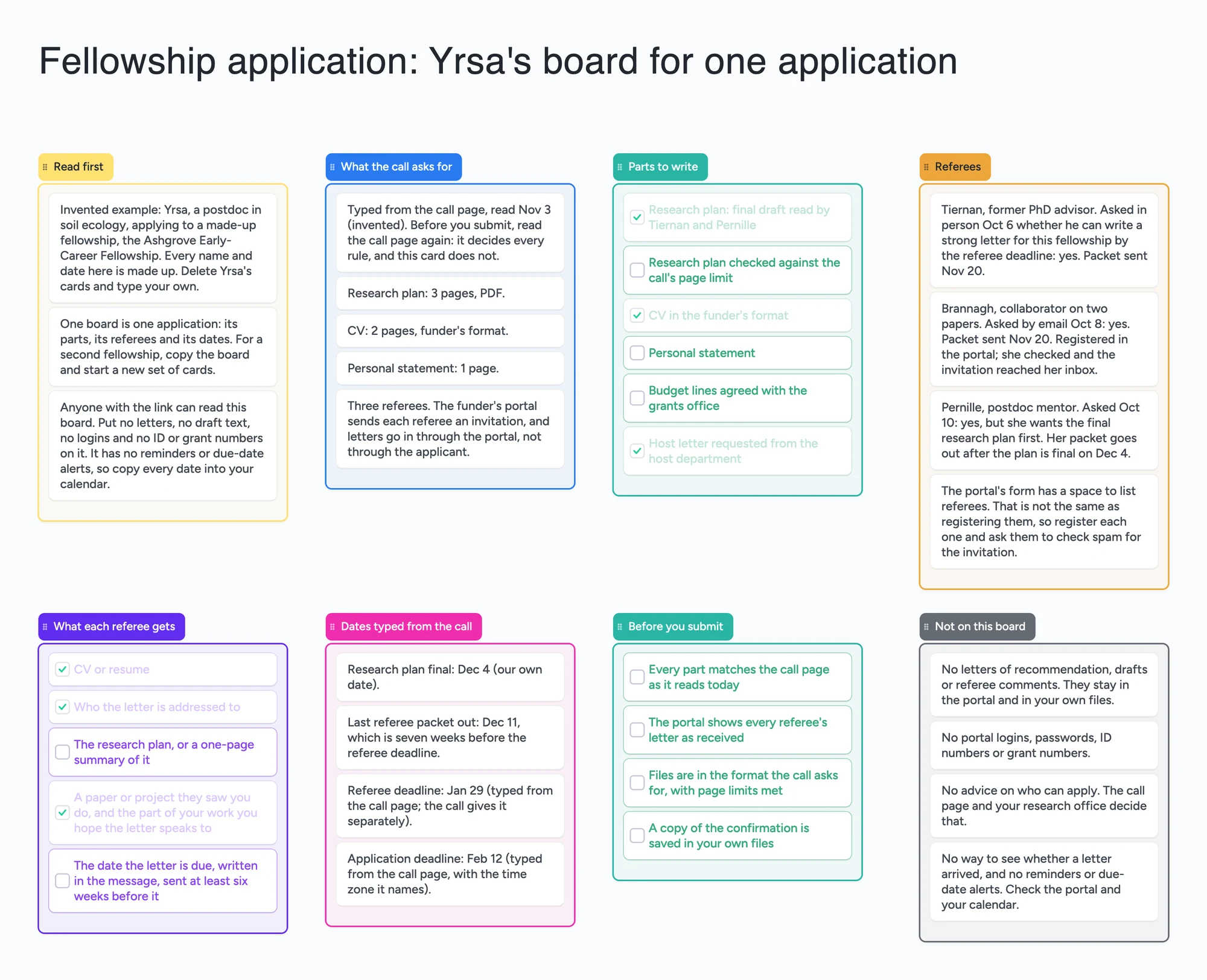
We make Instaboard, an online board. This page gives you one fellowship application already laid out on it, filled in for an invented postdoc, Yrsa, and a made-up fellowship, the Ashgrove Early-Career Fellowship. The board is for a single application: what the call asks for, the parts to write, three referees and what each was sent, and the dates you copy from the call page. It sends no alerts, it cannot see whether a letter arrived, and it holds no letters, drafts, logins or grant numbers. Open it, replace Yrsa's cards with yours, and keep the call page open beside it, because the call decides every rule and this board decides none.
Opens in your browser. Anyone can view; a free sign-in lets you edit.
Updated
Before you copy it: what the board holds and what it leaves to the call
- What it is: one application on one board, so you, a mentor or a co-applicant can see the parts, the referees and the dates in one place. The example uses 44 of your 150 free items.
- What it isn't: no reminders or due-date alerts, no way to see whether a referee's letter arrived, no deadline lookup, and no advice on who may apply. Every date is text you type from the call page.
- Written for adults: graduate students and postdocs. If you are under 18, check with a parent or your school before you put an account on any site.
- Keep these off it: letters of recommendation, drafts of anything the funder reads, portal logins, passwords, and ID or grant numbers. A free board is shared by link.
- Free plan: 5 boards, 150 items, 3 pictures per board. Copying the board takes 1 of your 5 boards. Writing on it needs a free sign-in. New boards start with "Anyone who joins can view".
The call page decides; the board only keeps your copy of it
Every fellowship has its own page limits, file formats, number of referees and dates, and they change from one year to the next. The second list on the board, What the call asks for, is a card per rule that you typed from the call page on a date you wrote down. Yrsa's first card there says to read the call page again before submitting, because the card is a copy and the call is the source.
- The board does not know who can apply. Eligibility is the call's and your research office's to decide, and nothing here promises that a fellowship fits you.
- The dates on the example are invented. Yrsa's referee deadline of January 29 and application deadline of February 12 belong to a made-up fellowship. Copy yours from the call page, with the time zone it names.
- Nothing on the board moves by itself. A date passes without a sound; put each one in your own calendar as well.
Referees are where a plain list of parts runs out
A research plan or a CV is yours to finish. A letter is not, and the funder's portal controls how it gets in. Two pages say a few related things, and each is one source's view of its own process.
- NSF's reference-writer pages (Information for Reference Writers and its FAQ, both showing Publication date and Last updated August 25, 2026; read in a browser November 27, 2026) describe the Graduate Research Fellowship Program. They say reference letters must be submitted through the NSF Reference Writer System (RLS), not by email or mail, that a wrong or mistyped referee email means the letter will not match the application, that the referee should check spam, and that the one-time password lasts 10 minutes. The page gave its own letter deadline as Friday, October 16, 8:00 p.m. Eastern; that is that program's date, not yours.
- Penn's Center for Undergraduate Research and Fellowships is an undergraduate fellowships office, so its advice is written for undergraduate applicants and is one office's view (Letters of Recommendation; the page shows no update date, only a 2026 copyright line; read November 27, 2026). It advises asking a referee whether they can write a strong recommendation letter for this fellowship by this deadline. It says to send the referee a packet at least six weeks before the date their letter is due to the CURF office, or to the fellowship if there is no CURF deadline, and that the form's space to list a referee is not the same as registering one in the portal. It adds that a letter is written for one application and is not shared across portals.
Those points are the shape of the Referees and What each referee gets lists. Yrsa's board keeps who was asked, on what date and what they answered, whether each is registered in the portal, and when each packet went out. It does not keep the letter, which stays in the portal and the referee's own files.
What each referee gets
A packet is the set of things a referee needs to write a specific letter, so that they are not hunting for them. The list on the board is a tick-box checklist you copy per referee, with three cards ticked as the example.
- CV or resume, the same one that goes into the application.
- Who the letter is addressed to, as the call page says.
- The research plan, or a one-page summary if the plan is long.
- A paper or project they saw you do, and the part of your work you hope the letter speaks to.
- The date the letter is due, written in the message you send, sent at least six weeks before it. That is Penn's undergraduate fellowships office's advice, and it counts from the date the letter is due to that office, or to the fellowship if there is no office deadline.
Yrsa's dates show how this plays out. Her research plan is final on December 4, so her mentor Pernille, who asked to see the plan first, gets her packet on December 11, seven weeks before the January 29 referee deadline. Her other two referees were sent packets on November 20, ten weeks before it. Those are invented dates, and the arithmetic is ours.
Yrsa's board, list by list
- Read first. Three cards: the board is invented, one board is one application, and what must stay off a board you share.
- What the call asks for. Five cards: the rule that the call page wins, then the research plan, CV and personal statement limits and the three-referee rule.
- Parts to write. Six tick-box cards. Three are ticked: the plan's final draft read by two people, the CV in the funder's format and the host letter requested.
- Referees. Four cards: Tiernan (former PhD advisor), Brannagh (collaborator) and Pernille (postdoc mentor), each with when and how they were asked and what they said, and a fourth card on the portal's form space versus registering each referee.
- What each referee gets. The five-item packet above, as tick boxes.
- Dates typed from the call. Four cards, each marked as typed from the call page or as Yrsa's own date.
- Before you submit. Four tick boxes: every part matches the call page as it reads today, the portal shows each letter as received, files are in the format asked for, and a copy of the confirmation is saved in your own files.
- Not on this board. Four cards listing what stays off: letters, logins and ID numbers, advice on who can apply, and any way to see whether a letter arrived.
Dates the board can show and cannot watch
Each card in Dates typed from the call carries one date and says where it came from. A card does not change colour when its date comes near. You can sort the cards inside one list by due date if you give them due dates, but the board has no view across lists, no totals and no reminders or due-date alerts. For that reason the board's last card says to check the portal and your calendar.
- Referee deadline versus application deadline. Yrsa's call gives them separately, and the board keeps them on two cards so the earlier one does not hide behind the later one.
- Your own dates (plan final, last packet out) are labelled as yours so they are not mistaken for the funder's.
- Time zone. The application-deadline card says to copy the time zone the call names.
What one fellowship takes of your 150 items
The free plan stops at 150 items, counted over every board you have. Cards, lists and the title text box each count as one; arrows, sections and pen strokes count as none. Our arithmetic for Yrsa's copy:
- As built: 8 lists + 35 cards + 1 title = 44 items.
- Two applications on separate copies: 2 x 44 = 88.
- Three: 3 x 44 = 132, which fits only if the rest of your boards are nearly empty.
- Four: 4 x 44 = 176, over 150. At that point trim the cards you no longer need, or keep older applications in your own files.
- Each copy also uses 1 of your 5 boards, and what is on your other boards is added to the total. Pro removes the item limit.
Where the funder's portal, a sheet or a calendar does this better
Read on November 27, 2026. A date appears below only when the page itself shows it. A funder page describes its own process, so it is that funder's claim.
| Option | How it works | Wins when |
|---|---|---|
| The funder's own portal (NSF's Reference Writer System, as its FAQ describes it) | Takes the referee's letter directly, matches it to the application by the email address entered, and sends the referee an invitation | Showing whether a letter was received, which a board cannot see |
| An undergraduate fellowships office's advice page (Penn CURF, no update date shown) | Tells undergraduate applicants how to ask referees and how far ahead to send a packet | Rules and advice from the people who run the program, which a board does not know |
| A spreadsheet | One row per referee or per part, with columns you choose | Sorting by date, filtering by status, and several applications on one sheet |
| A calendar app | A date that alerts you before it passes | Every deadline; this board has no reminders or due-date alerts |
| Instaboard board | Free: 5 boards, 150 items, 3 pictures per board. A card per part or referee, shared by link with a mentor or co-applicant | One screen for one application, seen by the people helping you |
Swipe the table sideways to see every column.
From each page, read November 27, 2026: nsf.gov/funding/initiatives/grfp/references and /references/faq, curf.upenn.edu/fellowships/how-can-i-prepare-apply/letters-recommendation. The spreadsheet and calendar rows are general descriptions, not a vendor's claim. Our wording, not theirs.
Where these win
If you need to know whether a letter arrived, use the portal. If you want an alert before a date, use a calendar. If you want to sort several applications by date, a spreadsheet does that. This board fits when you want the parts, the referees and the dates of one application where a mentor can see them too.
Setting up your own copy
- Open the board, then sign in with a free account the first time you type. Clear Yrsa's cards and keep the eight lists.
- Fill What the call asks for first, one card per rule, and write the date you read the call page on the first card.
- Add the referees with the date you asked each one, what they said and whether you registered them in the portal.
- Type the dates with a label for each: the funder's or your own.
- Send each packet and tick the cards on the packet list for that referee. Make a copy of the list per referee if they need different things.
- To share it, a mentor who only reads can stay on the default view setting; a co-applicant who adds cards needs "Anyone who joins can edit" and a free account.
Start from the ready board
It opens in your browser in a few seconds, with nothing to install. Sign in for free when you want to save it and share it.
Questions
What goes on a fellowship application checklist?
The parts the call asks for (research plan, CV, statement, budget or host letter), each referee and when each packet went out, and the dates that matter. Which parts, how long and by when come only from the call page. On this board each part is a tick-box card and each referee is a card.
How far ahead should I ask referees?
Penn's undergraduate fellowships office advises sending a referee a packet at least six weeks before the date their letter is due to that office, or to the fellowship if there is no office deadline. Your funder may say something different, and its call page and the people who run your program are the ones to follow. Yrsa's board keeps the date each packet was sent so you can see the gap.
Can the board tell me whether a referee has submitted their letter?
No. Letters go through the funder's portal, and only the portal shows whether one arrived. The board has a Before you submit tick box that reminds you to check the portal, and nothing on it updates by itself.
Does the board remind me before a deadline?
No. A date is text you type into a card, and the board gives no sign when one has passed. Put each date into your own calendar as well.
Can I share the board with a mentor or co-applicant?
Yes. New boards start with "Anyone who joins can view", so whoever you send the link to can read it. For a co-applicant who needs to add cards, set it to "Anyone who joins can edit"; each person who writes signs in free. Keep letters, drafts, logins and grant numbers off it.
Is Instaboard free?
Yes. The free plan includes 5 boards, 150 cards and items across your account (pen strokes, arrows and sections don't count), 3 images and 1 file per board, unlimited collaborators and video calls up to an hour. Pro is $5 a month billed yearly ($59.99 a year), or $7.99 monthly, and the people you invite join free.
Sources
- NSF Graduate Research Fellowship Program: Information for Reference Writers (Publication date and Last updated August 25, 2026; the funder's own page; read in a browser November 27, 2026)
- NSF Graduate Research Fellowship Program: FAQ for Reference Writers (Publication date and Last updated August 25, 2026; read in a browser November 27, 2026)
- Penn Center for Undergraduate Research and Fellowships: Letters of Recommendation (page shows no update date; an undergraduate fellowships office's advice; read in a browser November 27, 2026)