For two writers or game masters settling the setting of one world
A worldbuilding checklist board: decide the setting one card at a time
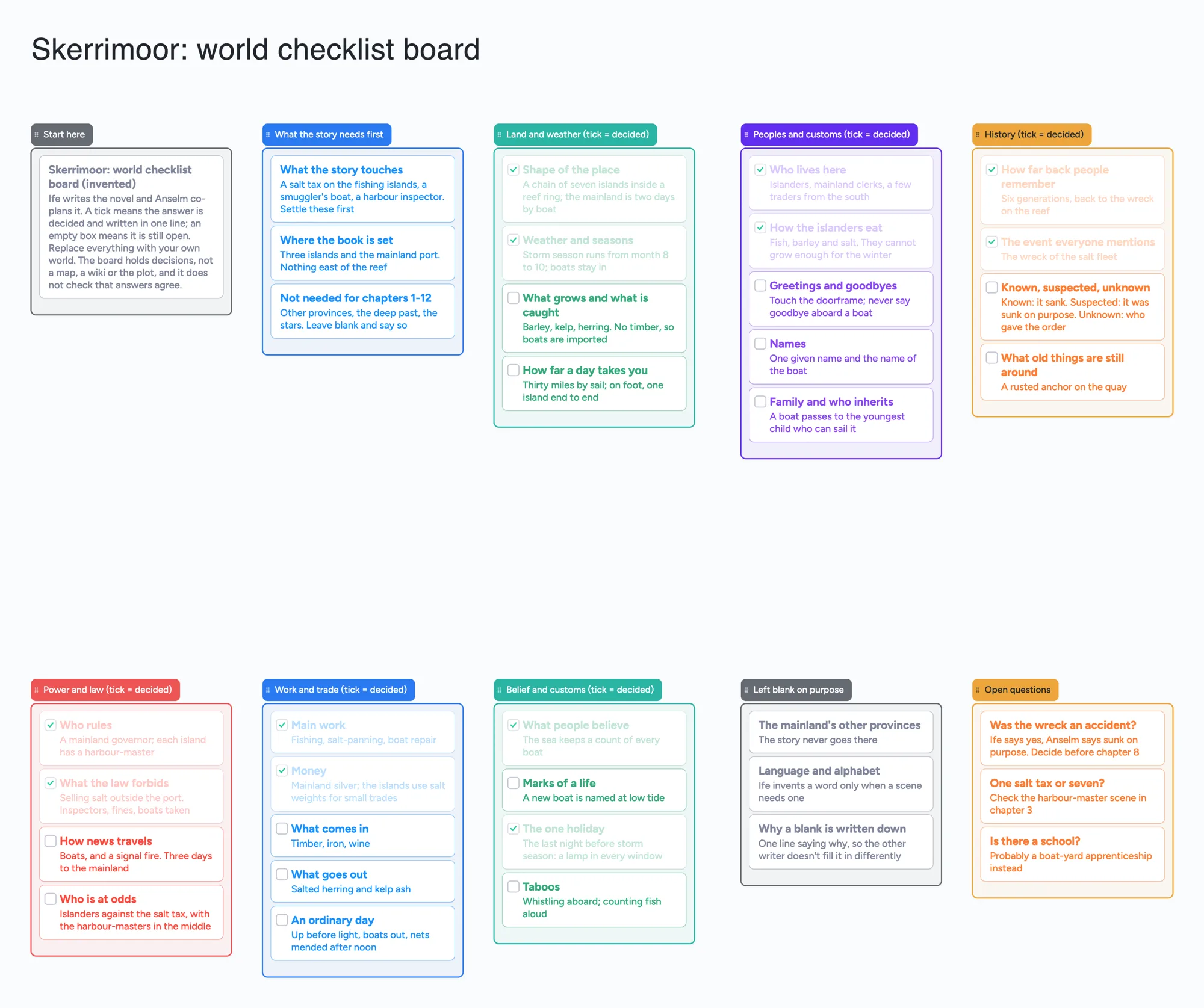
We make Instaboard, an online board. This one is a worldbuilding checklist you can do with a co-writer or a co-GM: one card per decision (land and weather, peoples, history, power and law, work and trade, belief), a tick box for "decided", a list for what you are leaving blank on purpose and a list for what you disagree about. It is filled in for an invented island world, Skerrimoor, settled by Ife and Anselm. It starts from what the story touches, not from everything a world could contain, because one commenter in the first thread says a complete list cannot exist and another says to write your own. It does not hold a map, a wiki or the plot, and it does not check that your answers agree. A long question list does more of the prompting, and we say where below. What a board adds is one screen where two people can see what is settled, what is open and what they chose to skip.
Opens in your browser. Anyone can view; a free sign-in lets you edit.
Updated
What this world board holds, and what it leaves to you
- It holds decisions, one per card. A tick means decided and written in one line. An empty box is still open. It does not tell you whether two answers clash.
- It starts from the story. The first list names what the story touches, so you answer those cards first and leave the rest blank on purpose.
- It holds answers, not questions. The long question lists live in the threads and guides named below; the board is where two people record what they chose.
- No map and no wiki. Long entries, maps and family trees belong in your own files; write the name on the card.
- Free plan limits: 5 boards, 150 items across your account and 3 pictures per board. A copy of this board takes 1 of your 5. Pro removes the 3-picture limit and the item limit.
- Everyone with edit access can tick or untick any card. Agree who ticks which.
No list is complete, so start from the story
In r/worldbuilding, a thread titled "Is there a complete worldbuilding checklist available?" (posted October 26, 2016 by u/SludgeWorm) asked for a checklist "that includes EVERYTHING". The top answer, from u/onomatodoxast, was "Taken literally, what you are asking for cannot exist, because worlds are potentially infinite in both scope and detail, and I cannot tell you what aspects you are most interested in chronicling." Another commenter, u/Tanath, wrote "Make your own. Use a question-driven approach." and "If a question doesn't occur to you it probably wasn't important for you to answer it (yet)." Those are two people's views, not a rule.
That is why the first list on this board is "What the story needs first". In Skerrimoor the story touches a salt tax, a smuggler's boat and a harbour inspector, so those cards get answered before anything about the deep past. Everything else can wait, or go on the "Left blank on purpose" list.
Skerrimoor, list by list
The world is invented: seven islands inside a reef ring, two days by boat from a mainland port. Ife writes the novel and Anselm co-plans it. The lists are our layout, not a rule.
| List | What goes in it | In Skerrimoor |
|---|---|---|
| Start here (grey) | What the board is and isn't, and what a tick means | One card |
| What the story needs first (blue) | What the story touches, where it is set, what it does not need yet | 3 cards |
| Land and weather (green) | Shape of the place, seasons, what grows, how far a day takes you | 4 tick-box cards, 2 ticked |
| Peoples and customs (purple) | Who lives there, food, greetings, names, inheritance | 5 tick-box cards, 2 ticked |
| History (orange) | How far back people remember, the event everyone mentions, known and unknown | 4 tick-box cards, 2 ticked |
| Power and law (red) | Who rules, what is forbidden, how news travels, who is at odds | 4 tick-box cards, 2 ticked |
| Work and trade (blue) | Main work, money, what comes in and goes out, an ordinary day | 5 tick-box cards, 2 ticked |
| Belief and customs (green) | What people believe, marks of a life, the one holiday, taboos | 4 tick-box cards, 2 ticked |
| Left blank on purpose (grey) | What the story never touches, and one line saying why | 3 cards |
| Open questions (orange) | What the two writers disagree about, with the chapter it must be settled by | 3 cards |
Swipe the table sideways to see every column.
The board's own wording. Chapter numbers are typed text; the board has no timeline or outline.
What the culture checklists in the threads ask, and what the board keeps
In a second thread, "When worldbuilding cultures, do you have a sort of checklist?" (posted January 1, 2024 by u/Avi-Supazamin), u/DeScepter wrote "Yep, I do keep a checklist! it's beneficial to have a comprehensive checklist to ensure you cover the various aspects that make societies unique and believable." and posted a numbered list that runs from language and customs through religion, economy, education and law to health and medicine. u/spunlines answered the other way: "it's very much interwoven with the rest of the worldbuilding." And u/GokuWantsToDie wrote "It's more like a mindset". Each is one person's habit.
- What we kept. Six topic lists (land, peoples, history, power, trade, belief) with four or five cards each. That is a short checklist, not a complete one.
- What we did not copy. The numbered questions in those comments are the commenters' own. Read them there, in the thread, and write your own answers on the cards.
- What the board adds. A tick for decided, a list for open questions and a list for what you skipped. A checklist in a document does not show which of two people's answers is settled.
Leaving a blank on purpose
A long list invites you to fill every line. The Skerrimoor board has a list called "Left blank on purpose": the mainland's other provinces, the language and alphabet, and a card that says why a blank is written down. One line saying "the story never goes there" stops the other writer inventing something that contradicts the book later. It also keeps the board small enough to see whole.
- Move a card there when the story does not touch it, and keep its title.
- Write the reason in one line, not an answer.
- Move it back the day a scene needs it, and add a tick box to it.
Two writers, one answer: using Open questions
A shared board helps most when two people do not agree. In the example, Ife thinks the wreck of the salt fleet was an accident and Anselm thinks it was sunk on purpose. That sits as a card on Open questions with the chapter by which it has to be decided, and the "Known, suspected, unknown" box in History stays unticked until it is.
- One card per disagreement, with both views in the text.
- Write the answer once on the topic card, tick it, and delete the open question.
- Keep a note, not a thread. A card is typed text that anyone with edit access can change.
Notion, question lists, wikis and documents: what each does for a world
What follows is what four kinds of tool say about themselves, read November 24, 2026. We have not used any of them, none is ranked, and Instaboard is not affiliated with them. Check each page, because plans and features change.
| Option | What we read about it | It does better | What the board adds |
|---|---|---|---|
| Notion template "Fantasy Map & Kingdom Builder for Worldbuilding" (Notion Marketplace) | The page shows it as Free and "Last updated last month". The description names 5 views, a Getting Started guide, a Quick Add spot and a worldbuilding checklist, and says each kingdom, city, region, ruin and landmark is a card with a ruler, population, climate, magic level, allies and rivals and a build status. We did not open the template itself | A workspace of places with fields, views and a build status for each | A short list of decisions about the whole setting with no setup and no database |
| The question lists in the two r/worldbuilding threads | Long lists of questions posted by commenters, from history and industry to religion and information flow | Prompting you with questions you had not thought of | Recording the answers two people agreed, and what you skipped |
| A wiki or a notes app | We did not read one for this page | Long entries, linked pages, maps | A short, shared checklist you can see whole |
| A document | We did not read one for this page | Prose, a printed copy | Tick boxes for decided and open |
| Your outline tool | We did not read one for this page | Chapters, scenes and timelines | Setting decisions only, no chapters |
Swipe the table sideways to see every column.
Sources: the Notion Marketplace page and the two r/worldbuilding threads listed below, all read November 24, 2026.
How many worlds fit in your 150 items
Our arithmetic. A card is one item and so is a list; the title text box is one more, and arrows, sections and pen strokes are free:
- As built: 10 lists + 36 cards + the title = 47.
- Room to grow: 150 - 47 = 103, so 103 more cards fit before the limit, one per decision.
- Each extra world as its own copy adds 47 items against the 150 for your whole account: two worlds are 94, three are 141, a fourth is 188 and passes the limit. Each copy takes 1 of your 5 boards.
- Notes grow. Each note or open question is one card; delete a note once its answer is written.
- Other boards share the 150. A co-writer who adds cards counts them toward their own 150.
Pro ($5 a month billed yearly, $59.99 a year, or $7.99 monthly) removes the item limit.
What a board can't do for a world
- Check that answers agree. It will not tell you the law contradicts the trade.
- Prompt you with questions. Only the cards you write are there.
- Hold a map, a family tree or long lore. Free boards take 3 pictures each.
- Remind or schedule. No reminders or due-date alerts, and no notice when a card is ticked.
- Record who ticked a box, or when. Anyone with edit access can untick any card.
- Keep your world private. Anyone who joins can view it. Pro has invite-only boards.
Build your own world board in seven steps
- Write what the story touches on "What the story needs first", plus what it never touches.
- Make a card for each topic you need, with an empty tick box and one question in the title.
- Answer the story's topics first, in one line each, and tick them together.
- Move the rest to Left blank on purpose with a reason, or leave the box empty.
- Put disagreements on Open questions with the chapter that forces a decision.
- Share the link. New boards start view-only; to let your co-writer write, tick "Anyone who joins can edit" in Share, and each person signs in free to write.
- Agree who ticks which boxes, and keep first names only and nothing you would not want a stranger to read.
What the free plan limits on a world board
- Items. The free plan allows 150 cards and lists across your whole account. This example uses 47 of them. Arrows, sections and pen strokes are not counted.
- Copies. You get 5 boards. Making a copy of this one uses one.
- Pictures. Each board takes 3. This one has none, so a map goes in your own files.
- Co-writers. To write on it your co-writer signs in free; the board then counts as one of their 5.
- Privacy. A link board is not the place for unpublished chapters or anything you would not want a stranger to read.
Start from the ready board
It opens in your browser in a few seconds, with nothing to install. Sign in for free when you want to save it and share it.
Questions
Is this a complete worldbuilding checklist?
No. One commenter we read says a complete list cannot exist, and this board has 26 topic cards. It is a short list you edit, with a tick for decided and a list for what you skipped on purpose.
Does the board check that my answers agree with each other?
No. It holds one decision per card and a tick for decided. Whether the law contradicts the trade is a call you and your co-writer make.
Can I put a map or a family tree on it?
Not much. The free plan holds 3 pictures per board and the board is not a map tool. Keep maps and long lore in your own files and write the name on the card.
What does a tick mean on a card?
Whatever you and your co-writer say it means. In the example a tick is decided and written in one line. The board does not check it, and anyone with edit access can untick it.
How many cards fit on the free plan?
150 items across your account, where each card and each list is one item. The example is 47, so about 103 more cards fit by our arithmetic. Your other boards share the same 150.
Is this writing or game-design advice?
No. The world is invented to show the layout, and the ideas about checklists come from threads named on this page, each one person's view.
Sources
- r/worldbuilding: "Is there a complete worldbuilding checklist available?" (posted 2016-10-26; Reddit shows 20 comments, the archived copy has 21 entries, 1 of them removed; read November 24, 2026)
- r/worldbuilding: "When worldbuilding cultures, do you have a sort of checklist?" (posted 2024-01-01; Reddit shows 14 comments, the archived copy has 14; read November 24, 2026)
- Notion Marketplace: Fantasy Map & Kingdom Builder for Worldbuilding (page shows Free and "Last updated last month"; read November 24, 2026)
Related
A game jam plan your whole team can see and edit
A shared game jam or hackathon plan for a small team: scope lists, a list per person, assets and hour checkpoints. A filled example to copy.
DnD NPC tracker online: a filled board you can share with your table
A filled NPC tracker to copy: people by place, factions, a next-session list and arrows for who leans on whom. Share one link with your table. Free plan limits stated.
A visual novel planning board: scenes as cards, choices as arrows
Plan a branching story on one shared board: a card per scene, a captioned arrow per choice. Free ready board, and where Twine, Ink and Arcweave do more.