For people who must hold a Series 65 license by a date someone else set
Series 65 Study Plan: count back from your deadline, with a retake in the margin
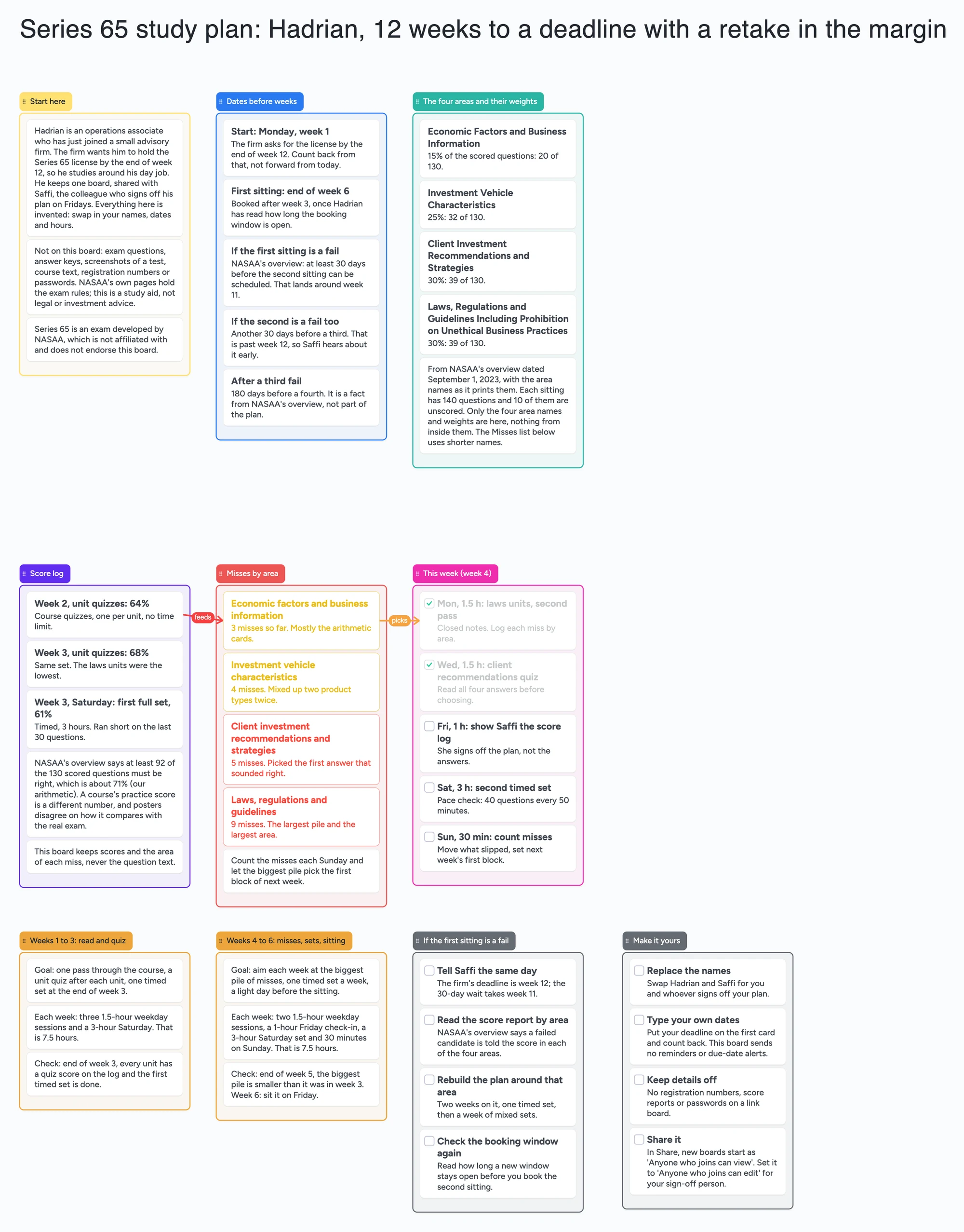
Hadrian is an operations associate who has just joined a small advisory firm, and the firm wants the Series 65 license by the end of week 12. He keeps the plan on a board he shares with Saffi, the colleague who signs it off on Fridays. All of it is invented, so you can copy the board and type over it. We make Instaboard, a board tool, and have no tie to NASAA. The first lists are the dates, worked backward from the deadline with the waiting time after a failed sitting counted in, and the four areas with their weights; then come a score log, misses by area, this week, two phases and a plan for a fail. Series 65 is an exam developed by NASAA, which is not affiliated with and does not endorse this page.
Opens in your browser. Anyone can view; a free sign-in lets you edit.
Updated
What the board starts from, and what you add
- A date, not only a number of weeks. A course or a question set will tell you what to study. The board starts from the date your firm needs the license, and counts the waiting time after a failed sitting before it counts study weeks.
- On the board: the dates, the four areas with the weights NASAA prints, a score log, misses by area, this week's sittings, two phases and a plan for a fail. Hadrian's scores, misses and hours are invented; type your own.
- Not on the board: exam questions, answer keys, course text, registration numbers and passwords. There are no reminders or due-date alerts, so type your deadline on the first card. It is a study aid, not legal or investment advice and not a guide issued by NASAA.
- Size: Hadrian's board is 53 of the 150 items a free account allows (42 cards, 10 lists and the title box, our count); arrows and pen strokes are free. Anyone can read the link signed out, and writing needs a free sign-in. Pro lifts the item limit.
Dates before weeks: what a failed sitting does to a deadline
Hadrian's firm wants the license by the end of week 12. His first card says to count back from that date. The second card puts his first sitting at the end of week 6, which leaves room for a second. The numbers behind it come from NASAA's Series 65 overview (cover dated September 1, 2023, read in full on November 29, 2026): after a first fail, at least 30 days before the second sitting can be scheduled; after a second fail, at least 30 days before a third; after a third fail, at least 180 days before a fourth.
| Sitting | Week it falls in on Hadrian's board | What NASAA's overview says comes next |
|---|---|---|
| First | End of week 6 | A fail means at least 30 days before the second can be scheduled |
| Second | Around week 11 | Another fail means at least 30 days before a third, which is past his week 12 |
| Third | After week 12 | A third fail means at least 180 days before a fourth |
Swipe the table sideways to see every column.
The weeks are our arithmetic (6 weeks plus 30 days is about 10 and a half weeks, so the second sitting lands in week 11). The waiting times are as NASAA's overview prints them; read NASAA's current pages again before you book.
A board with a deadline and a retake margin is our design, not something NASAA recommends. We use it because the four people we read all describe a clock: a company that pays for three weeks, a two-week window, a six-week schedule and about five weeks around a job.
What 45 hours looks like on Hadrian's calendar
In weeks 1 to 3 he plans 7.5 hours a week: three weekday sessions of 90 minutes and a 3-hour Saturday. Weeks 4 to 6 are also 7.5 hours: two weekday sessions of 90 minutes, a 1-hour Friday check-in with Saffi, a 3-hour Saturday set and 30 minutes on Sunday. That is 45 hours over the six weeks to his first sitting (our arithmetic). Hadrian studies around his day job, and the plan leaves weeks 7 to 12 as the retake margin.
The posts further down give anything from about 57 to 89 hours, and one describes a firm that pays for three full-time weeks. Which fits you depends on what you already know, and we cannot tell you a number of hours is enough to pass.
If the firm pays for the weeks
A paid block changes the plan, not the dates. Keep the retake margin even if you study full time: one poster below says they failed by two questions after three weeks of full days.
Two weeks, three weeks, five weeks: what four r/Series65 posters report
We read four r/Series65 threads dated October 23 to November 18, 2026, with their replies, on November 29, 2026. The text came from an archive (arctic-shift); Reddit's own counts were read the same day in a browser and are in the table note and the source labels. Counts of comments with text include the poster's own replies. Each thread is one person's account of their own prep.
| Thread and date | Their situation | What they report about time and scores |
|---|---|---|
| u/bigbubba_123 (2026-11-10 UTC), asking if three paid weeks is enough | A company that pays for 3 weeks of study; they say they hold other state and industry licenses from years ago | Replies disagree. u/yottabit42: "I spent 89 hours using Achievable and reviewing my notes, including many practice exams" and says 3 weeks "sounds doable if you're dedicated", as long as you do not burn out. u/Andrewpruka: "I spent three weeks studying all day every day and failed my first attempt by two questions", and says all new hires at their firm get three weeks and "2 out of 3 fail their first time" (one person's claim about one firm) |
| u/Altruistic-Tap-8133 (2026-10-28 UTC), a pass after 6 weeks | About 2.5 years in wealth management; a publisher's course; roughly 3 hours a day, not every day, for the first three weeks; weeks 4 and 5 on practice exams and misses | Question-bank scores in the 60s, then the 70s; a practice exam around 66%, then a mastery exam at 68% a few days before the real one; the real exam "somewhere between the QBank and the Mastery Exam in terms of difficulty". They write that they rushed: 140-question exams in about 90 minutes against 3 hours |
| u/Osowp95 (2026-11-18 UTC), a pass | "1.5 hours per weekday and 2-3 hours per Sat/Sun for about 5 weeks" with a course; career changer | "Reviewing missed questions and the reasoning behind why I missed them during prep was the most helpful." In replies: a first practice exam at 67% and the last three at 82%, 84% and 86% |
| u/QStew (2026-10-23 UTC), asking if 2 weeks is enough | Interviewing for a role whose first two weeks would be paid full-time study, about 80 hours; no finance background, a newborn at home; no result posted | Replies split: "No.", "If you have two weeks dedicated to studying, barring any distractions or thoughts of being ready and skipping prep, you definitely will pass" with a practice test every day, and one person who says they did it in a week with two practice exams a day |
Swipe the table sideways to see every column.
Read November 29, 2026 through an archive; the posters' own replies are included in the counts. Reddit shows / renders: u/bigbubba_123 12 / 11; u/Altruistic-Tap-8133 9 / 9; u/Osowp95 20 / 18; u/QStew 4 / 4. The archive holds, with text: 11, 9, 20 and 4 comments, none by AutoModerator; the poster wrote 1, 4, 8 and 0 of them. Practice scores come from different courses and are not comparable.
The posts do not agree on how many weeks are enough. One poster failed after three full-time weeks and says most of their firm's new hires do the same on a first try; another passed in about five weeks around a job; a fourth asks whether two is enough and gets split answers. Hours, where given, run from about 57 to 68 (u/Osowp95's weekday and weekend sessions over about 5 weeks, our arithmetic) to 89 (u/yottabit42). Two of the four describe working through what they missed. So Hadrian's board keeps a score log and misses by area, and it keeps a retake in the margin.
The four areas and their weights, as NASAA prints them
NASAA's overview lists four subject areas and how many of the 130 scored questions each holds. Every sitting has 140 questions, 10 of them unscored and not marked as such. The board keeps only these area names and numbers on one list; nothing from inside an area, no outline text and no question.
| Area | Weight | Scored questions |
|---|---|---|
| Economic Factors and Business Information | 15% | 20 |
| Investment Vehicle Characteristics | 25% | 32 |
| Client Investment Recommendations and Strategies | 30% | 39 |
| Laws, Regulations and Guidelines Including Prohibition on Unethical Business Practices | 30% | 39 |
Swipe the table sideways to see every column.
From NASAA's overview, cover dated September 1, 2023. NASAA's exam page (no date shown) adds that updates are coming in early 2027 for questions touched by May 2026 model-rule amendments on adviser advertising, with the date to be announced. If your sitting is after that, read NASAA's page again.
The pass mark is 92 of the 130 scored questions, per both NASAA pages, which is about 71% (our arithmetic). One training provider's blog, read the same day (published November 3, 2026, updated November 28, 2026), says NASAA recommends 70 to 100 study hours and a pass of 97 of 130. NASAA's overview, read in full, gives 92 and no study hours, so we print neither the 97 nor the hours as NASAA's. NASAA's overview also says it does not endorse any third-party prep service.
The score log and the misses list: where the next block comes from
Two lists carry the weekly work. The Score log holds one card per quiz or timed set: a score, the mode and one line about pace. The Misses by area list has one card per area, with a count and one line about the kind of mistake. Hadrian's laws card has 9 misses and is the largest pile, so it picks his first block next week. Two arrows on the board, "feeds" and "picks", show that order; they are pointers only and are not counted among your 150 items.
| Area card on the board | Misses so far (invented) | Line on the card |
|---|---|---|
| Economic factors and business information | 3 | Mostly the arithmetic cards |
| Investment vehicle characteristics | 4 | Mixed up two product types twice |
| Client investment recommendations and strategies | 5 | Picked the first answer that sounded right |
| Laws, regulations and guidelines | 9 | The largest pile and the largest area |
Swipe the table sideways to see every column.
Our design, with invented entries. The Misses cards use shortened area names; the full names are in the table above. The board does not add anything up for you: count the misses yourself each Sunday.
A miss card never holds a question's text. NASAA's overview says all exam questions are NASAA copyright and bars copying or republishing them without its prior written consent, so the board keeps a score and an area and nothing else.
Setting up your own copy, deadline first
- Read the Start here list. It names what stays off a link board: exam questions, answer keys, course text, registration numbers and passwords.
- Swap the names. Hadrian and Saffi become you and whoever signs off your plan.
- Type your deadline first. Put it on the first card, then count back, and put the waiting time after a failed sitting on the Dates list before you pick your first sitting.
- Read the booking steps. NASAA's Series 65 page names the exam's administrator and links the steps for enrolling; read them again before you book, because fees and windows change.
- Log every set the day you do it. A score, a mode and one line about pace in the Score log, and each miss as a count on its area card.
- Share it. In Share, new boards start as "Anyone who joins can view". Set it to "Anyone who joins can edit" if the person who signs off will write on it, and keep registration details off the board.
What a copy takes from your free plan, and what stays off
- The rules are NASAA's. Format, weights, waiting times and fees come from its pages, read on November 29, 2026; check them again before you book.
- Scores and areas only. A card holds a number, a mode and a line about pace, never a question's text. Registration details and score reports stay off a link board.
- What it weighs. The example is 53 items (42 cards, 10 lists, 1 title text box) against the 150 on a free account, counted over all your boards; arrows and pen strokes cost nothing.
- Three copies break the limit. Our arithmetic: two copies use 106 items and a third reaches 159, past the 150. Pro lifts that limit: $5 a month billed yearly ($59.99 a year), or $7.99 if you pay monthly.
- Board slots. Each copy also uses one of your 5 free boards.
- Pictures. A free board takes 3 images; this one has none.
- Readable by link. A new board starts as "Anyone who joins can view", so whoever has the link reads every card. Invite-only boards need Pro.
- No reminders or due-date alerts. Nothing on the board warns you about a sitting or the deadline.
- Better tools for other jobs. A question bank from a training provider scores questions; a spreadsheet totals hours and percentages. This board suits a deadline, a plan and a score log that a second person can read.
Series 65 is an exam developed by NASAA, which is not affiliated with and does not endorse this page. This is a study aid, not legal or investment advice and not a guide issued by NASAA.
Start from the ready board
It opens in your browser in a few seconds, with nothing to install. Sign in for free when you want to save it and share it.
Questions
Is there a Series 65 study plan template I can share by link?
A board you copy rather than a file you download. The first lists hold the dates and the four areas; a score log, misses by area, two phases and a plan for a fail follow. Type your names over Hadrian and Saffi and send the link.
Why does the board start with dates and not weeks?
Because a deadline is set by someone else and a failed sitting is followed by a waiting time that NASAA prints. Counting back from the deadline shows early whether there is room for a second sitting. It is our design, not a method NASAA recommends and not a promise it works for everyone.
Can I put practice questions or answers on it?
No. Cards hold a score, a mode and a note in your own words. The questions belong to NASAA and to training providers.
Is this NASAA's study plan?
No. NASAA has no part in this page. Hadrian is invented, and the plan rests on NASAA's public Series 65 pages and the posts listed in the sources.
How long is the example's plan?
45 hours across the six weeks before the first sitting (our arithmetic); the six weeks after are the retake margin. The posters report anywhere from about 57 to 89 hours, or just a number of weeks. Use your own hours.
How much of my free plan does a copy use?
53 of the 150 items (cards, lists and the title box, counted across all your boards), so three copies reach 159 (our arithmetic). Arrows are free, and Pro lifts the item limit.
Sources
- NASAA: Series 65 Exam Content Outline page (read November 29, 2026 in a browser; no date shown; 130 scored questions plus 10 pretest, 180 minutes, at least 92 correct, $187 exam fee, 120-day window once registered; announcement of exam updates in early 2027 for May 2026 model-rule amendments; Series 65 is an exam developed by NASAA, which is not affiliated with and does not endorse this page)
- NASAA: Uniform Investment Adviser Law Examination (Series 65) Overview, PDF (cover dated September 1, 2023; read in full November 29, 2026; 140 questions of which 130 scored, four areas and weights, waiting times of 30, 30 and 180 days after a first, second and third fail, no study-hours figure; questions are NASAA copyright)
- VoraPrep: How to Pass the Series 65 Exam While Working Full Time (published November 3, 2026, updated November 28, 2026; read November 29, 2026 in a browser; a training provider's blog that sells a course; says NASAA recommends 70-100 study hours and a pass of 97 of 130, neither of which is in NASAA's overview)
- r/Series65: If a company pays 3 weeks to study for 65 is that enough time? (u/bigbubba_123, 2026-11-10 UTC; read November 29, 2026 through an archive; Reddit shows 12 comments and renders 11; archive 11 with text, 0 AutoModerator, 1 reply by the poster; one poster's account)
- r/Series65: Passed the Series 65 Today! My Experience Using Kaplan (6 Weeks of Studying) (u/Altruistic-Tap-8133, 2026-10-28 UTC; read November 29, 2026 through an archive; Reddit shows 9 comments and renders 9; archive 9 with text, 0 AutoModerator, 4 replies by the poster; one poster's account)
- r/Series65: Passed: Mid-40s Career Changer Using Kaplan (u/Osowp95, 2026-11-18 UTC; read November 29, 2026 through an archive; Reddit shows 20 comments and renders 18; archive 20 with text, 0 AutoModerator, 8 replies by the poster; one poster's account)
- r/Series65: Is 2 weeks long enough to study and pass? (u/QStew, 2026-10-23 UTC; read November 29, 2026 through an archive; Reddit shows 4 comments and renders 4; archive 4 with text, 0 AutoModerator, 0 replies by the poster; one poster's account)