For accounting graduates who study FAR around a full-time job, alone or with a friend who reads the plan
A CPA FAR study plan board: hours counted before weeks
American Institute of Certified Public Accountants and AICPA are trademarks of the American Institute of Certified Public Accountants, which is not affiliated with and does not endorse this page. This page is a study aid, not accounting, tax or licensing advice. Instaboard is our shared online board (we make it). The board below is one invented plan for the FAR section of the Uniform CPA Examination ® (CPA Exam): Prudence, who works full time and writes down the hours she can keep on a bad week, and her friend Montgomery, who reads it on Sundays. It starts from hours, not from a start date, then lays the units on top. It holds no exam questions, no Blueprint text and sends no reminders. It is a board, not a PDF or Excel planner; if you want a file to print or sum, a spreadsheet is the better choice.
Opens in your browser. Anyone can view; a free sign-in lets you edit.
Updated
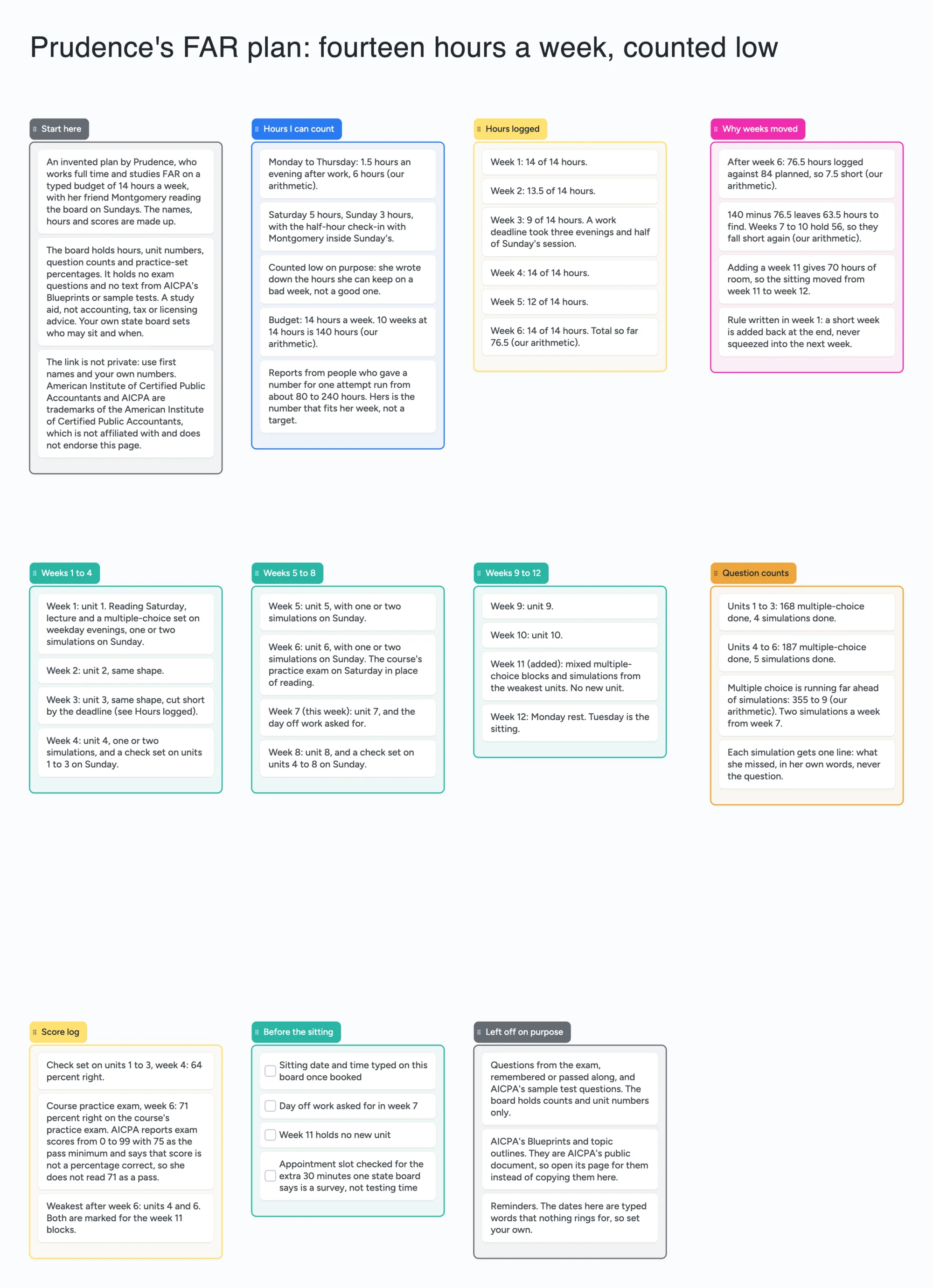
What goes on it and what stays off
- Hours first. The first list is a weekly budget typed from the evenings and weekend hours you can keep when work runs over. The week cards come after it, so a short week shows up as a number to add back.
- Counts and percentages, never questions. The board keeps unit numbers, how many multiple-choice questions and simulations you have done, and the percentage on each practice set. It holds none of the exam's questions, none of AICPA's sample test and none of its Blueprint text.
- A board, not a file. It is not a PDF planner, and it does not add up or average. If you want to print or sum, use a spreadsheet; the board is for a plan someone else can read and move.
- Who can edit: a new board starts view-only. To let a friend move cards, change Share so joiners can edit. They sign in, and your board takes one of their five free boards.
- Limits: the free plan allows five boards, 150 items over all of them and three pictures per board. A copy of this example takes one board. Pro removes the item limit: $5 a month billed yearly ($59.99 a year), or $7.99 paid monthly.
What people said about hours
The people in r/CPA who gave a number do not agree, and each number is their own report. In the "Realistic Timeline for FAR" thread, u/Fickle_Bat_5104 "did it in about 80 hours in one month while working full time, no videos textbook only." u/Moogles90: "I clocked 137 hours across 2.5 months. Felt that was enough for me. Got an 89." u/SeaPAyyy: "I did I think 150-180 hours. 11 weeks working full time. ... Passed with a 75." u/Thisgirlcanboard: "I put in 222 hours working full time. I had about three weeks at the end with just review and multiple practice tests." u/CardiologistFancy926 "took 3 months and did about 230 hours", and u/Abnormalhumanbeing wrote "I clocked 240 hrs on becker." At the other end, u/SkeezySkeeter wrote "400 total", with "220 my first time" and "180" the second time, which is two attempts, not one.
On weeks, the thread "Realistically, how long should I plan to study for FAR? (Weeks wise)" has u/CLDR16 writing "It's doable in 6 weeks at 25hrs a week", u/commonwealth97 "just spent like 8ish weeks and I work full time and have a toddler at home", and u/hgrebener2 "spent 13ish weeks studying usually 2 hours per day". A different voice in that thread is u/legend6_: "i took it w 1.25 months of study… failed w 69." In "Can I pass FAR with 5 weeks of studying?", u/welpwelpwelp wrote "Studied for 5 weeks about 30-35 hours a week and passed with a 93", and u/Bushdid9-II "studied FAR in 5 weeks. Studied for 4 to 8 hours a day, 6 days a week." Each of these is one person's account; the passes and the failure are their own words.
The example does not copy any of them. Prudence takes the hours she can count on a bad week: 6 on weeknight evenings, 5 on Saturday and 3 on Sunday, 14 in all (our arithmetic). Ten weeks of that is 140 hours, a number that lands inside the range people reported and says nothing about whether it is enough for you.
Adding a short week back
The board's Hours logged list writes down what actually happened each week. In the example, week 3 is 9 of 14 hours because a work deadline took three evenings and half of Sunday's session, and by the end of week 6 she has logged 76.5 hours against 84 planned (our arithmetic). The rule she wrote in week 1 is that a short week is added back at the end and never squeezed into the next one. The remaining weeks 7 to 10 hold 56 hours against the 63.5 still owed, so the Why weeks moved list adds a week 11 and moves the sitting from week 11 to week 12.
u/commonwealth97's advice in the "Realistically, how long should I plan to study for FAR? (Weeks wise)" thread is the same idea from the other side: "I would recommend underestimating how many hours you can do in a week because you can fall behind fast with just a few days where you're burned out from a long day at work." The board cannot count hours for you; it keeps the arithmetic where a friend can see it.
What the board leaves off
The board holds no question from the exam, none you remember and none from AICPA's sample test. It leaves AICPA's Blueprints off too: they are AICPA's own public document, so open its page for the topic list rather than copying it here. Nothing on the board alerts you, so the days stay typed words. Your own state board sets who may sit, when and after how many attempts; ask it, not this page. American Institute of Certified Public Accountants and AICPA are trademarks of the American Institute of Certified Public Accountants, which is not affiliated with and does not endorse this page.
What the FAR sitting is, as the pages print it
AICPA's CPA Exam overview (the page shows no date of its own; read November 29, 2026) says the exam "consists of three four-hour Core sections and one four-hour Discipline section of your choice", that Auditing and Attestation (AUD), Financial Accounting and Reporting (FAR) and Taxation and Regulation (REG) are the Core sections, and that "other requirements may differ by jurisdiction. You should check with your specific Board of Accountancy for details." The Texas State Board of Public Accountancy's CPA Exam page (it prints no date; read November 29, 2026) gives FAR as "4 hours", "50 Multiple-Choice Questions" and "7 Task-based Simulations", and says the appointment time on a scheduling notice is testing time "plus 30 minutes" for an exam survey, which "is NOT additional testing time." The example's Before the sitting list holds that as a tick box and nothing more; your own board sets your rules.
On scoring, AICPA's article (October 22, 2026) says "To pass a CPA Exam section, you must score a minimum of 75", on a scale of 0 to 99, that the reported score "does not represent a percentage correct" and that scores "are not curved." It prints FAR's cumulative pass rate as 43.54% for the first three quarters of 2026 and 42.12% for 2025. That is why the example's Score log never writes a practice percentage as a pass.
Multiple choice runs ahead of simulations
AICPA's "Seven things to know about the new CPA Exam" (April 21, 2025) says candidates "are doing better on multiple-choice questions but are more challenged by the simulations", and that they "should include practice task-based simulations in their Exam preparation regimen." Joe Maslott, CPA, AICPA's Director, CPA Exam Content Management, is quoted in the article saying "candidates struggle with the task-based simulations or small case studies in the FAR and BAR sections." These are statements about candidates in aggregate, not about you.
So the example's Question counts list keeps the two apart: 355 multiple-choice questions done against 9 simulations by week 6, which is 1.5 simulations a week (our arithmetic). Prudence's rule from week 7 is two simulations a week, and each gets one line that says what she missed in her own words, never the question.
When the clock starts and which section first
The same article says candidates "work under a time limit to pass all Exam sections", that passing the first section starts it, and that, as of that article (April 21, 2025), "What once was an 18-month limit for passing all four parts of the Exam is now at least 30 months, and in some states, three years." It adds that "with the previous shorter window, the conventional wisdom was that it was best to attempt the challenging Core section Financial Accounting and Reporting (FAR) first. With more time, candidates may want to consider which approach best fits their circumstances." The example takes no side. If you plan more than one section, a second board per section is how you would see the order, and your own state board decides the window.
Where a spreadsheet is the better choice
A spreadsheet (Google Sheets, Excel) sums hours, averages practice sets and prints. This board is not a PDF planner and does not add up or average: the totals above were added by hand and written on cards. Pick a spreadsheet if you want to print, chart your scores or use a formula. Pick the board if the plan is for someone else to read and move, with the week lists, the reasons weeks moved and the hours side by side.
How much of your free allowance it uses
Each list, each card and the title text box counts as one of your 150 items, summed over every board you have. This example uses 56. Our arithmetic for a version with a card for each of 84 days in place of the 12 week cards: 84 + 32 other cards + 11 lists + 1 title = 128, which leaves 22 for any other board. Pro lifts the item limit.
- Copy the board. The copy takes one of your five boards. Replace Prudence's and Montgomery's names, hours and scores with your own.
- Type your weekly budget first, from the hours you can keep on a bad week. Multiply by your weeks before you place a single unit.
- Log hours each Sunday, and write any shortfall on Why weeks moved with the week it is added back to.
- Count multiple-choice and simulations apart on the Question counts list, and write one line per simulation about what you missed.
- Let a friend in through Share ("Anyone who joins can edit") if they should move cards; they sign in before they can.
Start from the ready board
It opens in your browser in a few seconds, with nothing to install. Sign in for free when you want to save it and share it.
Questions
Are there CPA Exam questions on the board?
None. It holds your hours, the units by week, question counts and your practice percentages. Questions come from your course or from AICPA's own sample test.
How many hours does FAR take?
The accounts we read give about 80, 137, 150 to 180, 222, 230 and 240 hours for one attempt, and one person's 400 covers two attempts. They are single reports. The example's 140 hours is what its invented person can fit into ten weeks, not a target.
Does a 71 percent on a practice set mean I would pass?
AICPA says the exam score is reported from 0 to 99, that 75 is the minimum to pass and that the score is not a percentage correct. A course's practice percentage is a different scale, so the example does not read it as a pass.
Can the board add up my hours?
No. The totals on the example were added by hand and typed on cards. If you want it done for you, use a spreadsheet for the sums and the board for the plan.
Can a friend read or edit my plan?
Yes. Open Share and let joiners edit, and have your friend sign in once. Someone who only reads needs no account. Both of you can then change every card, so agree beforehand who moves the week lists.
How many items does a FAR plan take on the free plan?
The example takes 56 of the 150. By our arithmetic, a version with a card for each of 84 days plus the example's 32 other cards, 11 lists and the title is 128, and your other boards count against the same 150.
Sources
- AICPA & CIMA: Everything You Need to Know About the CPA Exam (the page shows no date of its own; it prints the Uniform CPA Examination ® (CPA Exam) mark; read November 29, 2026). American Institute of Certified Public Accountants and AICPA are trademarks of the American Institute of Certified Public Accountants, which is not affiliated with and does not endorse this page
- AICPA & CIMA: Learn more about CPA Exam scoring and pass rates (October 22, 2026 on the page; read in full November 29, 2026)
- AICPA & CIMA: Seven things to know about the new CPA Exam (April 21, 2025 on the page; read in full November 29, 2026)
- AICPA & CIMA: Terms & Conditions (the page shows no date beyond "Version 4" and a © 2025 line; its trademark notice lists the American Institute of Certified Public Accountants and AICPA names; read November 29, 2026)
- Texas State Board of Public Accountancy: CPA Exam (a state board's page; it prints no date beyond a © 2026 line; read November 29, 2026)
- r/CPA: "Realistically, how long should I plan to study for FAR? (Weeks wise)" (posted 2024-10-16 UTC; the archived copy has 8 comments, 0 removed, none the poster's own; Reddit showed 8 when we looked and our reader rendered 7; we read all 8 from the archive, November 29, 2026)
- r/CPA: "Realistic Timeline for FAR" (posted 2025-12-02 UTC; the archived copy has 20 comments, 0 removed, 1 the poster's own; Reddit showed 20 and our reader rendered 18; we read all 20 from the archive, November 29, 2026)
- r/CPA: "Can I pass FAR with 5 weeks of studying?" (posted 2025-06-21 UTC; the archived copy has 49 comments, 0 removed, 9 the poster's own; Reddit showed 49 and our reader rendered 49; we read all 49 from the archive, November 29, 2026)