For a fantasy writer outlining with a reader or co-writer
A fantasy novel outline board that starts with the plot
We make Instaboard, an online board. The board on this page outlines a fantasy novel with the plot first: the story in four lines, three acts of beats, then two short lists that hold only the world facts and the magic the plot touches, plus who wants what, subplots, open questions and decisions. The example is one invented novel, The Ashwright's Winter. It is an outline, not a worldbuilding bible.
Opens in your browser. Anyone can view; a free sign-in lets you edit.
Updated
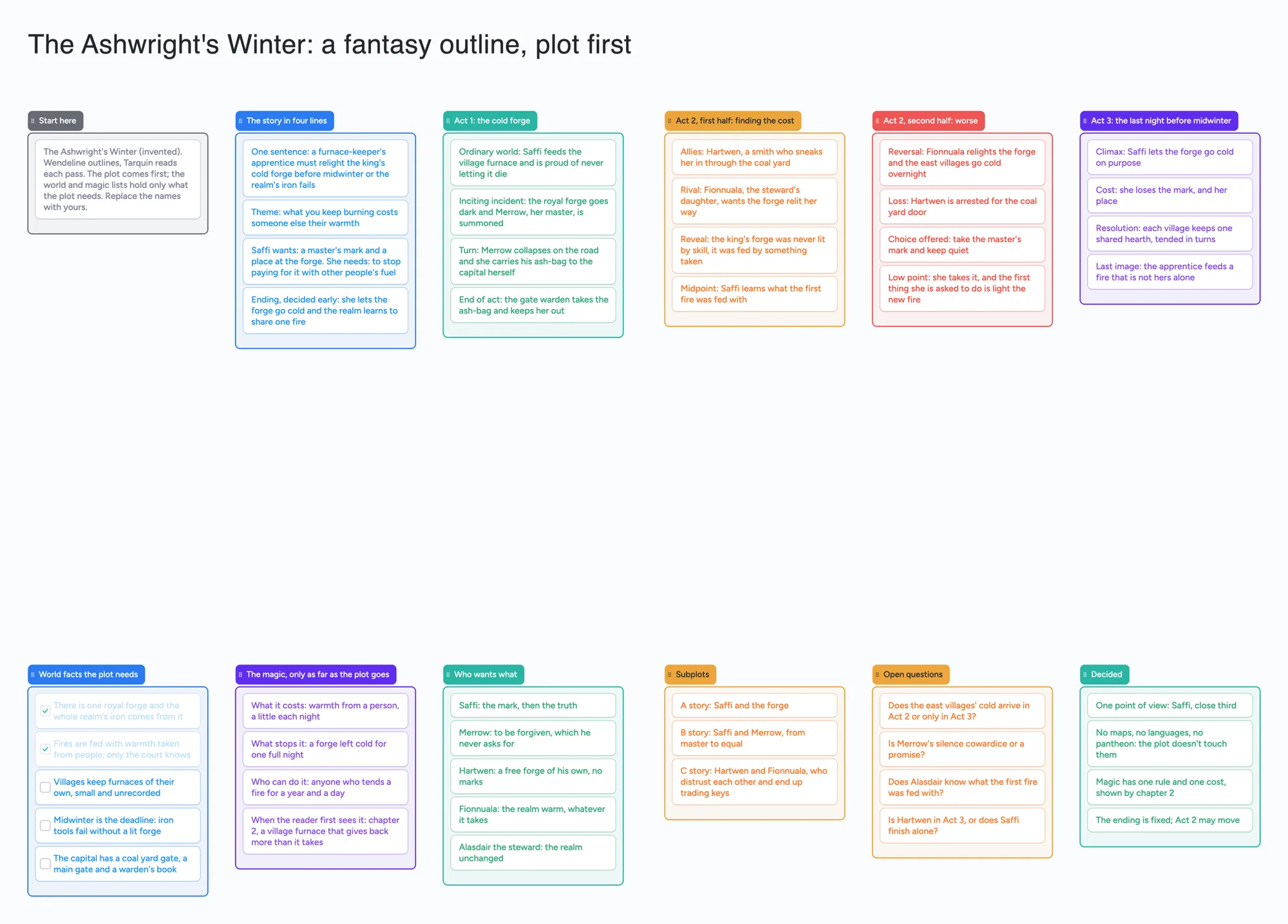
What this board does, and what it leaves to other tools
- Plot first. The acts are the largest part of the board. The world and the magic get one short list each and only hold what a plot beat needs.
- No worldbuilding wiki. A card can't link to another by name, and there are no map pins or timeline. For a large invented world a wiki tool is the better place.
- Not a method. The three acts are a common shape, not a rule. If you outline with the Hero's Journey or a beat sheet, our pages for those are linked below.
- No reminders or due-date alerts. Dates are words on a card.
- On the free plan you can keep 5 boards and 150 items, with 3 pictures a board; a copy of this one uses 1 board and 59 items.
- Any editor can tick or untick any card. Settle who ticks which.
Plot first or world first? What fantasy writers say
Fantasy outlines fight a pull that other genres don't: the world wants to be built before anything happens in it. The board takes a side, plot first, and you may not. Each view below is one person's, as written, from threads we read on November 28, 2026 (counts are Reddit's and the archive's; we read 25 comments of each thread).
- r/fantasywriters, “Do I just start writing? Or outline first? Or world build?” (u/MrRedTRex, posted 2018-12-30; Reddit shows 76 comments, the archive 80 with 3 removed). The top comment, by u/MadHatterMoran (190 votes), puts the world's rules and setting before the outline: write ideas, then “World build, laws”, then setting, then outline. u/TarekBadr advised giving two or three world elements 80% of the time (his figure). u/chevron_seven_locked warned that plotting and worldbuilding can become an excuse that keeps you from writing.
- r/writing, “Getting overwhelmed with plot, lore, world building, magic systems, character arcs, etc etc” (u/pollyprincess77, posted 2026-04-14 00:13 UTC; Reddit shows 46 comments, the archive 47). u/Prize_Consequence568 wrote: “You MIGHT need only a 10th of the worldbuilding that you have.” u/Fognox wrote that books work out better when you develop things one piece at a time.
- r/fantasywriters, “How much of the world and magic do you have planned before writing?” (posted 2024-08-22; Reddit shows 66 comments, the archive 69). u/sanguinesvirus said to write an outline first and build the world around it; u/sophisticaden_ said the bare minimum to get the story rolling; u/Spirintus tries to have quite a lot done because story arises from interactions between characters and the world.
People split on this, so the board doesn't enforce an order. It simply makes the plot lists big and the world and magic lists small, so a card has to earn its place by serving a beat.
Inside The Ashwright's Winter
The novel is invented: a furnace-keeper's apprentice has to relight a king's cold forge before midwinter. Wendeline outlines and Tarquin reads each pass. One line is one card.
| List | What goes in it | In The Ashwright's Winter |
|---|---|---|
| Start here (grey) | What the board is and isn't | One card |
| The story in four lines (blue) | One sentence, the theme, what the main character wants and needs, the ending | 4 cards; the ending is decided early |
| Act 1 (green) | Ordinary world, inciting incident, turn, end of act | 4 cards |
| Act 2, first half (orange) | Allies, rival, reveal, midpoint | 4 cards |
| Act 2, second half (red) | Reversal, loss, a choice offered, low point | 4 cards |
| Act 3 (purple) | Climax, cost, resolution, last image | 4 cards |
| World facts the plot needs (blue) | Only the facts a beat depends on, as tick boxes | 5 tick-box cards, 2 ticked |
| The magic, only as far as the plot goes (purple) | What it costs, what stops it, who can do it, when the reader first sees it | 4 cards |
| Who wants what (green) | One line per character | 5 cards |
| Subplots (orange) | A, B and C stories | 3 cards |
| Open questions (orange) and Decided (green) | What isn't settled and what is | 4 and 4 cards |
Swipe the table sideways to see every column.
The board's own wording. Act names are the example's, not a method; the board has no timeline axis or page count.
Filling it in, in the order the plot needs
- Start with “The story in four lines”, ending included.
- Lay the three acts out, one beat per card.
- Add a world fact or a magic line only when a beat asks for it.
- Then who wants what, and after that the subplots.
- Park each undecided thing in “Open questions” with a name beside it.
- Invite your reader. Send the link; new boards start view-only, so tick “Anyone who joins can edit” in Share if they should write, and they sign in free.
- Say who ticks which boxes, and keep to first names.
The world list: a fact earns a card by a beat that needs it
Each card in “World facts the plot needs” is something a plot beat leans on: there is one royal forge, fires are fed with warmth taken from people, the capital has a coal yard gate. Everything that doesn't touch a beat stays off the board. In the example, the decided list says so in plain words: no maps, no languages, no pantheon, because the plot doesn't touch them.
- Write the beat first in the Act lists.
- Ask what has to be true for it to work, and write that as a world-fact card.
- Tick the card when a chapter or scene uses it. In the example, “tick” means “planned, not yet written.”
- Move anything that no beat needs off the board, into your own notes if you want to keep it.
Ticking is the only mark the board gives. It doesn't record who ticked or when, and there is no reset-all.
Magic on the board: one rule, one cost
The magic list holds four lines in the example: what it costs, what stops it, who can do it, and when the reader first sees it. That is enough to write the beats that depend on it. If you want a full system with rules, limits and costs worked out in depth, that is a different board and a different job; this one keeps magic to what the story touches.
Who does the world part better
Pages read November 28, 2026. Check them again, since plans and prices change. These tools fit different writers, so there is no order. Each row is only what its page says; we haven't used any of them, and Instaboard isn't affiliated with them.
| Tool | What its page says | Better than a board at | Where a board fits |
|---|---|---|---|
| Reedsy Studio's Fantasy Starter Kit | Its page text says four connected boards, while its template block lists five (Outline, Characters, Places, Worldbuilding, Essentials); the Outline board maps the Hero's Journey in twelve stages with workshop questions and a worked example; the Worldbuilding board has nine in-built cards. We did not read its pricing | Guided questions per stage, a built-in worldbuilding set, linking stages to characters and places | A blank, shared canvas for two people; no guided questions |
| Plottr | Its fantasy outline page (published Aug 11, 2025, updated Aug 13, 2025) lists templates it suggests for fantasy, including the 24-chapter novel outline, the Heroine's Journey, the Hero's Journey and the Story Circle, and describes a Places tab with custom attributes | Reordering scene cards on a timeline, tracking places and attributes | Seeing the whole outline at once with a co-writer |
| A tutorial post such as Tonja K. Johnson's | Its step-by-step guide (April 10, 2025) goes from the core idea through the world, characters, structure and plot points to a chapter-by-chapter breakdown | Explaining the steps in order | Holding the answers |
| A wiki tool such as Kanka | Kanka's pricing page (no date shown) says its free plan has no limit on entries or campaigns | A large, linked, searchable world | The plot, not the encyclopedia |
Swipe the table sideways to see every column.
From the pages named in Sources, as read November 28, 2026. Plottr's price was not read for this page.
How many items one novel uses
A list counts as one item, so does a card, and so does the title box. Arrows, sections and pen strokes cost nothing. A free account holds 150 in total. Our arithmetic:
- As built: 12 lists + 46 cards + the title = 59.
- With a chapter-by-chapter list of 40 cards plus the list itself: 59 + 41 = 100.
- With 8 more cards each on the world list and the cast list, for a big world: 100 + 16 = 116.
- Two novels on one account: a second board of 59 brings it to 118; a third makes 177, over the limit.
- The count is across all your boards, and cards a co-writer adds count toward their own 150.
Pro removes the item limit; it costs $5 a month billed yearly ($59.99 a year), or $7.99 monthly.
What stays outside the board
- Hold a world. No links between cards by name, no backlinks, no maps with pins, no timeline.
- Keep your names consistent. If you rename a character, you change each card by hand.
- Hold a map or a picture of your cast beyond 3 pictures per board on the free plan.
- Show secrets only to some people. Everyone with the link sees the whole board; a card can't be hidden from one person. Pro has invite-only boards.
- Remind or alert. No reminders or due-date alerts.
- Guard spoilers. Whoever holds the link reads every card, so an outline line that gives away the ending is yours to hold back until you share.
Copying it on the free plan
- Cost of a copy: 1 of your 5 boards and 59 of your 150 items; sections, arrows and pen strokes are free.
- Pictures: 3 a board, and the example has none.
- Who can write: anyone can read from the link; a person has to sign in free to change it, and the board then takes 1 of their 5.
- Held-back text: a link board is a poor home for chapters or an ending you want to keep back.
Start from the ready board
It opens in your browser in a few seconds, with nothing to install. Sign in for free when you want to save it and share it.
Questions
Should I outline the plot or build the world first for a fantasy novel?
Writers split. In the threads read for this page, the top comment put the world's rules before the outline, another commenter said you may need only a tenth of the worldbuilding you have, and another said to write the outline first and build around it. This board takes the plot-first side but doesn't enforce it.
Is this a worldbuilding template?
No. It holds only the world facts and the magic that a plot beat depends on. It has no links between cards by name, maps with pins or timeline, so a large world belongs in a wiki tool or a notes app.
Do I have to use three acts?
No. The acts are the example's shape. Rename the lists to your own structure, such as the Hero's Journey's stages or a beat sheet, and keep one beat per card.
Can I put my map on the board?
Yes, up to 3 pictures: the free plan allows 3 per board, and the example uses none. A map is usually better kept in your world notes, since a card can't pin places on it.
Can my co-writer and I edit it at once?
At the same time, yes, after you tick “Anyone who joins can edit” under Share and your co-writer signs in free. Changes appear live on every screen, and a tick carries no name or time.
How many novels fit on the free plan?
Two, by our arithmetic: each uses 59 of the 150 free items (a card or a list is one item), so a third board of this size goes past the limit. Items on your other boards come out of the same 150.
Sources
- r/fantasywriters: “Do I just start writing? Or outline first? Or world build?” by u/MrRedTRex (posted 2018-12-30; Reddit 76, archive 80; 25 read November 28, 2026)
- r/writing: “Getting overwhelmed with plot, lore, world building, magic systems, character arcs, etc etc” by u/pollyprincess77 (posted 2026-04-14 00:13 UTC; Reddit 46, archive 47; 25 read November 28, 2026)
- r/fantasywriters: “How much of the world and magic do you have planned before writing?” (posted 2024-08-22; Reddit 66, archive 69; 25 read November 28, 2026)
- Reedsy Studio: Fantasy Starter Kit (page shows no date; read November 28, 2026)
- Plottr: Fantasy Novel Outline Templates: Plot Like a Seer (page shows published Aug 11, 2025 and updated Aug 13, 2025; read November 28, 2026)
- Tonja K. Johnson: How to Create a Fantasy Novel Outline: A Step-by-Step Guide (page shows April 10, 2025; read November 28, 2026)
- Kanka: plans and pricing (page shows no date; read November 28, 2026)
Related
A hero's journey template board: twelve stages, the figures, and where your story bends the model
A shared hero's journey template: 12 stage cards in three lists, the figures who appear, and a list for where your story merges, repeats or skips a stage. Free to open.
A novel beat sheet on one shared board: 15 beats, three acts, scenes under each beat
A 15-beat novel outline to open and edit: 3 act sections, a list per beat, scene cards under each. Free-plan item counts and where other tools are better.
24-chapter novel outline board: acts, chapters and beats on one shared board
A filled 24-chapter novel outline to open and edit: four act sections, a list per chapter, three beat cards each. Item counts for the free plan stated, and where other tools are better.
Character relationship map: a filled template two people can edit
A character relationship chart you fill in by hand: a card per character, captioned arrows, shared with a co-writer. No auto-layout or line styles.