For a small team with one goal and a long list of things it could build or do
An impact mapping template with arrows: one goal, who can change it, what should change, and only then what to do
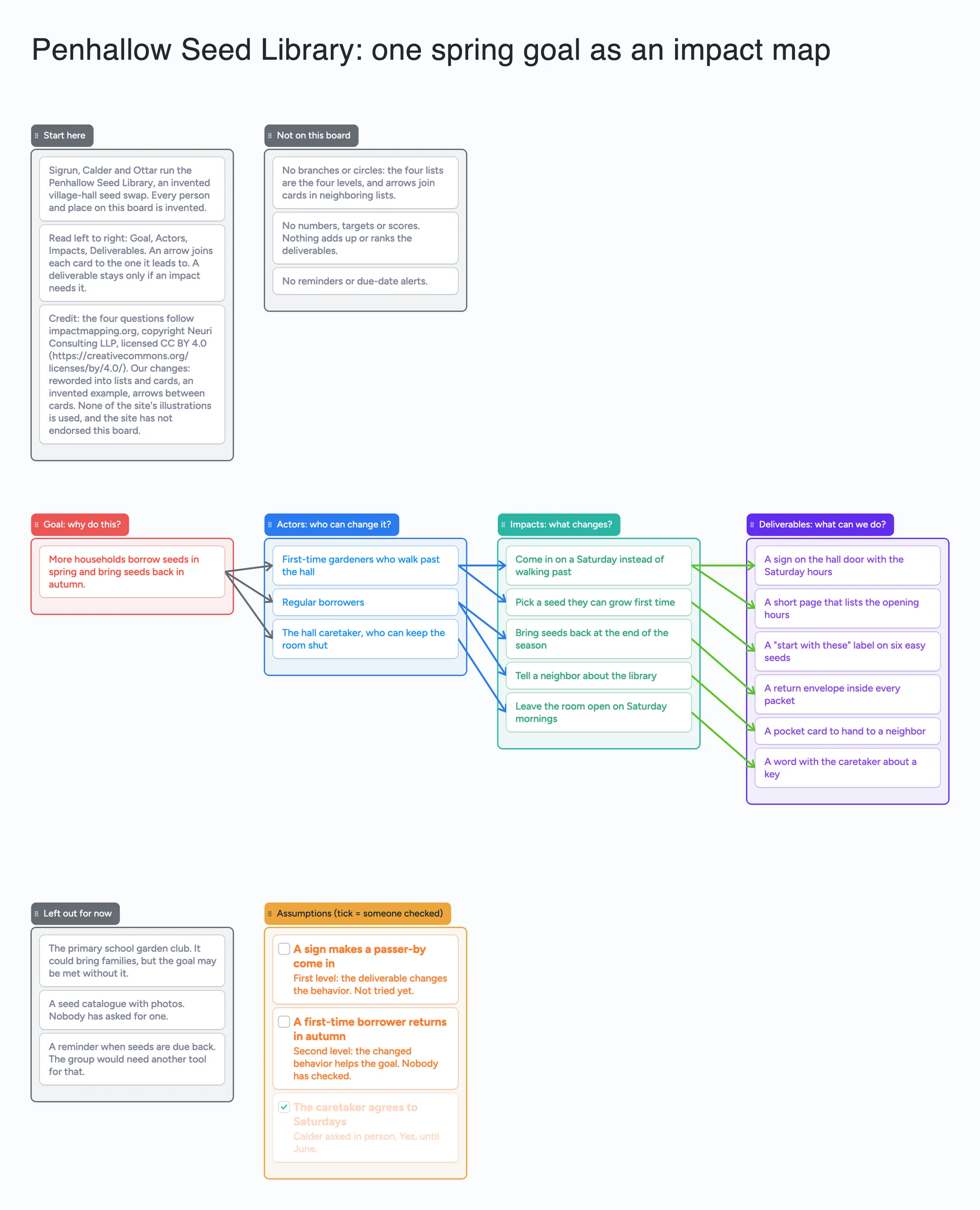
Impact mapping starts from a goal and asks who can change the result and how their behavior should change before it asks what to build or do. This board keeps that order as four lists, Goal, Actors, Impacts and Deliverables, with an arrow running from each card to the card it leads to. We make Instaboard, and the example is invented: Sigrun, Calder and Ottar at the Penhallow Seed Library want more households to borrow seeds in spring and bring seeds back in autumn. It has eight lists, 27 cards and 14 arrows. The four questions come from impactmapping.org, whose text is licensed CC BY 4.0, so the credit and our changes are printed on the board and again below. Nobody on it is real.
Opens in your browser. Anyone can view; a free sign-in lets you edit.
Updated
The map in five lines
- Use: a shared place for a small team to write one goal, the actors who can help or block it, the changes in their behavior it needs, and the deliverables that would support those changes, with arrows showing which leads to which. It takes 36 of the free plan's 150 items; the arrows are not counted.
- Not: a mind map. The levels are lists, and the links between cards are arrows you draw.
- Where it fits (our view): two to eight people choosing among many possible deliverables for a single goal.
- Poor fit (our view): a goal nobody has agreed on yet, or a team that needs a drawn map on a slide.
- Privacy: keep customers and colleagues off the cards by name; anyone you give the link to can read it.
Start from who can change what: the four questions
impactmapping.org describes the technique with four questions, one for each level. Goal: "Why are we doing this?" Actors: "Who can produce the desired effect? Who can obstruct it?" Impacts: "How should our actors' behaviour change?" Deliverables: "What can we do, as an organisation or a delivery team, to support the required impacts?" The order is the point. The site says project plans are often "shopping lists of features, without any context why such things are important", and that the map is meant to show why a deliverable is on the list at all.
Penhallow's goal is one card: more households borrow seeds in spring and bring seeds back in autumn. Three actors can change that, and one of them, the hall caretaker, can keep the room shut or open it. Everything the group might do is held back until the first three lists are written.
What the arrows do, and what this board cannot draw
The site says an impact map is "a mind-map grown during a discussion", and its home page has "Connect the related items visually". A board of lists cannot grow branches. Each level is a list, and the connections are arrows that start on one card and end on another; in the example each runs from a card to a card in the next list. If you reorder the cards or move a list the arrow follows, it can carry a short caption and its own color, and arrows are not counted toward the 150 items.
- Kept: the four levels in order, one idea per card, and the line from a deliverable back through an impact and an actor to the goal.
- Given up: the radial layout, branches that spread as you add cards, and collapsing a branch. Where one card leads to two things, two arrows leave it; in the example the first-time gardeners have two impacts, and the impact "Come in on a Saturday instead of walking past" supports two deliverables.
- Not done by the board: scoring or ranking. The home page of the site has "Prioritise from the goals down to impacts"; here a person does that, and records the choice by moving a card to Left out for now.
Three ways teams use a map, and which one this suits
The site's facilitation page describes three situations. To set a vision, stakeholders map goal, actors and impacts first, and the page says to "avoid listing the deliverables on the map" until a second workshop with the delivery team; afterwards facilitators "usually transform impact maps into some other document" and throw the map away. To focus delivery, the stakeholders and the delivery team "create the map together", agree one milestone goal first, and then keep the map and review metrics against it. To reframe a problem, one person collects views from several stakeholders and presents maps with "high level deliverables only".
Our view: a shared board is a poor fit for the first, where the site says the map is usually turned into another document and thrown away, and a reasonable fit for the second, where it stays around to be revisited. It also suits a small team that is both the stakeholder and the delivery team, as Penhallow's three people are. The board holds no metrics. A card can say what someone measured, typed by hand, and nothing collects or checks it.
Penhallow's map, level by level
- Goal. One card: more households borrow seeds in spring and bring seeds back in autumn.
- Actors. Three cards: first-time gardeners who walk past the hall, regular borrowers, and the hall caretaker. Three arrows leave the goal.
- Impacts. Five cards, written as changes in what someone does: come in on a Saturday instead of walking past, pick a seed they can grow first time, bring seeds back at the end of the season, tell a neighbor, and leave the room open on Saturday mornings.
- Deliverables. Six cards, each reached by one arrow from an impact: a sign on the hall door with the Saturday hours, a short page listing the opening hours, a "start with these" label on six easy seeds, a return envelope in every packet, a pocket card to hand to a neighbor, and a word with the caretaker about a key.
- Left out for now. Three cards. The school garden club could bring families but the goal may be met without it; nobody asked for a catalogue with photos; and a reminder when seeds are due back would need another tool.
- Assumptions (tick = someone checked). Three cards, one ticked: the caretaker agreed to Saturdays until June. The other two are guesses.
- Start here and Not on this board. Three cards each: who runs the library and how to read it, a credit and licence note, and what the board leaves out.
A deliverable with no arrow in does not belong
On the site's drawing page, the map helps "to throw out deliverables that do not really contribute to any impact that is critical for a particular goal". On the board that is visible: a deliverable card with no arrow arriving from an impact is a thing the group wants to do without a reason written down. Either draw the arrow, because an impact needs it, or move the card to Left out for now with a line saying why.
The example does this once. The school garden club sits in Left out for now, with the reason on its card: it could bring families, but the goal may be met without it. Moving a card between lists costs nothing, and you can draw an arrow to it later if you change your mind.
Two guesses behind every arrow
The site's About page says an impact map carries assumptions on two levels: "The first is that a deliverable will support a change in behaviour of an actor, produce an impact. The second is that once the impact is supported, the relevant actor will contribute to the overall objectives." It adds that once a deliverable ships, you can measure the actual change and decide whether to keep working on that part of the map.
The Assumptions list on the board takes both. In the example the first says a sign makes a passer-by come in, and the second says a first-time borrower returns in autumn; neither is ticked. A tick means someone checked, not that the guess was right. The board does not remind anyone to check, and it does not record what was measured unless a person types it.
Cases where a drawing tool or a backlog tool beats this
- You need the map as a picture. For a slide, a workshop wall or a document, a drawn template shows the branches that lists cannot.
- Your goal is a number. The site's example goals include "increase the number of active players to 1 million". The board can hold such a card, but it adds up nothing and shows no progress.
- You want the backlog next. UXPressia continues to user stories, estimates and a backlog. This board stops at deliverables.
- The goal is not settled. The site's facilitation page says to get "a full upfront agreement on a single milestone goal" first. If people disagree on the goal, a chat or a call will settle it faster than a card.
Where this comes from, and the licence
Impact mapping is described in Gojko Adzic's book Impact Mapping (published by Provoking Thoughts on 1 October 2012) and on impactmapping.org. That site's footer reads "Copyright © Neuri Consulting LLP" and says "Except where otherwise noted, the content in this site is licensed under Creative Commons Attribution 4.0 International License", and that its illustrations are licensed from Shutterstock or Gojko Adzic. We read that line on November 27, 2026.
- Credit: the four questions, the four levels and the two kinds of assumption follow the pages of impactmapping.org (Neuri Consulting LLP), licensed CC BY 4.0, https://creativecommons.org/licenses/by/4.0/.
- Changes we made: the text is reworded and shortened, the structure is turned into lists and cards with arrows, the example is invented, and we added a Left out list. Short quotations on this page keep the site's spelling.
- Not used: none of the site's illustrations or example maps. This board and page are our own work, and neither the site nor its authors have reviewed or endorsed them.
No page we read prints a trademark line for impact mapping; we have not searched a register.
Thirty-six items against the free 150
Free accounts get 150 items in total over every board you own. Cards, lists and the title box count; arrows, sections and pen strokes do not, so the 14 arrows here cost nothing.
- One copy of the board: 8 lists + 27 cards + 1 title = 36.
- More maps on one board: a map without Start here and Not on this board is 6 lists + 21 cards = 27. Keep those two lists and the title once (9 items) and n maps cost 27n + 9, our arithmetic: two maps 63, three 90, four 117, five 144, six 171.
- More copies: four copies are 4 x 36 = 144; a fifth passes 150.
Each copy uses one of your five free boards, and so does a visitor who signs in to write on it. The link lets whoever has it read the board; invite-only boards need a paid plan. A card can carry a due date, but no reminder or alert fires when it passes.
Three pages on the technique, what each gives you
We read all three start to finish in a browser on November 27, 2026, and list them in no order. The middle columns describe the page; the right-hand one is what we think.
| Page | What it gives you | How it lays the levels out | What lists and arrows add (our view) |
|---|---|---|---|
| impactmapping.org (no page date; the book is dated 1 October 2012) | The four questions, facilitation guidance, two example maps and a long list of links | A mind map or a hierarchical outline, with the goal in the center | Cards in lists with arrows for a team that wants to keep one map in view; the site's own examples are the better picture |
| Miro: Impact Mapping template (no date printed; vendor) | Four steps and a ready canvas to copy | Boxes joined by branches, goal first | Lists instead of branches; Miro is the better tool when you want to draw and rearrange freely |
| UXPressia: How to create an impact map in 7 easy steps (dated October 8, 2023 under the author's name; the text says it updates an article from 2017; company blog) | Seven steps, the last three break deliverables into user stories, estimate them and fill a backlog | A hierarchical tree diagram with a fifth level of user stories | A place to hold the first four levels; the story, estimate and backlog steps stay in a backlog tool |
Swipe the table sideways to see every column.
Rows show each page as it stood on November 27, 2026. Miro and UXPressia sell products, so those rows are vendor views, and none of the three is independent research. impactmapping.org's tips page links an article on how opportunity solution trees differ from impact maps; we did not read it. None of them pays us and we pay none of them.
Fill in your own map: four passes
- Copy the board, sign in with a free account, and replace the Goal card with one sentence. Leave the other lists empty.
- Fill Actors and then Impacts, one change in behavior per card, with the arrows from each actor. Leave deliverables out until everyone agrees on both lists, as the site's facilitation page advises for setting a vision.
- Add Deliverables and draw an arrow into each from the impact it supports. Any card with no arrow goes to Left out for now, with a line saying why.
- Write the two guesses behind your first deliverable in Assumptions, tick the one you have checked, and delete Start here and Not on this board when everyone knows how to read the map.
Start from the ready board
It opens in your browser in a few seconds, with nothing to install. Sign in for free when you want to save it and share it.
Questions
What is impact mapping?
A planning technique that starts from a goal and works outward: who can help or hinder it, how their behavior should change, and only then what to build or do. impactmapping.org says an impact map connects business goals, impacts on users and stakeholders, and team deliverables, and shows the assumptions between them. On the board each level is a list and arrows join the cards.
Do I need permission to use the method or the four questions?
The text of impactmapping.org is licensed under Creative Commons Attribution 4.0, except where it says otherwise, so reuse needs credit, a licence link and a note of changes; this page and the board carry all three. Its illustrations are separately licensed and we use none. We found no trademark line on the pages we read and did not search a register.
Can the board draw the map as a mind map?
No. The levels are lists and the connections are arrows between cards, with an optional caption and color on each. Reorder the cards or move a list and the arrows go with them. Branches that spread, collapse or loop are the job of a drawing tool.
Does an impact map use up the free plan?
Not by itself. A single copy is 36 of the 150 items (our arithmetic), arrows are left out of the count, and a fifth copy would pass the limit. Pro removes that cap, at $5 a month billed yearly ($59.99 a year) or $7.99 billed monthly.
Who should be in the room when we fill it in?
It depends on the use. The site's facilitation page says that to set a vision you map with stakeholders first and bring the delivery team in for a later workshop, while to focus delivery the stakeholders and delivery team make the map together. For a team of three that is also its own stakeholder, one sitting is enough.
Who can write on it?
Whoever receives the link can read right away. Writing needs a free sign-in, and editing works when the share setting reads "Anyone who joins can edit"; the board then takes one of that person's five free boards.
Sources
- impactmapping.org: home, About, Drawing impact maps, Example impact maps, Facilitating impact mapping, Tips and tricks, the book page (Neuri Consulting LLP; content licensed CC BY 4.0; every page read start to finish on November 27, 2026)
- Creative Commons Attribution 4.0 International License (the licence named in impactmapping.org's footer)
- Gojko Adzic, Impact Mapping: Making a big impact with software products and projects (Provoking Thoughts, 1 October 2012; as listed on impactmapping.org)
- Miro: Impact Mapping template (no date printed; opened and read on November 27, 2026; vendor content)
- UXPressia: How to create an impact map in 7 easy steps (dated October 8, 2023 under the author's name; the text says it updates an article from 2017; the tab title says 4 steps and we use the page's own heading, 7 steps; read November 27, 2026; company blog)