For college and graduate students, 18 and over, writing a paper, thesis chapter or dissertation
A research notes board that puts every quote under the point it supports
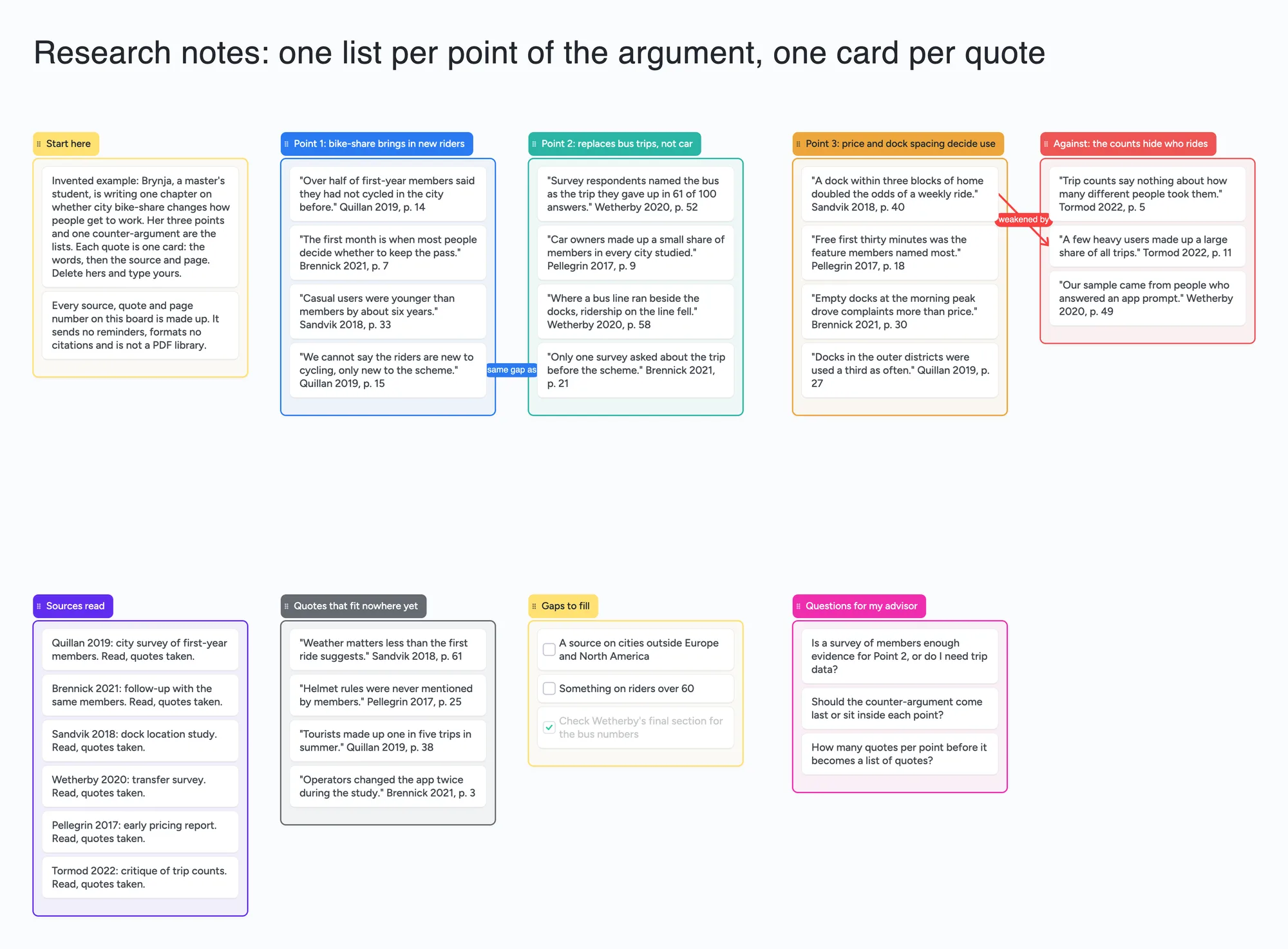
We make Instaboard, an online board. A citation manager keeps your sources and makes your citations, so that comes first. This page gives you a research notes board already laid out for one invented student, Brynja, who is writing one chapter on city bike-share: a list for each point of her argument, a card for each quote with its source and page, a list of sources read, a place for quotes that fit nowhere yet, gaps to fill and questions for her advisor. It formats no citations and is not a PDF library. Every source, quote and page number on it is made up.
Opens in your browser. Anyone can view; a free sign-in lets you edit.
Updated
What the board does for a research chapter
- A citation manager wins on sources. Zotero and EndNote keep your library and make citations. One account in the threads below says Zotero's search also scans annotations and highlights on stored PDFs. This board does none of that.
- What it is: the step between reading and writing. Each point of your argument is a list, each quote is a card, and you drag a quote to the point it supports. Brynja's copy takes 43 of your 150 free items.
- Your advisor can read it. Send the link and they can read it with no account; writing needs a free sign-in.
- What stays off: unpublished data, anything that identifies someone you interviewed, passwords and whole articles. A link to a shared board lets whoever holds it read everything on it.
- Limits of the free plan: 5 boards, 150 items, 3 pictures on each board. A copy uses one of those boards. A new board begins as "Anyone who joins can view".
When a citation manager or a notes app is the better start
Harvard Library's Inter Libros guide, a research guide for Classics, Byzantine and Medieval Studies, has a page "Organizing research notes and bibliographies" that opens with "Researchers organize their materials in many different ways. Certainly, no one solution works best for everyone." It names two bibliographic managers, Zotero and EndNote, which "allow users to create personal reference libraries from online catalogs and databases" and "generate bibliographies and citations in papers". If that is your job, start there. The board covers a different step: deciding which quote belongs under which point.
| Way of keeping quotes | What an account or guide says | Better for |
|---|---|---|
| Zotero or EndNote | The Inter Libros page describes a personal reference library with generated citations. u/BadOk633, who started the r/academia thread, says that if you annotate or highlight stored PDFs in Zotero "the search function will also scan these" | Your library, citations and searching every note at once |
| Scrivener | u/yukit866 wrote "my entire PhD thesis using it"; u/LOLELECTRONICS says "Tags are invaluable" | Writing the chapter with the notes beside it |
| A Word file per section | u/No-Lake-5246 builds an outline in Word for each main section and adds points under each topic; the original poster in r/GradSchool did something close, a Word document per section with pasted quotes, and found it "randomly scattered" | The final text and tracked changes |
| Obsidian | u/Stormzrift says you can "link your notes in the same way that Wikipedia links between different concepts" and search them by keyword or by link | Linked notes with search |
| Paper index cards | u/thought-tree still uses them for the main arguments, after tagging papers in Zotero | Moving a few pieces around by hand |
Swipe the table sideways to see every column.
Each line is one account's view or one guide's wording, read November 29, 2026. We did not open any of the tools' own pages. "Better for" is our wording.
A board sits beside these, not in place of them: it shows the whole argument at once, and your advisor can open it from a link. Everything below is about that one job.
What people say when they ask how to keep quotes and sources
Four threads, all read through an archive. A reply here speaks for one account only and proves nothing general. Accounts that only promote a tool are left out.
- r/AskAcademia "What is the best way to keep track of quotes and sources topically?" (OP u/4-8Newday, December 31, 2019, UTC; Reddit shows 24; archive 27, 1 removed or deleted, 26 with text, all 26 read). The OP writes: "I am reading a lot and I do not want to lose track of important information and sources." Scrivener comes from u/yukit866 and u/LOLELECTRONICS, EndNote from u/SnowblindAlbino, Mendeley from u/onca32 and u/NikosAnat. Two accounts describe the board's shape without a board: u/aishajoy kept "a physical notepad that had all the quotes I wanted to use under general headings", and u/secretsofthedivine "included my notes on each source/quote" and "turned the same document into a clean outline and eventually my actual thesis".
- r/GradSchool "How do you organize your research for longer papers?" (OP u/greypic, October 19, 2024, UTC; Reddit shows 15, 13 of them render; archive 15, 13 with text, all 13 read, 3 of them the OP's own replies). The OP pasted quotes into a Word document per section "so I knew where to go looking for more info. But it is all randomly scattered", and says undergraduate index cards with the citation on the back "won't work when writing long papers when citations start getting in the hundreds". u/thought-tree tags papers in Zotero, then "save the cards for the main players in the debates you’re engaging". Obsidian comes from u/Stormzrift, spreadsheets from u/Hazelstone37.
- r/AskLiteraryStudies "Organising material for essays, dissertation etc." (OP u/slavist2020, June 23, 2020, UTC; Reddit shows 12; archive 12, all with text, all 12 read, 3 of them the OP's own replies; one promoting account not cited). The OP ends up "with reams of notes on secondary things I've read, which then feel intimidating to sort through and pick out what to use in an essay". In a reply the OP adds that "having a clear idea of an argument to guide my reading is often where I get unstuck". u/BlissteredFeat asks "which comes first--the resources or the idea?" and says that "at some point, the idea has to become the primary focus".
- r/academia "Settle a Debate- Best Way to Organize Research Notes" (OP u/BadOk633, February 22, 2024, UTC; Reddit shows 26, 25 of them render; archive 26, all 26 read, 6 of them the OP's own replies, the quoted comments in full). u/exodusofficer keeps one Word file per project beside Zotero and adds citations as they read, so, in their words, the notes become "essentially annotated bibliographies"; u/BadOk633 uses Zotero as a "first level database".
Our reading of those threads: two things come up that a board can hold, a pile of notes that is hard to sort once the argument is known, and quotes that need to sit under the point they back. The searching and the citations stay with the library.
The outline made of quotes
In the r/AskAcademia thread, u/eLearningChris describes a second document that "paralleled my dissertation", a "shadow dissertation" where "I used all of the same headings but it literally was nothing but quotes and notes". u/secretsofthedivine calls it the best response there. That is a document. The same idea on a board turns each heading into a list you can see beside the others.
- A heading becomes a list. Brynja's chapter has three points and one counter-argument, so the board has three point lists and an Against list.
- A quote becomes a card. The words in quotation marks, then the source and the page, as one plain line.
- A move is a drag. If a quote turns out to back Point 2, not Point 1, you drag it. Nothing is retyped.
- The advisor sees the shape. One screen shows which point has four quotes and which has none, which a Word outline does not show until it is long.
What is on each list of Brynja's board
Brynja, her sources, their years and every page number are made up. The lists run across the top row and then across the bottom row.
- Start here. Two cards: who she is and what the board does not do.
- Point 1, Point 2, Point 3. Four quotes each. A card reads like "Over half of first-year members said they had not cycled in the city before." Quillan 2019, p. 14. Her points are claims, not topics, so a quote either backs the claim or it does not.
- Against. Three quotes that weaken her points, kept in their own list instead of scattered, so she can answer them in the chapter.
- Sources read. Six cards, one per source, each saying whether the quotes are taken. The list is a reading status, not a bibliography.
- Quotes that fit nowhere yet. Four quotes she liked and has not placed. This list is why nothing gets deleted early.
- Gaps to fill. Three tick boxes: a kind of source she is missing twice and one check she has done. A tick records neither who made it nor when, and anyone able to edit can clear it.
- Questions for my advisor. Three questions she types answers under.
- Two captioned arrows. "Weakened by" links a Point 3 quote to an Against quote, and "same gap as" links the last quotes of Points 1 and 2. They are not counted in the 150.
Turning Brynja's board into your chapter
- Open a copy and sign in with a free account at the moment it asks. Clear out Brynja's cards but leave the lists standing.
- Rename the point lists to the claims of your chapter. Add or delete lists as the chapter needs.
- Add each quote as it is read: the words in quotation marks, then the source and page, typed the way your citation manager shows them.
- Drop a quote you cannot place into Quotes that fit nowhere yet. Come back to that list when a point changes.
- Tick off Gaps to fill as you read, and type what your advisor says under each question.
- To share it, send the link. Let others write only if they need to add cards: change Share to "Anyone who joins can edit" and tell them to sign in first.
One quote card: the words, the source, the page
- Put quotation marks only on exact words. If a card holds your own paraphrase, leave the marks off, so you never mistake a paraphrase for a quote when you write.
- Write the source the way your citation manager does, so the card and the library match when you add the citation to the chapter.
- Write the page when you copy the quote. A card with no page costs a search through the source later. The board will not add it for you.
- Keep it short. A card is one quote or one idea. Whole articles and long passages belong in your library, not on a link board, and each quote card is one of your 150 free items.
- Say why it is there. A few words after the page ("first-year users", "survey, members only") make a card readable a month later.
When the argument changes: moving and answering quotes
u/slavist2020 says a clear idea of an argument is "often where I get unstuck"; u/greypic wants to organize "in a way that leads to writing and omitting info that does not fit". The board's answer is that nothing has to be deleted when the claim shifts.
- A claim changes: rename its list. The quotes stay under it.
- A quote moves: drag the card to another point list. Dragging a card to another list leaves the total as it was.
- A quote does not fit anymore: drag it to Quotes that fit nowhere yet instead of deleting it.
- A quote answers another: draw a captioned arrow from one card to the other. An arrow does not count toward the 150, and it stays attached when a card is reordered.
How many quotes fit in the 150 free items
Every card and every list is one of your 150 free items, counted over all your boards, and so is the title text box; arrows, sections and pen strokes are not counted. Worked out from the example, where only the quotes in the point lists and Against change:
- As built: 9 lists, 33 cards and 1 title make 43 items. 15 of the cards are quotes under a point or in Against; the other 18 are the Start here, Sources read, Quotes that fit nowhere yet, Gaps and advisor cards.
- 40 quotes: 40 + 18 + 9 + 1 = 68.
- 100 quotes: 100 + 18 + 9 + 1 = 128.
- 122 quotes: reaches 150. A 123rd quote is the 151st item.
- Several copies: each one adds 43 more. Three copies are 129; a fourth makes 172, over the 150 cap. Each copy also takes a place among your 5 boards.
- Over the limit: on Pro the 150-item cap no longer applies.
u/thought-tree's point fits here: "You won’t have hundreds of moving parts in your argument anyways". If you take hundreds of quotes, keep them in your library and put only the ones you plan to use on the board.
What stays with the library and the word processor
- No citations. The board formats no reference list and makes no in-text citation.
- Not a PDF library. A free board holds 1 file of up to 10 MB, and a PDF can be imported as a page you write on, but the board does not file your articles or read the highlights you made in them.
- No searching your whole library. To find a quote in another chapter's board, open that board and search there. Sort and Filter act on a single list.
- No reminders and no due-date alerts, so nothing warns you that the draft is due.
- No tally of quotes per point. We found no counter for it; read the number off each list.
- Visible to anyone with the link. A fresh board is set to "Anyone who joins can view", so keep private material off it.
- A copy keeps its ticks. They show no name and no time, so untick them before the board is used again.
- Copies and pictures. Each copy uses 1 of your 5 free boards; Brynja's has no pictures, so the 3-per-board limit never comes up.
Material that should not go on a link board
A shared board can be read by anyone who holds its link. These are our own rules of thumb; your university's and your publisher's take precedence.
- No unpublished data or results your lab or advisor has not cleared.
- Nothing that identifies a person you interviewed or surveyed. Use a code, and keep the key off the board.
- No whole articles or long passages. Quote what you need and keep the rest in your library.
- No logins or passwords for journals, databases or your university account.
- No private comments from reviewers or an advisor that were not meant to be shared.
Start from the ready board
It opens in your browser in a few seconds, with nothing to install. Sign in for free when you want to save it and share it.
Questions
What should a research notes organizer hold?
The accounts we read disagree. The Harvard Inter Libros guide points to a citation manager for sources and citations; u/secretsofthedivine kept notes on each source and quote in one document; u/eLearningChris kept a second document with the dissertation's headings and only quotes and notes under each. This board holds the last of those: quotes grouped under the point they support, each with its source and page.
Should I group research notes by source or by argument?
Accounts differ. u/thought-tree tags papers by topic and reading status in Zotero and uses cards for the main arguments; u/BadOk633 groups by project in Zotero and notes. A board groups by argument: a list for each point, with the source written on each card. Keep the by-source view in your citation manager.
Does the board format citations or hold my PDFs?
It formats no citations. A free board holds 1 file of up to 10 MB, and a PDF can be imported as a page you write on (it uses 1 of your 5 boards), but the board is not a PDF library and does not read your highlights. Keep articles and citations in Zotero, EndNote or your word processor, and type the source on each card the way your library shows it.
How many quotes can one board hold?
With the other cards as built, 122 quotes reach the 150-item limit of the free plan, and a 123rd quote is the 151st item. Past that, Pro removes the item limit. Every card and list counts; arrows, sections and pen strokes do not.
Can my advisor read and comment on it?
Yes. A new board is set to "Anyone who joins can view", so your advisor can open the link and read it with no account. To let them write, change Share to "Anyone who joins can edit"; whoever writes needs a free sign-in. Leave unpublished data and anything that identifies a participant off the board.
Is Instaboard free?
Yes. The free plan includes 5 boards, 150 cards and items across your account (pen strokes, arrows and sections don't count), 3 images and 1 file per board, unlimited collaborators and video calls up to an hour. Pro is $5 a month billed yearly ($59.99 a year), or $7.99 monthly, and the people you invite join free.
Sources
- r/AskAcademia: What is the best way to keep track of quotes and sources topically? (OP u/4-8Newday, December 31, 2019; each reply is one account; Reddit shows 24; archive 27, 1 removed or deleted, 26 with text, all 26 read; post dated UTC; November 29, 2026)
- r/GradSchool: How do you organize your research for longer papers? (OP u/greypic, October 19, 2024; each reply is one account; archive copy: Reddit shows 15, 13 render; archive 15, 13 with text, all 13 read incl. 3 OP replies; post dated UTC; November 29, 2026)
- r/AskLiteraryStudies: Organising material for essays, dissertation etc. (OP u/slavist2020, June 23, 2020; each reply is one account; Reddit shows 12; archive 12, 12 with text, all 12 read incl. 3 OP replies; post dated UTC; November 29, 2026)
- r/academia: Settle a Debate- Best Way to Organize Research Notes (OP u/BadOk633, February 22, 2024; each reply is one account; archive copy: Reddit shows 26, 25 render; archive 26, all 26 read incl. 6 OP replies, quoted comments in full; post dated UTC; November 29, 2026)
- Harvard Library, Inter Libros, a research guide for Classics, Byzantine and Medieval Studies: Organizing research notes and bibliographies (the page prints a Last Updated date of Oct 1, 2026; read November 29, 2026)