For a director and producer choosing lines from interviews
A documentary paper edit board: selects from three interviews, in cut order
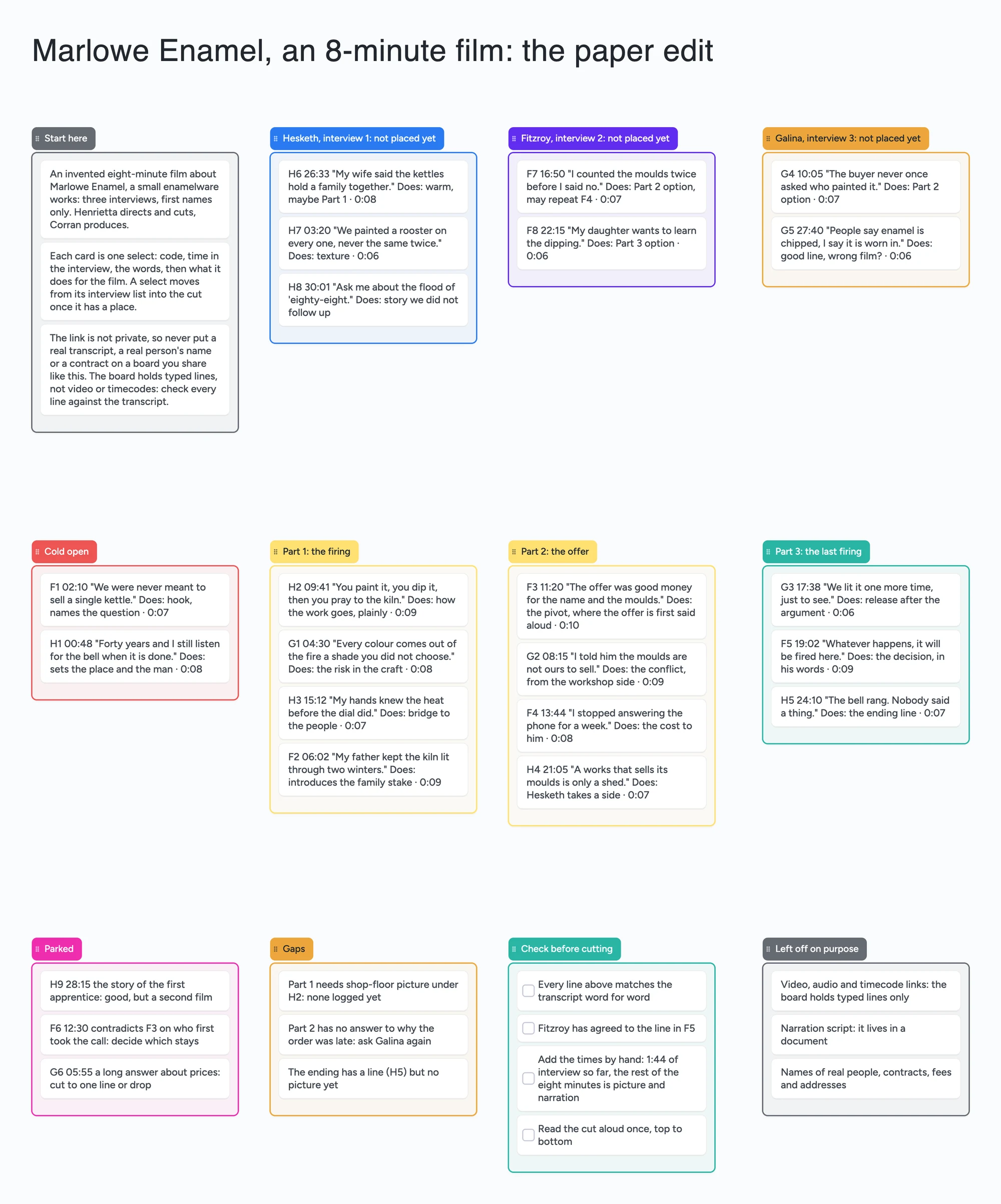
We make Instaboard, an online board. A paper edit is the pass between the interviews and the timeline: you take the lines worth keeping from each transcript and put them in the order the film will use them. The board below is one invented film's: Marlowe Enamel, an eight-minute film about a small enamelware works, with three interviews (Hesketh, Fitzroy and Galina), cut by Henrietta with producer Corran. Lists: Start here; one list of lines not placed yet for each interview; four lists for the cut (Cold open, Part 1: the firing, Part 2: the offer, Part 3: the last firing); then Parked, Gaps, Check before cutting and Left off on purpose. It holds typed lines, not video, and it does not know your footage.
Opens in your browser. Anyone can view; a free sign-in lets you edit.
Updated
Before you put a transcript on it
- Never put a real transcript on a board you share by link. Whoever holds the link can read all of it. The example holds invented first names and made-up lines. Keep real interviewees' names, contracts and fees in your own files.
- The board holds typed lines, not footage. The time on each card is text someone typed. There is no transcript import, no link back to a clip and no way to hand the cut to an editing program: you copy lines across by hand, and you check every line against the transcript.
- It adds up nothing. The 1:44 in the example comes from adding thirteen lengths by hand, and a card on the Check list says to do that.
- Who can change it: a new board is view-only for others until you change the Share setting. For the producer to move cards, pick "Anyone who joins can edit"; they sign in, and the board counts as one of their five free boards. From then on any editor can change any card and tick any box.
- What the free plan allows: five boards, 150 items in total and three pictures on a board. Your copy of this one uses a board slot. Pro lifts the item limit; it is $5 a month billed yearly ($59.99 a year), or $7.99 month to month.
After the interviews, not before the shoot
Storyflow's guide to the method (a vendor's blog; it prints "2026-07-29"; read November 29, 2026) defines a paper edit as "the structure of a film written out in text before any footage is assembled in a timeline". ScriptCut's guide (also a vendor's blog; it prints "June 9, 2026") starts from a transcript: "transcribe with real timecode, read everything once, highlight the strongest lines, arrange them into a story on the page". Both begin once the interviews exist.
That is what separates this board from our documentary outline board, which plans acts, interviews to film and B-roll before the shoot. Here the interviews are done. Each card is a line somebody said, and the work is deciding which lines make the film and where they go.
The Does: line on every card
Storyflow's guide puts its weight on one column: "Function is the one that separates a paper edit from a playlist." It calls "Great quote" "Praise, not function", and its example rows say what a moment does, such as "Sets up the relationship the film is about". The board turns that column into a line on the card.
A card reads: a code, the time in the interview, the words in quotes, then Does: and the job in a few words, then the length. The first letter of the code is the interviewee (H for Hesketh, F for Fitzroy, G for Galina). One card from Part 2: the offer reads F3 11:20 "The offer was good money for the name and the moulds." Does: the pivot, where the offer is first said aloud · 0:10. If you cannot finish the Does: line, the card belongs in Parked, not in the cut.
The same guide says "A paper edit without durations always feels shorter than it is". The thirteen placed selects carry a length each, and by our arithmetic they come to 15 seconds in the cold open, 33 in Part 1, 34 in Part 2 and 22 in Part 3: 1:44 of interview in an eight-minute film, with the rest left to picture and narration.
From three interview lists to four parts of a cut
Every line starts in its interviewee's list, which is titled "not placed yet": three cards for Hesketh, two for Fitzroy, two for Galina. When a line gets a place, the card moves into one of the four cut lists. What stays behind is what the film has not found a use for yet, and the list tells you at a glance whose interview you have used least.
Two more lists catch what the cut leaves out. Parked holds three lines that are good but belong to another film or contradict one already in the cut (F6 is parked because it disagrees with F3 about who took the call first). Gaps holds three notes about picture the cut still needs, for example that Part 1 has no shop-floor picture under H2. In a documentary the visual side is often a second column. One commenter in r/editors (u/hot-dry-noodles, one editor's account, read November 29, 2026) describes it as "a table in Word with 3 columns. One is just numbered rows/scene numbers, the next is visual, and finally interview." On the example board, the Gaps list is where the missing picture is written down.
Moving cards between lists is the whole method, and it is old. In the "What is a paper cut?" thread, u/greenysmac writes "Take each moment or scene and put it on a strip of paper. Rearrange at will." and "I've seen it done with index cards, paper and (ha) in a word processor." In the other r/editors thread we read, u/_mshollygolightly (one commenter, 2019-09-11 UTC) suggests getting interviews transcribed so you can "read through each interview and highlight good segments and then match their timecodes to the timecode in your sequence and pull selects." The board is the shared version of the strips of paper.
A line can read well and play badly
ScriptCut's guide quotes Errol Morris, from a conversation it links at Transom (we did not open Transom): "No, I don't edit from the transcripts, ever. I edit from the film." ScriptCut says he is talking about observational, performance-driven documentary, where tone and behavior matter more than words, and that its own method is stronger for interview-driven work. Its advice is to "watch each selected line against its source clip before trusting it". In the r/editors "paper cut" thread, u/yankeedjw makes a similar point from the editor's chair: "Tone and delivery makes a difference and you don't get that from a paper edit, especially when the client wants to chop up and mash 3 different sentences into one."
A board cannot play a clip, so it cannot do that check for you. The Check before cutting list is where it is written down. Its four tick cards read: every line above matches the transcript word for word; Fitzroy has agreed to the line in F5; add the times by hand; read the cut aloud once, top to bottom. ScriptCut gives the same reason for reading aloud, that it "exposes problems silent reading hides", and calls stitching fragments into a sentence nobody said "a frankenbite", "an ethics problem, not a style choice". The second card is the board's version of that warning: a line is not in the cut until the person who said it has seen how it will be used.
Where other tools beat a board for this job
| What we read on November 29, 2026 | What it does for a paper edit | Our note |
|---|---|---|
| A plain document (Storyflow's guide, a vendor's blog, prints "2026-07-29") | The guide says "A plain document is what most working editors use and is simpler to share for client sign-off" | Sign-off is a job a document does with less setup than a board |
| Premiere's Paper Edit panel (Adobe Help, "Last updated on Sep 9, 2026") | "Select the sentences or parts of sentences you want to keep, then assemble them into a sequence"; the panel shows the selected transcript and the total selected duration, then Preview and Create new sequence | The board makes no sequence and adds nothing up, so Premiere does more once the footage is in it |
| Descript or Premiere text editing (Storyflow names both; ScriptCut describes text-based editing; we did not read Descript's own pages) | Storyflow's guide says they "collapse the paper edit and the assembly into one step" | A board cannot cut video, so for dialogue-led films these do more |
| ScriptCut (a vendor's guide, prints "June 9, 2026") | Its guide says a transcript-based editor "keeps the transcript and the clip welded together, so checking a line is a click instead of a search" | The board has no media, so every check is by hand. We opened no pricing page |
| Index cards on a wall (Storyflow's guide; r/editors "paper cut" thread) | The guide calls them "unbeatable for a group working in one room" and says they do not travel and do not version | The board travels by link but has no version history, so keep a dated copy of each pass |
Swipe the table sideways to see every column.
The board is a shared place to move typed lines and the notes beside them. Everything that touches footage happens elsewhere.
When this board is more than you need
Storyflow's guide lists times to skip the method. One is "When the material is short. Under a few minutes with a small amount of footage, a paper edit is overhead. Assemble it." Another is "A paper edit that has been revised eleven times is procrastination with a respectable name. Two or three passes, then assemble." Both come from a company that sells a card tool, so read them as one maker's rule of thumb. For a short piece, or one cut straight from a single interview, a document is simpler.
The board is worth opening when two people argue the order of lines from several interviews and want to see them side by side. It is a poor fit for comedy or music-led work where, as the same guide puts it, the value is "in timing rather than order".
How far it goes on the free plan, and your own copy
Lists, cards and the title text box each take one of your 150 free items; pen strokes take none, and the example has none. The example takes 49 (12 lists, 36 cards, the title). By our arithmetic, one more interview with 12 selects is a list plus 12 cards, 13 items, so 8 more interviews bring it to 49 + 8 x 13 = 153. A film with 11 interviews outgrows the free plan by itself, and the boards you already have use up part of that 150 first. Pro lifts the item limit.
- Use Make a copy (a copy uses one of the five free board slots), then replace the example's names with your film's.
- Make one list per interviewee and one card per select, with the time, the line and a Does: line. Delete the lists you do not need.
- Share it with the two of you. Choose "Anyone who joins can edit" under Share so the producer can move cards; they sign in first.
- Before anything goes to an editor, tick the check cards and copy the lines across by hand.
Start from the ready board
It opens in your browser in a few seconds, with nothing to install. Sign in for free when you want to save it and share it.
Questions
Can I paste a transcript into the board?
There is no transcript import. You type or copy each select onto its own card, with the time and the line, and the board keeps no link to your video. Because the board link is not private, use it for invented or cleared text only and keep real transcripts in your own files.
Does it play the clip or keep timecode?
No. The time on a card is typed text, and the board has no media, no player and no timecode link. Checking a line against the footage happens in your editing program, which is why the Check before cutting list asks for it.
Can we both move cards at the same time?
Yes. Two signed-in people can move cards at once and see each other's changes within seconds. If both type into the same card the text can merge, so give each person their own cards. A person who only reads needs no sign-in.
Who can see the board?
Whoever has the link can open it and read every card, so the example uses invented first names and made-up lines. Share it with the people cutting the film, and keep real interviewees' names, fees and contracts off it.
How many selects fit on the free plan?
The free plan gives you 150 items in total, one per card and one per list. The example is 49. Another interview with 12 selects adds 13, so 8 more reach 153. That is our arithmetic, and the count is shared with your other boards.
How is this different from the documentary outline board?
The outline board plans a film before the shoot: acts, interviews to film, B-roll and rights. This one starts after the interviews, with the lines people said, and moves them from each interviewee's list into the order of the cut.
Sources
- Storyflow: What Is a Paper Edit? The Complete Guide (2026) (a vendor's blog; prints "2026-07-29"; read in full November 29, 2026)
- ScriptCut: How to Do a Paper Edit, Step by Step (a vendor's blog; prints "June 9, 2026"; read in full November 29, 2026)
- Adobe Help Center: Create a sequence with Paper Edit (prints "Last updated on Sep 9, 2026"; read November 29, 2026)
- r/editors: "First time editing a documentary. I need some workflow advice." (posted 2019-09-11 UTC; the archived copy has 64 comments, 2 deleted, 62 with text, 17 of them the poster's own; our reader returned 13 comments and we read those 13, not the whole thread, November 29, 2026)
- r/editors: "Just a simple question: What is a "paper cut"?" (posted 2021-02-17 UTC; the archived copy has 25 comments, 1 removed, 24 with text, 4 of them the poster's own; our reader returned 13 comments and we read those 13, not the whole thread, November 29, 2026)