For an author and a reader or co-writer planning three connected books
A trilogy outline board: three books, one set of threads
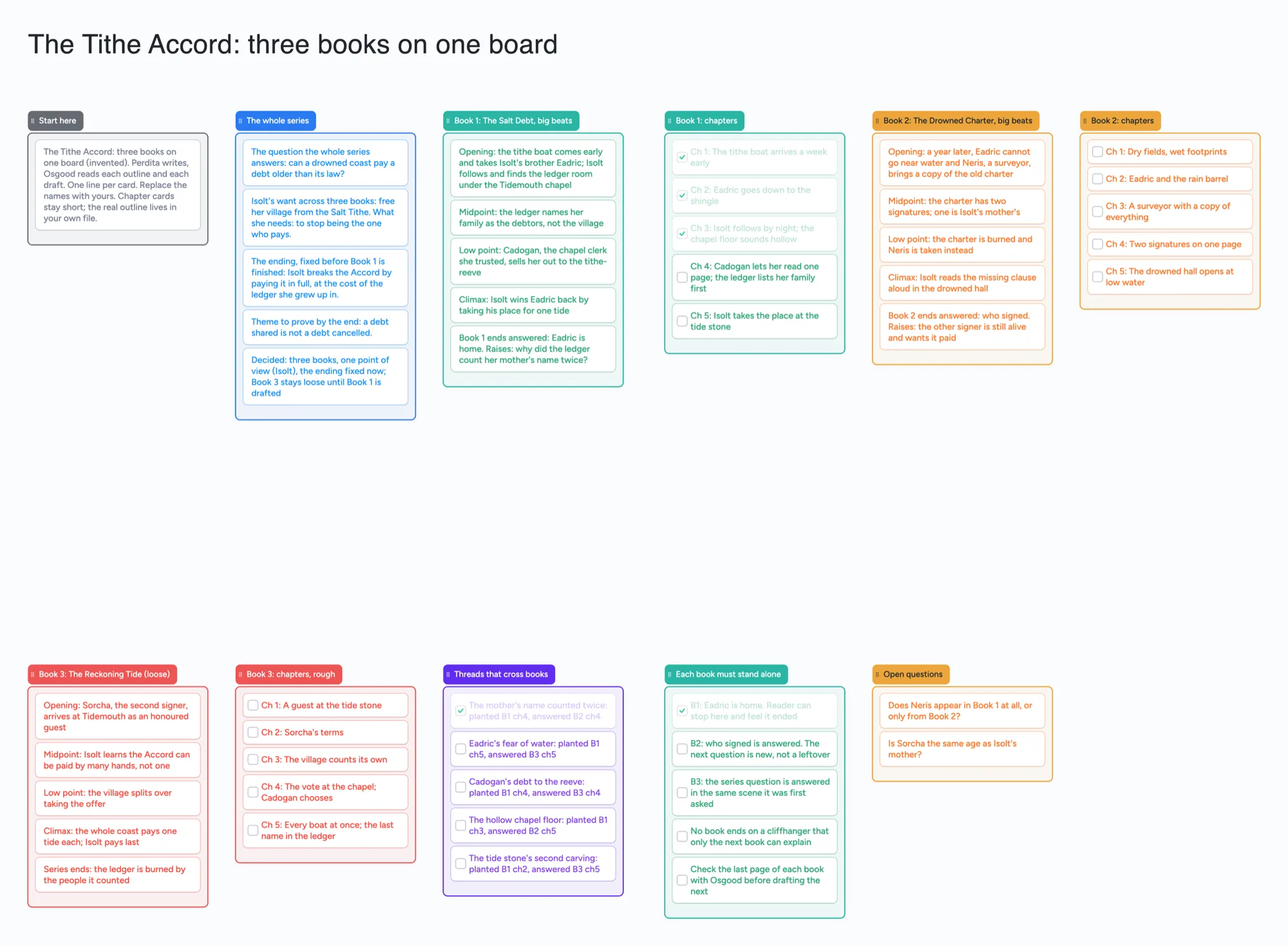
We make Instaboard, an online board. This one plans a trilogy on a single canvas: the question the whole series answers and its ending, big beats and chapter cards for each of three books, a list of threads planted in one book and paid off in another, and a check that every book can end on its own. It is filled in for one invented series, The Tithe Accord, and it plans only; no draft text lives on it.
Opens in your browser. Anyone can view; a free sign-in lets you edit.
Updated
What this board is for, and where it stops
- It plans three books side by side. Each book gets a list of big beats and a list of chapter cards. A longer series just needs more lists.
- Its one special job is threads. A thread is something planted in one book and answered in a later one. They sit in one list so you can see what is still owed.
- It holds outline lines, not manuscript. One line per card. Keep drafts in your writing app and write the file name on a card if you want to point at one.
- No timeline axis, word counts or reminders. Dates and deadlines are words on a card. Nothing alerts anyone.
- Free plan: 5 boards, 150 items in all and 3 pictures per board; copying this board uses 1 board and 60 items.
- Anyone with edit access can tick or untick any card, so agree who does.
How far ahead to plan: what writers say, and what the board does with it
Writers disagree about how much of a series to outline before writing book one. The board does not take a side; it makes either habit visible. Each point below is one person's view as written, from threads we read on November 28, 2026 (counts are Reddit's and the archive's; we read the comments the archive returned).
- r/fantasywriters, “How much in advance do authors plan a fantasy Epos/series of more than 3+ books?” (u/krautpotato, posted 2020-11-22; Reddit shows 29 comments, the archive 30 with 3 by the poster; we read 25). u/peruvianhorse wrote: “You kind of have to plan it out until the end, before writing (or at least before publishing, as you can always rewrite) book 1, because otherwise you'll write yourself into corners.” u/allthebenjamins described a sliding scale from planners to discovery writers.
- r/writing, “If you were planning a large series of books how far ahead should you plan?” (u/KIMBO1133, posted 2022-01-13; Reddit shows 38 comments, the archive 39 with 2 removed and 3 by the poster, 34 render; we read 25). u/Youmeanmoidoid wrote: “Plan your book one at a time. They should be able to stand on their own.” u/R_Ramey_Guerrrero said they outlined a 13-book series in one sitting and then filled in the gaps.
- r/writers, “When writing a series, do you plan all your books at once, or as you get to them?” (u/strawberryshortycake, posted 2021-11-11; Reddit shows 15 comments, the archive 15 with none by the poster; we read 14). u/LadyofToward wrote that each book “needs its own three act structure, but there must also be an overarching plot”; u/Dizzy-Entrepreneur96 leaves some scenes open so later books can be set up.
- Helping Writers Become Authors, “How to Outline a Series of Bestselling Books” (K.M. Weiland; the page shows January 16, 2017). Its answer: “outline the overarching story upfront, but not all the books,” and each book in a series must be “complete unto itself.”
On the board that is two different amounts of work. “The whole series” and the three “big beats” lists are filled early; the chapter lists for a later book can stay thin until the earlier book is drafted. The example does exactly that: Book 3's chapters are labelled rough and its beats are marked loose.
Walking through The Tithe Accord board
The series is invented: a drowned coast that owes a debt older than its law. Perdita writes and Osgood reads each outline and each draft. One line is one card.
| List | What goes in it | In The Tithe Accord |
|---|---|---|
| Start here (grey) | What the board is and isn't | One card |
| The whole series (blue) | The question the series answers, the main character's want and need, the ending, the theme | 5 cards, one of them the decisions; the ending is fixed before Book 1 is finished |
| Book 1 / 2 / 3 big beats (green, orange, red) | Opening, first turn, midpoint, low point, climax, and what the book answers and raises | 5 cards each; Book 3 is marked loose |
| Book 1 / 2 / 3 chapters | One short line per chapter, as a tick box | 5 tick-box cards each, 3 of Book 1's ticked |
| Threads that cross books (purple) | What was planted where and where it is answered | 5 tick-box cards, 1 ticked |
| Each book must stand alone (green) | A check before drafting the next book | 5 tick-box cards, 1 ticked |
| Open questions (orange) | What isn't settled yet | 2 cards |
Swipe the table sideways to see every column.
The board's own wording. Chapter numbers are text on the cards; the board has no chapter order, word count or progress bar.
Threads: the job a series board does that a one-book outline doesn't
In one book a loose end is easy to spot. Across three it hides. Every card in “Threads that cross books” has the same shape: what it is, where it is planted, where it is answered. When the answer is written into a chapter card, tick the thread.
- Write the thread when you plant it, with the planting chapter. “The mother's name counted twice: planted B1 ch4, answered B2 ch4.”
- Write the answer chapter as soon as you know it, even if it is in a book you haven't outlined. An unanswered thread has no second half yet; say so on the card.
- Tick it when the answering chapter card exists, not when the book is drafted. The tick means “planned both ends.”
- Read the unticked cards before each new book. They are what the next outline owes the earlier ones.
The list is only as good as the habit. The board will not notice that a chapter was cut and a thread now points at nothing; when you move or delete a chapter card, search the threads list by eye.
The stand-alone check before each next book
The last list is a short check you run before drafting the next book: Book 1 ends with its own question answered, Book 2 raises a new question rather than leaving an old one open, Book 3 answers the series question in the scene where it was first asked, and no book ends on a cliffhanger only the next book can explain. The wording is the example's, built from the advice in the threads above; your rules may differ.
Ticking a check box means “Osgood and Perdita both agree.” There is no record of who ticked, so say it aloud or write a name in the card.
What the free plan allows for this board
- Items: the example uses 60 of your 150; sections, arrows and pen strokes are free.
- Boards: you can hold 5, and making a copy of this one spends 1.
- Pictures and files: 3 pictures and 1 file (10 MB) per board; the example has neither.
- Sign-in: anyone can read from the link, but to write a person signs in free, and the board becomes 1 of their 5.
- Privacy: a link board is open to whoever has the link, so leave off unfinished chapters and an ending you want held back.
Tools that plan a series with more than a canvas
Read November 28, 2026; features and prices move, so check each page. They suit different people, so this is no ranking. A row repeats what a page says, not our use of the tool, and Instaboard isn't affiliated with any of them.
| Tool | What its page says | Better than a board at | Where a board fits |
|---|---|---|---|
| Plottr | Its series-bible article (published Nov 25, 2024, updated Dec 23, 2024) describes a Project tab to add and organise books, a Series View that maps plotlines across the whole series on a timeline, and saving a book outline as a template to reuse | A real timeline across books, scene cards you can reorder, reusing one book outline for the next | Two people looking at all three books at once on a canvas; no timeline |
| A series bible in a wiki tool such as Kanka | Kanka's pricing page (page shows no date) lists its free plan with no cap on entries or campaigns | Hundreds of linked entries for characters, places and rules; search | The shape of the story, not the encyclopedia behind it |
| A document or spreadsheet | Not read for this page | A long list of every chapter, sorting, a printed copy | Seeing the three books and their threads in one view |
| Your writing app | Not read for this page | The manuscript itself, word counts, drafts | Planning the books before and between drafts |
Swipe the table sideways to see every column.
From the Plottr and Kanka pages named in Sources, as read November 28, 2026. Plottr's price was not read for this page.
Counting to 150 with three books
Every list and every card is one of the 150 free items on your account, and so is the title text box; arrows, sections and pen strokes aren't counted. The sums are our arithmetic.
- The example: 11 lists + 48 cards + the title = 60, with 5 chapter cards in each book.
- 25 chapters a book: 60 - 15 + 75 = 120.
- 35 chapters a book: 60 - 15 + 105 = 150, all 150 before a single new thread card.
- A fourth book: its beats list and chapter list push the total past 150 at 25 chapters a book (52 + 4 × 25 = 152; at 24 it is 148).
- Staying under: keep chapter lines in your writing app and put only the beats on the board, about 42 items for three books (60 - 3 chapter lists - 15 chapter cards).
- Shared with your other boards. Cards a co-writer adds count toward their own 150.
Pro ($5 a month billed yearly, $59.99 a year, or $7.99 monthly) takes the item limit away.
Where a canvas stops short for a series
- Show a timeline. No axis, so “this happens before that” is only the order you place cards.
- Link cards by name. An arrow joins two cards; a card can't point at another by name, and there are no backlinks.
- Notice a broken thread. Delete a chapter and the thread card still points at it.
- Hold your books. The free plan gives 1 file (10 MB) and 3 pictures per board, nowhere near three manuscripts.
- Remind or alert. No reminders or due-date alerts, and a tick doesn't tell anyone.
- Keep a series private. Whoever holds the link reads every card, so unpublished text stays off it and an ending-spoiling line is yours to weigh before you share. Pro has invite-only boards.
Starting your own series board
- Begin with “The whole series”: the question, the want and need, the theme, and the ending, which you fix before anything else.
- Give Book 1 full beats and give Books 2 and 3 only a rough shape.
- Add chapter cards only for the book you are about to draft, one line each.
- Open the threads list with the first thread you plant.
- Send the link to your reader or co-writer. New boards are view-only; to let them write, tick “Anyone who joins can edit” in Share, and each person signs in free.
- Settle who ticks what, and use first names only on the cards.
Start from the ready board
It opens in your browser in a few seconds, with nothing to install. Sign in for free when you want to save it and share it.
Questions
Should I outline all three books before writing the first?
Writers disagree. In the threads read for this page, one commenter said to plan until the end before writing book one, another said to plan one book at a time, and the series-outlining article says to outline the overarching story upfront but not every book. The board works for either: fill the series list and the beats early, and keep later chapter lists thin.
Does this work for a series longer than three books?
Add a beats list and a chapter list per book. A fourth book on this layout passes 150 items at 25 chapters a book by our arithmetic, so a longer series usually keeps chapters in a writing app and puts only beats and threads on the board.
Can I put my chapters on the board?
One-line chapter cards, yes. A whole draft, no: the free plan holds 1 file (10 MB) and 3 pictures per board, and whoever holds the link can read it. Keep drafts in your writing app.
How do I track what a later book still owes an earlier one?
Use the threads list: one card per thread, with where it is planted and where it is answered, ticked when both ends exist. The board does not check that a chapter still exists, so look at the list when you move or delete chapter cards.
Can my co-writer and I edit it at once?
Yes, once you tick “Anyone who joins can edit” in Share and each person signs in free. Edits show up live for everyone with edit access. Nothing records who ticked a card.
How many series fit on the free plan?
150 items across your account, where each card and each list is one item. The example is 60, so a second series on another board brings you to 120 and a third passes 150, by our arithmetic. Your other boards share the same 150.
Sources
- r/fantasywriters: “How much in advance do authors plan a fantasy Epos/series of more than 3+ books?” by u/krautpotato (posted 2020-11-22; Reddit 29, archive 30; 25 read November 28, 2026)
- r/writing: “If you were planning a large series of books how far ahead should you plan?” by u/KIMBO1133 (posted 2022-01-13; Reddit 38, archive 39; 25 read November 28, 2026)
- r/writers: “When writing a series, do you plan all your books at once, or as you get to them?” by u/strawberryshortycake (posted 2021-11-11; Reddit 15, archive 15; 14 read November 28, 2026)
- Helping Writers Become Authors: How to Outline a Series of Bestselling Books, K.M. Weiland (page shows January 16, 2017; read November 28, 2026)
- Plottr: How to Create a Series Bible with Plottr (page shows published Nov 25, 2024 and updated Dec 23, 2024; read November 28, 2026)
- Kanka: plans and pricing (page shows no date; read November 28, 2026)
Related
24-chapter novel outline board: acts, chapters and beats on one shared board
A filled 24-chapter novel outline to open and edit: four act sections, a list per chapter, three beat cards each. Item counts for the free plan stated, and where other tools are better.
A novel beat sheet on one shared board: 15 beats, three acts, scenes under each beat
A 15-beat novel outline to open and edit: 3 act sections, a list per beat, scene cards under each. Free-plan item counts and where other tools are better.
Character relationship map: a filled template two people can edit
A character relationship chart you fill in by hand: a card per character, captioned arrows, shared with a co-writer. No auto-layout or line styles.