For a video essayist with a pile of sources and a claim
A video essay planning board: sources under the points they back, then the order of the video
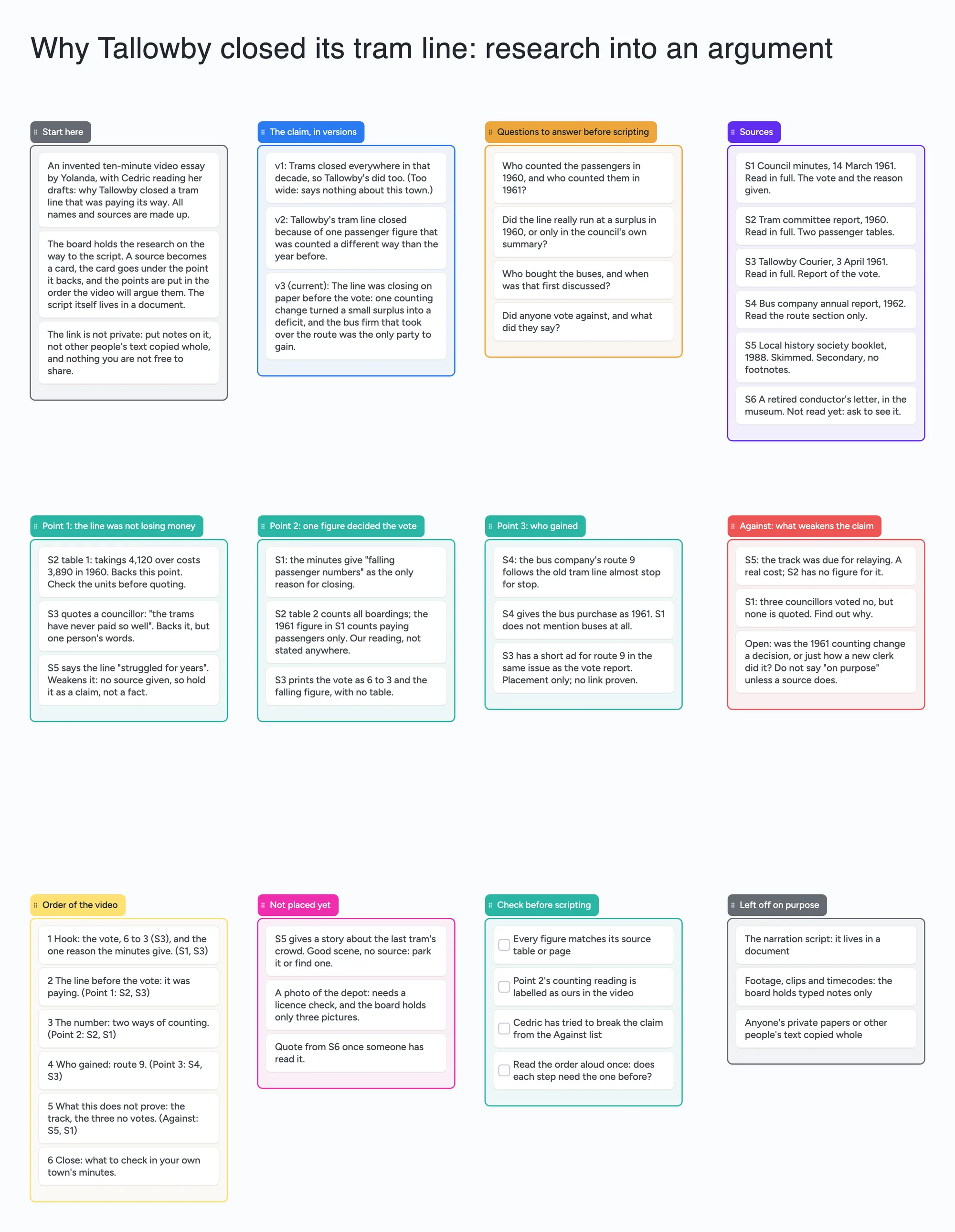
Instaboard is our shared online board (we make it). This page is about the stretch of a video essay before the script: you have read a pile of sources and have a claim, and you need to see which source backs which point, what weakens the claim, and what order the video will argue it in. It is not the script, and it is not a hand-off tracker between a client, a team and a freelancer like our video production planner board. The board below is one invented essay's: Yolanda's ten-minute video on why the town of Tallowby closed a tram line, with her friend Cedric reading her drafts. Lists: Start here; The claim, in versions; Questions to answer before scripting; Sources; three Point lists and an Against list; Order of the video; Not placed yet; Check before scripting; Left off on purpose. It holds typed notes, not footage, and it checks no source.
Opens in your browser. Anyone can view; a free sign-in lets you edit.
Updated
What to know before you use it
- Notes and short quotes, not other people's pages. Anyone who opens the link can read every card, so the example holds an invented essay with invented sources. Put your own notes on yours, with the source named, and leave out text you are not free to share. If you are under 18 (a school video essay, say), check with a parent or your teacher before you put a board link anywhere.
- It checks nothing. A source card is typed text. The board makes no citations, reads no text from a PDF and adds up no figures; the Check before scripting list is where you tick things off by hand.
- Typed notes, not footage. There are no clips or timecodes on the board, and a free board holds three pictures, so the example has none.
- Editing is off by default. A fresh board lets others look but not touch. To have your draft reader add cards, change Share to "Anyone who joins can edit"; they sign in, and the board takes one of their five free slots. Every editor can then rewrite any card or tick any box.
- On the free plan you get five boards, 150 items shared by all of them and three pictures on each board. Your copy of this example is one of the five. Pro takes away the item limit, at $5 a month billed yearly ($59.99 a year) or $7.99 month to month.
The research comes before the script
Macalester's guide (a college digital liberal arts page; it prints no date; read November 29, 2026) says a video essay is "an in-depth analysis that allows you to take advantage of image and sound to present an argument or develop a thesis", and lists "Structure an argument or inquiry" among the things a student learns from making one. StudioBinder's blog (a vendor's blog; its byline prints "June 10, 2024") says "A thesis is a point, claim, theme, or idea that the rest of the essay is designed to support." Both start from a claim.
Some of the people in the Reddit threads we read describe research first. u/Illegalminecraftexe (one commenter, in r/youtubers) writes "the script is the second thing to get done, after the research". u/Aggravating_Creme652 (one commenter's seven steps, in a thread about too much research) says "Step 2: decide on a thesis. This is important because it will dictate your essay flow, main points, and structure." Others work differently: u/BigSpud (r/NewTubers) says "script everything first. Get a full script written so you can understand the structure", and u/JonHiller (r/youtubers) writes that they "often edit and write simultaneously". The board is for the first kind of work: the reading is done, the script is not started.
The claim, written three times
The first list after Start here holds the claim in versions. Version 1 in the example is too wide (trams closed everywhere in that decade, so this town's did too) and says nothing about the town. Version 3 is the current one: one counting change turned a small surplus into a deficit, and the bus firm that took over the route was the only party to gain. Older versions stay on the list, so you can see what you stopped claiming.
u/Thebulfrog (one commenter, r/youtubers) describes the same habit: "It's my opening hypothesis. Then I'll poke and prod at every point to see where I'm right and where I'm not." u/BigSpud (one commenter, r/NewTubers) adds that the angle should be "a question you want to answer". The board's second list is that question, broken into four: who counted, whether the line really ran at a surplus, who bought the buses, and whether anyone voted against.
A source card says what it backs
Sources has six cards, S1 to S6, each with how much of the source was read: three read in full, one read for the route section only, one skimmed, one not read yet. Under the three Point lists, each card starts with a source code and says what that source shows. In Point 1 each also ends with a plain verdict ("Backs this point", "Weakens it", or a note that it is one person's words); in Points 2 and 3 the verdict sits in the wording of the card. One card from Point 2 reads: S2 table 2 counts all boardings; the 1961 figure in S1 counts paying passengers only. Our reading, not stated anywhere.
The Against list is for what weakens the claim: the track was due for relaying, three councillors voted no and none is quoted, and whether the counting change was a decision or a new clerk's habit. The last card says not to write "on purpose" unless a source does. In a video that makes an argument, the Against list is the part a viewer will test first.
The example has six sources and nine evidence cards. u/alonesomestreet (one commenter, in a thread about overwhelming research) suggests "find a thing that you can use 10-20 sources to make the video", and the board is built to hold that many, with room for the claim around them.
The order of the video is a list you can move
Order of the video has six cards: a hook, three points, what the video does not prove, and a close. Each names the point and the source codes behind it, for example "3 The number: two ways of counting. (Point 2: S2, S1)". Move a card and the order changes; the codes tell you which sources to look at again. u/cam48483 (one commenter, r/youtubers) says "I try to come up with the conclusion to my essay first, then the hook and the body of the essay last. You don't have to write linearly." A list of cards lets you build the order in that way too.
Macalester's guide suggests "placing your script (or outline) alongside visual and auditory elements will help you think through transitions, gather the appropriate materials, and strengthen the rhetoric of your images and sound." The board does the outline half of that and nothing with images. u/Pompous_Frenchman (one commenter, r/NewTubers) advises "really plan what your video will look like alongside your script" and says they read the script aloud as they write to judge its length. The last tick card on the board asks something different: read the order aloud and see whether each step needs the one before.
Not placed yet holds what has no home: a good scene with no source, a photo that needs a licence check, and a quote from the source nobody has read. The script comes after, in a document.
Where other tools do more
| What we read on November 29, 2026 | What the commenter says it does for this job | Our note |
|---|---|---|
| Google Docs (u/DrDoktir in r/youtubers, one commenter) | "clipped quotes and smashed them into a google doc. Then I recorded and would check myself during edit." | A document holds long quotes and the script together; the board is for the sorting, not the writing |
| Scrivener (u/angelofmusic997 in r/youtubers; we did not open Scrivener's pages) | Research "segmented into the sources I am quoting from/the section of the video that is covered"; the same commenter says Firefox sub-folders for video research "quickly make subfolders unwieldy and hard to parse" | A writing program does more once a single source is long. The board is for the short notes that say what a source backs |
| Zotero (u/Aggravating_Creme652 in r/youtubers; we did not open Zotero's pages) | Described as "an ereader, an annotator, and a bibliography tool all in one" | The board makes no citations and reads no text from a PDF, so a reference manager does more for the source list |
| Miro (u/CuriousMindLab in r/youtubers; we did not open Miro's pages) | "create mind maps using a whiteboard tool like Miro", clustering sticky notes "into themes and sub-themes using different color stickies" | The same idea. This board is one filled example of it, with a list per point and a numbered order |
| Obsidian (u/Nickolas1279 in r/youtubers; we did not open Obsidian's pages) | "Obsidian is a great tool for research layout." | We cannot say more than the commenter did; linked notes may suit a large pile of reading better than one board |
Swipe the table sideways to see every column.
The board is a shared place to group short notes under points and put the points in order. Anything that reads, cites or edits happens elsewhere.
When a document is enough
A video built on one source, or one with a single clear point, does not need this. u/fleureo (one commenter, r/youtubers) keeps it small: "Just pick an argument you are trying to prove, simplify it, and minimize the research." A list of notes in a document is quicker to set up than a board.
The board earns its place when two people disagree about which point a source backs, or about the order the points come in, and want to see the pile in one view. It does not write, check or schedule anything.
Fitting a real pile of sources, and making your copy
Every list, every card and the title text box counts as one of your 150 free items, and the example uses 57. Our arithmetic for a bigger project: the example's 44 cards are 6 source cards, 9 evidence cards and 29 others (claim versions, questions, the Against list, the order, checks and notes). Give a project of 30 sources one card each and two evidence cards each and the count is 30 + 60 = 90 cards, plus the 29 others, 12 lists and the title: 90 + 29 + 13 = 132 of 150. At 40 sources it is 120 + 29 + 13 = 162, past the limit, and your other boards draw on the same 150. Pro lifts the item limit.
- Choose Make a copy (it takes one of your five free boards), then swap the names and topic for yours.
- Write your claim as one sentence in the claim list, and add a new card each time it changes instead of editing the old one.
- Add a card per source with how much of it you read, then a card per fact under the point it backs, with the source code first.
- Invite your draft reader. In Share, choose "Anyone who joins can edit" and send the link; they sign in before they can type.
- Before you script, tick the check cards and read the order aloud once.
Start from the ready board
It opens in your browser in a few seconds, with nothing to install. Sign in for free when you want to save it and share it.
Questions
Is there a script template?
No. This board is for the research before the script: the claim, the sources, the points and their order. The script itself belongs in a document, such as Google Docs, Notion or Word; the board does not format a script or count its words. The Order of the video list tells you what each stretch of the script has to carry.
Can I paste articles or PDFs onto it?
Write short notes and quotes, each with its source code. The board is not a PDF library: a free board holds one file of up to 10 MB and three pictures. The link is not private, so do not paste a whole article or text you are not free to share.
Does it keep track of which sources I have read?
Only as typed text. A card in the Sources list says how much you read, and nothing on the board checks it. The Check before scripting list is where you tick each figure against its source by hand.
Can my co-writer and I edit at the same time?
Yes, once the Share setting lets joiners edit and each of you has signed in. Each of you then sees the other's changes within a few seconds. Someone who only reads the board needs no sign-in.
How many sources fit on the free plan?
The free plan counts 150 items in all: each card, each list and the title. The example uses 57. By our arithmetic a project with 30 sources and three cards per source, plus the example's other 29 cards, 12 lists and the title, reaches 132; at 40 sources it is 162. Your other boards count against the same 150.
How is this different from the video production planner board?
That board follows who is waiting on whom between a client, a team and a freelancer on a video job. This one starts earlier, with one person's reading, and groups sources under the points of an argument. The example has no owners or hand-offs.
Sources
- Macalester College, Digital Liberal Arts: Video Essays 101 (the page prints no date; read in full November 29, 2026)
- StudioBinder: What is a Video Essay? The Art of the Video Analysis (with Examples) (a vendor's blog; byline prints "June 10, 2024"; read in full November 29, 2026)
- r/youtubers: "People who make video essays, how do you manage to create your video scripts?" (posted 2022-12-26 UTC; the archived copy has 20 comments, 1 removed, 19 with text, 2 of them the poster's own; Reddit showed 19 when we looked, our reader returned 10; we read all 19 from the archive, November 29, 2026)
- r/youtubers: "How do you handle overwhelming amounts of research for your YouTube channel?" (posted 2025-03-08 UTC; the archived copy has 55 comments, 14 removed, 41 with text, 5 of them the poster's own; Reddit showed 54, our reader returned 23; we read the 41 with text from the archive, the longest cut at about 2,200 characters, November 29, 2026)
- r/NewTubers: "How do you make 8-10+ minute commentary/video essay videos?" (posted 2022-10-19 UTC; the archived copy has 69 comments, 2 removed, 67 with text, 10 of them the poster's own; Reddit showed 69, our reader returned 26; we read the 67 with text from the archive, the longest cut at about 900 characters, November 29, 2026)