For a game master running a mystery, or a writer working one out
Detective board online: a shared case wall for one mystery
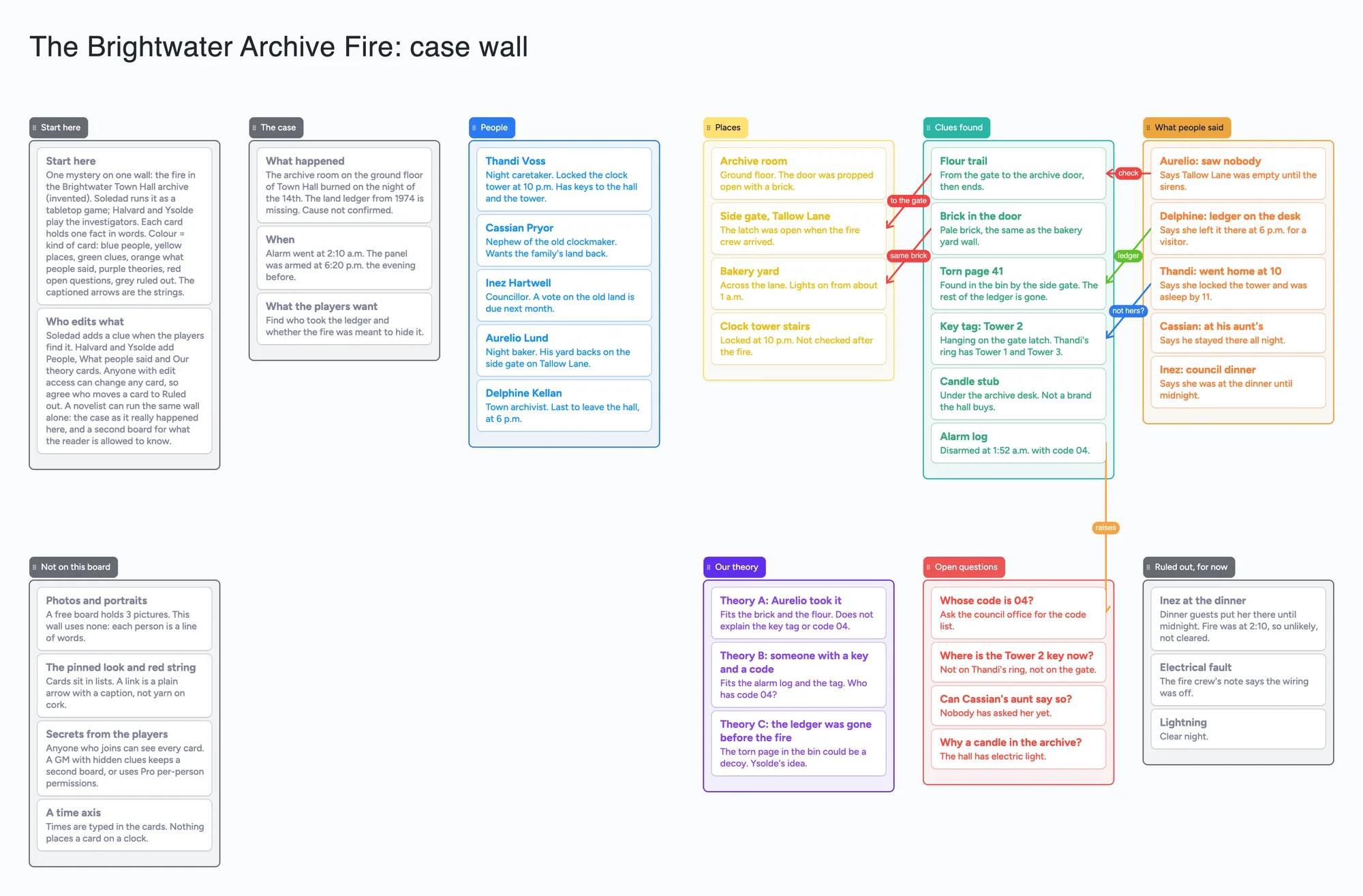
We make Instaboard, and on it a detective board is a shared wall of text cards. This page hands you one already filled in for an invented tabletop mystery, the Brightwater Archive Fire, run by a game master, Soledad, for two players, Halvard and Ysolde. People who search for a detective board usually picture photos pinned to cork with red string. This board has neither: a board holds 3 pictures, so the example is text cards joined by arrows with captions.
Opens in your browser. Anyone can view; a free sign-in lets you edit.
Updated
The pinned look and photos come first: what this wall does instead
- First, what you will not get: photos and the cork-and-red-string look. People who ask for an online detective board often want exactly that, and a free Instaboard board holds 3 pictures. The example uses none: each person, place and clue is a card of words, and a string is an arrow with a caption.
- What it is: one mystery on one wall. Lists for the case, people, places, clues found, what people said, theories, open questions and what is ruled out, with six captioned arrows between them. The example uses 50 of your 150 free items.
- What it isn't: not a photo board, not a timeline and not a place to hide clues from players. Times are typed into cards, and anyone who joins can see every card.
- Who it suits: a game master and players, or a writer working out what really happened in a mystery. The example is invented, and we would keep real people's names off any board shared by link.
- Free plan: 5 boards, 150 items, 3 pictures per board. Copying the board takes 1 of your 5 boards. Writing on it needs a free sign-in. Pro removes the 150-item limit and adds invite-only boards and per-person permissions (price in the last question).
What game masters asked for in five threads
We read five threads where a game master asks for an online detective board, in r/rpg, r/DMAcademy and r/FoundryVTT. Each is one person's question and each reply is one account's view. Dates are UTC. Each entry gives the count Reddit showed and the count in an archived copy:
- r/rpg, "Any good resource for an online corkboard to make a \"Wall of Crazy\" Evidence Board?" (u/Directioneer, 2021-10-13; Reddit showed 12; the archived copy has 12): the poster runs a game where the players are the city guard working a mystery and wants one "that looks like a cork board and has red twine". u/Alistair49 suggested Miro, u/machinekng13 said Padlet "has the corkboard look, but doesn't have red twine connectors", u/theicewalker used Google Drawings, and u/JaskoGomad wrote "There isn't a good one as far as I know."
- r/rpg, "Online shareable \"conspiracy cork board\"?" (u/i_tyrant, 2020-04-12; Reddit showed 11; the archived copy has 12, one of them deleted): a game master running a "fantasy police procedural" who wanted something "with a bit of charm" where the yarn can be drawn between pins and notes with "text, images". The poster later wrote that they used Google Jamboard, "a black board with colored sticky notes", with a secret copy for the game master and a shared copy for the players. u/Never_Poe suggested Roll20, and the poster replied that there "Players can't add images".
- r/rpg, "Anyone know a way to do an evidence board for a remotely played rpg?" (u/MoistBrain, 2021-07-26; Reddit showed 11; the archived copy has 11): a missing-person campaign, wanting a board "editable by all the players". u/Cat_Or_Bat suggested Google Jamboard and the poster answered that a corkboard picture as the background "gives it a real evidence board feel". u/sofinho1980 suggested Miro and added a warning about a friend's billing problem after cancelling (one report we could not check); u/octobod used Miro's free version for about a year and wrote "3 boards was more than enough for my game".
- r/DMAcademy, "Is there a good free \"conspiracy board\" tool?" (u/Karutala, 2022-03-27; Reddit showed 9; the archived copy has 9): the poster wanted objects such as "Villain A" with a line between two of them and a note on it like "C provides weapons to A's gang". Replies named draw.io (u/BongoQueeny: "a little bit of a learning curve, and a little clunky"), Google Jamboard, Miro's free account, Obsidian and Diagrams.net.
- r/FoundryVTT, "How good is Foundry for creating an evidence board?" (u/CameOutAndFarted, 2025-06-30; Reddit showed 14; the archived copy has 15, one of them AutoModerator): the poster wanted an evidence board "with photos, drawings". u/Cergorach wrote it can be done but "it'll take some work", u/GrantAdoudel said a sticky-note module "didn't work that well", u/protoctopus wrote "Alt tab to miro.com", and u/spriggan02 said Foundry would be "clunkier than a miro board".
Our reading, from these five threads only: all five posters are game masters, and none is a writer planning a novel. Three asked for the pinned look or pictures (the first, second and fifth); the third asked for a visual aid every player can edit, and the fourth for lines and notes between objects. Miro was suggested in four of the five and Google Jamboard in four. Four of the threads date from 2020 to 2022. Nobody names Instaboard.
How one case runs on the wall
Soledad runs the Brightwater Archive Fire for Halvard and Ysolde: the ledger from 1974 is missing from the burned town hall archive, and the players have to say who took it. Each list holds one kind of card:
- The case, People, Places: the case list holds what happened, when, and what the players want. People and places get one card each, with one line on why they matter.
- Clues found and What people said: a clue is added when the players find it. A statement is its own card in a separate list, so a claim never sits where a fact should and the two can be set against each other.
- The links: six arrows with captions between cards in different lists. The flour trail points to the side gate ("to the gate"); the brick in the door to the bakery yard ("same brick"); Aurelio's "saw nobody" card to the flour trail ("check"); Delphine's ledger statement to the torn page ("ledger"); Thandi's statement to the key tag ("not hers?"); and the alarm log to the open question "Whose code is 04?" ("raises").
- Theories and open questions: three theories, each saying in its text which clues it fits and which it does not, and four open questions. No arrow joins a theory to a clue; the card text names them.
- Ruled out, for now: what is cleared so far, with the reason. Inez was at a dinner until midnight and the fire was at 2:10, so her card says unlikely, not cleared.
- Colour: blue people, yellow places, green clues, orange statements, purple theories, red questions, grey the rest. It is a convention the Start here card explains; the board does not enforce it.
Photos, string and secrets: what to do instead
The people in the threads above wanted a cork look and photos. This board is lists of text cards, so each of these is a limit and a workaround:
- Photos: a board holds 3 pictures. Use them for the scenes that matter most, such as a map or the building, and put the rest in the card text. For a wall of portraits, use a tool built for it (next section).
- String: a link here is an arrow from one card to another, with a caption and its own colour. It stays attached when a card is moved or a list is moved. It is not drawn as yarn on cork.
- Secrets: anyone with the link sees every card. A game master with hidden clues can keep a second board for themselves, which is what the second poster above did with a secret copy and a shared copy. Pro adds per-person permissions; we have not tested them for hiding a single card.
- Time: times are typed into the cards (the alarm log says 1:52 a.m., the alarm went at 2:10). Nothing places a card on a clock.
Tools that fit a photo wall, a diagram or a story better
Read on November 25, 2026; plans and pages change, so check the page.
| Tool | What the page says | Better for |
|---|---|---|
| detectiveboard.io (home and crime-board pages) | "Pin notes, photos and articles to a corkboard, connect the clues with red string, and share the case as a public board. Free to start and works in the browser." The home page says "No account needed to begin" and lists more than 1,000 public boards; the crime-board page says boards are private until you publish them and you can invite collaborators. Its steps give each person a card with "a photo or portrait". We saw no price or plan limits on either page | The look and the photos: cork, red string, pinned articles, a gallery of public boards |
| Creately (evidence board maker and plans pages) | Says its evidence board layout organizes "documents, images, audio, and video", with real-time collaboration, version control, embedding and access control. The plans page shows Free at $0 with "Up to 45 shapes per diagram" and Pro at $8 per editor a month billed monthly (the page also shows $5 a month billed annually), with unlimited shapes and diagrams and private links. The questions on the evidence page were collapsed, so we did not read them | Evidence with images, audio and video, version history, and a general diagramming canvas |
| Miro (pricing page) | Free is $0 with 3 editable boards ("Create and share unlimited boards. Three most recent ones will remain editable"). Starter is $8 per member a month billed yearly ($10 billed monthly), with unlimited boards and "Visitor editing" so others can edit a shared board with no sign-in. We read nothing there about evidence boards | Pictures and files on the board, visitors editing without a sign-in on a paid plan, and the tool four of the five threads suggested |
| A real corkboard and string | In the threads: u/Garqu answered the "conspiracy board" question with "an actual cork board, index cards and coloured string", and u/pkcs11 and a partner use "3 corkboards and twine" for mystery games | The look, in a room, with everyone at one table |
| Instaboard board | 5 boards, 150 items, 3 pictures per board on the free plan; lists of text cards with captioned arrows; anyone with the link can read | One case a game master and players, or two writers, can open and rearrange with nothing to install, with facts, statements and theories kept in separate lists |
Swipe the table sideways to see every column.
Pages read November 25, 2026: detectiveboard.io, creately.com and miro.com (links in Sources). Our wording, not theirs. The threads also name Padlet, Jamboard, draw.io, Roll20 and Foundry, which we did not read.
Writing a mystery: two walls, one crime
detectiveboard.io's own guide says writers "plot a murder mystery from both sides: the truth of what happened, and the trail of clues the reader is allowed to see. Two boards, one crime." Its tips add: "For fiction, keep a second board for what the reader knows, and compare the two." On Instaboard that is two copies of this wall.
- Wall one is the truth: the case list says what really happened, the clues list holds everything that exists, and What people said holds each person's account, true or not.
- Wall two is the reader's: keep only the clues the reader has met and the statements they have heard, and compare the walls to see which clue the reader has no way to find.
- Alibis against clues: set a statement beside a clue with an arrow, as the example does with Delphine's ledger line and the torn page. The board does not check whether your plot holds together; you do.
How many cards a case takes on the free plan
Each card and each list is 1 of your 150 free items, across all your boards. The title text box counts too. Arrows, sections and pen strokes don't. Our arithmetic from the example:
- As built: 10 lists + 39 cards + 1 title = 50. The 39 cards are 30 case cards (5 people, 4 places, 6 clues, 5 statements, 3 theories, 4 questions, 3 ruled out) and 9 note cards (Start here and Who edits what, the three case cards, and four on what is not on the board).
- A case with 100 cards in the same 10 lists and a title: 100 + 10 + 1 = 111.
- Two such walls, the truth and what the reader knows: 2 x 111 = 222, over 150, and 2 of your 5 boards. Two copies of the example: 2 x 50 = 100.
- With Pro, the 150-item limit is removed.
Start from the ready board
It opens in your browser in a few seconds, with nothing to install. Sign in for free when you want to save it and share it.
Questions
What is a detective board online?
A shared board where the people, places, clues and statements of a mystery sit as cards and the links between them are lines. This one is filled in for an invented case and uses text cards and captioned arrows, not photos and string.
Can I pin photos and use red string?
Not in the cork-and-yarn sense. A board holds 3 pictures, and a link is an arrow with a caption and a colour. Tools built for the pinned look, such as detectiveboard.io, are a better fit if the look and the photos matter most.
Can I hide clues from my players?
Not on one shared board: anyone with the link sees every card. Keep a second board for your own notes, or look at Pro's per-person permissions, which we have not tested for hiding a single card.
Can I use it to plan a mystery novel?
Yes, as a place to keep what happened and what each person says. Keep one wall for the truth and a second for what the reader has seen, as the section above describes. It does not check your plot or hold a manuscript.
How many cards fit on the free plan?
The example is 50 of your 150 free items. A case with 100 cards in the same 10 lists and a title is 111, and two such walls would be 222, over the limit. Pro removes the limit.
Is Instaboard free?
There is a free plan: 5 boards, 150 cards and items across your account (pen strokes, arrows and sections don't count), and 3 pictures and 1 file per board. Anyone with the link can read a board; writing on it takes a free sign-in. Pro removes the item limit and adds invite-only boards: $5 a month billed yearly ($59.99 a year), or $7.99 monthly.
Sources
- r/rpg: Any good resource for an online corkboard to make a "Wall of Crazy" Evidence Board? (OP u/Directioneer, 2021-10-13 UTC; replies are single accounts; Reddit showed 12; archived copy 12, read November 25, 2026)
- r/rpg: Online shareable "conspiracy cork board"? (OP u/i_tyrant, 2020-04-12 UTC; Reddit showed 11; archived copy 12 with 1 deleted, read November 25, 2026)
- r/rpg: Anyone know a way to do an evidence board for a remotely played rpg? (OP u/MoistBrain, 2021-07-26 UTC; Reddit showed 11; archived copy 11, read November 25, 2026)
- r/DMAcademy: Is there a good free "conspiracy board" tool? (OP u/Karutala, 2022-03-27 UTC; Reddit showed 9; archived copy 9, read November 25, 2026)
- r/FoundryVTT: How good is Foundry for creating an evidence board? (OP u/CameOutAndFarted, 2025-06-30 UTC; Reddit showed 14; archived copy 15 with AutoModerator, read November 25, 2026)
- Detective Board: home page (read November 25, 2026)
- Detective Board: Crime Board Maker (read November 25, 2026)
- Creately: Free Evidence Board Maker (read November 25, 2026)
- Creately: Plans and Pricing (read November 25, 2026)
- Miro: Pricing (read November 25, 2026)