Biology · Kidney
RAAS for the MCAT: renin, angiotensin, aldosterone step by step
When your blood pressure drops, the fix starts in your kidney, then it needs your liver, your lungs and your adrenal glands. The video follows that four-organ chain step by step while the notes build live on a board. The notes below add the exam terms the video leaves out, and the board is yours to copy.
By Boardling, from the Instaboard teamLesson 015 · 2:20 videoUpdated
RAAS in 30 seconds
- When blood pressure or blood volume drops, special cells in the kidney (the juxtaglomerular cells) release the enzyme renin into the blood.
- Renin turns angiotensinogen, a protein the liver makes, into angiotensin I. In the lungs, ACE (angiotensin-converting enzyme) turns angiotensin I into angiotensin II.
- Angiotensin II narrows small blood vessels (vasoconstriction), signals the adrenal cortex to release aldosterone, triggers thirst, and also releases ADH.
- Aldosterone makes the kidneys take more sodium back into the blood, and water follows sodium. More blood volume plus narrower vessels = higher blood pressure.
The notes board from the lesson
This is the board built during the video. Copy it and it's yours: add your own cards, rearrange it, draw on it.
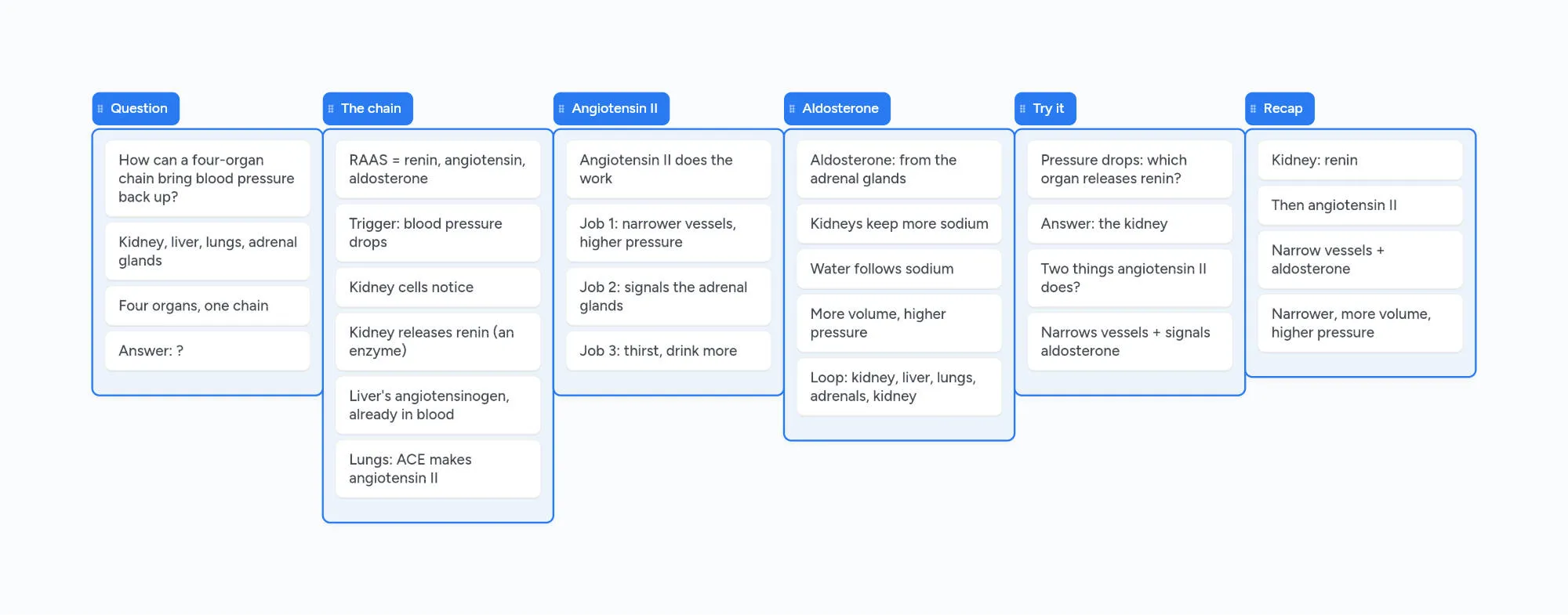
Four organs, one chain
In the video at 0:00
A drop in blood pressure is fixed by a chain that runs through four organs: the kidney, the liver, the lungs and the adrenal glands. Following the chain one step at a time shows why each organ is needed and how the pressure comes back up.
The trigger: the kidney releases renin
In the video at 0:21
The chain starts in the kidney. Specialized cells in the wall of the afferent arteriole, the juxtaglomerular (JG) cells, respond to decreased blood pressure by secreting renin into the blood. Low blood volume triggers it too. How these cells and their neighbours (the macula densa) sense the change is covered in the juxtaglomerular apparatus lesson.
Renin is an enzyme: a protein that speeds up a reaction. Some sources call it a hormone because of its role in this pathway, but it works by cutting another protein.
Liver and lungs: angiotensin I to angiotensin II
In the video at 0:35
The liver makes angiotensinogen, a plasma protein that is always in the blood. Renin cuts a few amino acids off it to make angiotensin I, which is not yet active.
Angiotensin I circulates to the lungs, where angiotensin-converting enzyme (ACE) turns it into angiotensin II, the active hormone. Textbooks mention that ACE inhibitors, a class of blood pressure drugs, work by blocking this step.
What angiotensin II does
In the video at 0:50
Angiotensin II is a powerful vasoconstrictor: it makes the arterioles narrower, which raises blood pressure quickly. That is job one in the video.
Job two: it signals the adrenal cortex (the outer layer of the adrenal glands, the zona glomerulosa) to release aldosterone. Job three: it acts on the thirst center in the hypothalamus, so you drink more, which adds to blood volume.
Exam extras the video leaves out: angiotensin II also makes the kidney tubules reabsorb more NaCl and water directly, increases the desire for salt, and stimulates the release of ADH (antidiuretic hormone) from the posterior pituitary, which makes the kidneys keep more water.
Aldosterone: keep sodium, keep water
In the video at 1:00
Aldosterone goes to the kidneys and increases the reabsorption of sodium into the blood (in the distal tubule and collecting duct). Water follows sodium, so more water is kept too. More water in the blood means more blood volume, and more volume means higher pressure.
Aldosterone also makes the kidneys excrete more potassium, and a high blood potassium level triggers aldosterone release on its own, without the rest of the chain.
Back to the question
In the video at 1:50
When blood pressure drops, the kidney releases renin, renin starts a chain that ends with angiotensin II, and angiotensin II narrows the vessels and signals aldosterone, so the kidneys keep sodium and water. Narrower vessels plus more volume give higher blood pressure.
The opposite signal comes from the heart: when blood volume is high, the atria release atrial natriuretic hormone, which suppresses renin, aldosterone and ADH so the kidneys lose sodium and water.
Practice question
A drug blocks ACE. What happens to angiotensin I, angiotensin II and aldosterone?
Show the answer
Angiotensin I builds up, angiotensin II falls, and aldosterone falls. ACE is the step that turns angiotensin I into angiotensin II, so angiotensin I can't be converted. With less angiotensin II, the adrenal cortex gets less signal to release aldosterone, and blood pressure goes down.
Common mix-ups
Renin is made by the liver.
Renin comes from JG cells in the kidney. The liver makes angiotensinogen, the protein renin acts on.
ACE turns angiotensinogen into angiotensin I.
Renin turns angiotensinogen into angiotensin I. ACE, mainly in the lungs, turns angiotensin I into angiotensin II.
Aldosterone makes the kidneys get rid of more sodium.
Aldosterone makes the kidneys keep more sodium (and water follows); it is potassium that it makes them excrete.
How this lesson was made
Boardling lessons are made by the Instaboard team. The narration is a synthetic (text-to-speech) voice, and the script and these notes were written with AI help, then checked against the sources listed below (last checked November 11, 2026). The notes board is built live in Instaboard during the video. Spotted a mistake? Tell us and we'll fix it.
Put this lesson in your notes
The board opens in your browser in a few seconds. Add your lecture notes, photos of your handwritten pages and your own questions next to it. Sign in for free to keep it.
Questions
What are the steps of the renin-angiotensin-aldosterone system?
Low blood pressure → JG cells in the kidney release renin → renin turns angiotensinogen (from the liver) into angiotensin I → ACE in the lungs turns it into angiotensin II → angiotensin II narrows vessels, releases aldosterone and ADH and triggers thirst → aldosterone makes the kidneys keep sodium and water → blood pressure rises.
Where is angiotensin I converted to angiotensin II?
Mainly in the lungs, by angiotensin-converting enzyme (ACE).
Where is aldosterone made?
In the adrenal cortex, in its outer layer (the zona glomerulosa).
What triggers aldosterone release besides angiotensin II?
A high level of potassium in the blood, a low level of sodium, and low blood pressure or volume. ACTH from the pituitary also plays a part.
Exam fit
- MCAT biology
- A&P
- AP Biology
Sources
- OpenStax Anatomy & Physiology 2e, 20.4 Homeostatic Regulation of the Vascular System: renin, angiotensinogen, ACE, angiotensin II, aldosterone, thirst, ADH, ANH (checked November 11, 2026)
- OpenStax Anatomy & Physiology 2e, 17.6 The Adrenal Glands: aldosterone triggers and effects, the functions of angiotensin II, ACE inhibitors (checked November 11, 2026)
- OpenStax Anatomy & Physiology 2e, 25.4 Microscopic Anatomy of the Kidney: JG cells, macula densa, renin (checked November 11, 2026)