Biology · Immune system
B cells and T cells: who does what in the immune response
How does your body stop a virus that hides inside your own cells, where antibodies can't see it? The video follows one virus and builds the board live: the killer T cell, the B cell and plasma cell, the helper T cell and memory cells. The notes below add the textbook terms, and the board is yours to copy.
By Boardling, from the Instaboard teamLesson 011 · 2:37 videoUpdated
B cells and T cells in 30 seconds
- Killer T cells (textbook name: cytotoxic T cells) find cells infected by a virus and make them destroy themselves (apoptosis). Antibodies can't reach a virus while it is inside a cell.
- B cells handle germs outside your cells. A B cell that meets its antigen turns into a plasma cell, which pours out antibodies with the same binding shape as its receptor.
- Helper T cells kill nothing. They send chemical signals called cytokines, and for most antigens B cells need that go-ahead to make antibodies.
- Memory cells stay behind after the first fight, so the next time the same germ shows up the response is faster and stronger.
The notes board from the lesson
This is the board built during the video. Copy it and it's yours: add your own cards, rearrange it, draw on it.
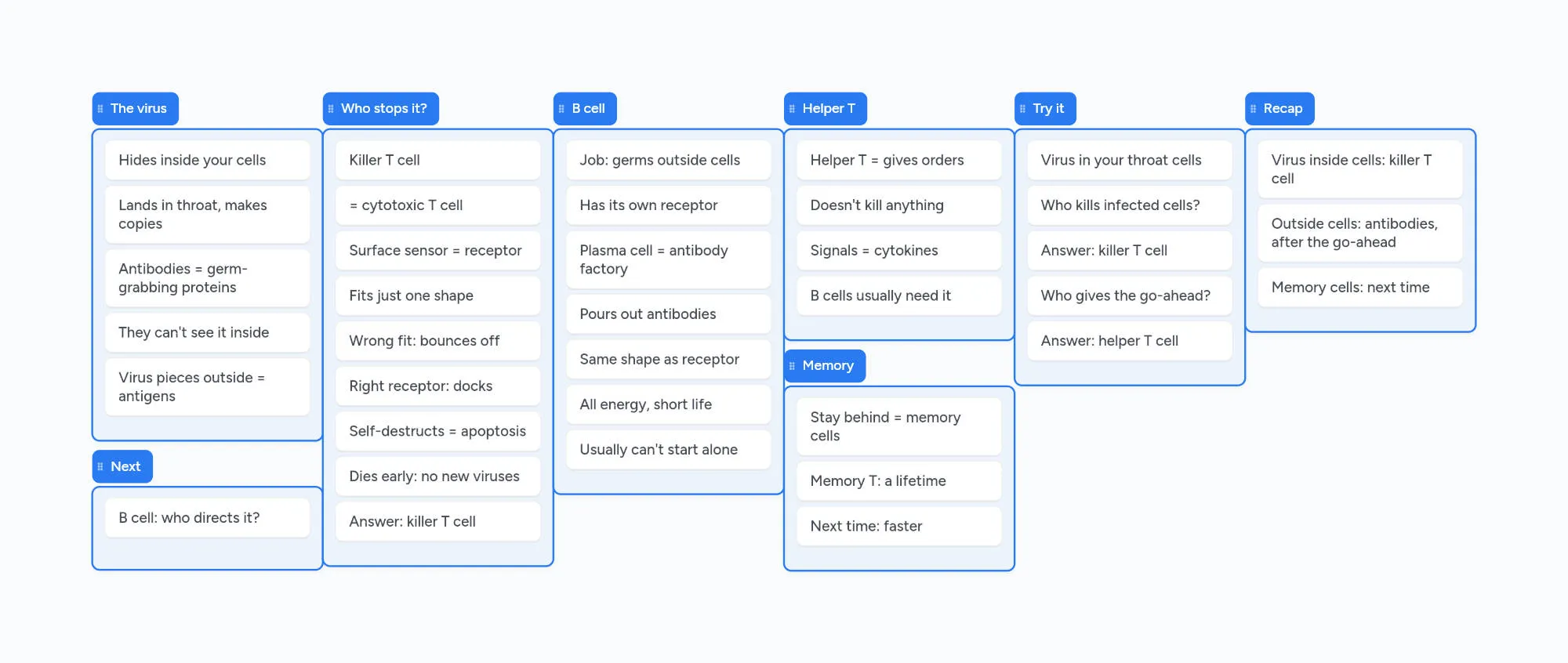
A virus hiding inside your cells
In the video at 0:00
A virus lands in your throat, gets inside a cell and starts making copies of itself. Antibodies, the proteins that grab germs in your blood and tissue fluid, can't detect it while it is inside the cell. So something else has to deal with the infected cell itself.
The killer T cell and its receptor
In the video at 0:17
That job belongs to the killer T cell; your textbook calls it the cytotoxic T cell. Each T cell has a sensor on its surface, its receptor, and each receptor fits just one shape.
An infected cell shows small pieces of the virus on its outside. Those pieces are antigens. A T cell whose receptor doesn't fit moves on; one whose receptor fits docks and makes the infected cell destroy itself. That planned self-destruction is apoptosis. If the cell dies before the virus finishes copying, no new virus particles get out.
Extra terms for the exam: cytotoxic T cells carry the marker CD8, and they trigger apoptosis using proteins called perforins and granzymes. One cytotoxic T cell can kill more than one target.
B cells and plasma cells
In the video at 0:56
Germs floating outside your cells are the B cell's job. A B cell is a white blood cell with its own receptor. When that receptor meets its antigen, the B cell can turn into a plasma cell, an antibody factory. Its antibodies are essentially a released form of the B cell's receptor, so they grab the exact same shape.
Plasma cells are short-lived, because nearly all of their energy goes into making antibody. How one B cell becomes many is covered in the lesson on clonal selection, and how antibodies tag germs for eating is in the lesson on opsonization.
The helper T cell gives the go-ahead
In the video at 1:20
A B cell usually can't start on its own. The helper T cell gives the orders. It kills nothing; it sends out chemical signals called cytokines that boost other white blood cells. For most protein antigens, B cells need that go-ahead before they make antibodies.
Extra terms for the exam: helper T cells carry the marker CD4, and the type that acts on B cells is called Th2.
Memory cells
In the video at 1:37
After the fight, some B cells and T cells stay behind as memory cells, cells that remember this germ. Memory T cells can last a lifetime.
The next time the same germ shows up, the response is faster and stronger, and the germ is often overwhelmed before it can cause any symptoms.
The difference between B cells and T cells
B cells are the antibody side: an activated B cell becomes a plasma cell that releases antibody. T cells don't make antibody. Helper T cells send cytokine signals, and killer (cytotoxic) T cells kill infected cells.
So a B cell answers with a product it releases, a helper T cell answers with a signal, and a killer T cell answers by killing. Memory cells exist on both sides.
Back to the question
In the video at 2:13
Inside your cells, antibodies can't see the virus, so a killer T cell makes the infected cell destroy itself. Outside your cells, plasma cells pour out antibodies once a helper T cell gives the go-ahead. And memory cells remember the germ for next time.
Practice question
A virus has infected cells in your throat. Which cell kills the infected cells, and which cell gives B cells the go-ahead?
Show the answer
The killer (cytotoxic) T cell kills the infected cells. The helper T cell gives B cells the go-ahead. The virus is copying itself inside your own cells, where antibodies can't detect it, so the infected cell itself has to be killed, which is the killer T cell's job. Making antibody is the B cell's job, and for most antigens it needs the cytokine signal from a helper T cell first.
Common mix-ups
Helper T cells kill infected cells.
Helper T cells kill nothing. They send cytokines that boost other immune cells. The killing is done by killer (cytotoxic) T cells.
Antibodies can find and destroy a virus anywhere, even inside your cells.
Antibodies work outside cells. While a virus is copying itself inside a cell, antibodies can't detect it, so killer T cells destroy the infected cell instead.
A plasma cell is a long-lived cell that sits in the body waiting.
Plasma cells are short-lived because nearly all their energy goes into making antibody. The cells that stay behind for the next infection are memory cells.
How this lesson was made
Boardling lessons are made by the Instaboard team. The narration is a synthetic (text-to-speech) voice, and the script and these notes were written with AI help, then checked against the sources listed below (last checked November 9, 2026). The notes board is built live in Instaboard during the video. Spotted a mistake? Tell us and we'll fix it.
Put this lesson in your notes
The board opens in your browser in a few seconds. Add your lecture notes, photos of your handwritten pages and your own questions next to it. Sign in for free to keep it.
Questions
What is the difference between B cells and T cells?
B cells become plasma cells that release antibodies. T cells include helper T cells, which signal other cells with cytokines, and killer (cytotoxic) T cells, which kill infected cells.
What do helper T cells do?
They carry the marker CD4 and release cytokines that boost other immune cells. One type, Th2, drives B cells to become antibody-making plasma cells.
What do cytotoxic T cells do?
Also called killer T cells, they carry the marker CD8 and kill target cells, such as virus-infected cells, by inducing apoptosis with perforins and granzymes.
What is a plasma cell?
An activated B cell that has changed to release large amounts of antibody. It is short-lived, because nearly all its energy goes into making antibody.
What are memory cells?
B cells and T cells that remain after an infection. On a second exposure they give a faster, stronger response, and memory T cells can persist for a lifetime.
Exam fit
- A&P
- AP Biology
- MCAT biology
Sources
- OpenStax Anatomy & Physiology 2e, 21.3 The Adaptive Immune Response: T Lymphocytes and Their Functional Types: helper and cytotoxic T cells, memory (checked November 9, 2026)
- OpenStax Anatomy & Physiology 2e, 21.4 The Adaptive Immune Response: B Lymphocytes and Antibodies: plasma cells and T cell help (checked November 9, 2026)
- Janeway's Immunobiology, 5th edition, section 1-15 T cells are needed to control intracellular pathogens and to activate B-cell responses to most antigens: viruses replicate inside cells where they cannot be detected by antibodies (read November 6, 2026)