Biology · Kidney
The nephron: filtration, reabsorption and secretion
Your kidneys filter about 150 to 180 liters of fluid a day, yet you make only 1 to 2 liters of urine. The video follows one drop through a nephron while the notes build live on a board. The notes below add the exam terms the video leaves out, and the board is yours to copy.
By Boardling, from the Instaboard teamLesson 018 · 2:25 videoUpdated
Nephron in 30 seconds
- A nephron is one tiny filter with a long tube attached. It does three jobs: filtration, reabsorption and secretion.
- Filtration: blood pressure pushes fluid out of the glomerulus (a tuft of capillaries) into Bowman's capsule. Blood cells and large proteins stay in the blood. About 180 L a day in males and 150 L in females is filtered.
- Reabsorption: about 99 percent of the filtrate goes back to the blood, so only about 1 to 2 liters of urine are made. The proximal tubule does most of it: about 67 percent of the water, Na+ and K+, and almost 100 percent of glucose and amino acids.
- Secretion moves substances from the blood into the tubule, such as H+ and creatinine. In the collecting duct, ADH sets how much water is taken back.
The notes board from the lesson
This is the board built during the video. Copy it and it's yours: add your own cards, rearrange it, draw on it.
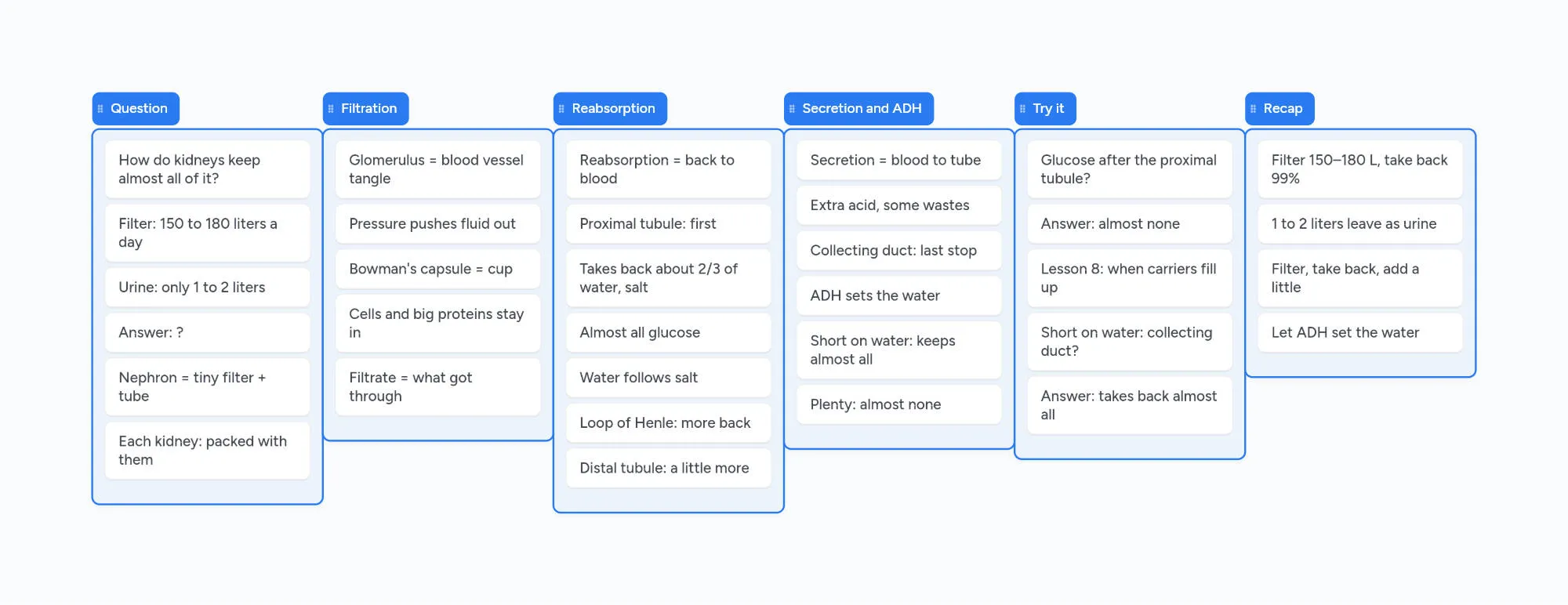
Filter that much, keep almost all?
In the video at 0:00
The kidneys filter about 125 mL of plasma a minute in males (105 mL in females). That adds up to about 180 L a day in males and 150 L a day in females. Ninety-nine percent of this filtrate is returned to the circulation, so only about 1 to 2 liters of urine are made each day. The nephron is where that happens.
One nephron
In the video at 0:15
Each nephron starts with a renal corpuscle (the glomerulus inside Bowman's capsule), then runs through a tube: the proximal convoluted tubule (PCT), the loop of Henle, and the distal convoluted tubule (DCT). "Convoluted" means twisty. Several nephrons then drain into one collecting duct, which is continuous with the nephron but not technically part of it.
Nephrons balance the plasma to its set points and get rid of wastes in the urine through three functions: filtration, reabsorption and secretion.
Step one: filtration
In the video at 0:25
The glomerulus is a high-pressure capillary bed between the afferent and efferent arterioles. Its inner wall is wrapped by podocytes, cells whose finger-like arms (pedicels) interlock and leave filtration slits. Together with the windows (fenestrations) in the capillary wall and the shared basement membrane, they form the filtration membrane. Blood cells and large proteins can't get through; what does get through is the filtrate.
Filtration is driven by pressure. Net filtration pressure = glomerular blood hydrostatic pressure − (capsular hydrostatic pressure + blood colloid osmotic pressure) = 55 − (15 + 30) = about 10 mm Hg. Because this net pressure is small, small changes in blood pressure or blood osmolarity change how much filtrate forms. Mesangial cells in the filtration membrane can contract to help regulate the filtration rate.
Next to the glomerulus sits the juxtaglomerular apparatus (JGA): the macula densa cells of the DCT sense the fluid flowing past, and the juxtaglomerular cells in the afferent arteriole adjust blood flow and release renin. The juxtaglomerular apparatus lesson covers it.
Step two: reabsorption in the proximal tubule
In the video at 0:43
Reabsorption means taking things from the tubule back into the blood, through the peritubular capillaries and the vasa recta. The PCT does the most: about 67 percent of the water, Na+ and K+, and almost 100 percent of glucose, amino acids and other organic substances such as vitamins. Its cells carry a brush border of microvilli and many mitochondria for this work.
Na+ is actively pumped out of the PCT cells, and water follows it by osmosis. This is called obligatory water reabsorption: water is "obliged" to follow the Na+.
Many substances ride with Na+. A symport moves two substances the same way at once (Na+ with glucose or amino acids); an antiport moves them in opposite directions (a Na+/H+ antiporter brings Na+ in while sending H+ out into the tubule). Glucose reabsorption is secondary active transport: the Na+/K+ pump on the far side of the cell keeps Na+ low inside, and Na+ moving back in drags glucose with it. When glucose levels are high enough to fill every carrier, glucose spills into the urine: the transport maximum lesson shows how.
Bicarbonate (HCO3–) is a fast buffer for acid–base balance, and 80 to 90 percent of it is recovered in the PCT. The enzyme carbonic anhydrase turns bicarbonate in the tubule into CO2 and water, which enter the cell and are turned back into bicarbonate, which then goes to the blood.
Loop of Henle and distal tubule
In the video at 1:07
The descending limb of the loop of Henle has permanent water channels (aquaporins) and lets water out into the salty tissue around it (up to 15 percent of the filtered water). The thick ascending limb has no aquaporins, so it is impermeable to water, but it actively pumps out salt (Na+ and Cl–; about 25 percent of the filtered Na+). So the descending limb gives up water and the ascending limb gives up salt.
This side-by-side flow in opposite directions is the countercurrent multiplier: salt pumped out by the ascending limb, plus urea that the collecting ducts pump out, makes the deep medulla very salty (up to about 1,200 mOsmol/kg), and that pulls more water out of the descending limb and the collecting ducts. Urea recycling helps: urea diffuses into the descending limb and is recovered again at the collecting duct. The vasa recta, the capillaries beside the loop, flow slowly so they return water and salt to the blood without washing out this gradient.
By the DCT about 80 percent of the filtered water has been recovered; the DCT takes back another part (the book gives 10 to 15 percent of water, about 5 percent of Na+), and aldosterone increases Na+ recovery here and in the collecting duct.
Step three: secretion
In the video at 1:16
Secretion goes the other way: substances move from the blood into the tubule. The book lists H+, creatinine, NH4+ and some K+ among the secreted substances. Secreting H+ and recovering bicarbonate is how the kidneys help keep blood pH in range.
Collecting duct and ADH
In the video at 1:24
About 10 percent of the filtered water (about 18 L a day) reaches the collecting ducts. ADH (antidiuretic hormone) from the posterior pituitary makes the duct cells insert aquaporin water channels, so water is pulled out into the salty medulla. When you are short on water, the ducts can recover almost all of it; when you have had plenty, almost none, and the urine is dilute.
Back to the question
In the video at 2:02
The kidneys filter about 150 to 180 liters a day and then take back about 99 percent of it, leaving 1 to 2 liters of urine. Filter at the glomerulus, take back along the tubule (most of it in the PCT), add a little by secretion, and let ADH set the water at the collecting duct. What is left leaves the body as urine, the last step, called excretion: filtration, reabsorption, secretion, excretion.
Practice question
A drop of filtrate holds glucose. After it passes the proximal convoluted tubule, how much of that glucose is still in the filtrate, and how did it leave?
Show the answer
Almost none; almost 100 percent was reabsorbed in the PCT. In the PCT, glucose crosses into the cells together with Na+ through a symport (secondary active transport), then leaves the cells by facilitated diffusion into the blood. Glucose appears in urine only when the carriers are all full (the transport maximum).
Common mix-ups
The kidneys filter 1 to 2 liters a day.
They filter about 150 to 180 liters a day and reabsorb about 99 percent of it; 1 to 2 liters is the urine left over.
Secretion and reabsorption are the same thing.
Reabsorption moves substances from the tubule back into the blood; secretion moves them from the blood into the tubule.
The ascending limb of the loop of Henle lets water out.
The thick ascending limb is impermeable to water. It pumps out salt; the descending limb is the part that lets water out.
How this lesson was made
Boardling lessons are made by the Instaboard team. The narration is a synthetic (text-to-speech) voice, and the script and these notes were written with AI help, then checked against the sources listed below (last checked November 11, 2026). The notes board is built live in Instaboard during the video. Spotted a mistake? Tell us and we'll fix it.
Put this lesson in your notes
The board opens in your browser in a few seconds. Add your lecture notes, photos of your handwritten pages and your own questions next to it. Sign in for free to keep it.
Questions
What are the three functions of the nephron?
Filtration (fluid pushed from the glomerulus into Bowman's capsule), reabsorption (substances taken from the tubule back into the blood) and secretion (substances moved from the blood into the tubule).
How much filtrate do the kidneys make a day?
About 180 liters a day in males and 150 liters in females. About 99 percent is reabsorbed, so only about 1 to 2 liters of urine are made.
Where is most water and salt reabsorbed in the nephron?
In the proximal convoluted tubule: about 67 percent of the water, Na+ and K+, and almost all glucose and amino acids.
What does ADH do in the nephron?
ADH makes the collecting duct cells insert aquaporin water channels, so more water is taken back into the blood and the urine becomes more concentrated.
Exam fit
- A&P
- MCAT biology
- Nursing
Sources
- OpenStax Anatomy & Physiology 2e, 25.4 Microscopic Anatomy of the Kidney: nephron functions, glomerulus, podocytes, filtration membrane, mesangial cells, JGA, PCT, loop of Henle, DCT, collecting ducts and ADH (checked November 11, 2026)
- OpenStax Anatomy & Physiology 2e, 25.5 Physiology of Urine Formation: GFR, 180 L/day in males and 150 L/day in females, 99 percent reabsorbed, 1–2 L of urine, net filtration pressure (checked November 11, 2026)
- OpenStax Anatomy & Physiology 2e, 25.6 Tubular Reabsorption: PCT 67 percent, glucose and amino acids, symport and antiport, bicarbonate, loop of Henle, countercurrent multiplier, urea, vasa recta, secretion, ADH (checked November 11, 2026)
More on the kidney
Juxtaglomerular apparatus
The spot where the kidney tubule touches its own arteriole: macula densa, JG cells, mesangial cells and renin.
Transport maximum
Why glucose spills into urine: read the filtered, reabsorbed and excreted glucose lines, the transport maximum, the renal threshold and splay.
RAAS
The renin-angiotensin-aldosterone system for the MCAT: kidney, liver, lungs and adrenal glands in one chain that brings blood pressure back up.
Afferent vs efferent arteriole
Which kidney arteriole do you squeeze to filter more? How the afferent (entrance) and efferent (exit) arterioles set glomerular pressure and filtration.