Biology · Blood and breathing
The oxygen hemoglobin dissociation curve, step by step
The same hemoglobin picks up oxygen in your lungs and drops it off in a working muscle. The video builds the curve that explains how, while the notes build live on a board. The notes below add the exam terms the video leaves out, and the board is yours to copy.
By Boardling, from the Instaboard teamLesson 017 · 2:33 videoUpdated
Oxygen hemoglobin dissociation curve in 30 seconds
- Hemoglobin carries oxygen in red blood cells. Each molecule has four iron-containing heme groups, so it holds up to four oxygen molecules. Saturation is the percentage of those spots that are full.
- The oxygen hemoglobin dissociation curve plots saturation against the partial pressure of oxygen (PO2). Higher pressure, more oxygen bound; lower pressure, more lets go. Once one oxygen binds, the next binds more easily, which gives the curve its S shape.
- In the capillaries PO2 is about 100 mm Hg and hemoglobin is nearly full; in a working muscle it drops to about 20 mm Hg, so a lot of oxygen lets go. Blood leaving a tissue still carries a reserve.
- Higher temperature and lower pH (more CO2, the Bohr effect) make oxygen let go more readily and shift the curve to the right: at the same pressure, hemoglobin holds less oxygen.
The notes board from the lesson
This is the board built during the video. Copy it and it's yours: add your own cards, rearrange it, draw on it.
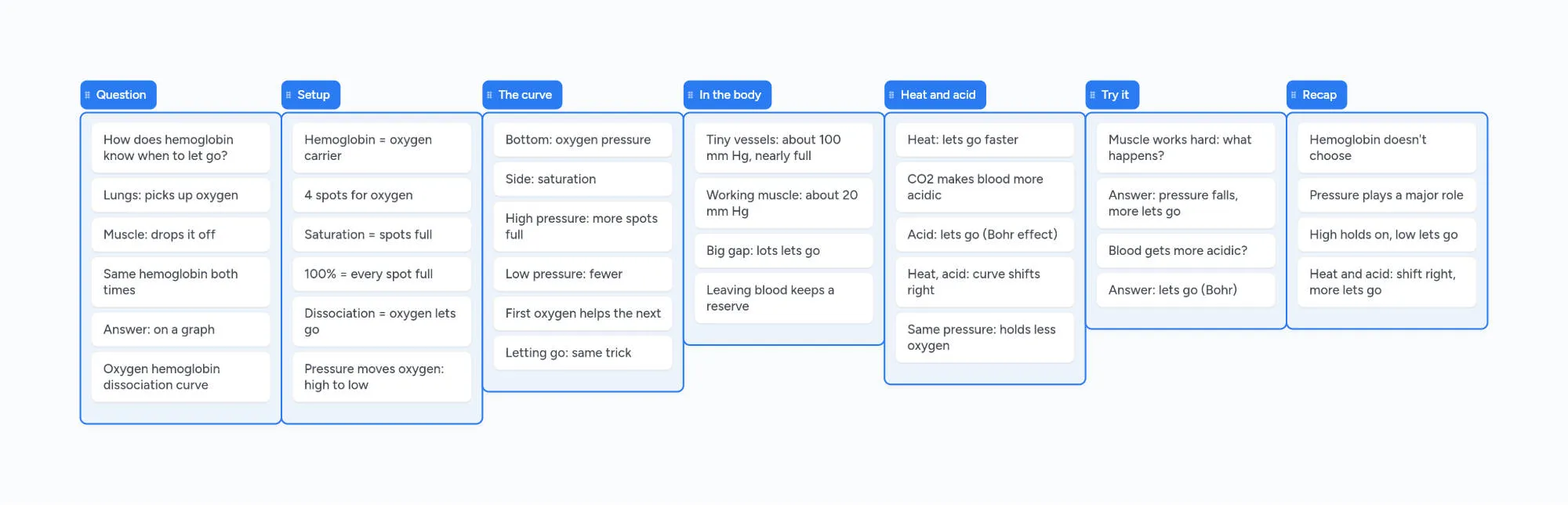
Hold on or let go?
In the video at 0:00
Hemoglobin picks up oxygen in the lungs and drops it off in the tissues, and it is the same molecule both times. It doesn't decide anything. The partial pressure of oxygen around it plays a major role in how much oxygen it binds, and the dissociation curve shows that relationship.
Hemoglobin and saturation
In the video at 0:17
Hemoglobin is the protein in red blood cells that carries oxygen. It is made of four subunits, each around a heme group that contains iron, and each heme binds one oxygen molecule, so one hemoglobin carries up to four. Most oxygen in the blood, about 98.5 percent, travels bound to hemoglobin; only about 1.5 percent is dissolved in plasma.
Saturation is how many of the available spots hold oxygen. 100 percent means every heme is bound. In a healthy person, saturation generally ranges from 95 to 99 percent. Dissociation is the opposite of binding: oxygen letting go of hemoglobin. Hemoglobin with oxygen bound is called oxyhemoglobin, so some books call this graph the oxyhemoglobin dissociation curve.
Building the graph
In the video at 0:45
Partial pressure is the pressure one gas contributes in a mix: in plain words, how hard that gas is pushing. Gases move from higher partial pressure to lower partial pressure.
The curve puts the partial pressure of oxygen (PO2, in mm Hg) on the horizontal axis and saturation on the vertical axis. As PO2 rises, more oxygen binds, and as it falls, fewer oxygen molecules stay bound.
The first oxygen helps the next
In the video at 0:58
The affinity of hemoglobin for oxygen increases as more oxygen molecules are bound: once one oxygen binds, the next binds more easily, and once one lets go, the next lets go more easily. Exam books call this cooperative binding. It is why the curve is S-shaped (sigmoidal) rather than a straight line: steep in the middle, flat near the top.
From the lungs to a working muscle
In the video at 1:06
Inside the capillaries the partial pressure of oxygen is about 100 mm Hg, on the flat top of the curve, so hemoglobin is nearly full. In highly active tissue such as working muscle, oxygen is used quickly to make ATP and PO2 drops to about 20 mm Hg, on the steep part. The gap of about 80 mm Hg makes a lot of oxygen dissociate and enter the tissue.
Tissues that use less oxygen, such as fat, keep a higher PO2, so less oxygen lets go there. Venous blood is called deoxygenated, but some oxygen is still bound to its hemoglobin: a reserve for when a tissue suddenly needs more.
Heat, acid and the Bohr effect
In the video at 1:29
A higher temperature makes hemoglobin and oxygen dissociate faster, and a lower temperature slows it. Working skeletal muscle gives off heat, so it gets more oxygen.
Carbon dioxide reacts with water in the blood to form bicarbonate and hydrogen ions, so more CO2 means a lower pH. A lower, more acidic pH promotes oxygen dissociation; a higher pH inhibits it. This link between pH and hemoglobin's affinity for oxygen is the Bohr effect.
2,3-bisphosphoglycerate (BPG), a byproduct of glycolysis in red blood cells, also promotes oxygen release. Some hormones, such as androgens, epinephrine, thyroid hormones and growth hormone, raise BPG production.
Right shift and left shift
In the video at 1:43
When heat or acid lower hemoglobin's affinity for oxygen, the whole curve shifts to the right: more oxygen pressure is needed to reach the same saturation, so at any given pressure hemoglobin holds less oxygen and releases more. Higher CO2, lower pH and higher temperature all shift it right.
The opposite changes (lower CO2, higher pH, lower temperature) raise the affinity and shift the curve to the left: hemoglobin holds on more tightly at the same pressure.
Fetal hemoglobin
A fetus gets its oxygen across the placenta, where maternal blood has a PO2 of only about 35 to 50 mm Hg and fetal blood about 20 mm Hg. Two of the four subunits of fetal hemoglobin have a different structure that gives it a greater affinity for oxygen than adult hemoglobin, so its curve sits to the left of the adult curve and it can take oxygen from the maternal blood.
Carrying carbon dioxide back, and the Haldane effect
Carbon dioxide travels to the lungs three ways: about 7 to 10 percent dissolved in plasma, about 70 percent as bicarbonate (made in red blood cells by carbonic anhydrase, with the chloride shift swapping bicarbonate for chloride), and about 20 percent bound to the globin part of hemoglobin as carbaminohemoglobin.
The Haldane effect is the other side of the Bohr effect: hemoglobin saturated with oxygen does not readily bind CO2, but when oxygen has let go and PO2 is low, hemoglobin readily binds CO2. So tissues load CO2 onto hemoglobin, and the lungs unload it.
Back to the question
In the video at 2:08
Hemoglobin doesn't choose. The partial pressure of oxygen around it plays a major role: at about 100 mm Hg in the lungs' capillaries it holds on, and at about 20 mm Hg in a working muscle it lets go. Heat and acid from a busy muscle shift the curve to the right, so even more oxygen comes off right where it is needed.
Practice question
During hard exercise, a muscle gets warmer and its blood gets more CO2. At the same partial pressure of oxygen, does hemoglobin there hold more oxygen or less, and which way does the curve shift?
Show the answer
Less oxygen; the curve shifts to the right. Higher temperature and more CO2 (lower pH, the Bohr effect) both reduce hemoglobin's affinity for oxygen. More oxygen pressure is then needed for the same saturation, so at the same pressure more oxygen is released to the muscle.
Common mix-ups
A right shift means hemoglobin holds oxygen more tightly.
A right shift means lower affinity: at the same pressure, hemoglobin holds less oxygen and releases more. A left shift means it holds on more tightly.
Venous blood has no oxygen left.
Venous blood is called deoxygenated, but some oxygen is still bound to hemoglobin. That reserve is used when a tissue suddenly needs more.
The curve is a straight line: each oxygen binds just as easily as the last.
It is S-shaped because binding one oxygen makes the next bind more easily, and losing one makes the next let go more easily.
How this lesson was made
Boardling lessons are made by the Instaboard team. The narration is a synthetic (text-to-speech) voice, and the script and these notes were written with AI help, then checked against the sources listed below (last checked November 11, 2026). The notes board is built live in Instaboard during the video. Spotted a mistake? Tell us and we'll fix it.
Put this lesson in your notes
The board opens in your browser in a few seconds. Add your lecture notes, photos of your handwritten pages and your own questions next to it. Sign in for free to keep it.
Questions
What does the oxygen hemoglobin dissociation curve show?
How hemoglobin saturation (the percentage of oxygen spots filled) changes with the partial pressure of oxygen. Higher pressure, more oxygen bound; lower pressure, more oxygen released.
What shifts the oxygen hemoglobin dissociation curve to the right?
More carbon dioxide, a lower (more acidic) pH and a higher temperature. Each lowers hemoglobin's affinity for oxygen, so more oxygen is released at the same pressure. BPG also promotes release.
What is the Bohr effect?
The link between blood pH and hemoglobin's affinity for oxygen: a lower, more acidic pH (often from more CO2) promotes oxygen release, and a higher pH inhibits it.
Why is the oxygen hemoglobin dissociation curve S-shaped?
Hemoglobin's affinity for oxygen increases as more oxygen is bound, so after the first oxygen binds the next ones bind more easily. This cooperative binding makes the curve steep in the middle and flat near the top.
Exam fit
- A&P
- MCAT biology
- Nursing
Sources
- OpenStax Anatomy & Physiology 2e, 22.5 Transport of Gases: hemoglobin and heme, saturation, the dissociation curve, 100 and 20 mm Hg, the reserve, temperature, BPG, the Bohr effect, fetal hemoglobin, CO2 transport, the Haldane effect (checked November 11, 2026)
- OpenStax Biology 2e, 39.4 Transport of Gases in Human Bodily Fluids: 98.5 percent bound to hemoglobin, CO2 and pH shift the curve to the right, temperature from skeletal muscle, left and right shifts (checked November 11, 2026)