Biology · Muscle and nerve physiology
The sodium-potassium pump: 3 sodium out, 2 potassium in
Most of a nerve cell's ATP goes to one kind of pump that only swaps ions across the membrane. The video follows one turn of it while the notes build live on a board. The notes below add the exam terms the video leaves out, and the board is yours to copy.
By Boardling, from the Instaboard teamLesson 016 · 2:07 videoUpdated
Sodium-potassium pump in 30 seconds
- The sodium-potassium pump (Na+/K+ ATPase) moves sodium (Na+) out of the cell and potassium (K+) in.
- Each ion goes toward the side that already has more of it (against its concentration gradient), so the pump needs energy: one ATP per turn. That is why it is called an ATPase.
- One turn: 3 Na+ out, 2 K+ in, 1 ATP. Three positive charges leave and two come back, which helps keep the inside negative (about −70 mV, the resting potential).
- Leakage channels let sodium slowly in and potassium slowly out all the time, so the pump never stops. In nerve cells it accounts for the majority of their ATP use.
The notes board from the lesson
This is the board built during the video. Copy it and it's yours: add your own cards, rearrange it, draw on it.
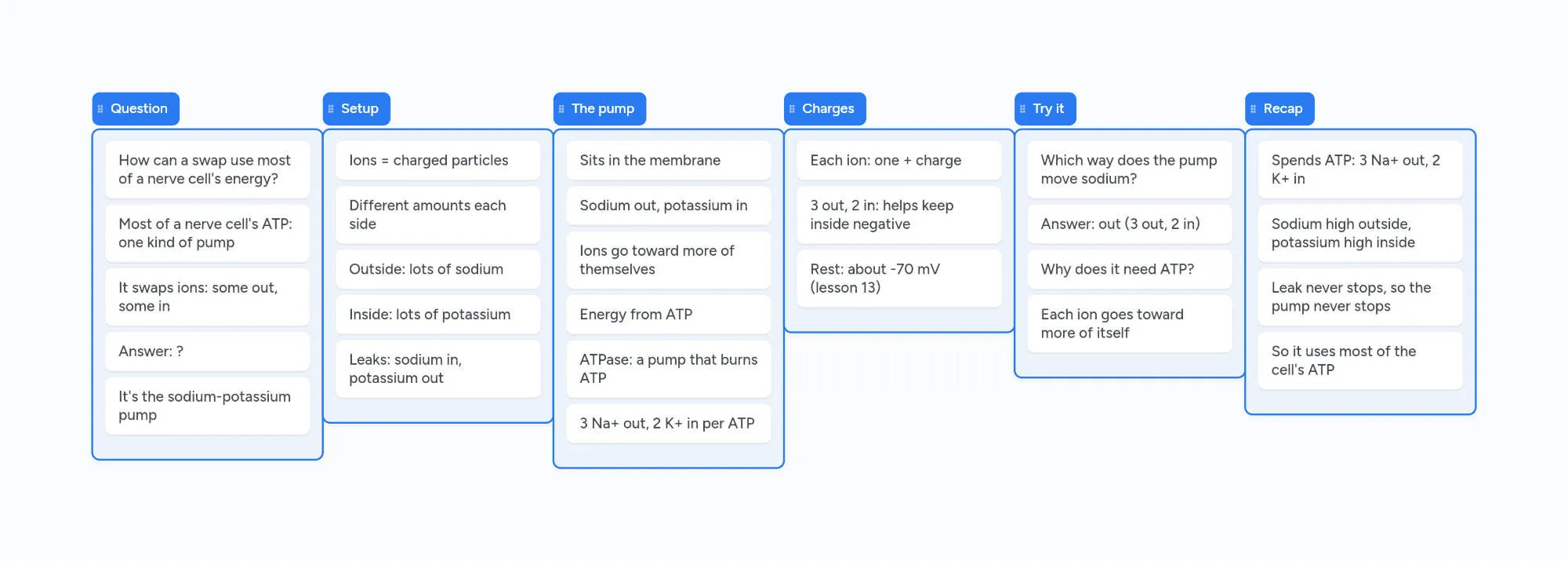
A swap worth most of the energy
In the video at 0:00
Nerve cells spend the majority of their ATP on one kind of pump. All it does is exchange ions across the cell membrane: sodium goes out and potassium comes in. The lesson follows why such a simple swap costs so much.
Ions on each side of the membrane
In the video at 0:17
Ions are charged particles. Sodium (Na+) and potassium (K+) each carry one positive charge. The cell membrane keeps different amounts of them on each side: the concentration of Na+ outside the cell is about 10 times greater than inside, and the concentration of K+ is higher inside than outside.
A difference in concentration across the membrane is a concentration gradient. Left alone, an ion moves down its gradient, from where there is more of it to where there is less.
The leak
In the video at 0:29
The membrane is not sealed. Leakage channels open and close at random, so Na+ slowly moves into the cell and K+ slowly moves out. The pump restores them.
Leakage channels matter for the resting potential too. Neurons have far more potassium leakage channels than sodium ones, so K+ leaks out faster than Na+ leaks in. More positive charge leaves than enters, and that is the main reason the inside is negative. The pump keeps the gradients that this leak depends on.
The pump and ATP
In the video at 0:37
The pump sits in the cell membrane and moves each ion against its concentration gradient: Na+ out to where there is already more Na+, K+ in to where there is already more K+. Moving something against its gradient takes energy, so this is active transport.
The energy comes from ATP (adenosine triphosphate). Because the pump uses ATP, it is also called an ATPase: Na+/K+ ATPase.
One turn: 3 out, 2 in
In the video at 0:58
In a single cycle of the pump, three sodium ions go out of the cell and two potassium ions come in, for each ATP used. The 3:2 ratio is the number exam questions ask for.
Count the charges
In the video at 1:07
Each Na+ and K+ carries one positive charge. Three leave and two come back, so every turn takes one more positive charge out than it brings in. This helps keep the inside of a nerve cell negative, at about −70 mV relative to the outside. That is the resting membrane potential from the action potential lesson.
The pump's charge count is only part of the story. Most of the −70 mV comes from the leak of K+ out through its many leakage channels, plus large negative proteins and phosphate ions kept inside the cell. The pump's job is to keep the gradients in place so that this can keep happening. After an action potential, it also helps restore the resting state.
Secondary active transport: the pump's gradient does more work
Because the pump keeps sodium high outside, sodium always tends to flow back in. Other carriers use that inflow to move a second substance. This is secondary active transport: the pump spends the ATP, and the sodium gradient powers the second carrier.
A symporter moves two substances in the same direction. The sodium-glucose symporter uses sodium flowing in to pull glucose into the cell against glucose's own gradient. An antiporter moves two substances in opposite directions. The sodium-hydrogen antiporter uses sodium flowing in to push hydrogen ions (H+) out, which helps keep the pH inside the cell steady.
In nervous tissue, supporting cells called astrocytes help keep the concentrations of chemicals in the space outside the neurons steady, so the neurons' gradients stay usable.
Back to the question
In the video at 1:41
The pump spends ATP to move sodium out and potassium in, three for two. That keeps sodium high outside, potassium high inside and helps keep the inside negative. The leak never stops, so the pump never stops, and that is why it takes the majority of a nerve cell's ATP.
Practice question
A cell runs out of ATP. What happens to the sodium and potassium gradients over time, and why?
Show the answer
They slowly run down: sodium builds up inside and potassium is lost from inside. Without ATP the pump stops. The leakage channels keep letting Na+ in and K+ out, and nothing puts them back, so the concentration differences across the membrane shrink over time.
Common mix-ups
The pump moves 3 potassium out and 2 sodium in.
It's 3 sodium (Na+) out and 2 potassium (K+) in, per ATP. Sodium is kept high outside, potassium high inside.
The pump moves ions down their concentration gradients, like a channel.
The pump moves each ion against its gradient, which is why it needs ATP. Channels let ions move down their gradients without ATP.
The pump alone makes the −70 mV resting potential.
Its 3-for-2 charge count only helps. Most of the −70 mV comes from K+ leaking out through many K+ leakage channels; the pump keeps the gradients that the leak depends on.
How this lesson was made
Boardling lessons are made by the Instaboard team. The narration is a synthetic (text-to-speech) voice, and the script and these notes were written with AI help, then checked against the sources listed below (last checked November 11, 2026). The notes board is built live in Instaboard during the video. Spotted a mistake? Tell us and we'll fix it.
Put this lesson in your notes
The board opens in your browser in a few seconds. Add your lecture notes, photos of your handwritten pages and your own questions next to it. Sign in for free to keep it.
Questions
How many sodium and potassium ions does the sodium-potassium pump move?
Three sodium ions out and two potassium ions in for each ATP used.
Why does the sodium-potassium pump need ATP?
It moves both ions against their concentration gradients, toward the side that already has more of each. That takes energy, which comes from ATP, so the pump is also called Na+/K+ ATPase.
Is the sodium-potassium pump active or passive transport?
Active transport. It uses ATP directly (primary active transport). Carriers that use the sodium gradient it builds, such as the sodium-glucose symporter, are secondary active transport.
How does the sodium-potassium pump affect the resting membrane potential?
It keeps sodium high outside and potassium high inside, and each turn moves one more positive charge out than in, which helps keep the inside negative at about −70 mV. The larger share comes from potassium leaking out through leakage channels.
Exam fit
- A&P
- MCAT biology
- AP Biology
Sources
- OpenStax Anatomy & Physiology 2e, 3.1 The Cell Membrane: active transport, Na+/K+ ATPase, 3 Na+ out and 2 K+ in per ATP, majority of nerve cell ATP use, secondary active transport, symporters and antiporters (checked November 11, 2026)
- OpenStax Anatomy & Physiology 2e, 12.4 The Action Potential: ATPase, concentration gradients, leakage channels, resting membrane potential −70 mV (checked November 11, 2026)
- OpenStax Biology 2e, 35.2 How Neurons Communicate: more K+ than Na+ leakage channels, the pump helps maintain the resting potential (checked November 11, 2026)
- OpenStax Anatomy & Physiology 2e, 12.2 Nervous Tissue: astrocytes maintain the concentration of chemicals in the extracellular space (checked November 11, 2026)
More on the muscle and nerve physiology
Twitch, summation and tetanus
How to read a myogram: one twitch, wave summation, unfused and fused tetanus, and why calcium makes twitches add up.
Motor unit recruitment
How a muscle grades its force: motor units, small versus large units, the size principle, and the two ways to turn force up.
Sliding filament theory
How a muscle gets shorter when its threads never do: actin and myosin, cross-bridges, the power stroke, ATP and the calcium switch, in plain words.
Action potential
Every step of the action potential graph for the MCAT: resting potential, threshold, depolarization, the +30 mV peak, repolarization, hyperpolarization and the refractory period.
Frank-Starling law
Why more blood filling the heart makes the next beat stronger: preload, sarcomere stretch, more cross-bridges and a bigger stroke volume.