Biology · Kidney
Afferent vs efferent arteriole: which one do you squeeze?
Squeeze the end of a hose and the pressure behind it rises. The kidney's filter has two tiny tubes, one bringing blood in and one taking it out, so which one do you squeeze to filter more? The video answers it while the notes build live on a board. The notes below add the exam terms the video leaves out, and the board is yours to copy.
By Boardling, from the Instaboard teamLesson 020 · 2:23 videoUpdated
Afferent vs efferent arteriole in 30 seconds
- The glomerulus is a tuft of capillaries between two arterioles: the afferent arteriole brings blood in (afferent = arriving) and the efferent arteriole takes it out (efferent = exiting).
- Fluid is filtered out because blood pressure pushes it out. The net push is small (about 10 mm Hg), so a small change in pressure changes the glomerular filtration rate (GFR) a lot.
- Squeeze the efferent arteriole (the exit) and blood backs up in the glomerulus: pressure and GFR go up. Squeeze the afferent arteriole (the entrance) and less blood gets in: pressure and GFR go down. Opening the entrance wider raises them.
- The body uses both at once: it can dilate the afferent and constrict the efferent arteriole to keep glomerular pressure up when blood pressure changes.
The notes board from the lesson
This is the board built during the video. Copy it and it's yours: add your own cards, rearrange it, draw on it.
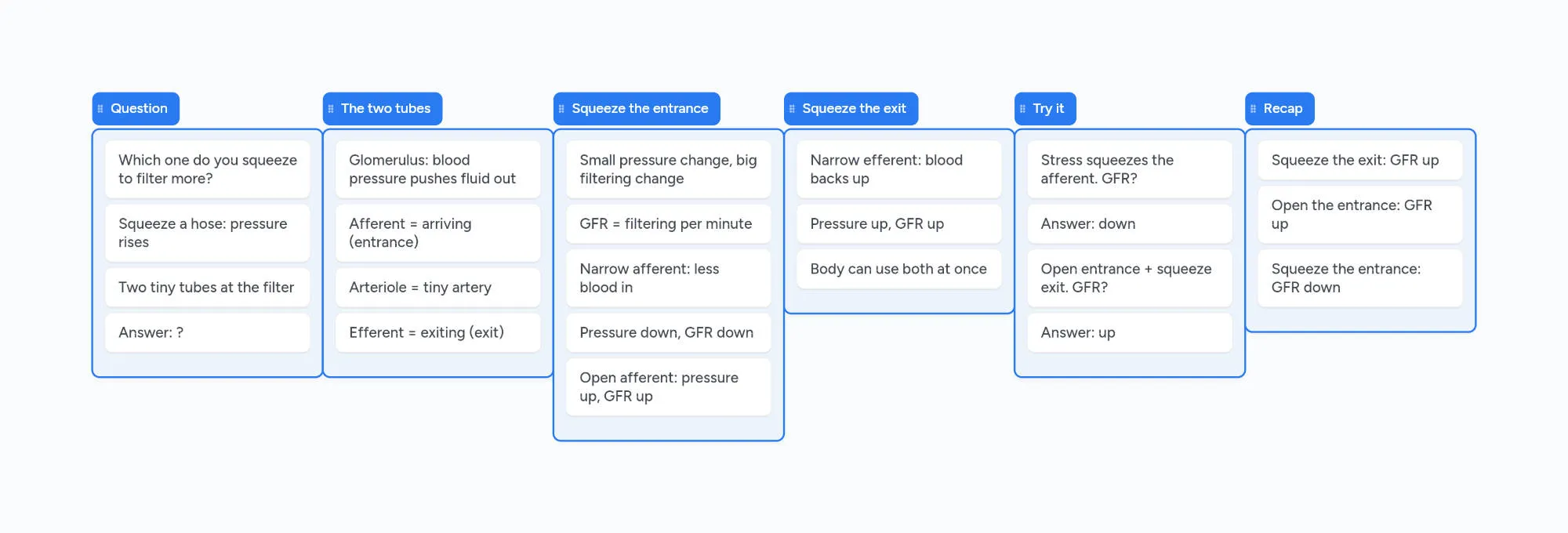
A hose and a filter
In the video at 0:00
Squeeze the end of a garden hose and the pressure inside the hose goes up. The kidney's filter runs on pressure too. Each glomerulus sits between two tiny tubes, one bringing blood in and one taking it out, and the question is which one to squeeze to filter more.
Fluid is only filtered out of the glomerulus because the blood pressure inside it pushes fluid through the filtration membrane into the capsule around it.
Afferent and efferent arterioles
In the video at 0:24
An arteriole is a tiny artery. Blood arrives at the glomerulus through the afferent arteriole (afferent means arriving) and leaves through the efferent arteriole (efferent means exiting). A quick way to remember it: afferent = arriving, efferent = exiting.
Both arterioles have smooth muscle in their walls, so each can narrow (constrict) or widen (dilate). That is what lets the body tune the pressure inside the glomerulus.
Why a small pressure change matters
In the video at 0:36
The pressure pushing fluid out is only a little bigger than the pressures pushing back. In the book's numbers, net filtration pressure = glomerular blood hydrostatic pressure − (capsular hydrostatic pressure + blood colloid osmotic pressure) = 55 − (15 + 30) = about 10 mm Hg.
Because the net pressure is so small, a very small change in pressure makes a big change in how much fluid is filtered per minute. That amount per minute is the glomerular filtration rate (GFR). The book says the same about the afferent side: only a 10 mm Hg differential across the glomerulus is needed for a normal GFR, so very small changes in afferent arterial pressure significantly increase or decrease GFR.
Squeeze the entrance (afferent)
In the video at 0:49
Narrow the afferent arteriole and less blood gets into the glomerulus. The pressure in the glomerulus drops and filtering goes down. Open the afferent arteriole wider and the opposite happens: more blood gets in, pressure rises and GFR rises.
The book gives a real case. Under stress, sympathetic nerve activity increases and directly constricts the afferent arterioles (the norepinephrine effect), and the adrenal medulla adds a general vasoconstriction through epinephrine. Blood flow through the kidneys falls, less filtration occurs, and blood is redirected to organs with more immediate needs. The juxtaglomerular apparatus lesson shows the kidney narrowing its own afferent arteriole when too much salt reaches the macula densa (tubuloglomerular feedback).
The afferent arteriole also works on its own: in the myogenic mechanism, smooth muscle in its wall contracts when blood pressure stretches it and relaxes when pressure drops, so filtration changes very little across a wide range of blood pressures.
Squeeze the exit (efferent)
In the video at 1:10
Constrict the efferent arteriole and blood can't leave the glomerulus as easily, so it backs up inside. The pressure in the glomerulus goes up and filtering goes up. That is the hose: squeeze the exit and the pressure behind it rises.
So to filter more, squeeze the exit (efferent) or open the entrance (afferent). To filter less, squeeze the entrance.
Using both at once
In the video at 1:25
The body can act on both arterioles together. Dilating the afferent arteriole while constricting the efferent arteriole lets more blood in and holds it back, which keeps the pressure in the glomerulus up even when blood pressure changes (A&P 2e 25.6).
Back to the question
In the video at 1:57
Which one do you squeeze to filter more? The exit, the efferent arteriole. Squeeze the exit to raise the pressure; squeeze the entrance, the afferent arteriole, to lower it. That is the whole trick.
Practice question
During stress, sympathetic nerves constrict the afferent arterioles of the kidney. What happens to glomerular pressure and filtering, and why?
Show the answer
Glomerular pressure falls and filtering (GFR) goes down. A narrower entrance lets less blood into the glomerulus, so the pressure inside it drops. The net filtration pressure is only about 10 mm Hg, so even a small drop lowers GFR noticeably. Blood is redirected to organs with more immediate needs.
Common mix-ups
Afferent and efferent mean the same thing, so it doesn't matter which arteriole you narrow.
They have opposite effects on the glomerulus. Narrowing the afferent arteriole (arriving) lowers the pressure and GFR; narrowing the efferent arteriole (exiting) raises them.
Squeezing the efferent arteriole reduces filtering because less blood leaves the kidney.
Blood that can't leave easily backs up inside the glomerulus, so its pressure rises and filtering goes up, like squeezing the end of a hose.
Filtering needs a big pressure difference, so small changes barely matter.
The net filtration pressure is only about 10 mm Hg (55 − (15 + 30)), which is why a small pressure change makes a large change in GFR.
How this lesson was made
Boardling lessons are made by the Instaboard team. The narration is a synthetic (text-to-speech) voice, and the script and these notes were written with AI help, then checked against the sources listed below (last checked November 15, 2026). The notes board is built live in Instaboard during the video. Spotted a mistake? Tell us and we'll fix it.
Put this lesson in your notes
The board opens in your browser in a few seconds. Add your lecture notes, photos of your handwritten pages and your own questions next to it. Sign in for free to keep it.
Questions
What is the difference between the afferent and efferent arteriole?
The afferent arteriole brings blood into the glomerulus (arriving) and the efferent arteriole carries it away (exiting). Narrowing the afferent lowers glomerular pressure and GFR; narrowing the efferent raises them.
How does constricting the efferent arteriole affect GFR?
It makes blood back up in the glomerulus, so the pressure inside rises and GFR goes up.
Why does a small change in pressure change GFR so much?
Because the net filtration pressure is small, about 10 mm Hg (55 − (15 + 30)). A small change in the pressure pushing fluid out is a large change relative to that net value.
What does GFR mean?
GFR is the glomerular filtration rate: how much fluid is filtered out of the glomerular blood into the capsule each minute.
Exam fit
- A&P
- MCAT biology
- Nursing
Sources
- OpenStax Anatomy & Physiology 2e, 25.4 Microscopic Anatomy of the Kidney: glomerulus, afferent and efferent arterioles (checked November 15, 2026)
- OpenStax Anatomy & Physiology 2e, 25.5 Physiology of Urine Formation: GFR and net filtration pressure 55 − (15 + 30) = 10 mm Hg (checked November 15, 2026)
- OpenStax Anatomy & Physiology 2e, 25.6 Tubular Reabsorption: dilating the afferent arteriole while constricting the efferent arteriole (checked November 15, 2026)
- OpenStax Anatomy & Physiology 2e, 25.7 Regulation of Renal Blood Flow: sympathetic constriction of afferent arterioles, myogenic mechanism, tubuloglomerular feedback (checked November 15, 2026)
More on the kidney
Juxtaglomerular apparatus
The spot where the kidney tubule touches its own arteriole: macula densa, JG cells, mesangial cells and renin.
Transport maximum
Why glucose spills into urine: read the filtered, reabsorbed and excreted glucose lines, the transport maximum, the renal threshold and splay.
RAAS
The renin-angiotensin-aldosterone system for the MCAT: kidney, liver, lungs and adrenal glands in one chain that brings blood pressure back up.