Biology · Endocrine system
Steroid vs peptide hormones: why insulin is fast and cortisol is slow
Insulin works in seconds. Cortisol takes hours. It comes down to one thing: whether the hormone dissolves in fat. By the end of this you'll be able to look at what any hormone is made of and predict how it travels, where its receptor sits and how fast it works.
By Boardling, from the Instaboard teamLesson 003 · 3:33 videoUpdated
- 0:00Insulin: seconds. Cortisol: hours. Why?
- 0:21Steroid vs peptide, and cholesterol
- 0:37Made from, dissolves in
- 0:56Travel in the blood
- 1:04Where the receptor sits
- 1:24Genes vs second messengers
- 1:42Speed
- 1:54Storage
- 2:05Examples
- 2:16The exam trap: amine hormones
- 2:42Your turn
- 3:06Back to the question: insulin vs cortisol
Steroid vs peptide hormones in 30 seconds
- Steroids are made from cholesterol, dissolve in fat and ride on carrier proteins in the blood. Peptides are amino-acid chains, dissolve in water and travel freely.
- A steroid crosses the membrane, so its receptor is inside the cell. A peptide can't, so its receptor is on the surface.
- Steroids switch genes on or off (slow, hours, long-lasting). Peptides trigger a second messenger like cAMP (fast, seconds to minutes).
- Peptides are stored in vesicles; steroids are made only when needed.
- Exam trap: amine hormones split. Adrenaline acts like a peptide; thyroid hormone acts like a steroid.
The notes board from the lesson
This is the board built during the video. Copy it and it's yours: add your own cards, rearrange it, draw on it.
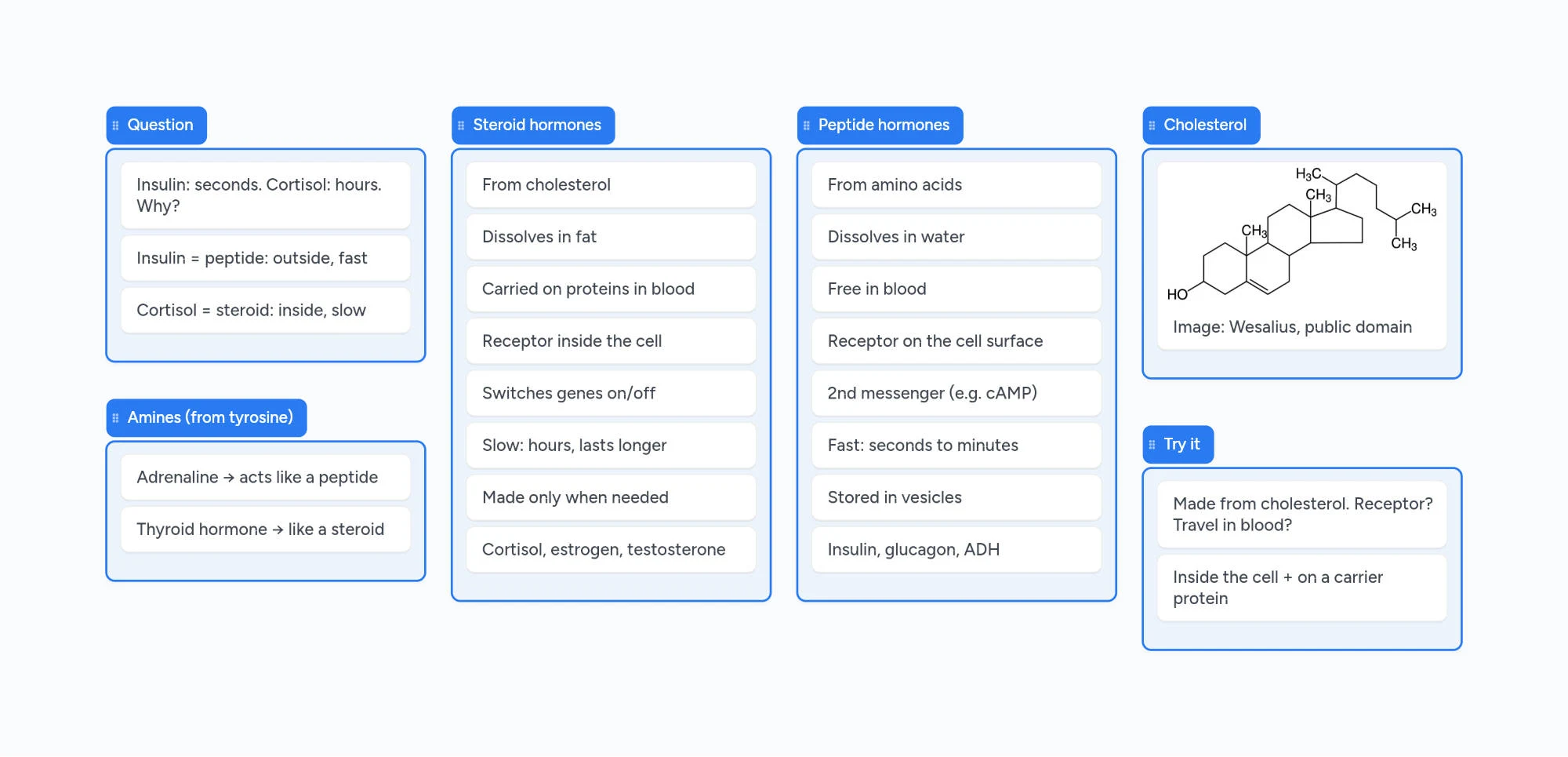
Made from, and what they dissolve in
In the video at 0:37
Cortisol is a steroid hormone; insulin is a peptide hormone. Every steroid is built from cholesterol, which is mostly carbon and hydrogen, so steroids are lipids and dissolve in fat.
Peptides are chains of amino acids, small proteins, so they dissolve in water.
How they travel in the blood
In the video at 0:56
Blood is mostly water. So peptides travel freely in the blood, but steroids have to ride on carrier proteins.
Where the receptor sits
In the video at 1:04
The cell membrane is made of fat. A steroid slips straight through it, so its receptor waits inside the cell, in the cytoplasm or the nucleus.
A peptide like insulin can't cross the membrane, so its receptor sits on the cell surface.
Genes vs second messengers
In the video at 1:24
The steroid and its receptor act on DNA, switching genes on or off, so the cell makes new proteins.
A peptide triggers a second messenger inside the cell, like cyclic AMP (cAMP), which switches on enzymes that are already there.
Speed and storage
In the video at 1:42
Peptide effects start within seconds to minutes, because nothing new has to be built. Steroid effects take hours, but they last longer.
Peptides are made ahead of time and stored in vesicles, ready to release. Steroids would leak straight out through the membrane, so the gland makes them only when needed.
Examples. Steroids: cortisol, aldosterone, estrogen, testosterone. Peptides: insulin, glucagon, ADH.
The exam trap: amine hormones
In the video at 2:16
Amine hormones are made from a single amino acid, tyrosine, and they split between the two groups. Adrenaline acts like a peptide, with its receptor on the surface.
Thyroid hormone acts like a steroid: it gets into the cell through transporters and binds a receptor in the nucleus.
Practice question
A new hormone is made from cholesterol. Where is its receptor, and how does it travel in the blood?
Show the answer
Inside the cell, and on a carrier protein. Made from cholesterol means it's a steroid. So it dissolves in fat, crosses the membrane, and needs a carrier in watery blood.
Common mix-ups
All amine hormones act like peptides.
Adrenaline does, but thyroid hormone acts like a steroid, with a receptor in the nucleus.
Steroid hormones are stored in vesicles like peptides.
Steroids would leak through the membrane, so they're made only when needed.
Peptide hormones change which genes are expressed directly.
Peptides work through a second messenger (e.g. cAMP) that switches on enzymes already in the cell.
How this lesson was made
Boardling lessons are made by the Instaboard team. The narration is a synthetic (text-to-speech) voice, and the script and these notes were written with AI help, then checked against the sources listed below (last checked October 29, 2026). The notes board is built live in Instaboard during the video. Spotted a mistake? Tell us and we'll fix it.
Put this lesson in your notes
The board opens in your browser in a few seconds. Add your lecture notes, photos of your handwritten pages and your own questions next to it. Sign in for free to keep it.
Questions
What is the main difference between steroid and peptide hormones?
Steroids are made from cholesterol and dissolve in fat, so they cross the membrane and bind receptors inside the cell. Peptides are amino-acid chains that dissolve in water, so they bind receptors on the cell surface.
Why are peptide hormones faster than steroid hormones?
Peptides work through second messengers that switch on enzymes already in the cell, so effects start in seconds to minutes. Steroids change gene expression, so the cell must make new proteins, which takes hours.
Why do steroid hormones need carrier proteins?
Blood is mostly water and steroids dissolve in fat, so most steroid hormone travels bound to carrier proteins.
Is insulin a steroid or a peptide?
Insulin is a peptide hormone. Its receptor is on the cell surface.
Is thyroid hormone a steroid?
No, it's an amine hormone made from tyrosine, but it behaves like a steroid: it enters the cell through transporters and binds a nuclear receptor.
Exam fit
- MCAT 3A: endocrine system
- AP Biology 4.1–4.2
- Anatomy & physiology
- A-level biology